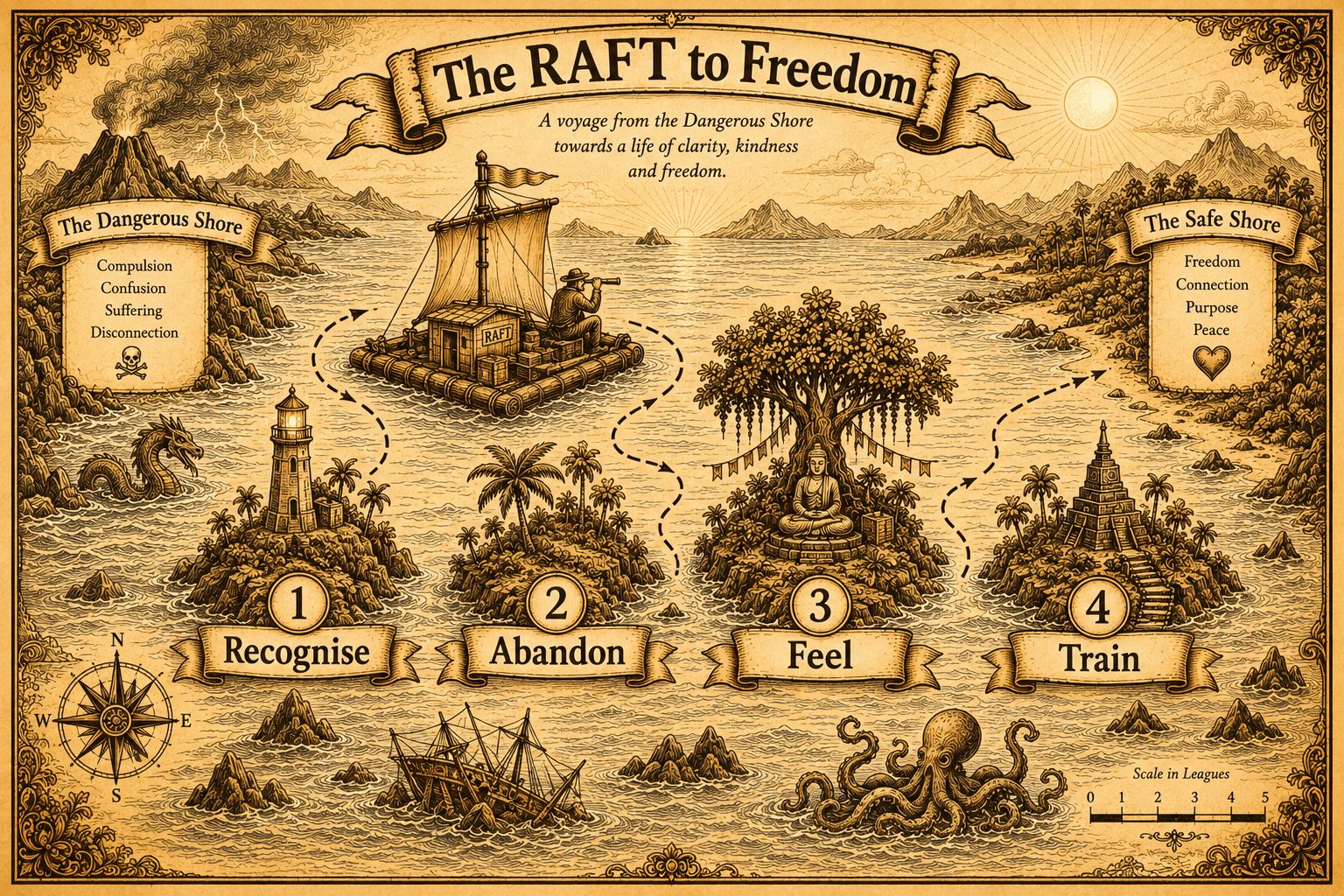
A map to navigate our journey: introducing the RAFT framework
Suppose there was a person traveling along the road. They’d see a large deluge, whose near shore was dubious and perilous, while the far shore was a sanctuary free of peril. But there was no ferryboat or bridge for crossing over. They’d think, ‘Why don’t I gather grass, sticks, branches, and leaves and make a raft? Riding on the raft, and paddling with my hands and feet, I can safely reach the far shore.’
Gotama, Alagaddūpama Sutta (the raft simile), MN 22, translated by Bhikkhu Sujato
Welcome to the RAFT
Opening this workbook and embarking on the journey towards freedom from our human struggles with pain, difficulties and disappointments is a profound act of courage. It means facing down our destructive patterns of escape and self-sabotage. The RAFT to Freedom programme and workbook offer us compassionate, comprehensive guidance by blending ancient Buddhist wisdom with insights from modern sciences. Whether you seek to transform deeply ingrained patterns or simply cultivate greater peace and clarity in daily life, this workbook is designed for you.
This workbook explores a wide range of tools, skills, perspectives, attitudes, and actions that are recognised as being helpful in contemporary approaches to health and well-being. We don’t need a diagnosis, a label, or to identify as Buddhist to benefit from this programme. All that’s required is an open, caringly curious mind.
The core aim of the path taught by Gotama (the Buddha) is to overcome greed, hatred and delusion and find freedom. To put it another way, it is to be released from craving, aversion and confusion. In the language of this workbook, that whole movement is held in four tasks: Recognise the pain, Abandon the craving, Feel the resulting freedom, Train the body-mind.
This workbook offers shared practice and community, not treatment. If you are in significant distress or managing a mental-health condition, please also seek the support of a qualified professional. See Setting out with the workbook for the fuller note on support.
Gotama’s four realisations
In his first talk after awakening to life as it really is, Gotama presented four vital realisations. They are the doctrinal spine of this whole workbook, so it is worth sitting with them fully here, once, before we meet them again throughout the chapters ahead.
Recognise what it is to be human. Life is sometimes naturally painful, difficult, and disappointing: we often do not get what we want, yet frequently encounter what we don’t want. Gotama encouraged us to see this clearly and understand it deeply. This is universal, not personal – we are all in the same boat.
Abandon our blind obedience to the evolutionary drives to protect, promote, and satisfy, which manifest as habitual cravings, compulsions, aversions, and preferences. Gotama urged us to abandon these destructive inclinations – not through force or suppression, but through compassionate understanding and skilful letting go.
Feel the resulting freedom. We sense the space, ease, clarity, connection, calm, and freedom that open as the pull of craving, aversion, or compulsion begins to soften – the hush, the lightness, the still point. Gotama insisted that we can personally experience this liberation by actively cultivating moments of clarity, peace, and non-reactivity.
Train with wisdom. Gotama provided a structured programme – the Middle Way Programme – that integrates wisdom, ethical conduct, and mental discipline into our daily lives. Through ongoing training, we develop equanimity and resilience, steering ourselves consistently towards freedom.
The RAFT metaphor: from the dangerous shore to the safe shore
Gotama described our experience of craving and confusion as a ‘dangerous shore’, fraught with suffering and risk. Yet he also pointed towards a ‘safe shore’ of liberation – characterised by peace, clarity, and profound well-being. The crossing is not a journey to a different place. The dangerous shore and the safe shore are both here, in this same life. They are states of heart and mind, not destinations on a map.
How do we make this crossing? We build a raft – skilfully constructed from the materials available to us. Each of us is simultaneously captain, navigator, and crew, responsible for safely steering our raft across challenging waters.
Key components of our raft
Planks (ethical foundations): Commitment to harmlessness, guided by the Five Gifts (precepts), ensures a solid and stable foundation.
Binding ropes (Heart Practices): Compassion, Befriending, Appreciative Joy, and Resilient Equanimity – cultivated as self-compassion, self-love, self-appreciation, and self-balance – bind our raft firmly together.
Sails (the four stages of our journey): Recognise, Abandon, Feel, Train – each accomplished stage adds strength to our sails, catching wholesome winds that propel us forward.
Keel and ballast: Running low and steady through the vessel, Collectedness (samadhi) keeps it upright and tracking true even in rough water.
Four bearings: The Four Resolves of Prevent, Abandon, Cultivate, and Maintain are the bearings that precisely direct our efforts towards freedom.
Engine: The Four Creative Powers of Noble Desire, Courageous Energy, the Heart’s Compass, and Fearless Investigation provide motivation, energy, and intelligent navigation.
Tools and reinforcements: The Five Defenders of Confidence, Courageous Effort, Healing Mindfulness, a Gathered Mind, and Discernment equip us to navigate life’s storms.
Anchors: The Four Foundations of Mindfulness; Mindfulness of Body, Hedonic Tone, Mind, and Principles that help us see clearly and steady us, keeping our raft secure amid turbulent waters.
Outriggers: The Seven Supports (Factors of Awakening) of Liberating Mindfulness, Penetrating Inquiry, Enthusiasm, Energising Joy, Deep Calm, a Unified Mind, and Balancing Equanimity – these arise as our practice matures, and are themselves the signs of a mind moving towards liberation.
The RAFT in action
R – Recognise: We begin by honestly recognising the situation we find ourselves in – understanding both life’s inherent difficulties and the particular pain caused by our own patterns of escape and self-sabotage. We survey the dangerous shoreline and gather the materials we will need for the journey ahead.
A – Abandon: We learn to abandon the primary cause of our suffering: craving. This means understanding how craving fuels compulsive and reactive behaviour, and developing the inner strengths of the Five Defenders.
F – Feel: We turn towards our destination, actively familiarising ourselves with the direct experience of freedom. We learn to notice, appreciate, and stabilise moments of peace, non-craving, and clarity – to pause, linger, and savour – cultivating The Seven Supports, the signs of a mind moving towards liberation.
T – Train: Finally, we commit to training body, heart, and mind by adopting Gotama’s Middle Way Programme, a structured programme in the service of well-being. Other such programmes exist – see the Navigational Aids for the Voyage page. It can help to explore which programme feels most comfortable and beneficial for you personally. In RAFT to Freedom, we draw on early Buddhist teachings that integrate wisdom, ethical conduct, and mental discipline – Gotama’s Middle Way as a path that leads reliably to a safe shore.
Many rafts
No two rafts are built the same way, and none is built from this workbook alone. RAFT to Freedom is a raft in Gotama’s own sense – a provisional means, used and then put down, as described in Conclusion: Moving from Surviving to Thriving. It is not a permanent identity, or a total system that replaces other help. The RAFT is one support in a much wider crossing. Other supports may include therapy, medication, sport, healthy eating, meditation, book clubs, Sangha, and family. All honoured in their own right rather than folded into the raft’s own parts. If you are already receiving support elsewhere, keep it; this workbook sits alongside your existing resources, not instead of them.
How to engage with this workbook
Throughout this workbook, we explore and cultivate various mindfulness based practices. We will also draw explicitly from modern therapeutic models.
Each chapter introduces a key concept, practical exercises, self-reflection questions, journaling prompts, and optional supporting materials from neuroscience, psychology, psychotherapy and philosophy. We invite you to engage actively, perhaps using a journal, and encourage honesty, patience, and kindness towards yourself throughout the process.
We warmly encourage participation in our RAFT to Freedom community through regular online meetings and practices. Please visit raft2freedom.org for details. New participants are always welcome at our Zoom meetings, where each week we explore a new practice together. You could also study this workbook alone, in your own time and at your own pace, but we do encourage you to meet with others, either online or in person.
Self-reflections
Before turning the page to begin this journey, take a few moments to reflect quietly.
What pain, difficulty or disappointment is prompting my search for change, right now? (view card)
Which qualities would mark my own ‘safe shore’ – what would freedom actually feel like, here, in my life? (view card)
What strengths do I already have for building this raft, and which existing supports – people, practices, and professionals – are already keeping me afloat? (view card)
What is my deeper motivation for undertaking this crossing – what makes it worth the effort to me? (view card)
What expectations, doubts, or preconceptions might I need to set aside so I can approach this crossing with an open, caringly curious mind? (view card)
Who might form part of my crew – which wise friends or community could share my journey? (view card)
What might help me stay with this journey when enthusiasm fades, life gets busy, or the work feels difficult? (view card)
Journaling prompts – charting our course
Spend some time with a journal.
The dangerous shore: describe, with compassion, your present struggles with pain, difficulties and disappointments.
The safe shore: picture clearly what a safe shore means to you.
An inventory of resources: list the inner strengths, outer supports, and helpful practices already available to you – the other supports already carrying you.
Preparing for the crossing: what conditions would help you make space for this journey – perhaps time, place, routine, community, boundaries, or practical support?
Naming the pull: what recurring harmful pattern most often sets you off course?
Laying down the burden: What unnecessary weight or old storyline are you ready to leave behind on the dangerous shore as you step aboard your raft?
Setting the intention: write down your core intentions for engaging fully with the crossing ahead.
Blending ancient wisdom with modern understanding
While the core framework is rooted in timeless Buddhist principles, we enhance our understanding by weaving in supportive insights from four fields.
Neuroscience: understanding how the drives to protect, promote and satisfy affect the brain, and how practices like mindfulness are thought to support neuroplasticity, helping rewire pathways towards health.
Psychology (including evolutionary psychology): gaining insights into behaviour change, emotional regulation, the healing of trauma, motivation, and the roots of our drives.
Psychotherapy: drawing on insight from therapeutic approaches such as Acceptance and Commitment Therapy (ACT), Dialectical Behaviour Therapy (DBT), Compassion-Focused Therapy (CFT) and so forth – these approaches to acceptance, values-based action, and self-compassion inform this workbook without being what it provides in itself.
Philosophy: exploring questions of ethics, meaning, purpose, and the nature of a well-lived life.
This integrated approach aims to make the path practical, relatable, and deeply empowering.
Remember to remember
RAFT to Freedom provides a structured yet flexible approach, integrating ancient wisdom with modern sciences to guide our individual journeys from pain, difficulties and disappointments towards lasting freedom. We don’t need a diagnosis, a label, nor be a Buddhist, to benefit from this programme. We just come as we are.
Embarking on the path of liberation is a profound act of courage and self-care. RAFT offers a reliable structure, integrating ancient wisdom with a modern understanding to guide our way. Trusting in our capacity to learn, grow, and heal, patiently and persistently.
For me, there is no happiness without freedom, and freedom is not given to us by anyone; we have to cultivate it ourselves.
Thich Nhat Hanh, Be Free Where You Are (Parallax Press)
Our courageous journey begins now – welcome aboard. Next, we look honestly at Gotama’s own life of plenty and disenchantment, and at what his story reveals about the challenges we all share.
Violence gives birth to fear.Just look at people and their quarrels.I shall describe the sense of urgencyin the way it was experienced by me.When I saw people thrashing about,like fish in a small puddleturning on one another,fear entered my heart.I saw nothing stable in the world.Everywhere, all things are changing.Wanting a place for myself,I saw that every spot was already taken.I was distressed by conflict everywhere.Then I saw an arrow here,so very hard to see,embedded in the heart.When struck by that arrow,you run around in all directions.But when that same arrow has been plucked out,you neither run nor sink into despair.
Gotama, Attadanda Sutta (Sn 4.15) (a composite rendition drawing on several published translations of this sutta, not a single translator’s exact words)
Episode 2 – Gotama’s intoxications
An AI-generated ‘deep dive’ into this aspect of the RAFT to Freedom
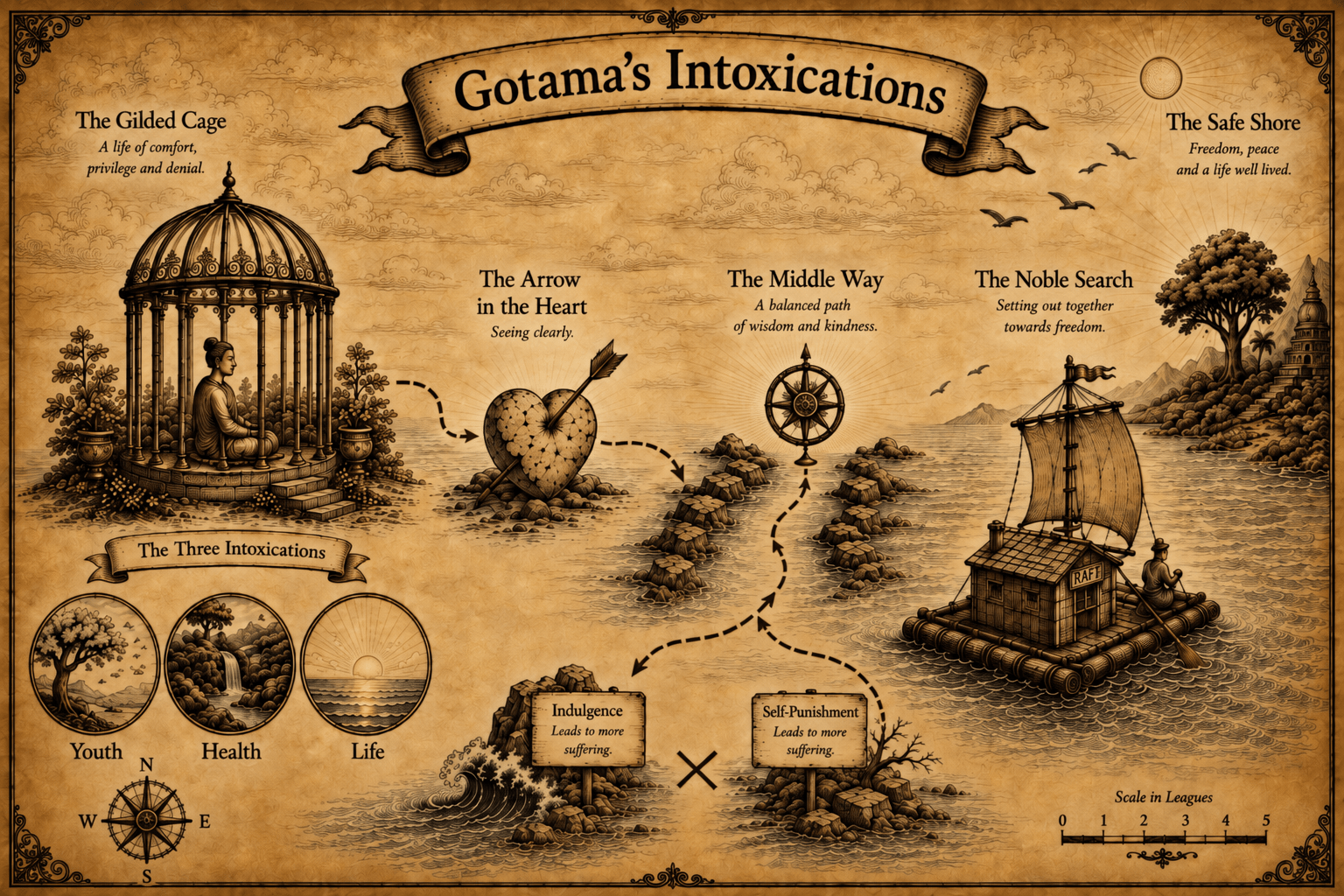
Gotama’s intoxications: a troubled young man in turbulent times
Recognising the landscape of human suffering
As we begin the first stage of our journey, we find ourselves on what the RAFT to Freedom programme calls the ‘dangerous shore’. This is the landscape of our familiar suffering, a place of turmoil and confusion where our most destructive cravings and habits hold sway. Before we can build a vessel to carry us away from this shore, we must first survey the terrain around us and understand its nature. This is the task of the ‘R’ in RAFT: to ‘Recognise’ that life is naturally painful, difficult, and disappointing.
To help us recognise the dangerous shore, we turn to the life story of Gotama (the Buddha), a historical figure who lived in India around 2,600 years ago. His journey is not a myth but a deeply human account of him confronting this same dangerous shore. By exploring Gotama’s story, we can see our own struggles reflected in his, not as personal failings, but as part of our shared human condition. His path serves as a guide, showing us the pitfalls and dead ends, but also revealing the possibility of us finding a way across the turbulent waters to the ‘safe shore’ of lasting well-being. This chapter, therefore, is not just a history lesson; it is the first step in gathering the understanding needed to construct our own raft.
The gilded cage and the three intoxications
To understand the radical nature of Gotama’s journey, we must first understand the world he chose to leave behind. Popular stories often depict him as a fairytale prince, but historical accounts suggest a more complex and relatable reality. He was born into the Sakya clan, an aristocratic republic in the Himalayan foothills. This was a turbulent era of political upheaval, and the Sakyan republic was a vassal state (a country that acknowledges the rule of a more powerful nation), living under the shadow of the powerful Kosala kingdom, Sakya was engaged in its own conflicts, including armed disputes over water rights.
While not a prince in the mythical sense, Gotama’s own accounts describe a life of extraordinary wealth and privilege. He wore only the finest perfumes and clothes:
I used no sandalwood that was not from Varanasi. My turban was from Varanasi, as were my tunic, my lower garments, and my outer cloak.
His every need was catered for:
I was delicately nurtured, most delicately nurtured, extremely delicately nurtured… I had three stilted longhouses: one for the winter, one for the summer, and one for the rainy season. I spent the four months of the rains in the rainy-season longhouse, being entertained by musicians, none of whom were male, and I did not leave that place.
Despite this gilded cage, a profound unease grew within him. He wanted to understand why he placed his happiness in sense-pleasures and in possessions that were impermanent and ultimately failed to satisfy him. Gotama recognised that his life, however comfortable, was built on a fragile foundation of denial. He later termed this denial ‘intoxication’. He saw that he, like most people, was intoxicated by three things: ‘the vitality of youth’, ‘the vigour of health’, and ‘the continuity of life itself’. These were not just states of being, but powerful delusions that created a false sense of permanence and security. To be intoxicated in this way was to revel in one’s own health while feeling repelled by the sick, to be absorbed in youth while looking down on the elderly – all while ignoring the inescapable reality that ageing, illness, and death come for everyone.
Gotama realised that, being subject to these exact same conditions, for him to continue living in a state of denial would be utterly unfitting and unfulfilling. Gotama’s deep dissatisfaction, which arose despite his unparalleled external comfort, powerfully mirrors the experience of many of us, who are caught in the tangle of habits that disconnect us from ourselves. That feeling of profound unease that persists even when life appears objectively good. The habits we use to manage our pain, difficulties and disappointments, often emerge as an attempt to escape this underlying unease, but like Gotama’s stilted long-houses, they offer us only temporary relief.
The arrow in the heart
This growing sense of existential dread is captured in the stark verses that open this chapter. Here Gotama describes seeing the world in turmoil and feeling a deep sense of fear and discontent. He then saw the source of this turmoil:
…an arrow here, so very hard to see, embedded in the heart.When struck by that arrow,you run around in all directions.But when that same arrow has been plucked out,you neither run nor sink into despair.
This ‘arrow embedded in the heart’ is a powerful metaphor. It is described as ‘so very hard to see’ because it represents the subtle, often unconscious, inner wound caused by our deepest afflictions – delusion, craving, and self-centered views. It is this hidden arrow that drives us to run restlessly ‘in all directions,’ seeking satisfaction or escape but never finding peace. Plucking out the arrow means uprooting these fundamental causes of suffering. At its core, Gotama’s motivation for leaving home was to discover a cure for this condition.
This inner wound is the source of what Gotama would later formalise as his ‘First Realisation’: dukkha. Often translated as ‘suffering’, dukkha encompasses a much broader spectrum of experience, including the stress, unease, and unsatisfactoriness inherent in our conditioned existence. It points to the fundamental truth that even pleasant experiences are impermanent and therefore cannot provide lasting, secure happiness. This insight finds a strong parallel in the modern psychological concept of the ‘hedonic treadmill,’ which observes that humans tend to quickly return to a baseline level of happiness, regardless of major positive or negative life events. The satisfaction from any new achievement or possession never lasts, leading to a perpetual cycle of seeking more.
This is the First Realisation that we must Recognise (R). The arrow of suffering is a universal part of the human condition that is explored in more detail in Recognising life is painful, difficult and disappointing. The compulsive patterns we get caught in are often just our frantic attempts to run from discomfort. The first stage of our journey requires us to stop running and, with self-compassion, acknowledge that the arrow is there. This honest and necessary surrender is grounded in Gotama’s First Realisation, that life is naturally painful, difficult and disappointing.
The turning point: embarking on the noble search
It seems likely that Gotama found this profound realisation overwhelming. We can perhaps read between the lines of these verses and other reflections by Gotama, that he was a troubled and anxious young man living in turbulent times. Gotama would have been conflicted by the weight of family and societal expectations. His experience prompted him to ‘go against the stream’, and he later captured his motivation with a powerful metaphor:
This home life is confinement, a basis for dust;the going forth is like an open space
For him, the ‘home life’ was not a sanctuary but a ‘confinement,’ a cramped space filled with obligations that restricted his ability to seek a deeper truth. It was a ‘basis for dust,’ a realm where the ‘dust of passion’ (craving, conflict, and confusion), was constantly stirred up, clouding the mind. He saw that leaving these worries behind was the only way to find the ‘open space’ – the mental and spiritual clarity needed to find a real end to fear and suffering.
…there are two kinds of illness. What two? Mental and physical. Some sentient beings are seen who can claim to be free of physical illness for a year, or two, or three years … even up to a hundred years or more. But it’s very hard to find any sentient beings in the world who can claim to be free of mental illness even for a moment, apart from those who have overcome intoxicating inclinations… Gotama
Gotama’s ‘Four Propositions’: raw insights for change
In Gotama’s earliest teachings, he presented the well known clinical framework of the Four Realisations (Four Noble Truths). But in later teachings, he also presented the lesser known but perhaps just as important ‘Four Propositions’ expounding the way things really are. These propositions are raw and piercing insights into Gotama’s existential crisis. After hearing them, a young wealthy nobleman called Ratthapala, was so inspired that he immediately sought to be ordained – to leave his family and own lavish lifestyle behind and to follow Gotama into homelessness.
These propositions were not abstract philosophies, but lived recognitions of fragility, dread, and powerlessness – the very tremors that often stir a person toward change. The Four propositions unveil the collapse of false security: the crumbling walls of the gilded cage, the failure of intoxicants to numb reality, and the painful, clear sight of the arrow embedded in the heart. These propositions became part of the catalyst for his journey.
All beings are swept along toward old age and death: The world is unstable.
Life is insecure, and nothing is truly within our control: The world has no shelter and no saviour.
We possess nothing – everything must be relinquished at death: The world has no owner.
There is a lack at the core of every life. No one is fully satisfied, for beings are enslaved by craving: The world is insatiable.
Driven by this sense of spiritual urgency, Gotama made a radical decision. He resolved to leave his life of privilege in search of peace, to find an end to the inner and outer conflict that caused so much fear. He sought a definitive end to suffering, leaving behind his wife Yasodhara and newborn son Rahula. This was not an act of abandonment but a courageous commitment to embark on what he termed the ‘Noble Search’ as distinguished from the ‘Ignoble search’ pursued by most.
The ‘Ignoble search’: Is the quest for happiness in things that are themselves subject to change, decay, and loss. Gotama saw this in his own life, recognising that his attachments to acquisitions – including spouses and children, male and female slaves, goats and sheep, fowl and pigs, elephants, cattle, horses, and even gold and silver – were impermanent and could not provide true security.
The Noble Search: Conversely, is the quest for that which lies beyond these conditions – a lasting freedom from the entire cycle of suffering. Something ‘wide and pure’ – a life free from the agitation of ignorance and craving. Gotama describes leaving home as a quest for ‘true happiness’, grounded on calm and peace.
This distinction provides a powerful lens for our own journey. The cycle of our harmful compulsions is an intense manifestation of the ignoble search – our repeated attempt to find relief in possessions, substances or behaviours that are impermanent and ultimately lead to more pain. The decision to begin building our raft marks a pivotal turning point. It is our commitment to undertake our own Noble Search – to turn away from seeking temporary fixes and begin the journey toward genuine, lasting freedom.
Gathering materials: the search for a seaworthy raft
Gotama’s search was a rigorous, six-year process of gathering materials for his own raft, a methodical investigation in which he tested various teachings and practices, keeping what was useful and discarding what was not.
Immediately after leaving home, he sought out the most esteemed meditation teachers of his time. He mastered their advanced techniques, attaining profound states of mental concentration. Yet, he recognised that these states, however blissful, were still temporary. They were useful tools, but they were not the final answer; they could not, by themselves, construct a raft that would reach the safe shore of complete freedom.
Having found these teachings insufficient, he dedicated himself to the opposite extreme of his former life: the path of severe self-mortification. The accounts of this period are harrowing; he engaged in extreme fasting, painful postures, and severe neglect of his body, pushing himself to the brink of death.
Self-harm is not the way
After these gruelling years, he came to a critical realisation: these practices had brought him no closer to his goal. They had only weakened his body and exhausted his mind, making the clarity required for wisdom impossible. He had tested these materials – harsh self-punishment and extreme denial – and found them rotten. They were unsuitable for building a durable vessel. This path, too, was a dead end. This episode holds a vital lesson: healing cannot be achieved through self-punishment. The cycle of indulgence followed by shame and harsh self-criticism is just another barren extreme.
It was then that a memory arose of him sitting in the cool shade of a tree as a boy, where he had spontaneously entered a state of deep, pleasant calm. He realised that there was a form of wholesome pleasure, born of clarity and peace, that could support his path. This insight marked his discovery of the ‘Middle Way’. Gotama abandoned his harsh austerities, accepted nourishing food, and regained his strength.
Avoiding extremes and the ‘Middle Way’
In his first teaching, Gotama laid out this core principle of the Middle Way, declaring that two extremes should be avoided: excessive indulgence in sensual pleasure and harsh self-denial. The Middle Way, he explained, is the balanced path between them. This discovery provides the central principle for the RAFT to Freedom. It is a balanced, sustainable framework that steers clear of both destructive indulgence and self-punishing rigidity. It reframes our journey not as a grim battle, but as the skilful and compassionate cultivation of the inner resources needed to build our vessel and navigate to the safe shore.
Māra the saboteur
Throughout this arduous search, Gotama was not only contending with physical hardships but also with the powerful internal forces of temptation, doubt, and fear. In the Buddhist tradition, these forces are personified as Māra, a figure representing the embodiment of harmful cravings and delusion. Māra is not an external demon but a metaphor for the persuasive whispers in the mind that try to pull us off course with doubt, rationalisations, and the lure of old destructive habits. Gotama’s path required him to constantly see through these deceptions, a skill of clear recognition explored in much greater detail in Māra – I know you: meeting the inner saboteur.
The story of Gotama’s unhappiness is, in many ways, our own story. It teaches us that the deep dis-ease we feel is not a sign that we are uniquely broken, but a fundamental part of the human condition that can be a powerful catalyst for change. His feeling of being trapped in a confinement of worldly duties and expectations, in a house dusted with passion and conflict, is a timeless expression of feeling overwhelmed by life. His journey was a methodical process of gathering materials for his raft. He tested advanced meditation and found it useful but incomplete. He tested extreme self-punishment and discarded it as harmful. He learned from every step.
His discovery of the Middle Way provides the blueprint for our RAFT to Freedom. It is a path of radical balance, wisdom, and compassion. By Recognising the landscape of our suffering with the same clear-eyed courage he demonstrated, we take the first essential step. We stop running from the arrow in our heart and instead turn to face it, ready to learn the skills needed to gently remove it and navigate our way to the safe shore.
It took Gotama six years to gather the materials for his raft and journey to the safe shore – a marathon not a sprint. This was followed by 45 years of practice until his final dying breath. Some of the skills he tried were not beneficial nor suitable, so he discarded them; he jettisoned them and left them behind.
In Recognising the arrow in the heart – our own and others’ – Gotama encouraged us to respond with compassion. This recognition is not self-blame but a tender awareness of shared human pain.
The GOTAMA practice
The following practices use Gotama’s name as a guide to walk in his footsteps, not to fix anything, but to see our own experience more clearly. Approach them as gentle experiments in awareness.
G – Ground yourself: Ground in the felt sense. Gotama’s journey began not with a theory, but with the felt reality of unease. When a moment of irritation or craving arises, pause. Instead of running, ground your awareness in the body. Where is this arrow felt? Is it a tightness in the chest? A hollowness in the stomach? A buzzing in the head? Simply place a hand there, acknowledging the raw sensation with presence instead of fear. Instead of pushing the pain away, name the difficulty and invite self-compassion: ‘This is hard. Let kindness be here.’
O – Observe ‘the intoxications’: Gotama saw through the delusions of youth, health, and life. We can observe our own. This week, when a strong judgement about someone older arises, gently note, ‘intoxicated with youth’. When frustration with a physical limitation appears, whisper, ‘intoxicated with health’. And when resistance to the thought of our impermanence arises, acknowledge, ‘intoxicated with life.’ This isn’t about self-criticism; it’s about seeing the subtle assumptions that fuel our reactivity.
T – Taste open space: The motivation for the Noble Search was the contrast between the ‘dusty confinement’ of his life and the possibility of open space. This week, intentionally taste small pockets of this. It could be five minutes of silence with a cup of tea and no phone. It could be a walk where you just notice the sky. These moments are rehearsals for freedom, reminding your nervous system that a life beyond the dusty room is possible.
A – Acknowledge the raw truth: Gotama’s Four Propositions are a stark acceptance of reality. Choose one for the day: ‘The world is unstable,’ ‘The world has no shelter and no saviour,’ ‘The world has no owner,’ or ‘The world is insatiable.’ Hold it lightly in mind and acknowledge how its truth shows up in small ways – a plan changing, a moment of insecurity, the desire for more. This is not pessimism; it is the practice of aligning with reality.
M – Map your confinement: Gotama felt his life was a ‘cramped, dusty room’. Take a moment to map your own life. What obligations, relationships, or thought patterns feel like confining walls? What is the dust of passion in your life – the gossip, the endless scrolling, the comparing – that clouds your mind? The first step is not to break down the walls, but simply to recognise them for what they are.
A – Awaken the Noble Search: Recognising the confinement and plucking out the arrow is not the end; it is the beginning. The final step is to awaken the aspiration (Noble Desire) for your own Noble Search. Form a clear resolve: ‘Seeing the dis-ease of the ignoble search, I resolve to seek genuine well-being.’ This sets your compass, turning recognition into a purposeful journey. This action is a ‘stroke of the oar’ on your raft.
Self-reflections
Take a few moments for honest self-inquiry, approaching these questions with a caring and curious mind:
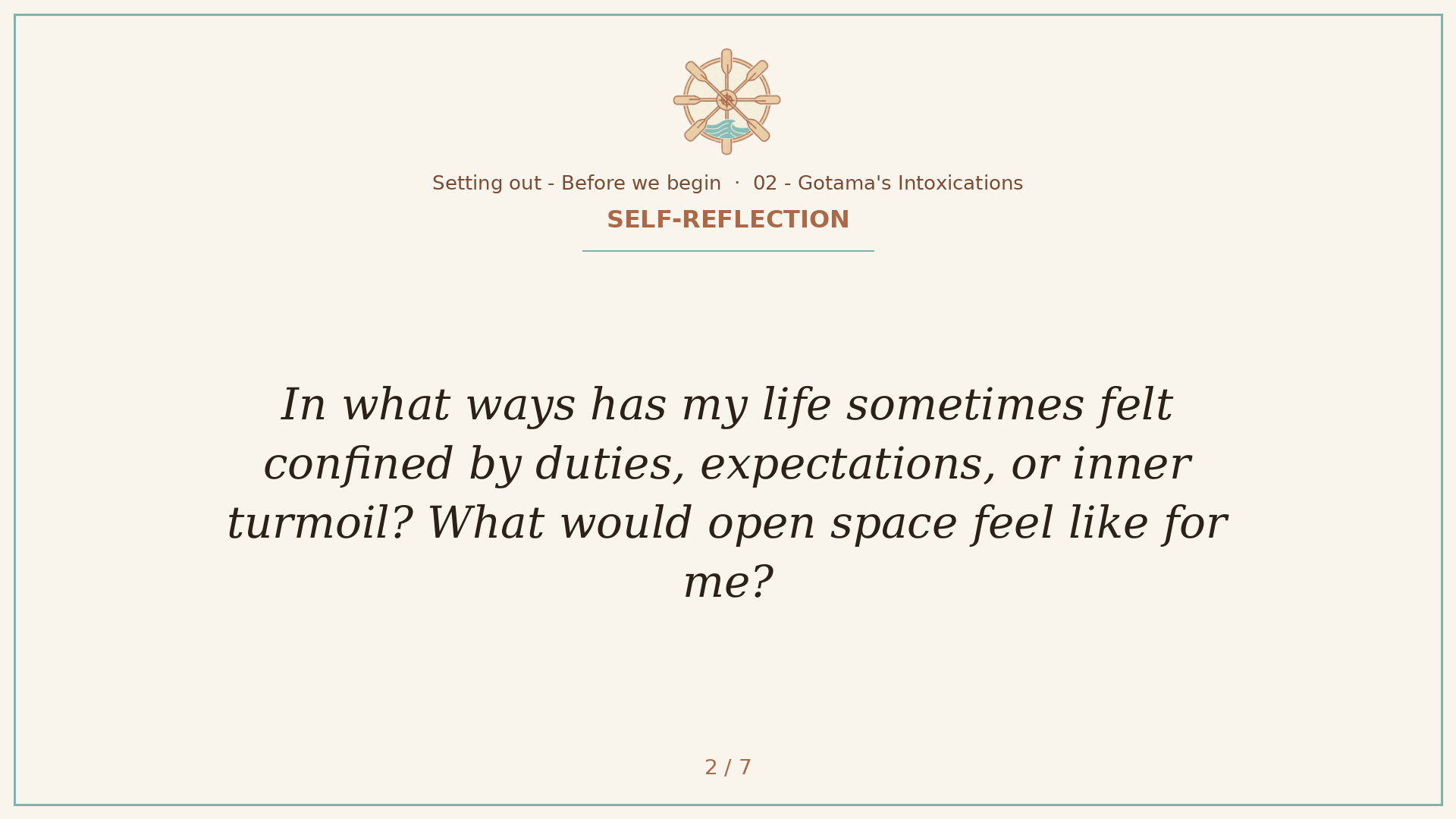
Reflect on a time when external comforts or acquisitions failed to bring me lasting peace. How did this arrow of dissatisfaction make itself known to me? (view card)
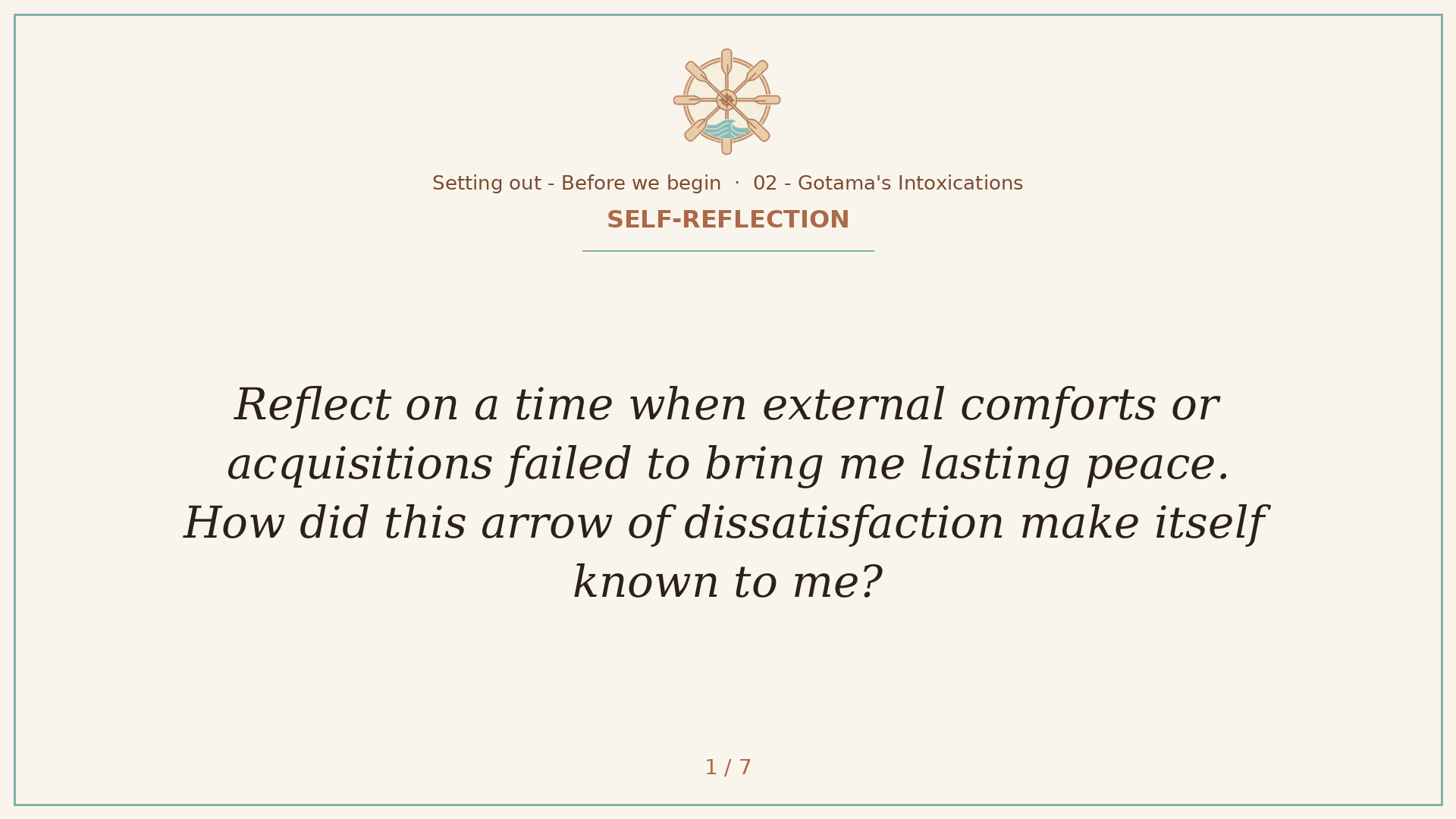
In what ways has my life sometimes felt confined by duties, expectations, or inner turmoil? What would open space feel like for me? (view card)
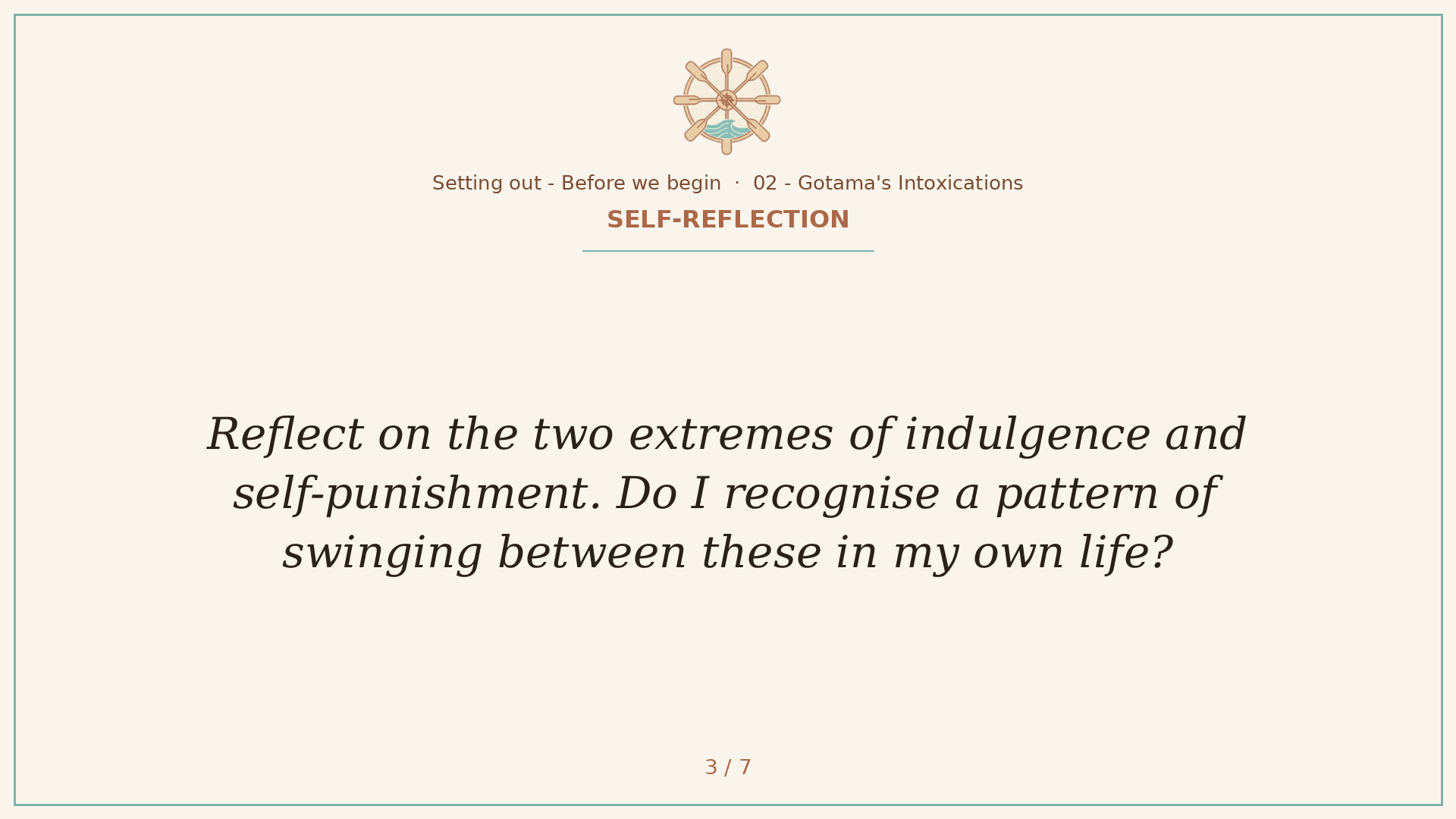
Reflect on the two extremes of indulgence and self-punishment. Do I recognise a pattern of swinging between these in my own life? (view card)
When have I noticed myself ‘running in all directions’ instead of pausing to recognise the arrow? (view card)
What are the ‘golden bars’ of my own gilded cage? (for example, a comfortable but unfulfilling job, a relationship based on habit, a reliance on digital distraction). What does this comfort cost me? (view card)
Of Gotama’s Four Propositions (the world is unstable, has no shelter, has no owner, is insatiable), which one resonates most strongly with my own experience today? Why? (view card)
What was one small, unhelpful practice or belief I have already discarded on my journey? What did I learn from letting it go? (view card)
Journaling prompts
Use your journal to explore these themes further:
Committing to the journey: The Noble Search begins with a powerful resolve. Write down your own intention for this journey. What kind of peace are you searching for? What commitment are you making to yourself as you begin to build your raft?
Materials for your raft: Gotama’s story shows him gathering and discarding materials for his journey. What materials from his experience – such as courage, clear-seeing, self-compassion, or the willingness to discard what doesn’t work – feel most essential for you to gather for your own raft right now?
An act of self-compassion: Gotama realised that punishing his body was a dead end. Write about one way you can abandon self-punishment this week and offer yourself an act of nourishment or care instead.
A weather report from the dangerous shore: Write a short weather report from your dangerous shore today. What are the prevailing winds (habitual thoughts)? What are the hidden reefs (triggers)? What storms (emotional reactions) have passed through recently?
Dialogue in the gilded cage: Write a short dialogue between the part of you that wants to stay safe and comfortable in the gilded cage and the part that yearns for the open space of the Noble Search. Let both voices speak honestly without judgment.
The Four Propositions in your life: Choose one of the Four Propositions (unstable, no shelter, no owner, insatiable). Write about a specific time in your life when you experienced the truth of this proposition directly. How did it feel? What did it teach you?
Daily GOTAMA check-in: At the end of the day, revisit the acronym. Which step (Ground, Observe, Taste, Acknowledge, Map, Awaken) felt most alive? Which do you need to strengthen tomorrow?
Supporting material: scientific and philosophical perspectives
For those interested in the scientific and philosophical underpinnings of Gotama’s intoxications, the following overview highlights some key connections. The path Gotama discovered resonates remarkably with contemporary scientific and philosophical understanding of the human mind.
Neuroscience: Gotama’s insight into craving (taṇhā) is illuminated by modern neuroscience. The habits we use to manage pain often hijack the brain’s natural reward system. Substances and compulsive behaviours can flood this system with dopamine, creating intense but temporary pleasure. The brain adapts by reducing its own sensitivity, meaning natural rewards become less satisfying and more of the substance or behaviour is needed to get the same effect, creating a painful cycle. The Middle Way’s emphasis on mindfulness and mental training aligns with the principle of neuroplasticity – the brain’s ability to change and form new neural pathways. Practices like meditation can strengthen the prefrontal cortex, the area responsible for impulse control and wise decision-making, effectively rewiring the brain away from automatic, compulsive loops and towards conscious, healthy choices.
Psychology & Psychotherapy: The First Realisation of pain, difficulties and disappointments finds a strong parallel in the psychological concept of the hedonic treadmill – the theory that people tend to return to a relatively stable baseline of happiness regardless of positive or negative life events. This explains why the Ignoble search for lasting happiness in fleeting pleasures is ultimately frustrating. Some of the most effective modern therapies, such as Acceptance and Commitment Therapy (ACT) and Dialectical Behaviour Therapy (DBT), integrate principles that resonate with Gotama’s path, such as mindfulness, acceptance of difficult feelings, and committed action based on personal values.
Philosophy: Gotama’s Noble Search resonates deeply with themes in existential philosophy, which grapples with universal human concerns about suffering, freedom, death, and the search for a meaningful life. Both traditions recognise that confronting the difficult realities of the human condition, rather than avoiding them, is the necessary catalyst for growth and transformation. Gotama’s journey is a profound example of taking responsibility for one’s own path to find an authentic and purposeful way of living.
Remember to remember
Gotama was an ordinary man who had some extraordinary insights. His own raft was six years in the building – a rigorous testing of teachings and practices, keeping what served him and discarding what did not – and it carried him from suffering towards freedom. He left home at the age of 29, “while still a black-haired young man endowed with the blessings of youth in the first stage of life” (Ariyapariyesana Sutta, MN 26). He died 51 years later, an old and homeless beggar, at peace with himself and the world. Even after he had woken up to how life really is, he continued to practise for the rest of his days; he was still subject to pain, but he chose not to suffer for it.
His is not the story of a saint who was somehow spared our difficulties, but of an ordinary person who recognised them fully – and it was this recognition, not any special immunity from pain, that let his freedom begin. We are not being asked to leave home or to walk for six years; we are simply being invited to notice our own arrow, and to trust that seeing it clearly is itself the first stroke of the oar.
The curious paradox is that when I accept myself just as I am, then I can change.
Carl Rogers, On Becoming a Person: A Therapist’s View of Psychotherapy (1961)
Our own noble search begins here – welcome aboard. Next, we turn to Generosity – the gift of open hands, and to the first plank we lay down for our raft.
If beings knew, as I know, the results of giving and sharing, they would not eat without having given, nor would the stain of miserliness overcome their minds.
Gotama (the Buddha), Dāna Sutta (Iti 26)
Episode 3 – Dana – the gift of generosity
An AI-generated ‘deep dive’ into this aspect of the RAFT to Freedom
Gathering the first materials with open-heartedness
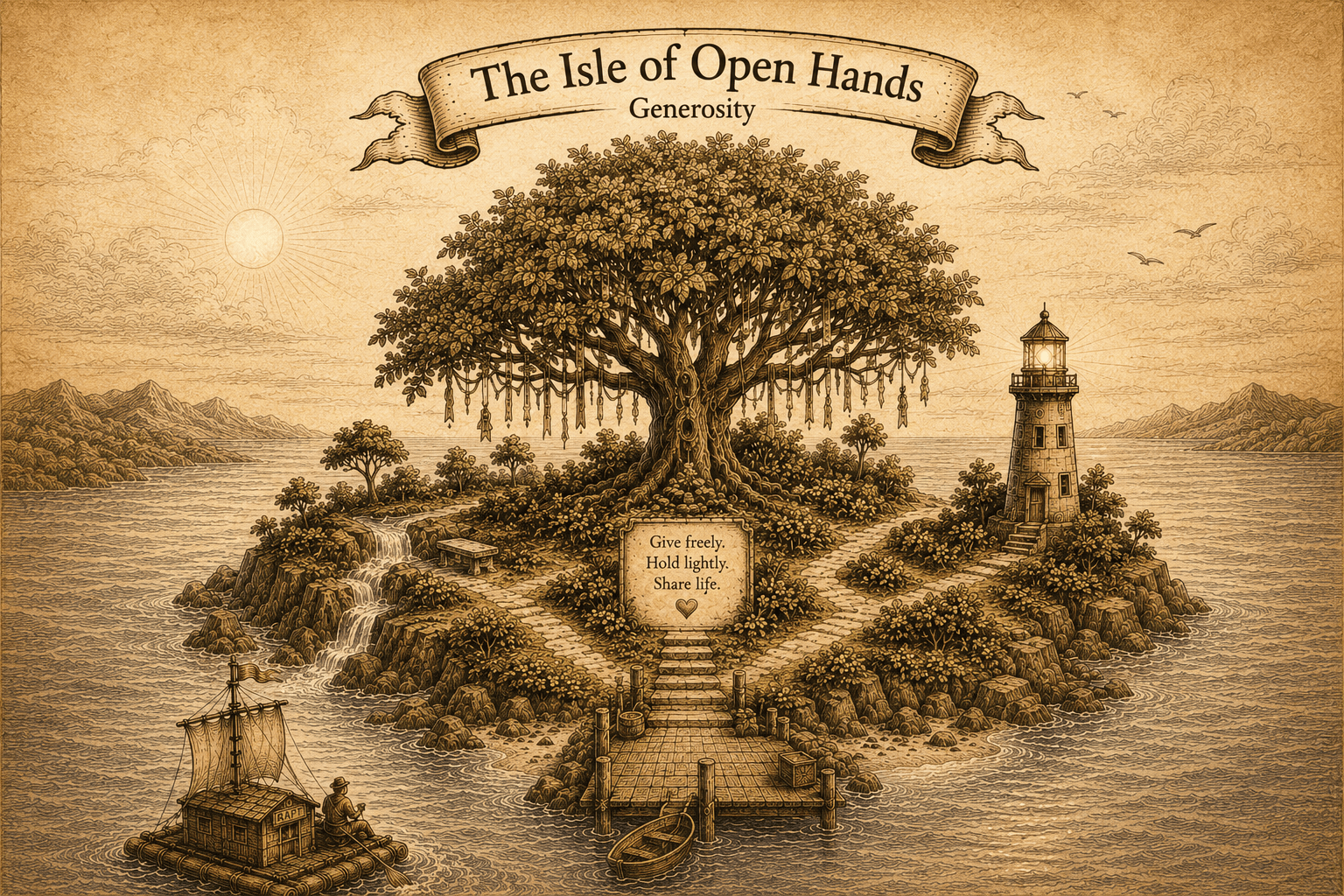
With our journey now begun – surveying the dangerous shore of suffering and disappointment – we now lay our hands upon the first, essential materials for building our vessel to freedom. At the very heart of this process is generosity (dana), which the early Buddhist tradition regards as a powerful, foundational attitude for our journey to freedom.
This practice invites us to begin building our raft with one of the oldest and most powerful practices in the Buddhist tradition: generosity. This is not merely about giving things away – it is about cultivating an open-hearted way of being that supports both personal healing and community connection.
Generosity extends far beyond the simple act of our giving away material possessions. It expresses a profound generosity of heart and mind – the deliberate antidote to the tightness, anxiety, and self-contraction that arise alongside our suffering and our human struggle with craving, grasping, and reactivity. Generosity, in this sense, is the opening of our hands, heart, and mind to life itself.
When we intentionally cultivate generosity, we are beginning to gather the initial materials needed to build our raft. With each act of generosity – whether it be a smile, a small kindness to a friend, an hour spent listening to someone in need, or a moment of patience with ourselves – we begin binding the pieces of our vessel together. These are the ropes of the Appropriate Responses: compassion, friendliness, appreciative joy, and equanimity (self-compassion, self-love, self-appreciation and self-balance).
When we practise generosity, we naturally foster gratitude and contentment. In Buddhist psychology, these qualities directly counteract our sense of not enough – the root of our harmful cravings and repetitive, self-defeating habits. As one teacher has put it, generosity is the antidote to today’s pervading sense of insufficiency.
Gotama taught us that the Five Gifts of ethical living, which we turn to next, are ancient and enduring. The very act of undertaking the Five Gifts is itself a form of generosity – giving safety, non-harm, and integrity to others. Each is a moral offering. They form the first five planks of our raft – the gifts of harmlessness – by which we grant ourselves and all beings fearlessness and goodwill. Each time we act generously, we both accept the gift and offer it; the gift becomes a steady platform on our raft to support us on our onward journey.
Generosity is the open hand, freely giving joy, care, and connection; harmlessness is the steady hand, refusing to harm ourselves or others. Together, they steer our raft toward freedom.
Crucially, generosity is not limited to others; it must also be offered to ourselves. Just as a sailor tends their own vessel before setting out, we begin our practice of generosity by offering generosity to ourselves – care, forgiveness, time, and the willingness to start again. This is not selfishness – it is self-compassion: putting on our own lifejacket before helping others. In this way, generosity helps us to recognise the pain, difficulties and disappointments of life. It helps us meet our struggles and ourselves with compassion – the Appropriate Response for this initial stage on the path to liberation.
Generosity, shared with ourselves and among our community (sangha), creates the fellowship and camaraderie needed for us to venture forth towards freedom. Mutual support and generosity allow us to navigate these lonely waters together.
True generosity is available to everyone, regardless of background or circumstances. Because generosity is simply our active intention to align each of our actions, words, and thoughts with our shared purpose of healing and well-being – a conscious forward step towards the safe shore of freedom.
Practice
Cultivating generosity
Generosity is a practice, not a single act – something we build day by day, plank by plank. Below are six areas of daily life in which generosity can be cultivated, deliberately and gently.
Self-generosity and forgiveness
Letting go of harsh self-criticism or unrealistic standards
Taking time to rest or nourish your body
Setting a boundary that protects your peace and wholesome intentions
Practising patience with yourself as you heal and grow
Allowing yourself to feel joy without guilt
Generosity of time and presence
Actively listening to someone without interrupting or judging
Offering to run errands or help with childcare for someone overwhelmed
Volunteering with a community or service organisation
Being fully present for a conversation, even when busy
Writing a heartfelt note or message of support or gratitude
Material generosity (giving possessions or resources, if you are able)
Offering food or drink to a guest, stranger, or neighbour
Donating to a cause aligned with your values (for example, support groups, mutual aid, spiritual centres)
Sharing your belongings with those in need – clothing, books, tools
Contributing to a teacher or guide
Paying forward a coffee or meal anonymously
Verbal and emotional generosity
Speaking kind words – even to those who challenge you
Offering genuine encouragement, praise, or acknowledgment
Apologising when wrong – without defensiveness
Sharing wisdom or skills without expecting credit
Extending compassion to someone struggling, even silently
Community and interpersonal generosity
Including others
Inviting someone new into a group or gathering
Sharing your healing story to offer hope
Teaching someone something you know freely
Supporting someone’s small business or creative work
Offering mediation or support in times of interpersonal conflict
Spiritual and ethical generosity
Sharing helpful teachings, or insight that supported your own path
Offering service in community or a spiritual practice group
Upholding the Five Gifts and values that protect others from harm
Mentoring or being available to those new on the path
Holding someone in silent friendliness or kind wishes during their struggle
Self-reflections
Take a few moments for honest self-inquiry, approaching these questions with a caring and curious mind:
When have my own patterns of craving, avoidance, or self-doubt limited my capacity to be generous – with things, time, or my presence? What did those inner constraints or conflicts feel like? (view card)
Recall a time I offered genuine generosity, to myself or another. How did this act change my internal weather? Did giving feel different from surrendering to old habits or cravings? (view card)
How might I cultivate an ‘open heart, open hands, open mind’ today, in small moments? (view card)
Pause for a moment: what plank of generosity will I lay down today? (view card)
When has receiving generosity from someone else been difficult for me? What made it hard to accept, and what would it mean for me to receive more openly? (view card)
What would it look like for me to extend the same generosity to myself that I offer so readily to others? (view card)
Where does my sense of not enough show up most strongly in daily life, and how might a single act of generosity loosen its grip? (view card)
Journaling prompts
Binding your raft: Describe your vision of lasting freedom or authentic well-being. How does practising generosity, in any form, bind your raft and carry you closer to that vision?
What happens when you give: Write about a recent time when giving (whether material, attention, time, or care) brought you a sense of deep peace or clarity. What sensations or feelings arose?
Self-care on the journey: What act of self-generosity today would serve as a fresh plank for your raft, steadying you for the onward journey?
Creating connections: How might generosity, extended to others, create ropes of connection and reduce isolation? Who can you offer a gift of presence or support to today?
The gift of presence: Write about a time someone gave you their full, undivided attention. What did that feel like? How might you offer that same gift to someone this week?
Loosening the grip of not enough: Where does the feeling of not having, being, or doing enough show up most often? Write about one small act of giving that might loosen its hold.
The gift you already carry: What wisdom, skill, or insight have you gained on this journey so far that could be freely shared with someone else? Write about what holds you back, and what it might mean to offer it.
Supporting material: scientific and philosophical perspectives
For those interested in the scientific and philosophical underpinnings of the practice of generosity, the following overview highlights key connections.
Neuroscience: Neuroscience increasingly demonstrates what wisdom traditions have long known: acts of generosity do more than benefit others – they reshape our own minds. While cravings and compulsive habits may offer brief spikes of pleasure, research shows that intentional giving activates regions of the brain associated with reward, social bonding, and sustained well-being (see, for example, the studies of Moll et al., 2006, on prosocial behaviour and reward circuitry). Generosity is shown to reduce chronic stress, increase subjective happiness, and build resilience over time.
Psychology & Psychotherapy: Research suggests that prosocial acts foster trust, cooperation, and social bonds that have supported human survival and flourishing as a species. In giving, we strengthen the very ties that hold our communities, and ourselves, together. From an evolutionary perspective, generosity is thought to play a vital role in human social life.
Philosophy: Generosity is more than a transaction; it is the lived recognition of interdependence. Giving generates a virtuous cycle in which both giver and receiver are uplifted, helping to break old cycles of harm and isolation and supporting our aspiration for a purposeful, ethical life.
Remember to remember
Generosity (dana) lies at the heart of our journey from suffering to freedom. It is the open-handed, open-hearted practice that gathers the first materials of our raft: with every act of giving, we bind a plank with kindness and compassion, and make our vessel a little more resilient for the voyage ahead.
Generosity is the first active step from pain toward freedom, and it costs us nothing we cannot spare. Every open hand, every shared story, every small kindness to ourselves strengthens the vessel we sail in – and the more we give, the lighter the journey becomes.
Attention is the rarest and purest form of generosity.
Simone Weil, letter to Joë Bousquet, 13 April 1942 (widely published in Gravity and Grace)
Our raft is gathering its first materials – welcome aboard. Next, we turn to the Five Gifts, and to the planks we lay down to keep it afloat.
Help support the RAFT to Freedom website RAFT to Freedom is offered freely, and there are ongoing costs involved in running the website and related online resources. If you would like to help with these costs, you can send a contribution via PayPal here: https://paypal.me/Raft2Freedom Contributions are currently collected through a personal PayPal account on behalf of the project, and a clear ledger of income and website-related expenses is kept. Thank you for your support.
Now, there are these five gifts, five great gifts – original, long-standing, traditional, ancient, unadulterated, unadulterated from the beginning – that are not open to suspicion, will never be open to suspicion, and are unfaulted by knowledgeable contemplatives & brahmans.
Gotama (the Buddha), Abhisanda Sutta (AN 8.39)
Episode 4 – The Foundational Planks of Our Raft: Commitment to harmlessness
An AI-generated ‘deep dive’ into this aspect of the RAFT to Freedom
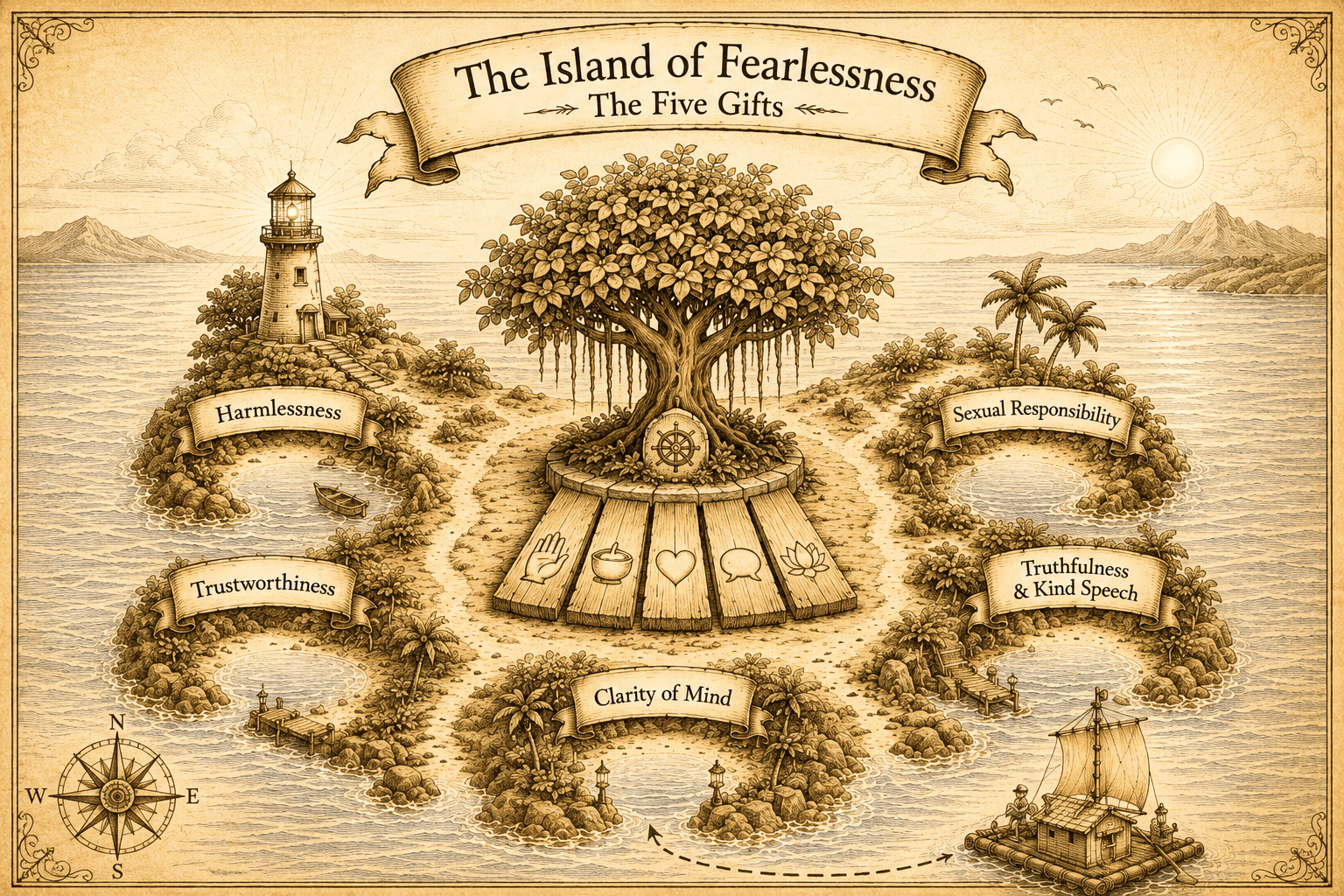
Commitment to harmlessness – the gifts of the five precepts
Having gathered the first materials of our raft through generosity, we now lay down its foundational planks. Before we look closely at our human suffering and the specifics of our own compulsions and destructive patterns of behaviour, it helps enormously to establish a baseline commitment to harmlessness. This commitment, embodied in what Buddhism calls the five precepts, is not about imposing rigid rules. It is about cultivating awareness of how our actions affect ourselves and others, and consciously choosing to minimise harm. This ethical awareness forms the very foundation of our RAFT to Freedom. In many ways, these Five Gifts can be considered an original harm-reduction programme.
If the foundational planks of our raft – the base upon which everything else rests – are weak and rotten, our vessel will leak and will not be seaworthy. This holds no matter how skilfully we gather other materials like mindfulness or wisdom. Committing to harmlessness, through the spirit of Gotama’s Five Gifts, ensures that we are building a watertight raft.
Universal guidelines for harmony: ancient wisdom
Gotama’s Five Gifts, as guidelines for ethical living, are not exclusively Buddhist but reflect a timeless, universal understanding of how humans could live together more peacefully. Long before Gotama was born, early legal codes addressed themes that societies still grapple with today: violence, theft, sexual impropriety, untruthfulness, and the disruption caused by intoxication (Ur-Nammu Code and Hammurabi Code).
These ancient codes aimed to establish frameworks that would prevent disputes and conflict. They recognised that certain actions reliably cause harm and undermine social stability. So when Gotama proposed the Five Gifts, he was not creating an entirely new concept – he was drawing on an ancient and traditional understanding of what helps promote social order and reduce suffering.
Beyond law: the five great gifts
Gotama, however, framed these guidelines very differently from the established legal codes of his time. Laws had typically focused on external rules, obligations and punishments, but around two thousand six hundred years ago Gotama presented the five precepts as profound, personal gifts.
Why did Gotama describe these precepts as gifts? Because when we sincerely undertake them, we are offering the gifts of fearlessness and harmlessness unconditionally to all beings, including ourselves. In each of these five fundamental areas where harm is so often caused, we are essentially saying: you have nothing to fear from me. It is our commitment to acting with awareness and care that fosters trust, safety and connection – qualities so often damaged by our destructive compulsions and behaviours. They are essential for healing, and when we offer these gifts, it is an act of profound kindness and generosity.
Practice
Setting the five intentions
These Five Gifts are best understood as training guidelines, or personal intentions, rather than rigid commandments demanding impossible perfection. The path from suffering to freedom is one of learning and growth, and we are all imperfect human beings – so we frame these gifts as conscious intentions:
I set the intention not to harm myself or others by my thoughts, my words or my actions.
I set the intention not to take anything that has not been freely given.
I set the intention not to harm myself or others by my sexual and sensual misconduct.
I set the intention not to harm myself or others by false speech, harsh speech, gossip and slander.
I set the intention to refrain from taking alcohol and other drugs that impair my mindfulness.
Framing the gifts this way means we are setting a caring, ethical course – cultivating an aspiration of harmlessness, and focusing on positive intention rather than prohibition. When we inevitably fall short, as all humans do, this framing encourages self-compassion and a renewal of commitment, rather than the shame and self-condemnation that can send us falling overboard back into old, harmful patterns.
Let’s look briefly at each intention:
Harmlessness: committing to refrain from killing, or from intentionally causing physical or deep emotional harm. This is the bedrock of ethical conduct.
Trustworthiness: committing to refrain from taking what is not ours, respecting others’ property and boundaries. This builds integrity.
Sexual responsibility: committing to refrain from sexual actions that cause harm to ourselves or others – for example, exploitation, adultery, or actions that break trust. This fosters respect and care in relationships.
Truthfulness and kind speech: committing to refrain from lying, harsh words, divisive gossip and slander. This promotes clear communication and connection.
Clarity of mind: committing to refrain from consuming intoxicants – alcohol and other drugs not specifically prescribed by a doctor – to the point of carelessness or loss of mindfulness. This gift is especially crucial on this journey, whatever our own most destructive compulsive patterns have been: intoxication directly clouds the awareness we need to uphold the other gifts and meet the challenges of life skilfully. It undermines our ability to navigate our raft effectively.
By setting these intentions, we proactively reduce the amount of harm we cause, lessening our future need to grapple with guilt and self-forgiveness, and the need to seek forgiveness from others. These categories of harm – violence, betrayal, dishonesty and so on – are so universal that they also form the basis for other practices, such as forgiveness meditation. Committing to the gifts is preventive medicine for the heart and for our relationships; it is a fundamental way of practising kindness – offering safety to others, and fostering self-respect within ourselves.
Self-reflections
Take a few moments for honest self-inquiry:
How does viewing the precepts as personal gifts, rather than imposed rules, change my relationship with them? (view card)
Which of the Five Gifts feels most challenging or most relevant for me right now? (view card)
How has my relationship with substances or other distractions affected my ability to uphold the other ethical commitments? (view card)
Can I identify ways that adopting these intentions might support my emotional well-being and personal integrity? (view card)
When my intentions aren’t upheld, is my instinct self-compassion and renewal, or shame and self-condemnation? What might it feel like to choose the former? (view card)
What would it mean for those closest to me to feel, in my presence, that they have nothing to fear from me? Where does this already feel true, and where is there room to grow? (view card)
Which of the five intentions, if held more closely, would most reduce my need for future repair or forgiveness in my relationships? (view card)
Journaling prompts
Reflecting on intentions: Choose one intention that resonates strongly or poses challenges. Observe how you navigate related situations, and journal about your experiences, challenges and insights.
The gift of safety: Reflect on how living with harmlessness might reduce fear, anxiety and conflict in your life and relationships.
Historical harm, present intention: Identify a past action causing harm aligned with one of the gifts. Without dwelling on guilt, reflect on how adopting the intention now might lead to a different outcome.
Clarity and ethics: Explore the direct connection between clarity of mind (avoiding intoxicants) and your ability to act ethically in daily situations.
Gifts, not rules: Rewrite one of the Five Gifts in your own words, as a personal intention rather than a rule. What shifts when you frame it this way?
The watertight raft: Which of the five planks (Five Gifts) feels least steady in your own life right now? What would strengthening it look like this week?
Falling short, beginning again: Write about a recent time an intention wasn’t kept. Rather than dwelling on the lapse, write about what renewing the commitment might look like today.
Supporting material: ancient wisdom and modern relevance
For those interested in the science and philosophy behind this practice, here is a brief overview:
Neuroscience: While ethics is complex, neuroscience suggests that practices which promote empathy, compassion and impulse control – all related to the precepts – involve, and can strengthen, specific brain circuits, particularly in the prefrontal cortex (involved in decision-making and social cognition) and in areas related to understanding others’ states (the mirror-neuron system, the insula). Committing to the precepts can be viewed as a cognitive training exercise that strengthens self-regulation and value-based decision-making.
Psychology & Psychotherapy: Modern psychology supports the importance of ethical conduct for mental health. Living in accordance with our values is thought to reduce cognitive dissonance, guilt and shame, while increasing self-esteem and self-respect. Prosocial behaviour – acting for others’ benefit, including non-harming – has been associated with greater happiness and stronger social connections. Rebuilding integrity and trustworthiness after old patterns of harm is a key psychological task that committing to the precepts directly supports; the precepts act as guidelines that help strengthen volitional behaviour aligned with deeper values.
Philosophy: The five precepts resonate strongly with various ethical philosophies. They embody the principle of non-maleficence (do no harm), a cornerstone of medical and general ethics. They align with virtue ethics, which focuses on cultivating good character – truthful, responsible, non-violent – rather than simply following rules. They also offer a practical ethical framework for creating the conditions for a flourishing life (eudaimonia), on the view that inner peace and social harmony are difficult to sustain amid ongoing harmful action. The parallels with ancient legal codes such as the Ur-Nammu and Hammurabi codes point to the timeless and universal nature of these ethical concerns, and to how long societies have recognised that regulating behaviour around violence, property, sex, speech and social order is fundamental to collective well-being.
Remember to remember
The five precepts, understood as personal intentions and gifts of harmlessness, form the essential ethical foundation for our RAFT to Freedom. They are the sturdy planks upon which we build our vessel. By committing to minimise harm in these five key areas, we create safety for ourselves and others, cultivate self-respect, and establish the stability needed for the deeper work ahead.
This commitment is not about achieving instant perfection, but about setting a clear, compassionate direction. Hold these intentions sincerely, and simply begin again whenever we fall short: each renewed commitment is itself a small act of freedom – freedom from conflict, blame, guilt, shame, agitation, discomfort, regret, debt, and freedom from hangovers!
We do good because it frees the heart. It opens us to a wellspring of happiness.
Sharon Salzberg, Lovingkindness: The Revolutionary Art of Happiness (Shambhala, 1995)
With these planks laid, our raft is taking shape. Next, we turn to Māra, I Know You, and to the currents of craving our foundation now helps us meet.
Forms and sounds, tastes and odours, tactile objects that delight the mind: I offer them right back to you, for I, O Māra, do not need them.
Vijayā Therī, addressing Māra, Vijayā Sutta (SN 5.4), translated by Bhikkhu Bodhi
Episode 5 – ‘Māra, I Know You’: Navigating the ongoing journey
An AI-generated ‘deep dive’ into this aspect of the RAFT to Freedom
Temptation and old patterns: guardrails against falling overboard
Māra – I see you, Māra – I hear you, Māra – I smell you, Māra – I taste you, Māra – I feel you… …Māra – I know you!
While these exact words aren’t a verbatim ancient quote, they capture a recurring theme found across early Buddhist teachings. Vijayā above gives us a clear example: Māra tempts her through the pull of sights, sounds, smells, tastes and touch, and she simply recognises what is happening and lets it pass. Whenever the inner saboteur (personified as Māra) appears to disrupt meditating nuns and monks, the remedy is always the same: clear recognition. The moment he is recognised, his illusion collapses and he disappears on the spot. Our refrain turns that repeated teaching into a practical mantra for daily practice: “Māra, I know you.”
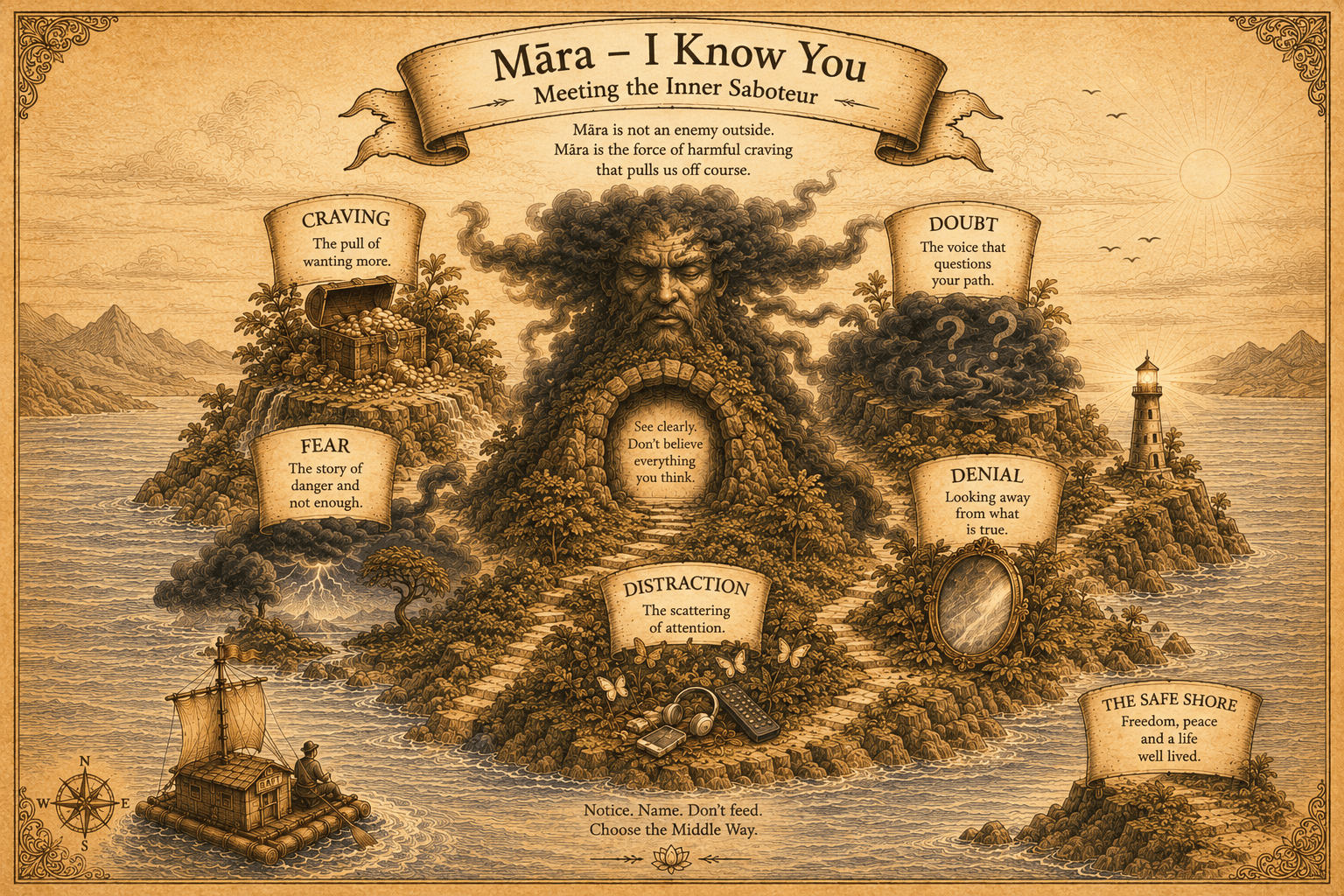
As we complete our preparations before stepping into Recognise, Māra is the perfect metaphor for craving, self-doubt, self-criticism and the many ways we react rather than choose. He is the personification of self-sabotage itself: subtle, cunning and persistently trying to pull us off course.
This is not about battling some monstrous external force. It is about learning to recognise, understand and wisely relate to our own patterns of thought and reactive behaviour. Māra is those persuasive whispers in the mind that try to convince us to give in to old habits, avoid what is difficult, rationalise unhelpful actions, or create doubt about the path to freedom. These are the hidden reefs and deceptive mirages that threaten to scupper our raft on the way to lasting peace.
Just as a vigilant navigator learns to identify hidden dangers, we learn to recognise Māra’s presence in his or her many disguises, if we are to steer our vessel to safety. What may once have felt like unrecognised or subconscious urges and fears can now be clearly seen for what they are: the manifestations of Māra.
Gotama and Māra: a dynamic of recognition
In the early Buddhist texts, Māra is the personification of temptation, delusion, and death – the one who tries, again and again, to obstruct awakening. Māra is not an external demon but the personification of our shared habits of compulsion and avoidance – our universal instinctual drives to protect, promote and satisfy. He appears as craving, aversion, doubt, fear, denial, or distraction.
What is striking is that Māra appears more often after Gotama’s awakening than before. Why? Because awakening does not remove temptation; it reveals it. With clarity comes recognition. Gotama no longer struggled with Māra; he simply saw him clearly and named him. Nor is this recognition reserved for Gotama alone: throughout the early texts, awakened monks and nuns meet Māra’s own attempts at seduction, fear or doubt the same way, simply seeing him for what he is. In every case the pattern is the same: once Māra is recognised, he grows sad and disappointed, and slips away.
This ability to see Māra – to name and disidentify from compulsive urges and self-defeating thoughts – is essential to cultivating well-being. It is the difference between being caught in a loop and stepping out of one. It reframes our struggle with craving and avoidance: instead of a battle against a monstrous, external force, it becomes a process of recognising, understanding and wisely relating to an internal pattern of thought, craving and compulsion. This approach – calm awareness, compassion and understanding – mirrors Gotama’s own response, and invites us to meet our inner challenges with gentleness, fostering self-compassion rather than internal conflict.
Māra and our embodied awareness: six lenses of mindfulness of body
The chapters ahead will guide us through Mindfulness of Body in real depth. Even before we reach them, its six elements can already serve as powerful lenses for recognising Māra’s subtle manifestations within our own experience:
Mindfulness of breathing and Māra: this foundational practice provides an immediate anchor, calming the inner agitation that Māra thrives on and helping us recognise the impermanent nature of cravings as they arise and pass. It helps us see Māra’s subtle arrival. Does an urge or a self-defeating thought make the breath shallow, fast or tense? Noticing this physical shift through mindful breathing is often the first clue that Māra is present, trying to pull us into reactivity.
Mindfulness of posture and Māra: cultivating awareness and stability in physical posture creates an embodied sense of groundedness that counters the restlessness and instability Māra often brings. Do the shoulders slump when hopelessness whispers? Do they tense when craving arises? Posture can be a mirror reflecting Māra’s subtle influence, a shift in internal state made visible.
Clear comprehension and Māra: this skill directly supports our ability to say “I know you, Māra.” It allows us to pause and wisely choose how to respond to an urge, rather than reacting automatically – investigating cravings non-judgementally, discerning their true nature. What is the voice of craving trying to achieve? Is it promising relief, escape or validation that ultimately leads to more suffering? Clear comprehension helps us see through the illusion.
Mindfulness of the reality of the body and Māra: grounding in the tangible sensations of the body helps dispel the mental fogginess and delusion that Māra uses to obscure our path. How does Māra manifest as physical sensation – a false sense of need, discomfort, or emptiness that only old habits promise to fix? Observed mindfully, these sensations can be recognised as impermanent events, not urgent commands.
Mindfulness of the body through the lens of the elements and Māra: cultivating awareness of awareness helps us observe Māra’s temptations, thoughts and cravings as temporary mental events, fostering a non-reactive stance towards them. When Māra arises, where is the heat of anger felt, the fluidity of fear, or the heaviness of despair? Grounding in these basic elemental qualities can prevent Māra from pulling us into mental narratives.
Mindfulness of the body’s impermanence and Māra: seeing that Māra’s temptations, like all experience, are temporary cultivates a radical acceptance that reduces the clinging that fuels the subtle chains we carry, diminishing Māra’s power over us. How does giving in to Māra deepen suffering over time – physically, mentally, spiritually? This longer view can disempower Māra’s short-term promises by revealing their true cost.
Māra through the lens of the four tasks
The story of Māra offers a vivid, close-up illustration of the four tasks at the heart of this workbook.
To Recognise Māra is Gotama’s first move: by calmly naming that life is painful, difficult and disappointing and particularly, that we don’t always get what we want. Gotama exposes Māra’s false claims that we can have everything that we want and that we don’t need to suffer. This dispels the illusion and drains Māra of his power – without anger or fear – simply an acknowledgement of what is present. It is the practice of seeing the patterns of escape and self-sabotage for what they are – an impersonal, conditioned pattern, not our true self.
To Abandon is not to defeat Māra by force, but to understand the drives to protect, promote and satisfy that give rise to him – the desire, aversion, doubt and fear that are his tools. In understanding them, we let the mental confusion they create go. Seeing clearly that the urge promises relief but delivers only more pain, difficulty or disappointment is itself the motivation to let it go. We are not white-knuckling through unhelpful desires but abandoning the illusion that they offer real solutions.
To Feel is to notice the peace of non-engagement – the moments when a trigger or a compulsive thought arises, is recognised, and simply has no power over us. This is not the absence of Māra’s temptations but freedom from being disturbed by them: the ease, clarity and calm that can be felt the moment craving’s grip loosens, even briefly. Gotama said that this can be personally experienced and verified by all of us.
To Train is to keep this practice going for a lifetime. Māra never completely vanishes; the texts show him returning again and again throughout Gotama’s own life. Our path asks for the same continuous cultivation: training in mindfulness to keep recognising Māra, training in wisdom to remember the consequences of following him, and training in ethical conduct to build a life where he finds less fertile ground to take root. Vigilance becomes, over time, not a stressful hyper-alert state but a calm, patient and compassionate practice of self-awareness.
Recognising Māra, the voice of our struggle with craving and avoidance, is a crucial step on this journey. It is about learning to read our inner map accurately, to identify these hazards as they appear, and to find skilful means to avoid being shipwrecked by them. By patiently and persistently consulting that map through mindful awareness, we learn to sail through these hazardous waters towards the calm harbour of freedom. This ongoing vigilance, supported by our growing awareness and compassion, is a vital guardrail against falling overboard – it lets us strengthen our raft and continue on our journey towards the safe shore.
Practice – “Māra, I know you”
A mindful response
When old urges or self-defeating thoughts arise, we can pause, name the pattern, and say: “I know you, Māra.” This empowers us to respond mindfully rather than react automatically. The acronym MARA offers a guide for this practice.
Mindful: we bring present-moment recollection to our experience – sati, remembering to remember what we are doing and why we are doing it. This is the foundation of all mindful cultivation of well-being. As mindfulness scholar Jon Kabat-Zinn notes, mindfulness is “moment-to-moment, non-judgmental awareness.” This is the spotting: something is here.
Awareness: we cultivate awareness of what is happening right now – the sensations in the body, the emotions arising, and the thoughts that swirl in the mind. This is sampajañña, the sister quality to sati that understands what has been noticed, not merely that something is present – a distinction we return to in Mindfulness with Clear Comprehension. This is where the friendly curiosity of investigation can truly take the wind out of anxiety, cravings and compulsions. Where mindfulness spots the object, awareness reads its context: is this an old, familiar pattern? What would feeding it actually cost?
Responds: crucially, we learn to respond rather than merely react. We are not our thoughts or our urges. Remembering to remember creates a pause and the vital space between our impulse and action.
Appropriately: choosing a response that is wise and kind, both to ourselves and to the situation. Meeting the challenge with non-judgmental awareness and self-compassion rather than suppression or self-criticism. An appropriate response might be a pre-planned coping strategy, seeking support, or simply observing the thought or urge without acting.
This act of remembering to remember changes our relationship with what arises, from being possessed by it to simply observing it. Seeing the pattern of escape and self-sabotage for what it is. It is an impersonal, conditioned pattern, not a true self. When self-doubt whispers that nothing changes, or that old patterns have failed too many times, or when avoidance beckons that “this isn’t needed”, we can mentally say, “Ah, this is Māra. I know you.” This naming restores our agency and reminds us that we are not our harmful habits. This same pause is the seed of the Resolve to Prevent – stopping a pattern before it can fully take hold – which we return to later in the workbook.
Inviting Māra to tea
A popular teaching from modern Buddhist psychology, inspired by this narrative, is inviting Māra to tea. Instead of fighting or suppressing a difficult thought, emotion or craving. We mindfully acknowledge its presence, let it be there without acting on it, and investigate it with compassionate curiosity. This approach resonates with Judson Brewer’s work on habit change and the practice of meeting an urge with curious interest rather than an automatic reaction.
This can be a written dialogue or a silent reflection: you are the calm, wise host; the visitor is Māra – the thought, the craving, the difficult emotion… For example:
Host: “Welcome, Māra. I know you – you are that familiar desire for distraction. What brings you here today?”
Māra (the urge): “I just want to feel better. I’m bored! This will make it go away, just for a little while.”
Host: “I understand your wish to feel better, but your solution leads to more pain. Thank you for visiting. I know you, and I choose to stay present whatever the weather.”
How to practise the mindful Māra pause
Next time an urge or unhelpful thought arises:
Pause, and come into the body.
Mindful – remember to remember – to come back to the present moment and see the situation clearly.
Awareness – note any sensations, thoughts or emotions.
Respond – name it as “Māra – I know you” or name the specific pattern at play (a craving, a fear, a habit of avoidance).
Appropriately – choose a wise response: a few mindful breaths, a call to a friend, or perhaps take a walk in nature.
A short Māra meditation
Sit quietly and let the breath settle. When a thought or craving arises, ask gently, “Who is this?” See if it has the quality of wanting, doubting, or fearing. Silently name it, “Māra.” Smile inwardly, not with hatred, but with recognition. Say softly in the mind, “I know you, Māra.” Then return to the breath.
This meditation restores power not by suppression, but by clear seeing. Recognition weakens the hold of the pull of compulsive and reactive behaviours.
Self-reflections
Approach these reflections gently, with self-compassion:
When I feel the pull of an old behaviour, what does Māra say to me? (view card)
How does Māra distract me in my everyday life? (view card)
Do I sometimes believe the voice of Māra? What happens when I do? (view card)
How might I develop my capacity to say, “I know you, Māra,” and let go? (view card)
Can I be mindful when a thought, urge or difficult emotion arises – what happens when I am not? (view card)
When Māra succeeds in tricking me, can I meet myself with kindness rather than self-criticism? (view card)
When I am distracted, what are the most wise and compassionate choices I can make? (view card)
Journaling prompts
Explore these themes in writing, remembering to be kind to yourself:
Seeing Māra clearly: “I know you, Māra, when…”: list five recent times you noticed a compulsive urge, thought, or story pulling you off the path.
Recognising Māra’s disguises: reflect on how Māra shows up for you now. Is it craving, boredom, self-criticism, irritation, busyness, or something else?
Mindfulness in action: write about a moment from your day when mindfulness saved – or could have saved – a situation.
When Māra won: describe a time you recognised Māra too late, or not at all, and what happened as a result.
The real cost: think of one recent time Māra won. What did it actually promise you, and what did it really cost?
Unhooking from thought: practise knowing Māra by rewriting a self-sabotaging thought as “I notice the thought that…”
Building a response toolkit: design your own response toolkit – three to five mindful tools you can reach for when Māra appears.
Supporting material: scientific and philosophical perspectives
For those interested in the scientific and philosophical underpinnings of this practice, here is a brief overview.
Neuroscience: cravings have been shown to activate brain regions such as the insula and anterior cingulate, both tied to interoception and the sensing of urges, while dopaminergic systems respond intensely to cues associated with old, familiar patterns. The default mode network, associated with self-referential thought, tends to be more active during rumination, craving and story-making, which is often how a craving first announces itself. Neuroimaging suggests that mindfulness training reduces activation in these same craving-related brain areas.
Psychology & Psychotherapy: craving, along with related patterns like avoidance and self-doubt, is thought to have evolved, at least in part, from mechanisms that once supported survival – securing food, safety and social belonging – and modern environments can exploit these old tendencies with supernormal stimuli that our ancestors never encountered. Freedom, from this perspective, arises when a deliberate, chosen action is available in place of an instinctive reaction. In Mindfulness-Based Relapse Prevention (MBRP), practitioners learn to notice triggers and choose a different response; Acceptance and Commitment Therapy (ACT) teaches a similar defusion – seeing thoughts as mental events passing through, not as truths to be obeyed.
Philosophy: the philosopher Søren Kierkegaard described a pervasive sickness of despair – not knowing one’s own true self – which, seen through a Buddhist lens, sits within Māra’s domain. In Buddhist terms, Māra can be understood as the fear of letting go of the false self, and of freedom itself; this reinforces the idea that Māra’s power lies in keeping us bound to self-deception and to what is familiar, even where it causes suffering.
Remember to remember
Māra is not something to fight, but someone to know. His or her power lies in going unnoticed, or in disguise. Gotama did not destroy Māra; he disempowered him by naming him, again and again – and we can learn this same art: to say, “I know you, Māra,” and to walk on.
Recognition, not struggle, is what disempowers Māra. Each time we notice him without engaging, the subtle chains that bind us loosen a little further, and our sustained, gentle awareness becomes the very thing that lets us choose freedom, moment by moment.
Seeing really clearly what we get when we get caught up in our behaviors, becoming disenchanted on a visceral level and from this disenchanted stance, naturally letting go.
Dr Judson Brewer, psychiatrist and neuroscientist, TED talk A simple way to break a bad habit (TEDMED 2015)