Setting out – Before we begin
Now, there are these five gifts, five great gifts – original, long-standing, traditional, ancient, unadulterated, unadulterated from the beginning – that are not open to suspicion, will never be open to suspicion, and are unfaulted by knowledgeable contemplatives & brahmans.
Gotama (the Buddha), Abhisanda Sutta (AN 8.39)

Episode 4 – The Foundational Planks of Our Raft: Commitment to harmlessness
An AI-generated ‘deep dive’ into this aspect of the RAFT to Freedom
Commitment to harmlessness – the gifts of the five precepts
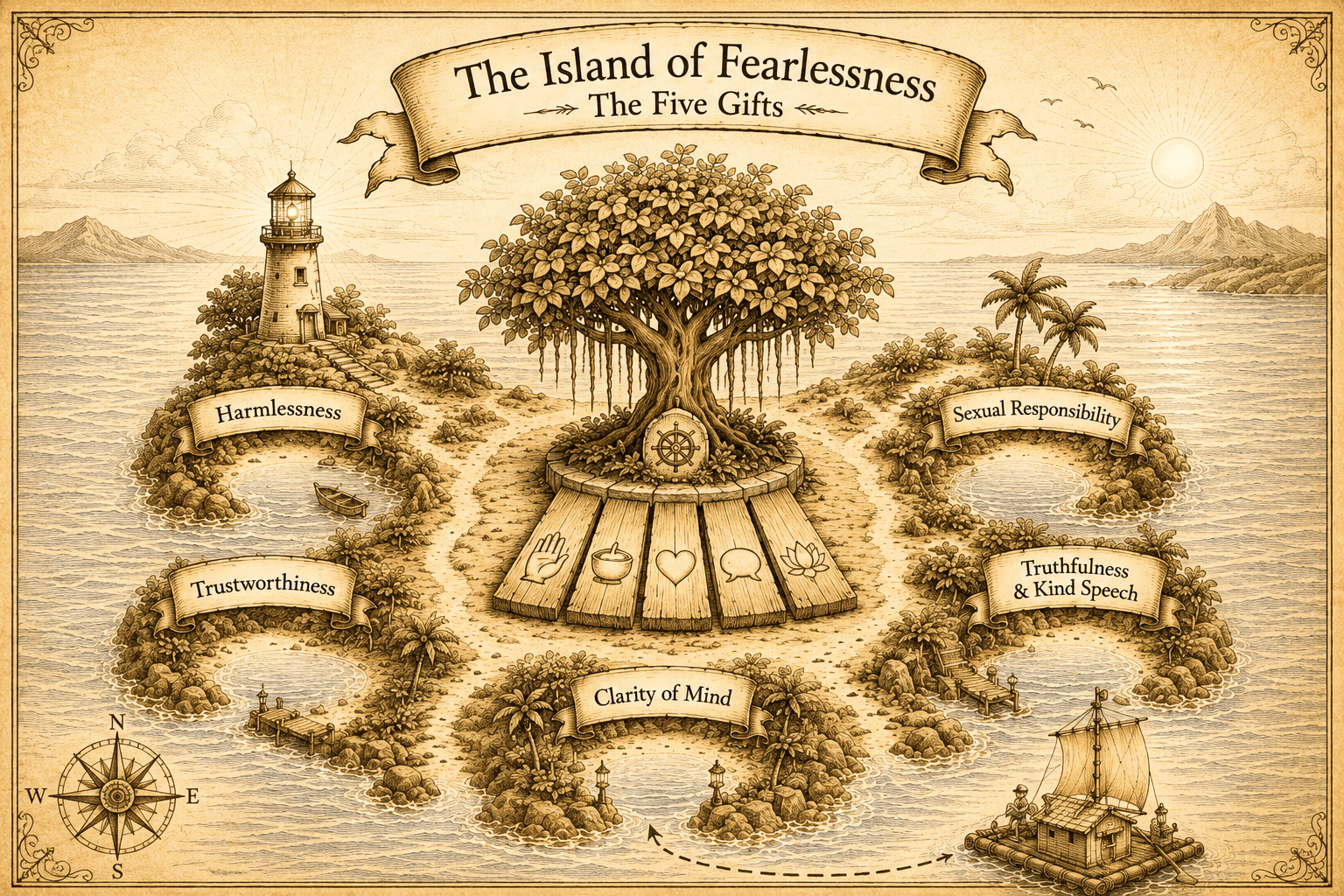
Having gathered the first materials of our raft through generosity, we now lay down its foundational planks. Before we look closely at our human suffering and the specifics of our own compulsions and destructive patterns of behaviour, it helps enormously to establish a baseline commitment to harmlessness. This commitment, embodied in what Buddhism calls the five precepts, is not about imposing rigid rules. It is about cultivating awareness of how our actions affect ourselves and others, and consciously choosing to minimise harm. This ethical awareness forms the very foundation of our RAFT to Freedom. In many ways, these Five Gifts can be considered an original harm-reduction programme.
If the foundational planks of our raft – the base upon which everything else rests – are weak and rotten, our vessel will leak and will not be seaworthy. This holds no matter how skilfully we gather other materials like mindfulness or wisdom. Committing to harmlessness, through the spirit of Gotama’s Five Gifts, ensures that we are building a watertight raft.
Universal guidelines for harmony: ancient wisdom
Gotama’s Five Gifts, as guidelines for ethical living, are not exclusively Buddhist but reflect a timeless, universal understanding of how humans could live together more peacefully. Long before Gotama was born, early legal codes addressed themes that societies still grapple with today: violence, theft, sexual impropriety, untruthfulness, and the disruption caused by intoxication (Ur-Nammu Code and Hammurabi Code).
These ancient codes aimed to establish frameworks that would prevent disputes and conflict. They recognised that certain actions reliably cause harm and undermine social stability. So when Gotama proposed the Five Gifts, he was not creating an entirely new concept – he was drawing on an ancient and traditional understanding of what helps promote social order and reduce suffering.
Beyond law: the five great gifts
Gotama, however, framed these guidelines very differently from the established legal codes of his time. Laws had typically focused on external rules, obligations and punishments, but around two thousand six hundred years ago Gotama presented the five precepts as profound, personal gifts.
Why did Gotama describe these precepts as gifts? Because when we sincerely undertake them, we are offering the gifts of fearlessness and harmlessness unconditionally to all beings, including ourselves. In each of these five fundamental areas where harm is so often caused, we are essentially saying: you have nothing to fear from me. It is our commitment to acting with awareness and care that fosters trust, safety and connection – qualities so often damaged by our destructive compulsions and behaviours. They are essential for healing, and when we offer these gifts, it is an act of profound kindness and generosity.
Practice
Setting the five intentions
These Five Gifts are best understood as training guidelines, or personal intentions, rather than rigid commandments demanding impossible perfection. The path from suffering to freedom is one of learning and growth, and we are all imperfect human beings – so we frame these gifts as conscious intentions:
- I set the intention not to harm myself or others by my thoughts, my words or my actions.
- I set the intention not to take anything that has not been freely given.
- I set the intention not to harm myself or others by my sexual and sensual misconduct.
- I set the intention not to harm myself or others by false speech, harsh speech, gossip and slander.
- I set the intention to refrain from taking alcohol and other drugs that impair my mindfulness.
Framing the gifts this way means we are setting a caring, ethical course – cultivating an aspiration of harmlessness, and focusing on positive intention rather than prohibition. When we inevitably fall short, as all humans do, this framing encourages self-compassion and a renewal of commitment, rather than the shame and self-condemnation that can send us falling overboard back into old, harmful patterns.
Let’s look briefly at each intention:
- Harmlessness: committing to refrain from killing, or from intentionally causing physical or deep emotional harm. This is the bedrock of ethical conduct.
- Trustworthiness: committing to refrain from taking what is not ours, respecting others’ property and boundaries. This builds integrity.
- Sexual responsibility: committing to refrain from sexual actions that cause harm to ourselves or others – for example, exploitation, adultery, or actions that break trust. This fosters respect and care in relationships.
- Truthfulness and kind speech: committing to refrain from lying, harsh words, divisive gossip and slander. This promotes clear communication and connection.
- Clarity of mind: committing to refrain from consuming intoxicants – alcohol and other drugs not specifically prescribed by a doctor – to the point of carelessness or loss of mindfulness. This gift is especially crucial on this journey, whatever our own most destructive compulsive patterns have been: intoxication directly clouds the awareness we need to uphold the other gifts and meet the challenges of life skilfully. It undermines our ability to navigate our raft effectively.
By setting these intentions, we proactively reduce the amount of harm we cause, lessening our future need to grapple with guilt and self-forgiveness, and the need to seek forgiveness from others. These categories of harm – violence, betrayal, dishonesty and so on – are so universal that they also form the basis for other practices, such as forgiveness meditation. Committing to the gifts is preventive medicine for the heart and for our relationships; it is a fundamental way of practising kindness – offering safety to others, and fostering self-respect within ourselves.
Self-reflections
Take a few moments for honest self-inquiry:

- How does viewing the precepts as personal gifts, rather than imposed rules, change my relationship with them? (view card)
- Which of the Five Gifts feels most challenging or most relevant for me right now? (view card)
- How has my relationship with substances or other distractions affected my ability to uphold the other ethical commitments? (view card)
- Can I identify ways that adopting these intentions might support my emotional well-being and personal integrity? (view card)
- When my intentions aren’t upheld, is my instinct self-compassion and renewal, or shame and self-condemnation? What might it feel like to choose the former? (view card)
- What would it mean for those closest to me to feel, in my presence, that they have nothing to fear from me? Where does this already feel true, and where is there room to grow? (view card)
- Which of the five intentions, if held more closely, would most reduce my need for future repair or forgiveness in my relationships? (view card)
Journaling prompts
- Reflecting on intentions: Choose one intention that resonates strongly or poses challenges. Observe how you navigate related situations, and journal about your experiences, challenges and insights.
- The gift of safety: Reflect on how living with harmlessness might reduce fear, anxiety and conflict in your life and relationships.
- Historical harm, present intention: Identify a past action causing harm aligned with one of the gifts. Without dwelling on guilt, reflect on how adopting the intention now might lead to a different outcome.
- Clarity and ethics: Explore the direct connection between clarity of mind (avoiding intoxicants) and your ability to act ethically in daily situations.
- Gifts, not rules: Rewrite one of the Five Gifts in your own words, as a personal intention rather than a rule. What shifts when you frame it this way?
- The watertight raft: Which of the five planks (Five Gifts) feels least steady in your own life right now? What would strengthening it look like this week?
- Falling short, beginning again: Write about a recent time an intention wasn’t kept. Rather than dwelling on the lapse, write about what renewing the commitment might look like today.
Supporting material: ancient wisdom and modern relevance
For those interested in the science and philosophy behind this practice, here is a brief overview:
- Neuroscience: While ethics is complex, neuroscience suggests that practices which promote empathy, compassion and impulse control – all related to the precepts – involve, and can strengthen, specific brain circuits, particularly in the prefrontal cortex (involved in decision-making and social cognition) and in areas related to understanding others’ states (the mirror-neuron system, the insula). Committing to the precepts can be viewed as a cognitive training exercise that strengthens self-regulation and value-based decision-making.
- Psychology & Psychotherapy: Modern psychology supports the importance of ethical conduct for mental health. Living in accordance with our values is thought to reduce cognitive dissonance, guilt and shame, while increasing self-esteem and self-respect. Prosocial behaviour – acting for others’ benefit, including non-harming – has been associated with greater happiness and stronger social connections. Rebuilding integrity and trustworthiness after old patterns of harm is a key psychological task that committing to the precepts directly supports; the precepts act as guidelines that help strengthen volitional behaviour aligned with deeper values.
- Philosophy: The five precepts resonate strongly with various ethical philosophies. They embody the principle of non-maleficence (do no harm), a cornerstone of medical and general ethics. They align with virtue ethics, which focuses on cultivating good character – truthful, responsible, non-violent – rather than simply following rules. They also offer a practical ethical framework for creating the conditions for a flourishing life (eudaimonia), on the view that inner peace and social harmony are difficult to sustain amid ongoing harmful action. The parallels with ancient legal codes such as the Ur-Nammu and Hammurabi codes point to the timeless and universal nature of these ethical concerns, and to how long societies have recognised that regulating behaviour around violence, property, sex, speech and social order is fundamental to collective well-being.
Remember to remember
The five precepts, understood as personal intentions and gifts of harmlessness, form the essential ethical foundation for our RAFT to Freedom. They are the sturdy planks upon which we build our vessel. By committing to minimise harm in these five key areas, we create safety for ourselves and others, cultivate self-respect, and establish the stability needed for the deeper work ahead.
This commitment is not about achieving instant perfection, but about setting a clear, compassionate direction. Hold these intentions sincerely, and simply begin again whenever we fall short: each renewed commitment is itself a small act of freedom – freedom from conflict, blame, guilt, shame, agitation, discomfort, regret, debt, and freedom from hangovers!
We do good because it frees the heart. It opens us to a wellspring of happiness.
Sharon Salzberg, Lovingkindness: The Revolutionary Art of Happiness (Shambhala, 1995)
With these planks laid, our raft is taking shape. Next, we turn to Māra, I Know You, and to the currents of craving our foundation now helps us meet.
Sutta references
See the Index of sutta references
Please note that ideas and concepts may evolve over time as the project develops.