Setting out – Before we begin
A map to navigate our journey: introducing the RAFT framework
Suppose there was a person traveling along the road. They’d see a large deluge, whose near shore was dubious and perilous, while the far shore was a sanctuary free of peril. But there was no ferryboat or bridge for crossing over. They’d think, ‘Why don’t I gather grass, sticks, branches, and leaves and make a raft? Riding on the raft, and paddling with my hands and feet, I can safely reach the far shore.’
Gotama, Alagaddūpama Sutta (the raft simile), MN 22, translated by Bhikkhu Sujato
Welcome to the RAFT
Opening this workbook and embarking on the journey towards freedom from our human struggles with pain, difficulties and disappointments is a profound act of courage. It means facing down our destructive patterns of escape and self-sabotage. The RAFT to Freedom programme and workbook offer us compassionate, comprehensive guidance by blending ancient Buddhist wisdom with insights from modern sciences. Whether you seek to transform deeply ingrained patterns or simply cultivate greater peace and clarity in daily life, this workbook is designed for you.
This workbook explores a wide range of tools, skills, perspectives, attitudes, and actions that are recognised as being helpful in contemporary approaches to health and well-being. We don’t need a diagnosis, a label, or to identify as Buddhist to benefit from this programme. All that’s required is an open, caringly curious mind.
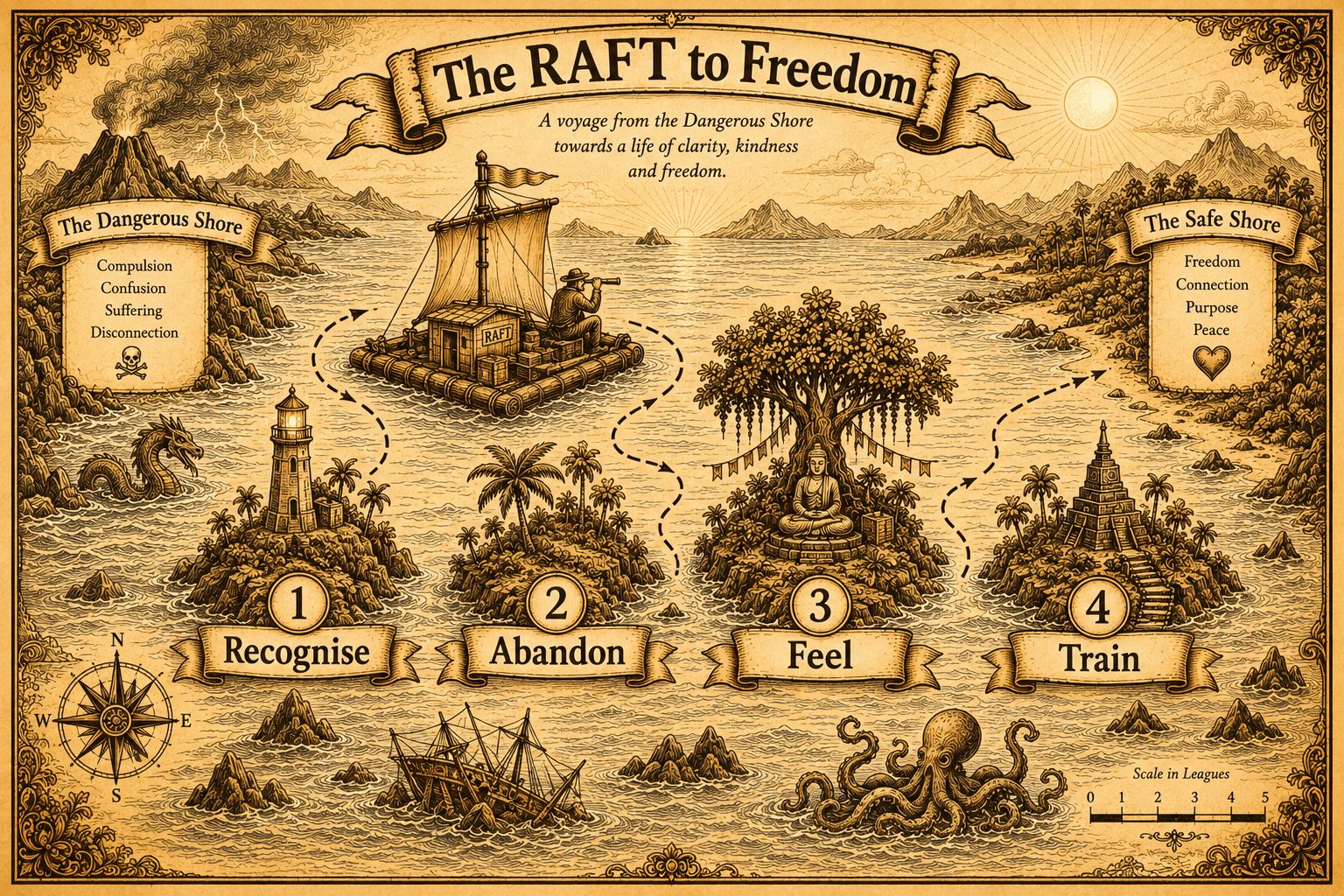
The core aim of the path taught by Gotama (the Buddha) is to overcome greed, hatred and delusion and find freedom. To put it another way, it is to be released from craving, aversion and confusion. In the language of this workbook, that whole movement is held in four tasks: Recognise the pain, Abandon the craving, Feel the resulting freedom, Train the body-mind.
This workbook offers shared practice and community, not treatment. If you are in significant distress or managing a mental-health condition, please also seek the support of a qualified professional. See Setting out with the workbook for the fuller note on support.
Gotama’s four realisations
In his first talk after awakening to life as it really is, Gotama presented four vital realisations. They are the doctrinal spine of this whole workbook, so it is worth sitting with them fully here, once, before we meet them again throughout the chapters ahead.
- Recognise what it is to be human. Life is sometimes naturally painful, difficult, and disappointing: we often do not get what we want, yet frequently encounter what we don’t want. Gotama encouraged us to see this clearly and understand it deeply. This is universal, not personal – we are all in the same boat.
- Abandon our blind obedience to the evolutionary drives to protect, promote, and satisfy, which manifest as habitual cravings, compulsions, aversions, and preferences. Gotama urged us to abandon these destructive inclinations – not through force or suppression, but through compassionate understanding and skilful letting go.
- Feel the resulting freedom. We sense the space, ease, clarity, connection, calm, and freedom that open as the pull of craving, aversion, or compulsion begins to soften – the hush, the lightness, the still point. Gotama insisted that we can personally experience this liberation by actively cultivating moments of clarity, peace, and non-reactivity.
- Train with wisdom. Gotama provided a structured programme – the Middle Way Programme – that integrates wisdom, ethical conduct, and mental discipline into our daily lives. Through ongoing training, we develop equanimity and resilience, steering ourselves consistently towards freedom.
The RAFT metaphor: from the dangerous shore to the safe shore
Gotama described our experience of craving and confusion as a ‘dangerous shore’, fraught with suffering and risk. Yet he also pointed towards a ‘safe shore’ of liberation – characterised by peace, clarity, and profound well-being. The crossing is not a journey to a different place. The dangerous shore and the safe shore are both here, in this same life. They are states of heart and mind, not destinations on a map.
How do we make this crossing? We build a raft – skilfully constructed from the materials available to us. Each of us is simultaneously captain, navigator, and crew, responsible for safely steering our raft across challenging waters.
Key components of our raft
- Planks (ethical foundations): Commitment to harmlessness, guided by the Five Gifts (precepts), ensures a solid and stable foundation.
- Binding ropes (Heart Practices): Compassion, Befriending, Appreciative Joy, and Resilient Equanimity – cultivated as self-compassion, self-love, self-appreciation, and self-balance – bind our raft firmly together.
- Sails (the four stages of our journey): Recognise, Abandon, Feel, Train – each accomplished stage adds strength to our sails, catching wholesome winds that propel us forward.
- Keel and ballast: Running low and steady through the vessel, Collectedness (samadhi) keeps it upright and tracking true even in rough water.
- Four bearings: The Four Resolves of Prevent, Abandon, Cultivate, and Maintain are the bearings that precisely direct our efforts towards freedom.
- Engine: The Four Creative Powers of Noble Desire, Courageous Energy, the Heart’s Compass, and Fearless Investigation provide motivation, energy, and intelligent navigation.
- Tools and reinforcements: The Five Defenders of Confidence, Courageous Effort, Healing Mindfulness, a Gathered Mind, and Discernment equip us to navigate life’s storms.
- Anchors: The Four Foundations of Mindfulness; Mindfulness of Body, Hedonic Tone, Mind, and Principles that help us see clearly and steady us, keeping our raft secure amid turbulent waters.
- Outriggers: The Seven Supports (Factors of Awakening) of Liberating Mindfulness, Penetrating Inquiry, Enthusiasm, Energising Joy, Deep Calm, a Unified Mind, and Balancing Equanimity – these arise as our practice matures, and are themselves the signs of a mind moving towards liberation.
The RAFT in action
- R – Recognise: We begin by honestly recognising the situation we find ourselves in – understanding both life’s inherent difficulties and the particular pain caused by our own patterns of escape and self-sabotage. We survey the dangerous shoreline and gather the materials we will need for the journey ahead.
- A – Abandon: We learn to abandon the primary cause of our suffering: craving. This means understanding how craving fuels compulsive and reactive behaviour, and developing the inner strengths of the Five Defenders.
- F – Feel: We turn towards our destination, actively familiarising ourselves with the direct experience of freedom. We learn to notice, appreciate, and stabilise moments of peace, non-craving, and clarity – to pause, linger, and savour – cultivating The Seven Supports, the signs of a mind moving towards liberation.
- T – Train: Finally, we commit to training body, heart, and mind by adopting Gotama’s Middle Way Programme, a structured programme in the service of well-being. Other such programmes exist – see the Navigational Aids for the Voyage page. It can help to explore which programme feels most comfortable and beneficial for you personally. In RAFT to Freedom, we draw on early Buddhist teachings that integrate wisdom, ethical conduct, and mental discipline – Gotama’s Middle Way as a path that leads reliably to a safe shore.
Many rafts
No two rafts are built the same way, and none is built from this workbook alone. RAFT to Freedom is a raft in Gotama’s own sense – a provisional means, used and then put down, as described in Conclusion: Moving from Surviving to Thriving. It is not a permanent identity, or a total system that replaces other help. The RAFT is one support in a much wider crossing. Other supports may include therapy, medication, sport, healthy eating, meditation, book clubs, Sangha, and family. All honoured in their own right rather than folded into the raft’s own parts. If you are already receiving support elsewhere, keep it; this workbook sits alongside your existing resources, not instead of them.
How to engage with this workbook
Throughout this workbook, we explore and cultivate various mindfulness based practices. We will also draw explicitly from modern therapeutic models.
Each chapter introduces a key concept, practical exercises, self-reflection questions, journaling prompts, and optional supporting materials from neuroscience, psychology, psychotherapy and philosophy. We invite you to engage actively, perhaps using a journal, and encourage honesty, patience, and kindness towards yourself throughout the process.
We warmly encourage participation in our RAFT to Freedom community through regular online meetings and practices. Please visit raft2freedom.org for details. New participants are always welcome at our Zoom meetings, where each week we explore a new practice together. You could also study this workbook alone, in your own time and at your own pace, but we do encourage you to meet with others, either online or in person.
Self-reflections
Before turning the page to begin this journey, take a few moments to reflect quietly.

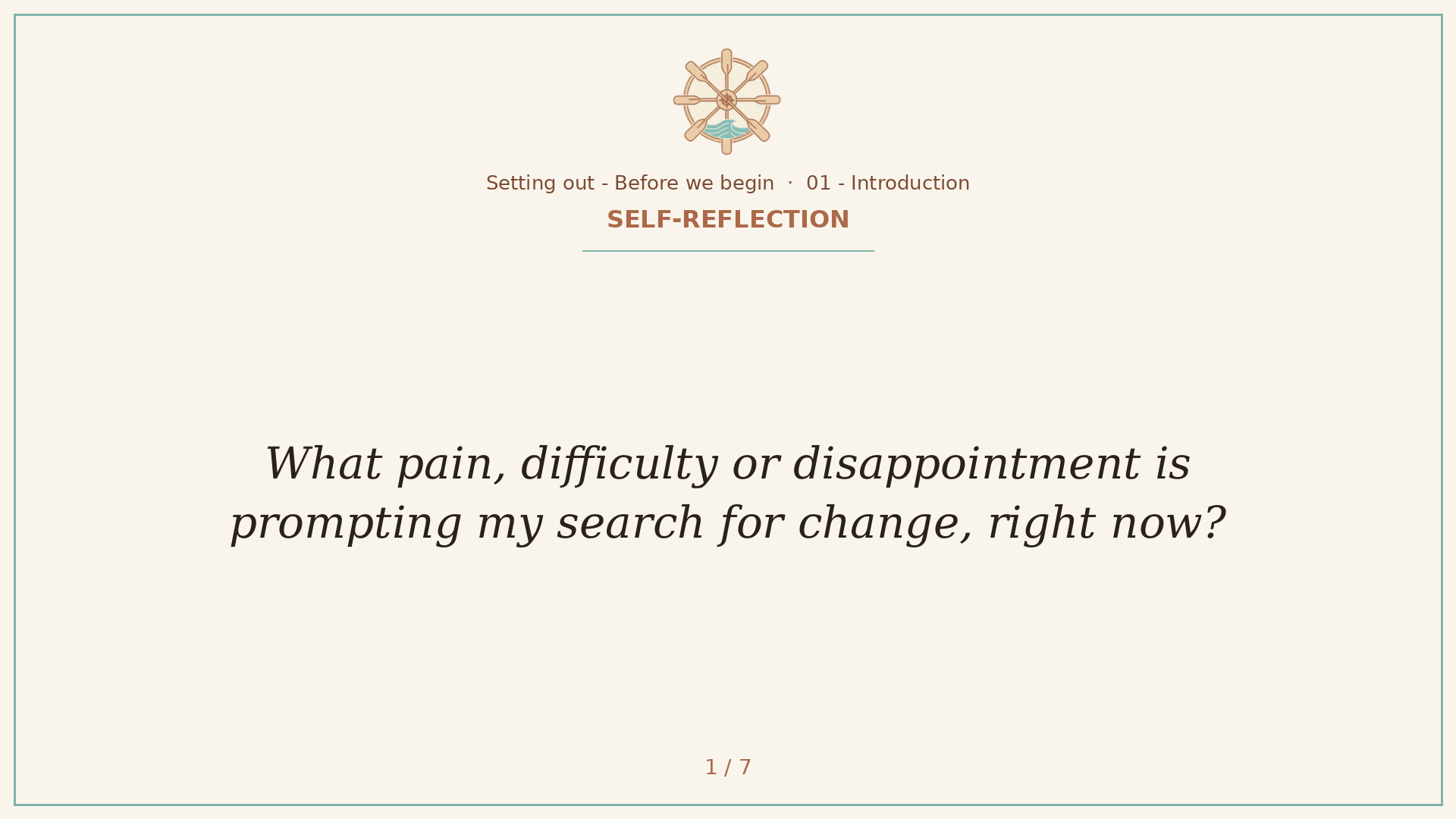
- What pain, difficulty or disappointment is prompting my search for change, right now? (view card)
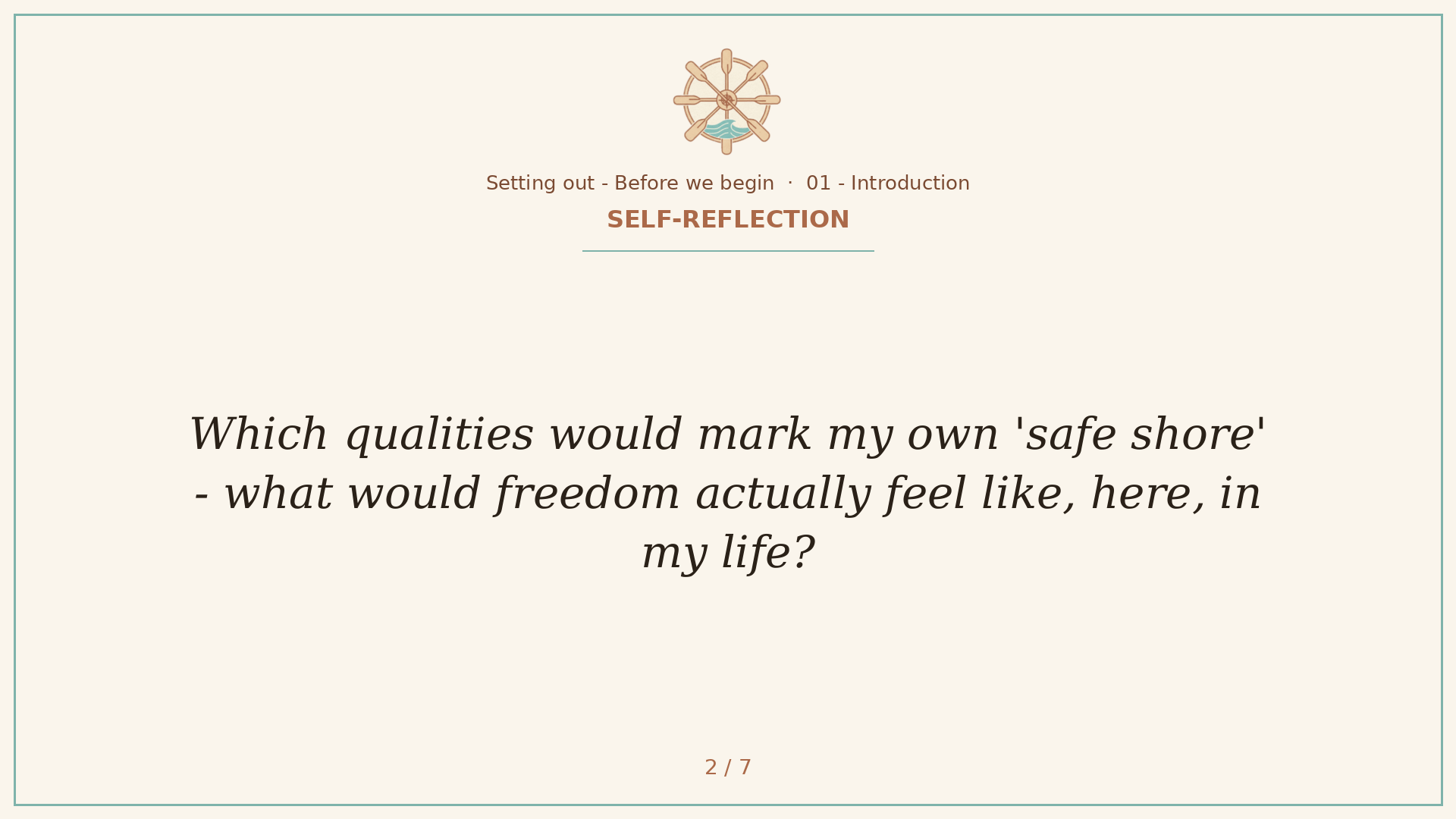
- Which qualities would mark my own ‘safe shore’ – what would freedom actually feel like, here, in my life? (view card)
- What strengths do I already have for building this raft, and which existing supports – people, practices, and professionals – are already keeping me afloat? (view card)
- What is my deeper motivation for undertaking this crossing – what makes it worth the effort to me? (view card)
- What expectations, doubts, or preconceptions might I need to set aside so I can approach this crossing with an open, caringly curious mind? (view card)
- Who might form part of my crew – which wise friends or community could share my journey? (view card)
- What might help me stay with this journey when enthusiasm fades, life gets busy, or the work feels difficult? (view card)
Journaling prompts – charting our course
Spend some time with a journal.
- The dangerous shore: describe, with compassion, your present struggles with pain, difficulties and disappointments.
- The safe shore: picture clearly what a safe shore means to you.
- An inventory of resources: list the inner strengths, outer supports, and helpful practices already available to you – the other supports already carrying you.
- Preparing for the crossing: what conditions would help you make space for this journey – perhaps time, place, routine, community, boundaries, or practical support?
- Naming the pull: what recurring harmful pattern most often sets you off course?
- Laying down the burden: What unnecessary weight or old storyline are you ready to leave behind on the dangerous shore as you step aboard your raft?
- Setting the intention: write down your core intentions for engaging fully with the crossing ahead.
Blending ancient wisdom with modern understanding
While the core framework is rooted in timeless Buddhist principles, we enhance our understanding by weaving in supportive insights from four fields.
- Neuroscience: understanding how the drives to protect, promote and satisfy affect the brain, and how practices like mindfulness are thought to support neuroplasticity, helping rewire pathways towards health.
- Psychology (including evolutionary psychology): gaining insights into behaviour change, emotional regulation, the healing of trauma, motivation, and the roots of our drives.
- Psychotherapy: drawing on insight from therapeutic approaches such as Acceptance and Commitment Therapy (ACT), Dialectical Behaviour Therapy (DBT), Compassion-Focused Therapy (CFT) and so forth – these approaches to acceptance, values-based action, and self-compassion inform this workbook without being what it provides in itself.
- Philosophy: exploring questions of ethics, meaning, purpose, and the nature of a well-lived life.
This integrated approach aims to make the path practical, relatable, and deeply empowering.
Remember to remember
RAFT to Freedom provides a structured yet flexible approach, integrating ancient wisdom with modern sciences to guide our individual journeys from pain, difficulties and disappointments towards lasting freedom. We don’t need a diagnosis, a label, nor be a Buddhist, to benefit from this programme. We just come as we are.
Embarking on the path of liberation is a profound act of courage and self-care. RAFT offers a reliable structure, integrating ancient wisdom with a modern understanding to guide our way. Trusting in our capacity to learn, grow, and heal, patiently and persistently.
For me, there is no happiness without freedom, and freedom is not given to us by anyone; we have to cultivate it ourselves.
Thich Nhat Hanh, Be Free Where You Are (Parallax Press)
Our courageous journey begins now – welcome aboard. Next, we look honestly at Gotama’s own life of plenty and disenchantment, and at what his story reveals about the challenges we all share.
Sutta references
See the Index of sutta references
Please note that ideas and concepts may evolve over time as the project develops.