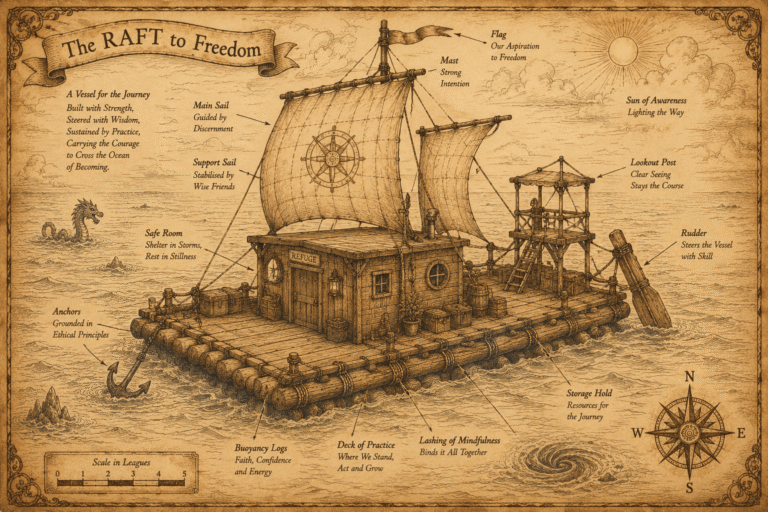
Our voyage towards greater freedom
RAFT to Freedom is a practical framework for anyone who finds themselves caught in harmful cravings, aversions, compulsive habits, difficult emotions, or patterns of behaviour that bring suffering.
It is for people who may be struggling with a particular compulsion, but it is not limited to addiction or recovery. Many of us know what it is to reach for relief in ways that do not help, to avoid what feels difficult, to become caught in old habits, or to lose touch with the life we want to live.
RAFT offers a way of exploring these experiences with greater clarity, kindness, courage, and care. It helps us recognise how we become caught, loosen the patterns that cause harm, feel the moments of space and freedom that become possible, and train ways of living that support greater steadiness and well-being.
The programme draws on the insights of Gotama, the man later known as the Buddha, alongside perspectives from neuroscience, psychology, and philosophy. No particular belief system is required, and no previous knowledge of Buddhism is assumed. The starting point is simply ordinary human experience and the possibility that things can be met differently.
From the dangerous shore towards freedom
Gotama often used the image of crossing a river to describe the movement from suffering towards freedom.
On one shore are the conditions in which we can feel caught: craving, aversion, confusion, difficult emotions, and habits that leave us feeling narrowed or disconnected. On the other is the possibility of greater ease, clarity, balance, connection, and well-being — qualities that can be sensed and felt, even in small moments, as the pull of reactivity begins to soften.
The image is not about escaping from life. It is about learning how to navigate life more wisely.
RAFT to Freedom uses the metaphor of building and steering a raft. The raft is not something separate from us. It is made from the capacities, practices, relationships, and qualities that can help us make the crossing.
What does RAFT mean?
RAFT is a framework with four connected movements: Recognise, Abandon, Feel, and Train.
They are not rigid stages to complete perfectly. They are ways of seeing what is happening, loosening what causes harm, sensing the freedom that becomes available when reactivity softens, and training a wiser way of living.
- Recognise: Seeing more clearly what is happening in the body, heart, and mind. This includes recognising the patterns that bring pain, as well as the conditions that support greater honesty, stability, and care.
- Abandon: Learning how to become less entangled in cravings, aversions, compulsive habits, and behaviours that add to harm. This is not about rejecting ourselves. It is about gently loosening what no longer serves us.
- Feel: Sensing the space, ease, clarity, connection, calm, or freedom that can be felt when the pull of craving, aversion, or compulsion begins to soften.
- Train: Developing the understanding, practices, and ways of living that support a freer, wiser, and more caring life.
Together, these movements offer a practical path from being caught in harmful patterns towards a life with more choice, steadiness, and well-being.
A short introduction to RAFT to Freedom
Created using AI-assisted video tools
Building our raft
The raft is built from many connected qualities and practices.
Its foundation is ethical commitment: learning to live in ways that reduce harm and support trust, generosity, and care.
Its ropes are the heart qualities of compassion, kindness, appreciative joy, and balance. These help us meet both ourselves and others with greater resilience.
Its anchors are the foundations of mindfulness, which can steady us when life becomes turbulent.
Its compass is skilful effort: learning when to prevent, let go, cultivate, and sustain.
Its engine is the energy and confidence that allow us to keep moving, even when the journey feels difficult.
Its tools are the inner strengths that help us meet life’s challenges with courage, mindfulness, a gathered mind, discernment, and trust.
The RAFT to Freedom workbook explores these elements gradually, linking them to everyday life rather than presenting them as abstract ideas.
Ancient wisdom and modern understanding
RAFT to Freedom is rooted in secular dharma. The practical teachings of Gotama offer our central way of understanding craving, aversion, confusion, suffering, ethical living, mindfulness, and freedom.
Alongside this core, RAFT draws on modern perspectives that can illuminate the same human difficulties from different angles.
- Psychology and psychotherapy: Ideas from psychology, psychotherapy, cognitive behavioural therapy, acceptance and commitment therapy, mindfulness-based approaches, and positive psychology can offer useful ways of understanding behaviour, emotion, relationships, and change.
- Neuroscience: Contemporary research helps explain habit formation, reward systems, stress responses, attention, and the brain’s capacity to change.
- Philosophy: Ethical reflection and wisdom traditions help us consider what it means to live well, act with care, and flourish as human beings.
These modern perspectives are offered as companions rather than competing explanations. They are included where they help illuminate the practice, while RAFT remains grounded in secular dharma.
A freely offered programme
RAFT to Freedom was created by Cathryn Jacob and Vince Cullen as a freely offered practice of generosity.
The programme has been shaped by lived experience, secular dharma, psychological insight, and a shared interest in how people can move from harmful patterns towards greater freedom and well-being.
Cathryn and Vince acknowledge with gratitude the inspiration drawn from Stephen Batchelor’s work, particularly his cartography of care.
The workbook, meetings, and resources are offered freely. Contributions towards the running costs of RAFT to Freedom are welcome but never expected.
Want to know more?
You are warmly invited to explore the workbook, join an online meeting, or get in touch.
Email: contact@raft2freedom.org
[mailerlite_form form_id=2]
Created by Cathryn Jacob and Vince Cullen
RAFT to Freedom was created by Dr Cathryn Jacob and Vince Cullen as a freely offered practice of generosity. It is rooted in secular dharma and shaped by lived experience, while drawing on insights from psychology, psychotherapy, neuroscience, and philosophy where these help illuminate the practice.
Its purpose is to support people in moving from harmful patterns towards greater freedom and well-being.