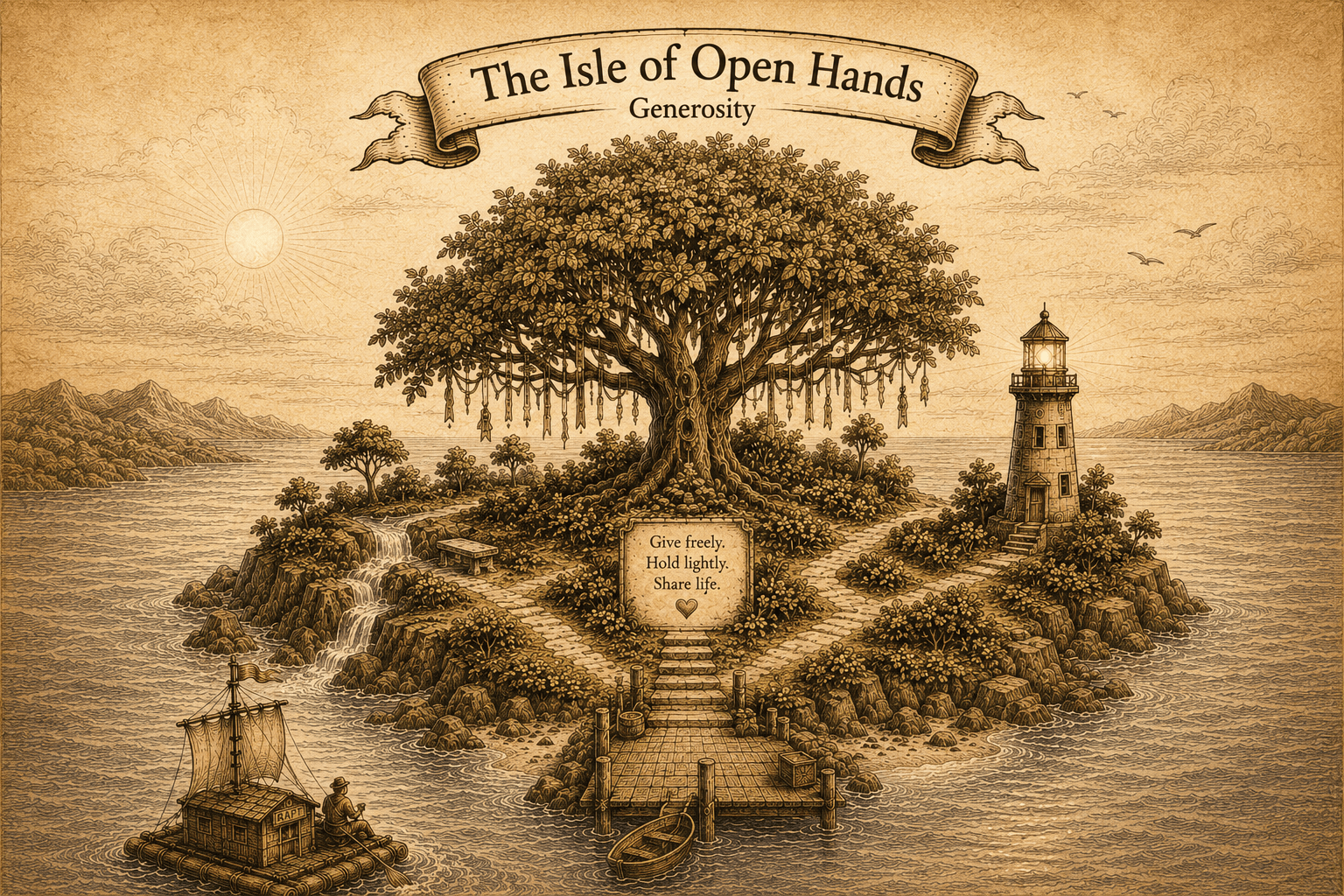
Setting out – Before we begin
If beings knew, as I know, the results of giving and sharing, they would not eat without having given, nor would the stain of miserliness overcome their minds.
Gotama (the Buddha), Dāna Sutta (Iti 26)

Episode 3 – Dana – the gift of generosity
An AI-generated ‘deep dive’ into this aspect of the RAFT to Freedom
Gathering the first materials with open-heartedness
With our journey now begun – surveying the dangerous shore of suffering and disappointment – we now lay our hands upon the first, essential materials for building our vessel to freedom. At the very heart of this process is generosity (dana), which the early Buddhist tradition regards as a powerful, foundational attitude for our journey to freedom.
This practice invites us to begin building our raft with one of the oldest and most powerful practices in the Buddhist tradition: generosity. This is not merely about giving things away – it is about cultivating an open-hearted way of being that supports both personal healing and community connection.
Generosity extends far beyond the simple act of our giving away material possessions. It expresses a profound generosity of heart and mind – the deliberate antidote to the tightness, anxiety, and self-contraction that arise alongside our suffering and our human struggle with craving, grasping, and reactivity. Generosity, in this sense, is the opening of our hands, heart, and mind to life itself.
When we intentionally cultivate generosity, we are beginning to gather the initial materials needed to build our raft. With each act of generosity – whether it be a smile, a small kindness to a friend, an hour spent listening to someone in need, or a moment of patience with ourselves – we begin binding the pieces of our vessel together. These are the ropes of the Appropriate Responses: compassion, friendliness, appreciative joy, and equanimity (self-compassion, self-love, self-appreciation and self-balance).
When we practise generosity, we naturally foster gratitude and contentment. In Buddhist psychology, these qualities directly counteract our sense of not enough – the root of our harmful cravings and repetitive, self-defeating habits. As one teacher has put it, generosity is the antidote to today’s pervading sense of insufficiency.
Gotama taught us that the Five Gifts of ethical living, which we turn to next, are ancient and enduring. The very act of undertaking the Five Gifts is itself a form of generosity – giving safety, non-harm, and integrity to others. Each is a moral offering. They form the first five planks of our raft – the gifts of harmlessness – by which we grant ourselves and all beings fearlessness and goodwill. Each time we act generously, we both accept the gift and offer it; the gift becomes a steady platform on our raft to support us on our onward journey.
Generosity is the open hand, freely giving joy, care, and connection; harmlessness is the steady hand, refusing to harm ourselves or others. Together, they steer our raft toward freedom.
Crucially, generosity is not limited to others; it must also be offered to ourselves. Just as a sailor tends their own vessel before setting out, we begin our practice of generosity by offering generosity to ourselves – care, forgiveness, time, and the willingness to start again. This is not selfishness – it is self-compassion: putting on our own lifejacket before helping others. In this way, generosity helps us to recognise the pain, difficulties and disappointments of life. It helps us meet our struggles and ourselves with compassion – the Appropriate Response for this initial stage on the path to liberation.
Generosity, shared with ourselves and among our community (sangha), creates the fellowship and camaraderie needed for us to venture forth towards freedom. Mutual support and generosity allow us to navigate these lonely waters together.
True generosity is available to everyone, regardless of background or circumstances. Because generosity is simply our active intention to align each of our actions, words, and thoughts with our shared purpose of healing and well-being – a conscious forward step towards the safe shore of freedom.
Practice
Cultivating generosity
Generosity is a practice, not a single act – something we build day by day, plank by plank. Below are six areas of daily life in which generosity can be cultivated, deliberately and gently.
- Self-generosity and forgiveness
- Letting go of harsh self-criticism or unrealistic standards
- Taking time to rest or nourish your body
- Setting a boundary that protects your peace and wholesome intentions
- Practising patience with yourself as you heal and grow
- Allowing yourself to feel joy without guilt
- Generosity of time and presence
- Actively listening to someone without interrupting or judging
- Offering to run errands or help with childcare for someone overwhelmed
- Volunteering with a community or service organisation
- Being fully present for a conversation, even when busy
- Writing a heartfelt note or message of support or gratitude
- Material generosity (giving possessions or resources, if you are able)
- Offering food or drink to a guest, stranger, or neighbour
- Donating to a cause aligned with your values (for example, support groups, mutual aid, spiritual centres)
- Sharing your belongings with those in need – clothing, books, tools
- Contributing to a teacher or guide
- Paying forward a coffee or meal anonymously
- Verbal and emotional generosity
- Speaking kind words – even to those who challenge you
- Offering genuine encouragement, praise, or acknowledgment
- Apologising when wrong – without defensiveness
- Sharing wisdom or skills without expecting credit
- Extending compassion to someone struggling, even silently
- Community and interpersonal generosity
- Including others
- Inviting someone new into a group or gathering
- Sharing your healing story to offer hope
- Teaching someone something you know freely
- Supporting someone’s small business or creative work
- Offering mediation or support in times of interpersonal conflict
- Spiritual and ethical generosity
- Sharing helpful teachings, or insight that supported your own path
- Offering service in community or a spiritual practice group
- Upholding the Five Gifts and values that protect others from harm
- Mentoring or being available to those new on the path
- Holding someone in silent friendliness or kind wishes during their struggle
Self-reflections
Take a few moments for honest self-inquiry, approaching these questions with a caring and curious mind:

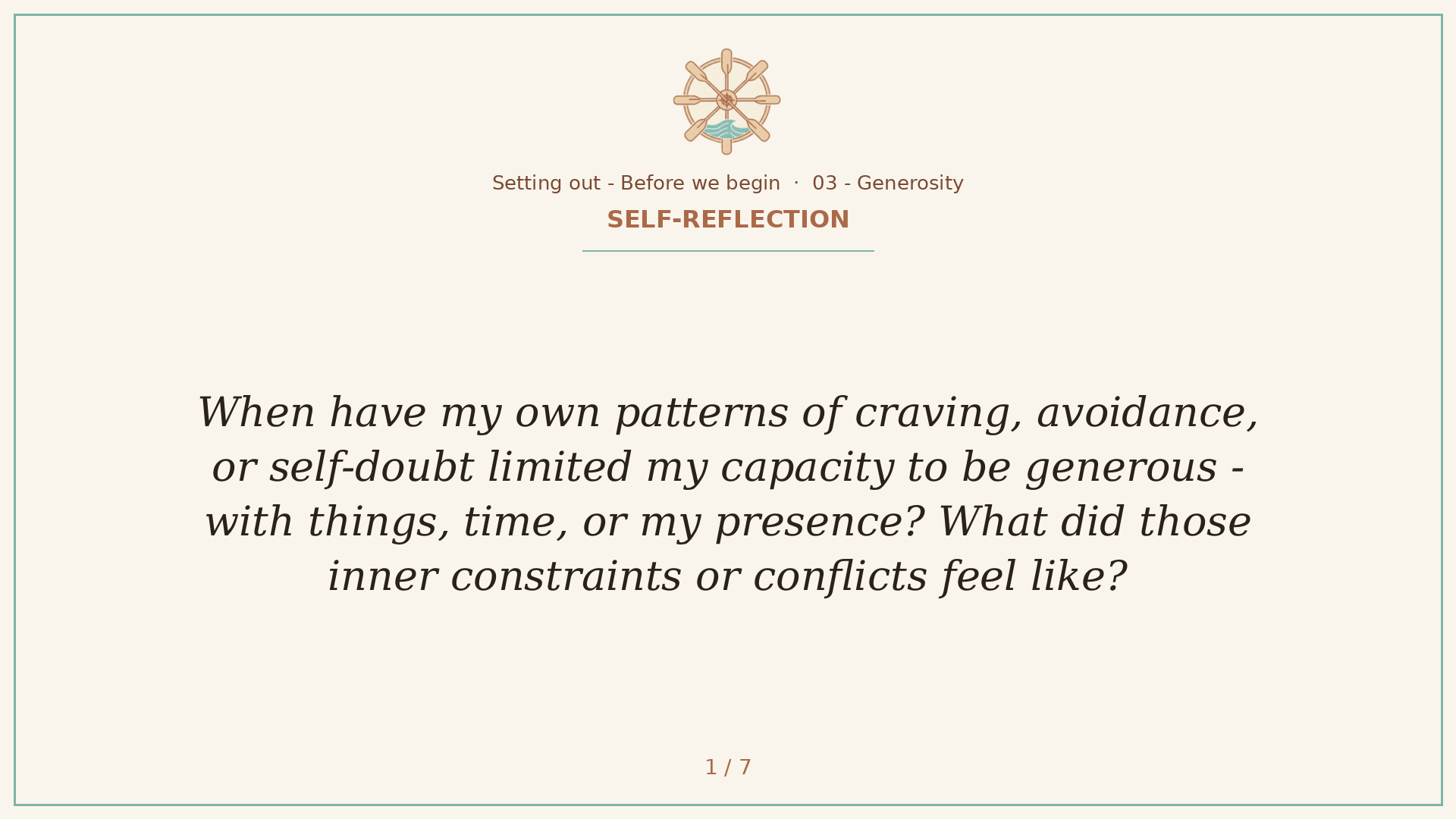
- When have my own patterns of craving, avoidance, or self-doubt limited my capacity to be generous – with things, time, or my presence? What did those inner constraints or conflicts feel like? (view card)
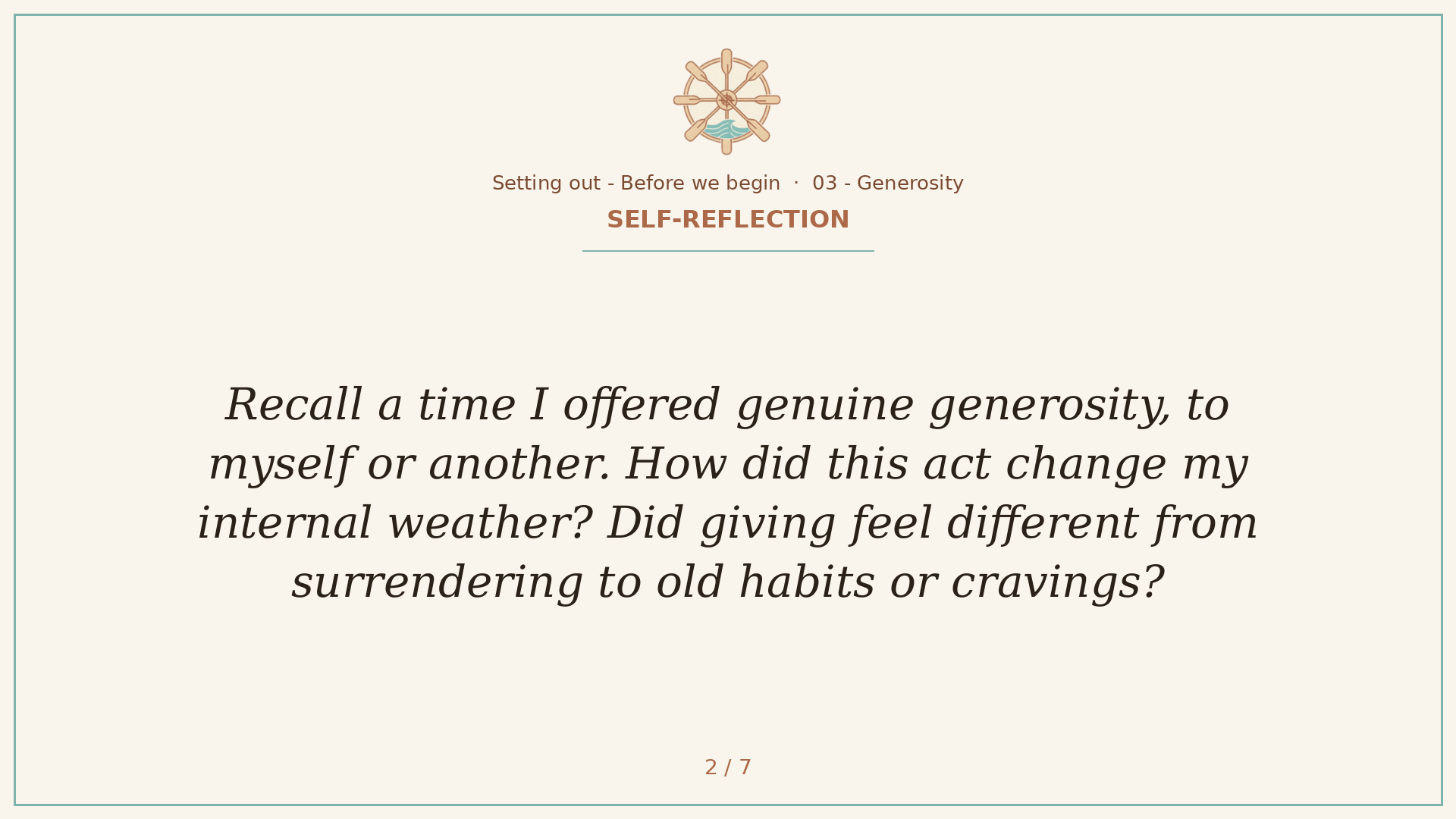
- Recall a time I offered genuine generosity, to myself or another. How did this act change my internal weather? Did giving feel different from surrendering to old habits or cravings? (view card)
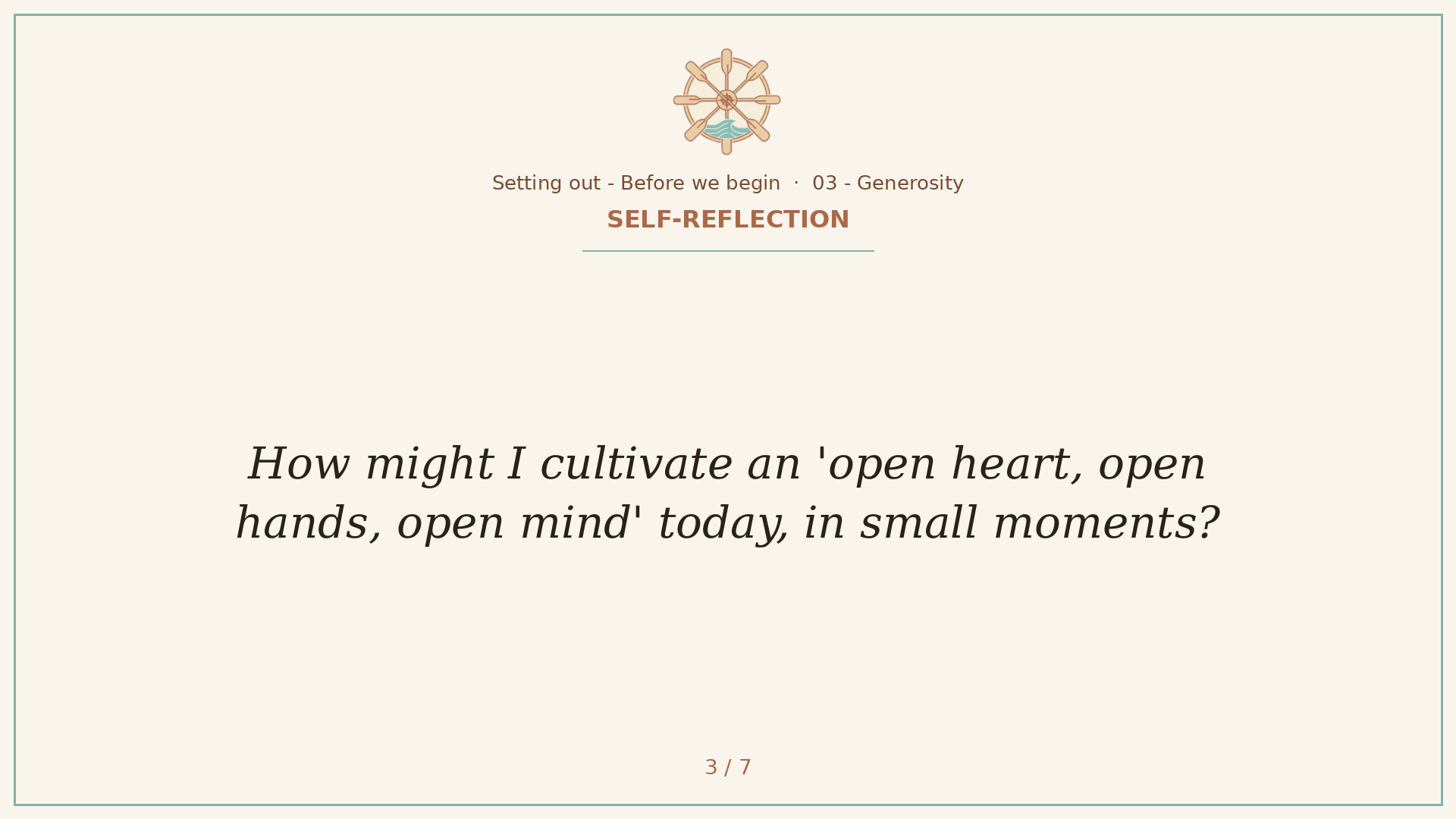
- How might I cultivate an ‘open heart, open hands, open mind’ today, in small moments? (view card)
- Pause for a moment: what plank of generosity will I lay down today? (view card)
- When has receiving generosity from someone else been difficult for me? What made it hard to accept, and what would it mean for me to receive more openly? (view card)
- What would it look like for me to extend the same generosity to myself that I offer so readily to others? (view card)
- Where does my sense of not enough show up most strongly in daily life, and how might a single act of generosity loosen its grip? (view card)
Journaling prompts
- Binding your raft: Describe your vision of lasting freedom or authentic well-being. How does practising generosity, in any form, bind your raft and carry you closer to that vision?
- What happens when you give: Write about a recent time when giving (whether material, attention, time, or care) brought you a sense of deep peace or clarity. What sensations or feelings arose?
- Self-care on the journey: What act of self-generosity today would serve as a fresh plank for your raft, steadying you for the onward journey?
- Creating connections: How might generosity, extended to others, create ropes of connection and reduce isolation? Who can you offer a gift of presence or support to today?
- The gift of presence: Write about a time someone gave you their full, undivided attention. What did that feel like? How might you offer that same gift to someone this week?
- Loosening the grip of not enough: Where does the feeling of not having, being, or doing enough show up most often? Write about one small act of giving that might loosen its hold.
- The gift you already carry: What wisdom, skill, or insight have you gained on this journey so far that could be freely shared with someone else? Write about what holds you back, and what it might mean to offer it.
Supporting material: scientific and philosophical perspectives
For those interested in the scientific and philosophical underpinnings of the practice of generosity, the following overview highlights key connections.
- Neuroscience: Neuroscience increasingly demonstrates what wisdom traditions have long known: acts of generosity do more than benefit others – they reshape our own minds. While cravings and compulsive habits may offer brief spikes of pleasure, research shows that intentional giving activates regions of the brain associated with reward, social bonding, and sustained well-being (see, for example, the studies of Moll et al., 2006, on prosocial behaviour and reward circuitry). Generosity is shown to reduce chronic stress, increase subjective happiness, and build resilience over time.
- Psychology & Psychotherapy: Research suggests that prosocial acts foster trust, cooperation, and social bonds that have supported human survival and flourishing as a species. In giving, we strengthen the very ties that hold our communities, and ourselves, together. From an evolutionary perspective, generosity is thought to play a vital role in human social life.
- Philosophy: Generosity is more than a transaction; it is the lived recognition of interdependence. Giving generates a virtuous cycle in which both giver and receiver are uplifted, helping to break old cycles of harm and isolation and supporting our aspiration for a purposeful, ethical life.
Remember to remember
Generosity (dana) lies at the heart of our journey from suffering to freedom. It is the open-handed, open-hearted practice that gathers the first materials of our raft: with every act of giving, we bind a plank with kindness and compassion, and make our vessel a little more resilient for the voyage ahead.
Generosity is the first active step from pain toward freedom, and it costs us nothing we cannot spare. Every open hand, every shared story, every small kindness to ourselves strengthens the vessel we sail in – and the more we give, the lighter the journey becomes.
Attention is the rarest and purest form of generosity.
Simone Weil, letter to Joë Bousquet, 13 April 1942 (widely published in Gravity and Grace)
Our raft is gathering its first materials – welcome aboard. Next, we turn to the Five Gifts, and to the planks we lay down to keep it afloat.
Help support the RAFT to Freedom website
RAFT to Freedom is offered freely, and there are ongoing costs involved in running the website and related online resources.
If you would like to help with these costs, you can send a contribution via PayPal here: https://paypal.me/Raft2Freedom
Contributions are currently collected through a personal PayPal account on behalf of the project, and a clear ledger of income and website-related expenses is kept.
Thank you for your support.
Sutta references
See the Index of sutta references
Please note that ideas and concepts may evolve over time as the project develops.