
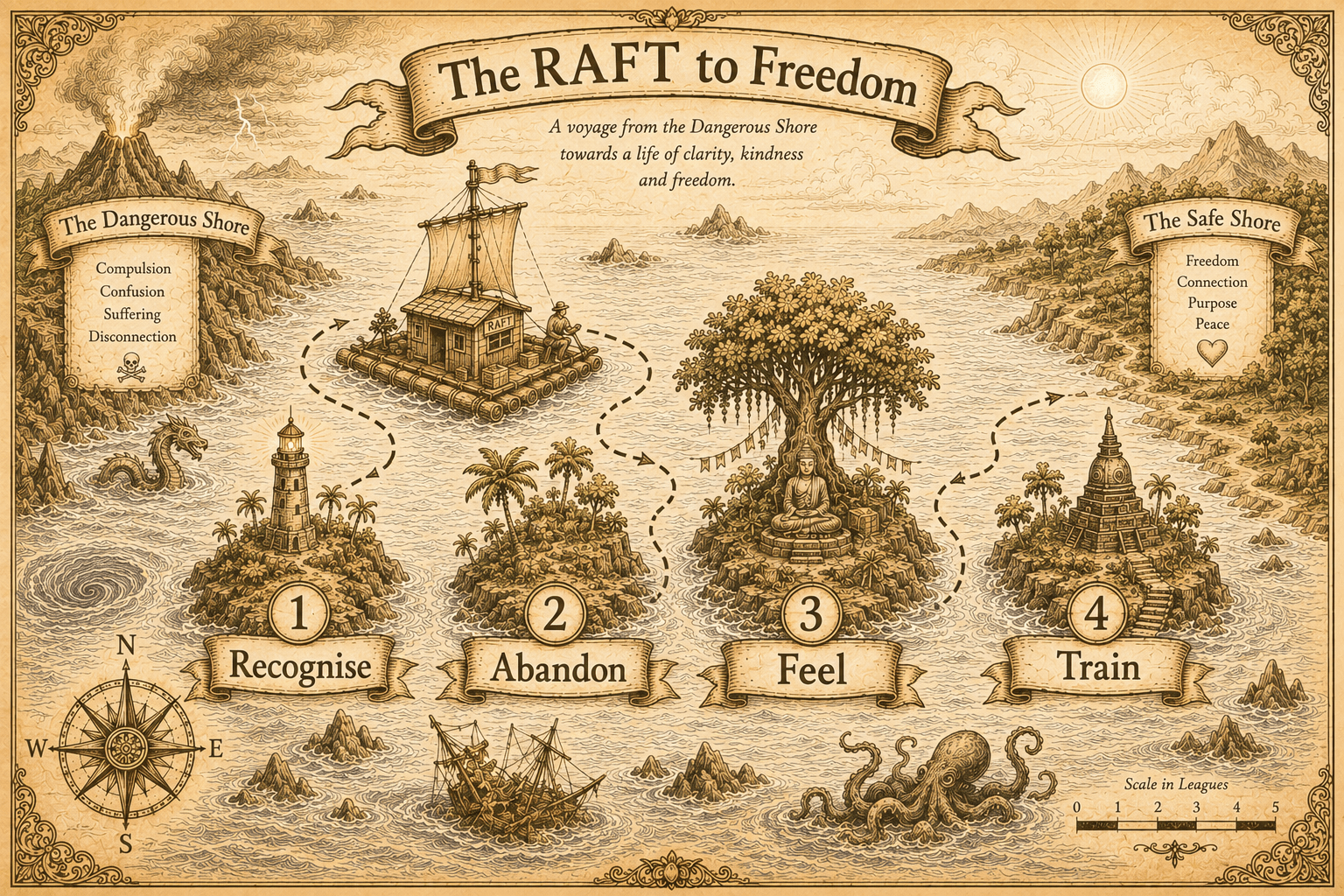
Setting out – Before we begin
No one can do it for you – you must do it for yourself.
Luangpor Charoen Panchan, Abbot of Wat Thamkrabok Monastery, Thailand
Finding your way with RAFT
Using the RAFT to Freedom workbook
This workbook is intended as a practical companion: something to read with real curiosity rather than simply take in, return to, question, write alongside, and gradually make your own.
It is rooted in secular dharma and brings in supporting insights from neuroscience, psychology, psychotherapy, and philosophy in clear, accessible language. No previous knowledge of Buddhism or any particular therapeutic approach is assumed.
Its concern is with the ordinary human experience of becoming caught: in harmful cravings, compulsions, avoidance, difficult emotions, and patterns of behaviour that can leave us feeling narrowed, disconnected, or out of step with the life we want to live.
The workbook follows the four movements of RAFT: Recognise, Abandon, Feel, and Train. These are not rigid steps to be completed perfectly or in sequence. They are strands of a continuing exploration: seeing more clearly what is happening; becoming less entangled in what causes harm; noticing moments when the pull of craving, aversion, or compulsion eases; and cultivating the conditions in which a freer, more caring way of living may become increasingly possible.
The chapters can be read from beginning to end, with each one building on what has come before. At the same time, they are designed to stand alone, offering a practice, reflection, or perspective to return to whenever it feels useful. Some sections may speak immediately; others may become meaningful only later.
A note on support Throughout this workbook we draw gratefully on insights from psychology and from evidence-based therapeutic approaches such as Acceptance and Commitment Therapy (ACT), Dialectical Behaviour Therapy (DBT), and mindfulness-based programmes. We borrow their understanding; we do not offer their treatment. RAFT to Freedom is a programme of self-directed practice and shared community – it is not psychotherapy, medical care, or a substitute for either. Some crossings call for a professional crew member aboard. If you are in significant distress, managing a mental-health condition, or navigating withdrawal that may carry medical risk, please seek the support of a qualified professional alongside – not instead of – this practice. Reaching for that help is not a failure of self-reliance; it is skilful navigation, and it can be done without shame.
Most chapters include:
- Global explanation: An introduction to the theme and the part it may play in everyday life.
- The RAFT metaphor: A connection between the topic and the shared journey from the dangerous shore towards greater freedom.
- Self-reflections: Questions that create space for pausing, noticing, and considering experience as it is.
- Journaling prompts: Suggestions for exploring a theme more personally, through writing or reflection.
- Practice: Simple invitations to bring the material into the texture of daily life.
- Supporting material: Brief perspectives from neuroscience, psychology, psychotherapy, and philosophy.
- Remember to remember: A few key ideas to carry forward.
- Sutta references: Optional pathways into the early Buddhist texts for anyone wishing to explore further.
Working with the material
The workbook is not a race to the final page. Its value may lie as much in the pauses it creates as in the material it contains: moments of noticing, reflection, recognition, and perhaps a slightly different response.
- A journal may be useful: It need not be formal or polished. A few words, a list, a sketch, or a quiet moment with a question can sometimes be enough. The self-reflections and journaling prompts are simply places where experience can be met with a little more attention.
- Honesty can be gentle: Difficult patterns often become easier to understand when they are approached with interest rather than blame. An old habit, a hard day, or a moment of being caught does not necessarily mean that anything has gone wrong. It may simply bring something into view.
- Progress, not perfection: This is a practice of steady, sustainable effort, not an all-or-nothing test to pass or fail. Setbacks are opportunities to learn something, not reasons for self-blame – the work is an ongoing process of gradually waking up to what’s possible, not a rigid standard to meet.
- There is no single pace: Some chapters may invite close attention, while others may be skimmed, set aside, or returned to later. Repetition is not necessarily going backwards. Sometimes an insight needs time before it finds a place in everyday life.
- The middle way may be a helpful companion: There can be times to stay with a question and times to let it rest; times to explore more deeply and times simply to pause – like tuning a lute string, neither too tight nor too loose. The work need not be forced, but nor does it have to be abandoned when it becomes difficult.
- Practices can remain flexible: Not every reflection or exercise will feel right at every time. Something that feels too much can be softened, adapted, postponed, or left aside. The workbook is intended to support well-being, not to become another demand.
- Nothing needs to be mastered: The supporting material and sutta references are available for anyone who finds them interesting or useful. They are not tests of understanding. The question running quietly through the workbook is simpler: what becomes possible when this moment is met with a little more clarity, kindness, and freedom?
Community and support
You may be the captain, navigator, and crew of your own raft, but no crossing has to be made entirely alone.
For many people, something shifts in the company of others: a friend who listens without trying to fix everything, a group where honesty is possible, or someone who understands a little of the terrain. Connection can bring encouragement, perspective, steadiness, and the reminder that difficult patterns are part of being human rather than evidence of personal failure.
- Shared exploration: Some people may prefer to work quietly through the workbook on their own. Others may enjoy exploring a chapter with a trusted friend, a meditation group, a well-being community, or one of the RAFT to Freedom meetings.
- Wise companionship: Connection can be the antidote to the isolation that so often deepens craving and avoidance. The people around us can quietly shape the direction of a journey, and supportive relationships may make it easier to stay close to what matters, especially when old habits or difficult emotions begin to pull strongly.
- A place to return to: Community need not mean sharing everything or being constantly involved. Sometimes it is simply the knowledge that others are travelling in a similar direction, and that there is somewhere to turn when the waters become rough.
You do not have to identify with any particular struggle, or be a Buddhist, to benefit from this workbook – all that’s needed is an open, caring, curious mind, and there’s no harm in simply dipping a toe in the water.
When you’re ready, The RAFT to Freedom is the natural place to begin – it lays out the raft itself, and the four movements of Recognise, Abandon, Feel, and Train that shape everything that follows.