Setting out – Before we begin
Violence gives birth to fear. Just look at people and their quarrels. I shall describe the sense of urgency in the way it was experienced by me. When I saw people thrashing about, like fish in a small puddle turning on one another, fear entered my heart. I saw nothing stable in the world. Everywhere, all things are changing. Wanting a place for myself, I saw that every spot was already taken. I was distressed by conflict everywhere. Then I saw an arrow here, so very hard to see, embedded in the heart. When struck by that arrow, you run around in all directions. But when that same arrow has been plucked out, you neither run nor sink into despair.
Gotama, Attadanda Sutta (Sn 4.15) (a composite rendition drawing on several published translations of this sutta, not a single translator’s exact words)

Episode 2 – Gotama’s intoxications
An AI-generated ‘deep dive’ into this aspect of the RAFT to Freedom
Gotama’s intoxications: a troubled young man in turbulent times
Recognising the landscape of human suffering
As we begin the first stage of our journey, we find ourselves on what the RAFT to Freedom programme calls the ‘dangerous shore’. This is the landscape of our familiar suffering, a place of turmoil and confusion where our most destructive cravings and habits hold sway. Before we can build a vessel to carry us away from this shore, we must first survey the terrain around us and understand its nature. This is the task of the ‘R’ in RAFT: to ‘Recognise’ that life is naturally painful, difficult, and disappointing.
To help us recognise the dangerous shore, we turn to the life story of Gotama (the Buddha), a historical figure who lived in India around 2,600 years ago. His journey is not a myth but a deeply human account of him confronting this same dangerous shore. By exploring Gotama’s story, we can see our own struggles reflected in his, not as personal failings, but as part of our shared human condition. His path serves as a guide, showing us the pitfalls and dead ends, but also revealing the possibility of us finding a way across the turbulent waters to the ‘safe shore’ of lasting well-being. This chapter, therefore, is not just a history lesson; it is the first step in gathering the understanding needed to construct our own raft.
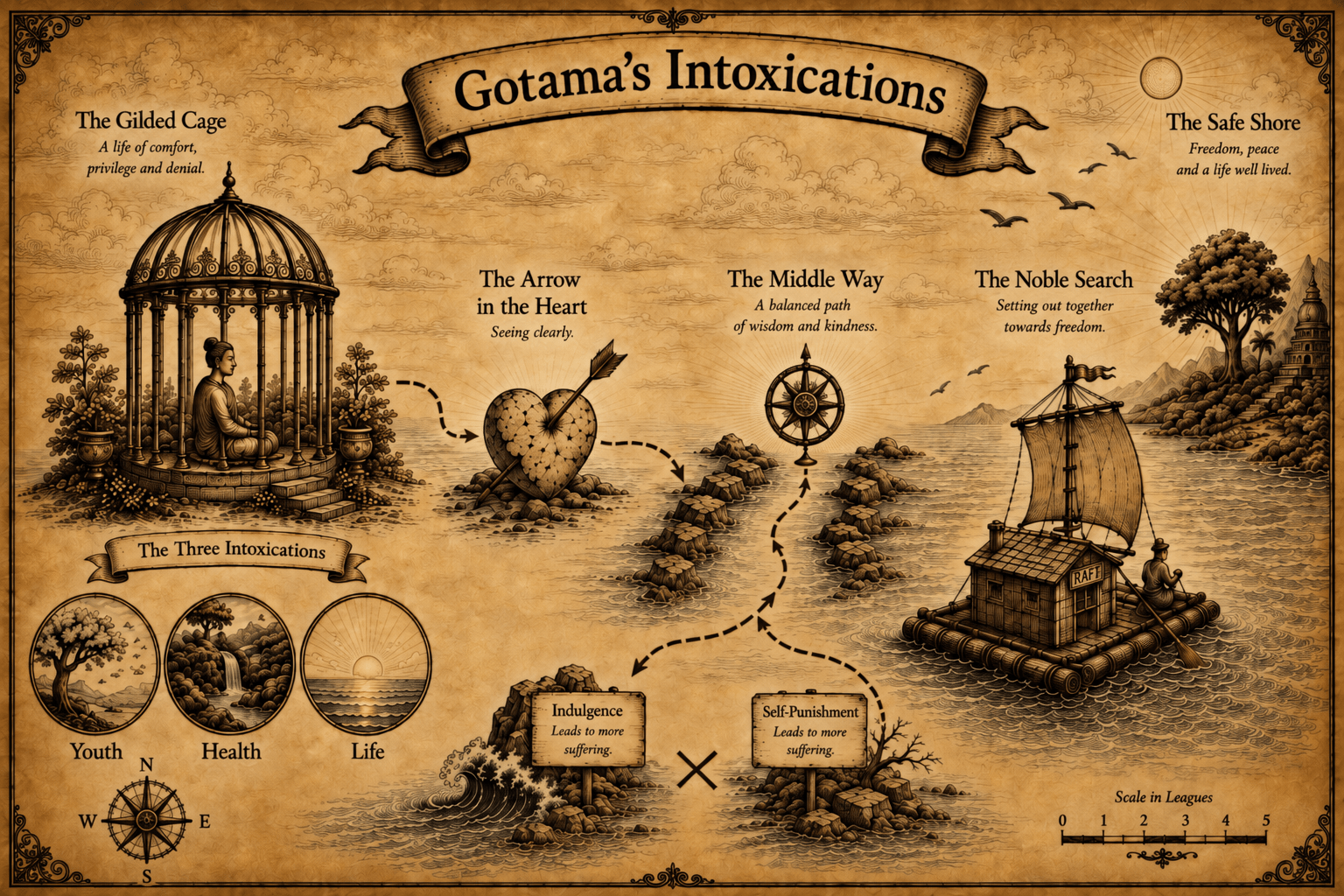
The gilded cage and the three intoxications
To understand the radical nature of Gotama’s journey, we must first understand the world he chose to leave behind. Popular stories often depict him as a fairytale prince, but historical accounts suggest a more complex and relatable reality. He was born into the Sakya clan, an aristocratic republic in the Himalayan foothills. This was a turbulent era of political upheaval, and the Sakyan republic was a vassal state (a country that acknowledges the rule of a more powerful nation), living under the shadow of the powerful Kosala kingdom, Sakya was engaged in its own conflicts, including armed disputes over water rights.
While not a prince in the mythical sense, Gotama’s own accounts describe a life of extraordinary wealth and privilege. He wore only the finest perfumes and clothes:
I used no sandalwood that was not from Varanasi. My turban was from Varanasi, as were my tunic, my lower garments, and my outer cloak.
His every need was catered for:
I was delicately nurtured, most delicately nurtured, extremely delicately nurtured… I had three stilted longhouses: one for the winter, one for the summer, and one for the rainy season. I spent the four months of the rains in the rainy-season longhouse, being entertained by musicians, none of whom were male, and I did not leave that place.
Despite this gilded cage, a profound unease grew within him. He wanted to understand why he placed his happiness in sense-pleasures and in possessions that were impermanent and ultimately failed to satisfy him. Gotama recognised that his life, however comfortable, was built on a fragile foundation of denial. He later termed this denial ‘intoxication’. He saw that he, like most people, was intoxicated by three things: ‘the vitality of youth’, ‘the vigour of health’, and ‘the continuity of life itself’. These were not just states of being, but powerful delusions that created a false sense of permanence and security. To be intoxicated in this way was to revel in one’s own health while feeling repelled by the sick, to be absorbed in youth while looking down on the elderly – all while ignoring the inescapable reality that ageing, illness, and death come for everyone.
Gotama realised that, being subject to these exact same conditions, for him to continue living in a state of denial would be utterly unfitting and unfulfilling. Gotama’s deep dissatisfaction, which arose despite his unparalleled external comfort, powerfully mirrors the experience of many of us, who are caught in the tangle of habits that disconnect us from ourselves. That feeling of profound unease that persists even when life appears objectively good. The habits we use to manage our pain, difficulties and disappointments, often emerge as an attempt to escape this underlying unease, but like Gotama’s stilted long-houses, they offer us only temporary relief.
The arrow in the heart
This growing sense of existential dread is captured in the stark verses that open this chapter. Here Gotama describes seeing the world in turmoil and feeling a deep sense of fear and discontent. He then saw the source of this turmoil:
…an arrow here, so very hard to see, embedded in the heart. When struck by that arrow, you run around in all directions. But when that same arrow has been plucked out, you neither run nor sink into despair.
This ‘arrow embedded in the heart’ is a powerful metaphor. It is described as ‘so very hard to see’ because it represents the subtle, often unconscious, inner wound caused by our deepest afflictions – delusion, craving, and self-centered views. It is this hidden arrow that drives us to run restlessly ‘in all directions,’ seeking satisfaction or escape but never finding peace. Plucking out the arrow means uprooting these fundamental causes of suffering. At its core, Gotama’s motivation for leaving home was to discover a cure for this condition.
This inner wound is the source of what Gotama would later formalise as his ‘First Realisation’: dukkha. Often translated as ‘suffering’, dukkha encompasses a much broader spectrum of experience, including the stress, unease, and unsatisfactoriness inherent in our conditioned existence. It points to the fundamental truth that even pleasant experiences are impermanent and therefore cannot provide lasting, secure happiness. This insight finds a strong parallel in the modern psychological concept of the ‘hedonic treadmill,’ which observes that humans tend to quickly return to a baseline level of happiness, regardless of major positive or negative life events. The satisfaction from any new achievement or possession never lasts, leading to a perpetual cycle of seeking more.
This is the First Realisation that we must Recognise (R). The arrow of suffering is a universal part of the human condition that is explored in more detail in Recognising life is painful, difficult and disappointing. The compulsive patterns we get caught in are often just our frantic attempts to run from discomfort. The first stage of our journey requires us to stop running and, with self-compassion, acknowledge that the arrow is there. This honest and necessary surrender is grounded in Gotama’s First Realisation, that life is naturally painful, difficult and disappointing.
The turning point: embarking on the noble search
It seems likely that Gotama found this profound realisation overwhelming. We can perhaps read between the lines of these verses and other reflections by Gotama, that he was a troubled and anxious young man living in turbulent times. Gotama would have been conflicted by the weight of family and societal expectations. His experience prompted him to ‘go against the stream’, and he later captured his motivation with a powerful metaphor:
This home life is confinement, a basis for dust; the going forth is like an open space
For him, the ‘home life’ was not a sanctuary but a ‘confinement,’ a cramped space filled with obligations that restricted his ability to seek a deeper truth. It was a ‘basis for dust,’ a realm where the ‘dust of passion’ (craving, conflict, and confusion), was constantly stirred up, clouding the mind. He saw that leaving these worries behind was the only way to find the ‘open space’ – the mental and spiritual clarity needed to find a real end to fear and suffering.
…there are two kinds of illness. What two? Mental and physical. Some sentient beings are seen who can claim to be free of physical illness for a year, or two, or three years … even up to a hundred years or more. But it’s very hard to find any sentient beings in the world who can claim to be free of mental illness even for a moment, apart from those who have overcome intoxicating inclinations… Gotama
Gotama’s ‘Four Propositions’: raw insights for change
In Gotama’s earliest teachings, he presented the well known clinical framework of the Four Realisations (Four Noble Truths). But in later teachings, he also presented the lesser known but perhaps just as important ‘Four Propositions’ expounding the way things really are. These propositions are raw and piercing insights into Gotama’s existential crisis. After hearing them, a young wealthy nobleman called Ratthapala, was so inspired that he immediately sought to be ordained – to leave his family and own lavish lifestyle behind and to follow Gotama into homelessness.
These propositions were not abstract philosophies, but lived recognitions of fragility, dread, and powerlessness – the very tremors that often stir a person toward change. The Four propositions unveil the collapse of false security: the crumbling walls of the gilded cage, the failure of intoxicants to numb reality, and the painful, clear sight of the arrow embedded in the heart. These propositions became part of the catalyst for his journey.
- All beings are swept along toward old age and death: The world is unstable.
- Life is insecure, and nothing is truly within our control: The world has no shelter and no saviour.
- We possess nothing – everything must be relinquished at death: The world has no owner.
- There is a lack at the core of every life. No one is fully satisfied, for beings are enslaved by craving: The world is insatiable.
Driven by this sense of spiritual urgency, Gotama made a radical decision. He resolved to leave his life of privilege in search of peace, to find an end to the inner and outer conflict that caused so much fear. He sought a definitive end to suffering, leaving behind his wife Yasodhara and newborn son Rahula. This was not an act of abandonment but a courageous commitment to embark on what he termed the ‘Noble Search’ as distinguished from the ‘Ignoble search’ pursued by most.
- The ‘Ignoble search’: Is the quest for happiness in things that are themselves subject to change, decay, and loss. Gotama saw this in his own life, recognising that his attachments to acquisitions – including spouses and children, male and female slaves, goats and sheep, fowl and pigs, elephants, cattle, horses, and even gold and silver – were impermanent and could not provide true security.
- The Noble Search: Conversely, is the quest for that which lies beyond these conditions – a lasting freedom from the entire cycle of suffering. Something ‘wide and pure’ – a life free from the agitation of ignorance and craving. Gotama describes leaving home as a quest for ‘true happiness’, grounded on calm and peace.
This distinction provides a powerful lens for our own journey. The cycle of our harmful compulsions is an intense manifestation of the ignoble search – our repeated attempt to find relief in possessions, substances or behaviours that are impermanent and ultimately lead to more pain. The decision to begin building our raft marks a pivotal turning point. It is our commitment to undertake our own Noble Search – to turn away from seeking temporary fixes and begin the journey toward genuine, lasting freedom.
Gathering materials: the search for a seaworthy raft
Gotama’s search was a rigorous, six-year process of gathering materials for his own raft, a methodical investigation in which he tested various teachings and practices, keeping what was useful and discarding what was not.
Immediately after leaving home, he sought out the most esteemed meditation teachers of his time. He mastered their advanced techniques, attaining profound states of mental concentration. Yet, he recognised that these states, however blissful, were still temporary. They were useful tools, but they were not the final answer; they could not, by themselves, construct a raft that would reach the safe shore of complete freedom.
Having found these teachings insufficient, he dedicated himself to the opposite extreme of his former life: the path of severe self-mortification. The accounts of this period are harrowing; he engaged in extreme fasting, painful postures, and severe neglect of his body, pushing himself to the brink of death.
Self-harm is not the way
After these gruelling years, he came to a critical realisation: these practices had brought him no closer to his goal. They had only weakened his body and exhausted his mind, making the clarity required for wisdom impossible. He had tested these materials – harsh self-punishment and extreme denial – and found them rotten. They were unsuitable for building a durable vessel. This path, too, was a dead end. This episode holds a vital lesson: healing cannot be achieved through self-punishment. The cycle of indulgence followed by shame and harsh self-criticism is just another barren extreme.
It was then that a memory arose of him sitting in the cool shade of a tree as a boy, where he had spontaneously entered a state of deep, pleasant calm. He realised that there was a form of wholesome pleasure, born of clarity and peace, that could support his path. This insight marked his discovery of the ‘Middle Way’. Gotama abandoned his harsh austerities, accepted nourishing food, and regained his strength.
Avoiding extremes and the ‘Middle Way’
In his first teaching, Gotama laid out this core principle of the Middle Way, declaring that two extremes should be avoided: excessive indulgence in sensual pleasure and harsh self-denial. The Middle Way, he explained, is the balanced path between them. This discovery provides the central principle for the RAFT to Freedom. It is a balanced, sustainable framework that steers clear of both destructive indulgence and self-punishing rigidity. It reframes our journey not as a grim battle, but as the skilful and compassionate cultivation of the inner resources needed to build our vessel and navigate to the safe shore.
Māra the saboteur
Throughout this arduous search, Gotama was not only contending with physical hardships but also with the powerful internal forces of temptation, doubt, and fear. In the Buddhist tradition, these forces are personified as Māra, a figure representing the embodiment of harmful cravings and delusion. Māra is not an external demon but a metaphor for the persuasive whispers in the mind that try to pull us off course with doubt, rationalisations, and the lure of old destructive habits. Gotama’s path required him to constantly see through these deceptions, a skill of clear recognition explored in much greater detail in Māra – I know you: meeting the inner saboteur.
The story of Gotama’s unhappiness is, in many ways, our own story. It teaches us that the deep dis-ease we feel is not a sign that we are uniquely broken, but a fundamental part of the human condition that can be a powerful catalyst for change. His feeling of being trapped in a confinement of worldly duties and expectations, in a house dusted with passion and conflict, is a timeless expression of feeling overwhelmed by life. His journey was a methodical process of gathering materials for his raft. He tested advanced meditation and found it useful but incomplete. He tested extreme self-punishment and discarded it as harmful. He learned from every step.
His discovery of the Middle Way provides the blueprint for our RAFT to Freedom. It is a path of radical balance, wisdom, and compassion. By Recognising the landscape of our suffering with the same clear-eyed courage he demonstrated, we take the first essential step. We stop running from the arrow in our heart and instead turn to face it, ready to learn the skills needed to gently remove it and navigate our way to the safe shore.
It took Gotama six years to gather the materials for his raft and journey to the safe shore – a marathon not a sprint. This was followed by 45 years of practice until his final dying breath. Some of the skills he tried were not beneficial nor suitable, so he discarded them; he jettisoned them and left them behind.
In Recognising the arrow in the heart – our own and others’ – Gotama encouraged us to respond with compassion. This recognition is not self-blame but a tender awareness of shared human pain.
The GOTAMA practice
The following practices use Gotama’s name as a guide to walk in his footsteps, not to fix anything, but to see our own experience more clearly. Approach them as gentle experiments in awareness.
- G – Ground yourself: Ground in the felt sense. Gotama’s journey began not with a theory, but with the felt reality of unease. When a moment of irritation or craving arises, pause. Instead of running, ground your awareness in the body. Where is this arrow felt? Is it a tightness in the chest? A hollowness in the stomach? A buzzing in the head? Simply place a hand there, acknowledging the raw sensation with presence instead of fear. Instead of pushing the pain away, name the difficulty and invite self-compassion: ‘This is hard. Let kindness be here.’
- O – Observe ‘the intoxications’: Gotama saw through the delusions of youth, health, and life. We can observe our own. This week, when a strong judgement about someone older arises, gently note, ‘intoxicated with youth’. When frustration with a physical limitation appears, whisper, ‘intoxicated with health’. And when resistance to the thought of our impermanence arises, acknowledge, ‘intoxicated with life.’ This isn’t about self-criticism; it’s about seeing the subtle assumptions that fuel our reactivity.
- T – Taste open space: The motivation for the Noble Search was the contrast between the ‘dusty confinement’ of his life and the possibility of open space. This week, intentionally taste small pockets of this. It could be five minutes of silence with a cup of tea and no phone. It could be a walk where you just notice the sky. These moments are rehearsals for freedom, reminding your nervous system that a life beyond the dusty room is possible.
- A – Acknowledge the raw truth: Gotama’s Four Propositions are a stark acceptance of reality. Choose one for the day: ‘The world is unstable,’ ‘The world has no shelter and no saviour,’ ‘The world has no owner,’ or ‘The world is insatiable.’ Hold it lightly in mind and acknowledge how its truth shows up in small ways – a plan changing, a moment of insecurity, the desire for more. This is not pessimism; it is the practice of aligning with reality.
- M – Map your confinement: Gotama felt his life was a ‘cramped, dusty room’. Take a moment to map your own life. What obligations, relationships, or thought patterns feel like confining walls? What is the dust of passion in your life – the gossip, the endless scrolling, the comparing – that clouds your mind? The first step is not to break down the walls, but simply to recognise them for what they are.
- A – Awaken the Noble Search: Recognising the confinement and plucking out the arrow is not the end; it is the beginning. The final step is to awaken the aspiration (Noble Desire) for your own Noble Search. Form a clear resolve: ‘Seeing the dis-ease of the ignoble search, I resolve to seek genuine well-being.’ This sets your compass, turning recognition into a purposeful journey. This action is a ‘stroke of the oar’ on your raft.
Self-reflections
Take a few moments for honest self-inquiry, approaching these questions with a caring and curious mind:

- Reflect on a time when external comforts or acquisitions failed to bring me lasting peace. How did this arrow of dissatisfaction make itself known to me? (view card)
- In what ways has my life sometimes felt confined by duties, expectations, or inner turmoil? What would open space feel like for me? (view card)
- Reflect on the two extremes of indulgence and self-punishment. Do I recognise a pattern of swinging between these in my own life? (view card)
- When have I noticed myself ‘running in all directions’ instead of pausing to recognise the arrow? (view card)
- What are the ‘golden bars’ of my own gilded cage? (for example, a comfortable but unfulfilling job, a relationship based on habit, a reliance on digital distraction). What does this comfort cost me? (view card)
- Of Gotama’s Four Propositions (the world is unstable, has no shelter, has no owner, is insatiable), which one resonates most strongly with my own experience today? Why? (view card)
- What was one small, unhelpful practice or belief I have already discarded on my journey? What did I learn from letting it go? (view card)
Journaling prompts
Use your journal to explore these themes further:
- Committing to the journey: The Noble Search begins with a powerful resolve. Write down your own intention for this journey. What kind of peace are you searching for? What commitment are you making to yourself as you begin to build your raft?
- Materials for your raft: Gotama’s story shows him gathering and discarding materials for his journey. What materials from his experience – such as courage, clear-seeing, self-compassion, or the willingness to discard what doesn’t work – feel most essential for you to gather for your own raft right now?
- An act of self-compassion: Gotama realised that punishing his body was a dead end. Write about one way you can abandon self-punishment this week and offer yourself an act of nourishment or care instead.
- A weather report from the dangerous shore: Write a short weather report from your dangerous shore today. What are the prevailing winds (habitual thoughts)? What are the hidden reefs (triggers)? What storms (emotional reactions) have passed through recently?
- Dialogue in the gilded cage: Write a short dialogue between the part of you that wants to stay safe and comfortable in the gilded cage and the part that yearns for the open space of the Noble Search. Let both voices speak honestly without judgment.
- The Four Propositions in your life: Choose one of the Four Propositions (unstable, no shelter, no owner, insatiable). Write about a specific time in your life when you experienced the truth of this proposition directly. How did it feel? What did it teach you?
- Daily GOTAMA check-in: At the end of the day, revisit the acronym. Which step (Ground, Observe, Taste, Acknowledge, Map, Awaken) felt most alive? Which do you need to strengthen tomorrow?
Supporting material: scientific and philosophical perspectives
For those interested in the scientific and philosophical underpinnings of Gotama’s intoxications, the following overview highlights some key connections. The path Gotama discovered resonates remarkably with contemporary scientific and philosophical understanding of the human mind.
- Neuroscience: Gotama’s insight into craving (taṇhā) is illuminated by modern neuroscience. The habits we use to manage pain often hijack the brain’s natural reward system. Substances and compulsive behaviours can flood this system with dopamine, creating intense but temporary pleasure. The brain adapts by reducing its own sensitivity, meaning natural rewards become less satisfying and more of the substance or behaviour is needed to get the same effect, creating a painful cycle. The Middle Way’s emphasis on mindfulness and mental training aligns with the principle of neuroplasticity – the brain’s ability to change and form new neural pathways. Practices like meditation can strengthen the prefrontal cortex, the area responsible for impulse control and wise decision-making, effectively rewiring the brain away from automatic, compulsive loops and towards conscious, healthy choices.
- Psychology & Psychotherapy: The First Realisation of pain, difficulties and disappointments finds a strong parallel in the psychological concept of the hedonic treadmill – the theory that people tend to return to a relatively stable baseline of happiness regardless of positive or negative life events. This explains why the Ignoble search for lasting happiness in fleeting pleasures is ultimately frustrating. Some of the most effective modern therapies, such as Acceptance and Commitment Therapy (ACT) and Dialectical Behaviour Therapy (DBT), integrate principles that resonate with Gotama’s path, such as mindfulness, acceptance of difficult feelings, and committed action based on personal values.
- Philosophy: Gotama’s Noble Search resonates deeply with themes in existential philosophy, which grapples with universal human concerns about suffering, freedom, death, and the search for a meaningful life. Both traditions recognise that confronting the difficult realities of the human condition, rather than avoiding them, is the necessary catalyst for growth and transformation. Gotama’s journey is a profound example of taking responsibility for one’s own path to find an authentic and purposeful way of living.
Remember to remember
Gotama was an ordinary man who had some extraordinary insights. His own raft was six years in the building – a rigorous testing of teachings and practices, keeping what served him and discarding what did not – and it carried him from suffering towards freedom. He left home at the age of 29, “while still a black-haired young man endowed with the blessings of youth in the first stage of life” (Ariyapariyesana Sutta, MN 26). He died 51 years later, an old and homeless beggar, at peace with himself and the world. Even after he had woken up to how life really is, he continued to practise for the rest of his days; he was still subject to pain, but he chose not to suffer for it.
His is not the story of a saint who was somehow spared our difficulties, but of an ordinary person who recognised them fully – and it was this recognition, not any special immunity from pain, that let his freedom begin. We are not being asked to leave home or to walk for six years; we are simply being invited to notice our own arrow, and to trust that seeing it clearly is itself the first stroke of the oar.
The curious paradox is that when I accept myself just as I am, then I can change.
Carl Rogers, On Becoming a Person: A Therapist’s View of Psychotherapy (1961)
Our own noble search begins here – welcome aboard. Next, we turn to Generosity – the gift of open hands, and to the first plank we lay down for our raft.
Sutta references
See the Index of sutta references
Please note that ideas and concepts may evolve over time as the project develops.