Setting out – Before we begin
Forms and sounds, tastes and odours, tactile objects that delight the mind: I offer them right back to you, for I, O Māra, do not need them.
Vijayā Therī, addressing Māra, Vijayā Sutta (SN 5.4), translated by Bhikkhu Bodhi

Episode 5 – ‘Māra, I Know You’: Navigating the ongoing journey
An AI-generated ‘deep dive’ into this aspect of the RAFT to Freedom
Temptation and old patterns: guardrails against falling overboard
Māra – I see you,
Māra – I hear you,
Māra – I smell you,
Māra – I taste you,
Māra – I feel you…
…Māra – I know you!
While these exact words aren’t a verbatim ancient quote, they capture a recurring theme found across early Buddhist teachings. Vijayā above gives us a clear example: Māra tempts her through the pull of sights, sounds, smells, tastes and touch, and she simply recognises what is happening and lets it pass. Whenever the inner saboteur (personified as Māra) appears to disrupt meditating nuns and monks, the remedy is always the same: clear recognition. The moment he is recognised, his illusion collapses and he disappears on the spot. Our refrain turns that repeated teaching into a practical mantra for daily practice: “Māra, I know you.”
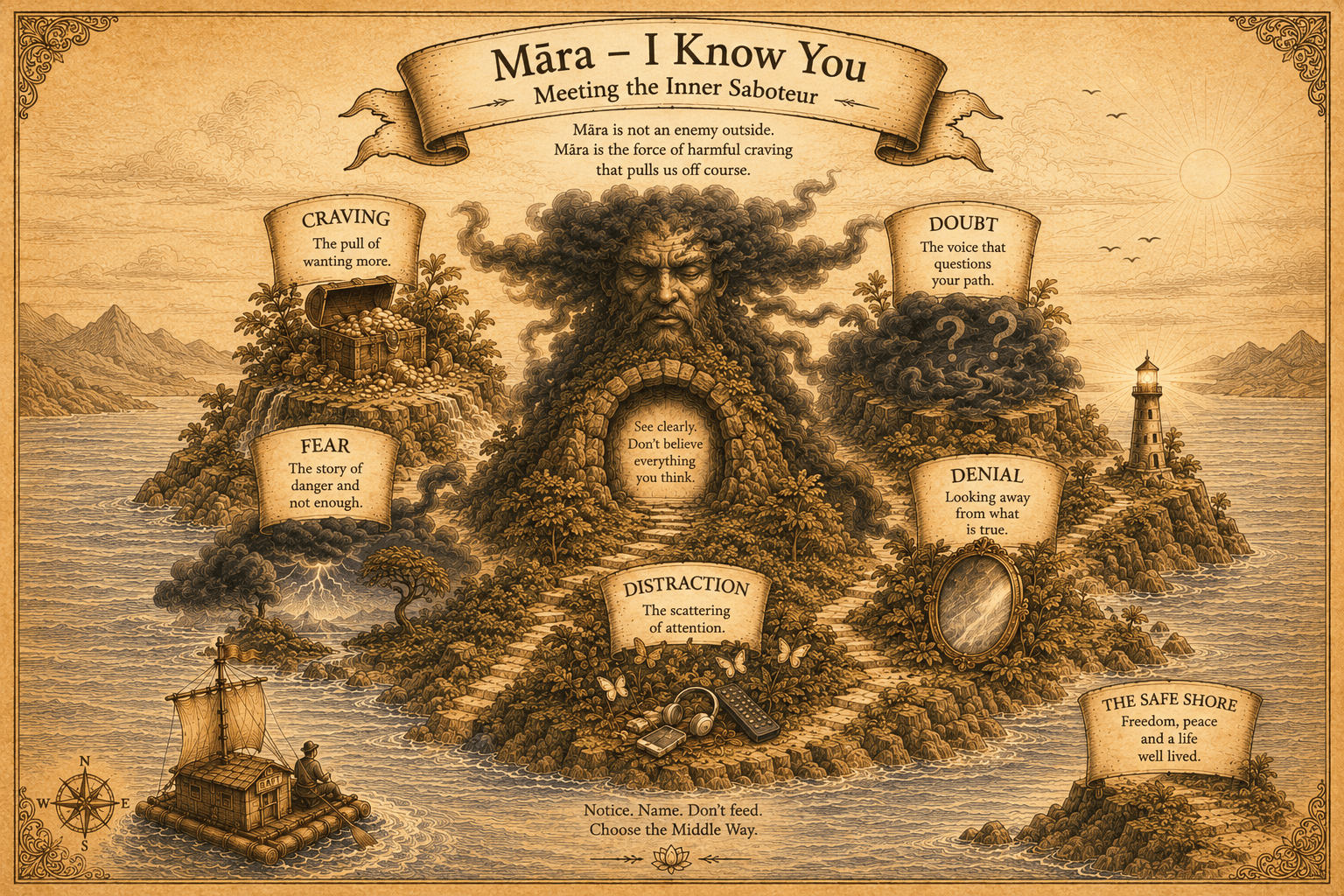
As we complete our preparations before stepping into Recognise, Māra is the perfect metaphor for craving, self-doubt, self-criticism and the many ways we react rather than choose. He is the personification of self-sabotage itself: subtle, cunning and persistently trying to pull us off course.
This is not about battling some monstrous external force. It is about learning to recognise, understand and wisely relate to our own patterns of thought and reactive behaviour. Māra is those persuasive whispers in the mind that try to convince us to give in to old habits, avoid what is difficult, rationalise unhelpful actions, or create doubt about the path to freedom. These are the hidden reefs and deceptive mirages that threaten to scupper our raft on the way to lasting peace.
Just as a vigilant navigator learns to identify hidden dangers, we learn to recognise Māra’s presence in his or her many disguises, if we are to steer our vessel to safety. What may once have felt like unrecognised or subconscious urges and fears can now be clearly seen for what they are: the manifestations of Māra.
Gotama and Māra: a dynamic of recognition
In the early Buddhist texts, Māra is the personification of temptation, delusion, and death – the one who tries, again and again, to obstruct awakening. Māra is not an external demon but the personification of our shared habits of compulsion and avoidance – our universal instinctual drives to protect, promote and satisfy. He appears as craving, aversion, doubt, fear, denial, or distraction.
What is striking is that Māra appears more often after Gotama’s awakening than before. Why? Because awakening does not remove temptation; it reveals it. With clarity comes recognition. Gotama no longer struggled with Māra; he simply saw him clearly and named him. Nor is this recognition reserved for Gotama alone: throughout the early texts, awakened monks and nuns meet Māra’s own attempts at seduction, fear or doubt the same way, simply seeing him for what he is. In every case the pattern is the same: once Māra is recognised, he grows sad and disappointed, and slips away.
This ability to see Māra – to name and disidentify from compulsive urges and self-defeating thoughts – is essential to cultivating well-being. It is the difference between being caught in a loop and stepping out of one. It reframes our struggle with craving and avoidance: instead of a battle against a monstrous, external force, it becomes a process of recognising, understanding and wisely relating to an internal pattern of thought, craving and compulsion. This approach – calm awareness, compassion and understanding – mirrors Gotama’s own response, and invites us to meet our inner challenges with gentleness, fostering self-compassion rather than internal conflict.
Māra and our embodied awareness: six lenses of mindfulness of body
The chapters ahead will guide us through Mindfulness of Body in real depth. Even before we reach them, its six elements can already serve as powerful lenses for recognising Māra’s subtle manifestations within our own experience:
- Mindfulness of breathing and Māra: this foundational practice provides an immediate anchor, calming the inner agitation that Māra thrives on and helping us recognise the impermanent nature of cravings as they arise and pass. It helps us see Māra’s subtle arrival. Does an urge or a self-defeating thought make the breath shallow, fast or tense? Noticing this physical shift through mindful breathing is often the first clue that Māra is present, trying to pull us into reactivity.
- Mindfulness of posture and Māra: cultivating awareness and stability in physical posture creates an embodied sense of groundedness that counters the restlessness and instability Māra often brings. Do the shoulders slump when hopelessness whispers? Do they tense when craving arises? Posture can be a mirror reflecting Māra’s subtle influence, a shift in internal state made visible.
- Clear comprehension and Māra: this skill directly supports our ability to say “I know you, Māra.” It allows us to pause and wisely choose how to respond to an urge, rather than reacting automatically – investigating cravings non-judgementally, discerning their true nature. What is the voice of craving trying to achieve? Is it promising relief, escape or validation that ultimately leads to more suffering? Clear comprehension helps us see through the illusion.
- Mindfulness of the reality of the body and Māra: grounding in the tangible sensations of the body helps dispel the mental fogginess and delusion that Māra uses to obscure our path. How does Māra manifest as physical sensation – a false sense of need, discomfort, or emptiness that only old habits promise to fix? Observed mindfully, these sensations can be recognised as impermanent events, not urgent commands.
- Mindfulness of the body through the lens of the elements and Māra: cultivating awareness of awareness helps us observe Māra’s temptations, thoughts and cravings as temporary mental events, fostering a non-reactive stance towards them. When Māra arises, where is the heat of anger felt, the fluidity of fear, or the heaviness of despair? Grounding in these basic elemental qualities can prevent Māra from pulling us into mental narratives.
- Mindfulness of the body’s impermanence and Māra: seeing that Māra’s temptations, like all experience, are temporary cultivates a radical acceptance that reduces the clinging that fuels the subtle chains we carry, diminishing Māra’s power over us. How does giving in to Māra deepen suffering over time – physically, mentally, spiritually? This longer view can disempower Māra’s short-term promises by revealing their true cost.
Māra through the lens of the four tasks
The story of Māra offers a vivid, close-up illustration of the four tasks at the heart of this workbook.
To Recognise Māra is Gotama’s first move: by calmly naming that life is painful, difficult and disappointing and particularly, that we don’t always get what we want. Gotama exposes Māra’s false claims that we can have everything that we want and that we don’t need to suffer. This dispels the illusion and drains Māra of his power – without anger or fear – simply an acknowledgement of what is present. It is the practice of seeing the patterns of escape and self-sabotage for what they are – an impersonal, conditioned pattern, not our true self.
To Abandon is not to defeat Māra by force, but to understand the drives to protect, promote and satisfy that give rise to him – the desire, aversion, doubt and fear that are his tools. In understanding them, we let the mental confusion they create go. Seeing clearly that the urge promises relief but delivers only more pain, difficulty or disappointment is itself the motivation to let it go. We are not white-knuckling through unhelpful desires but abandoning the illusion that they offer real solutions.
To Feel is to notice the peace of non-engagement – the moments when a trigger or a compulsive thought arises, is recognised, and simply has no power over us. This is not the absence of Māra’s temptations but freedom from being disturbed by them: the ease, clarity and calm that can be felt the moment craving’s grip loosens, even briefly. Gotama said that this can be personally experienced and verified by all of us.
To Train is to keep this practice going for a lifetime. Māra never completely vanishes; the texts show him returning again and again throughout Gotama’s own life. Our path asks for the same continuous cultivation: training in mindfulness to keep recognising Māra, training in wisdom to remember the consequences of following him, and training in ethical conduct to build a life where he finds less fertile ground to take root. Vigilance becomes, over time, not a stressful hyper-alert state but a calm, patient and compassionate practice of self-awareness.
Recognising Māra, the voice of our struggle with craving and avoidance, is a crucial step on this journey. It is about learning to read our inner map accurately, to identify these hazards as they appear, and to find skilful means to avoid being shipwrecked by them. By patiently and persistently consulting that map through mindful awareness, we learn to sail through these hazardous waters towards the calm harbour of freedom. This ongoing vigilance, supported by our growing awareness and compassion, is a vital guardrail against falling overboard – it lets us strengthen our raft and continue on our journey towards the safe shore.
Practice – “Māra, I know you”
A mindful response
When old urges or self-defeating thoughts arise, we can pause, name the pattern, and say: “I know you, Māra.” This empowers us to respond mindfully rather than react automatically. The acronym MARA offers a guide for this practice.
- Mindful: we bring present-moment recollection to our experience – sati, remembering to remember what we are doing and why we are doing it. This is the foundation of all mindful cultivation of well-being. As mindfulness scholar Jon Kabat-Zinn notes, mindfulness is “moment-to-moment, non-judgmental awareness.” This is the spotting: something is here.
- Awareness: we cultivate awareness of what is happening right now – the sensations in the body, the emotions arising, and the thoughts that swirl in the mind. This is sampajañña, the sister quality to sati that understands what has been noticed, not merely that something is present – a distinction we return to in Mindfulness with Clear Comprehension. This is where the friendly curiosity of investigation can truly take the wind out of anxiety, cravings and compulsions. Where mindfulness spots the object, awareness reads its context: is this an old, familiar pattern? What would feeding it actually cost?
- Responds: crucially, we learn to respond rather than merely react. We are not our thoughts or our urges. Remembering to remember creates a pause and the vital space between our impulse and action.
- Appropriately: choosing a response that is wise and kind, both to ourselves and to the situation. Meeting the challenge with non-judgmental awareness and self-compassion rather than suppression or self-criticism. An appropriate response might be a pre-planned coping strategy, seeking support, or simply observing the thought or urge without acting.
This act of remembering to remember changes our relationship with what arises, from being possessed by it to simply observing it. Seeing the pattern of escape and self-sabotage for what it is. It is an impersonal, conditioned pattern, not a true self. When self-doubt whispers that nothing changes, or that old patterns have failed too many times, or when avoidance beckons that “this isn’t needed”, we can mentally say, “Ah, this is Māra. I know you.” This naming restores our agency and reminds us that we are not our harmful habits. This same pause is the seed of the Resolve to Prevent – stopping a pattern before it can fully take hold – which we return to later in the workbook.
Inviting Māra to tea
A popular teaching from modern Buddhist psychology, inspired by this narrative, is inviting Māra to tea. Instead of fighting or suppressing a difficult thought, emotion or craving. We mindfully acknowledge its presence, let it be there without acting on it, and investigate it with compassionate curiosity. This approach resonates with Judson Brewer’s work on habit change and the practice of meeting an urge with curious interest rather than an automatic reaction.
This can be a written dialogue or a silent reflection: you are the calm, wise host; the visitor is Māra – the thought, the craving, the difficult emotion… For example:
- Host: “Welcome, Māra. I know you – you are that familiar desire for distraction. What brings you here today?”
- Māra (the urge): “I just want to feel better. I’m bored! This will make it go away, just for a little while.”
- Host: “I understand your wish to feel better, but your solution leads to more pain. Thank you for visiting. I know you, and I choose to stay present whatever the weather.”
How to practise the mindful Māra pause
Next time an urge or unhelpful thought arises:
- Pause, and come into the body.
- Mindful – remember to remember – to come back to the present moment and see the situation clearly.
- Awareness – note any sensations, thoughts or emotions.
- Respond – name it as “Māra – I know you” or name the specific pattern at play (a craving, a fear, a habit of avoidance).
- Appropriately – choose a wise response: a few mindful breaths, a call to a friend, or perhaps take a walk in nature.
A short Māra meditation
Sit quietly and let the breath settle. When a thought or craving arises, ask gently, “Who is this?” See if it has the quality of wanting, doubting, or fearing. Silently name it, “Māra.” Smile inwardly, not with hatred, but with recognition. Say softly in the mind, “I know you, Māra.” Then return to the breath.
This meditation restores power not by suppression, but by clear seeing. Recognition weakens the hold of the pull of compulsive and reactive behaviours.
Self-reflections
Approach these reflections gently, with self-compassion:

- When I feel the pull of an old behaviour, what does Māra say to me? (view card)
- How does Māra distract me in my everyday life? (view card)
- Do I sometimes believe the voice of Māra? What happens when I do? (view card)
- How might I develop my capacity to say, “I know you, Māra,” and let go? (view card)
- Can I be mindful when a thought, urge or difficult emotion arises – what happens when I am not? (view card)
- When Māra succeeds in tricking me, can I meet myself with kindness rather than self-criticism? (view card)
- When I am distracted, what are the most wise and compassionate choices I can make? (view card)
Journaling prompts
Explore these themes in writing, remembering to be kind to yourself:
- Seeing Māra clearly: “I know you, Māra, when…”: list five recent times you noticed a compulsive urge, thought, or story pulling you off the path.
- Recognising Māra’s disguises: reflect on how Māra shows up for you now. Is it craving, boredom, self-criticism, irritation, busyness, or something else?
- Mindfulness in action: write about a moment from your day when mindfulness saved – or could have saved – a situation.
- When Māra won: describe a time you recognised Māra too late, or not at all, and what happened as a result.
- The real cost: think of one recent time Māra won. What did it actually promise you, and what did it really cost?
- Unhooking from thought: practise knowing Māra by rewriting a self-sabotaging thought as “I notice the thought that…”
- Building a response toolkit: design your own response toolkit – three to five mindful tools you can reach for when Māra appears.
Supporting material: scientific and philosophical perspectives
For those interested in the scientific and philosophical underpinnings of this practice, here is a brief overview.
- Neuroscience: cravings have been shown to activate brain regions such as the insula and anterior cingulate, both tied to interoception and the sensing of urges, while dopaminergic systems respond intensely to cues associated with old, familiar patterns. The default mode network, associated with self-referential thought, tends to be more active during rumination, craving and story-making, which is often how a craving first announces itself. Neuroimaging suggests that mindfulness training reduces activation in these same craving-related brain areas.
- Psychology & Psychotherapy: craving, along with related patterns like avoidance and self-doubt, is thought to have evolved, at least in part, from mechanisms that once supported survival – securing food, safety and social belonging – and modern environments can exploit these old tendencies with supernormal stimuli that our ancestors never encountered. Freedom, from this perspective, arises when a deliberate, chosen action is available in place of an instinctive reaction. In Mindfulness-Based Relapse Prevention (MBRP), practitioners learn to notice triggers and choose a different response; Acceptance and Commitment Therapy (ACT) teaches a similar defusion – seeing thoughts as mental events passing through, not as truths to be obeyed.
- Philosophy: the philosopher Søren Kierkegaard described a pervasive sickness of despair – not knowing one’s own true self – which, seen through a Buddhist lens, sits within Māra’s domain. In Buddhist terms, Māra can be understood as the fear of letting go of the false self, and of freedom itself; this reinforces the idea that Māra’s power lies in keeping us bound to self-deception and to what is familiar, even where it causes suffering.
Remember to remember
Māra is not something to fight, but someone to know. His or her power lies in going unnoticed, or in disguise. Gotama did not destroy Māra; he disempowered him by naming him, again and again – and we can learn this same art: to say, “I know you, Māra,” and to walk on.
Recognition, not struggle, is what disempowers Māra. Each time we notice him without engaging, the subtle chains that bind us loosen a little further, and our sustained, gentle awareness becomes the very thing that lets us choose freedom, moment by moment.
Seeing really clearly what we get when we get caught up in our behaviors, becoming disenchanted on a visceral level and from this disenchanted stance, naturally letting go.
Dr Judson Brewer, psychiatrist and neuroscientist, TED talk A simple way to break a bad habit (TEDMED 2015)
With Māra recognised, we turn next to look honestly at why life is painful, difficult and disappointing in the first place.
Sutta references
See the Index of sutta references
Please note that ideas and concepts may evolve over time as the project develops.