Recognise – Mindfulness of body
This concentration by mindfulness of breathing, when developed and cultivated, is peaceful and sublime, an ambrosial pleasant dwelling, and it disperses and quells right on the spot evil unwholesome states whenever they arise.
Vesālī Sutta (SN 54.9), translated by Bhikkhu Bodhi

Episode 9 – Mindfulness of Breathing: gathering awareness
An AI-generated ‘deep dive’ into this aspect of the RAFT to Freedom
Tuning into the ever-present breath
Our first lens on this stage of the journey was grounded mindfulness, where we looked at mindfulness of the body as the primary field for recognising the nature of our existence. We now turn to the first, most fundamental and universally accessible practice within this domain: mindfulness of breathing. This practice helps us explore the nature of our direct experience, including its impermanence. It also helps us begin sitting with the discomfort that is part of life without immediately needing to escape it – an essential anchor we gather as we continue building our raft.
The breath is unique. It is an automatic bodily function, yet we can also control it consciously. It is constantly changing, yet always present from birth until death. It sits at the threshold between the voluntary and involuntary, the conscious and unconscious. Because it is always with us, the breath serves as a reliable home base to return to whenever our minds get lost in the past, carried away by future worries, or caught in the turbulent currents of reactivity or difficult emotion.
The basic instruction, as Gotama (the Buddha) gave it in his talk on the four Anchors of Mindfulness, is deceptively simple:
Here a practitioner, gone to the forest or to the root of a tree or to an empty hut, sits down; having folded the legs crosswise, set the body upright, and established mindfulness in front, ever mindful they breathe in, ever mindful they breathe out.
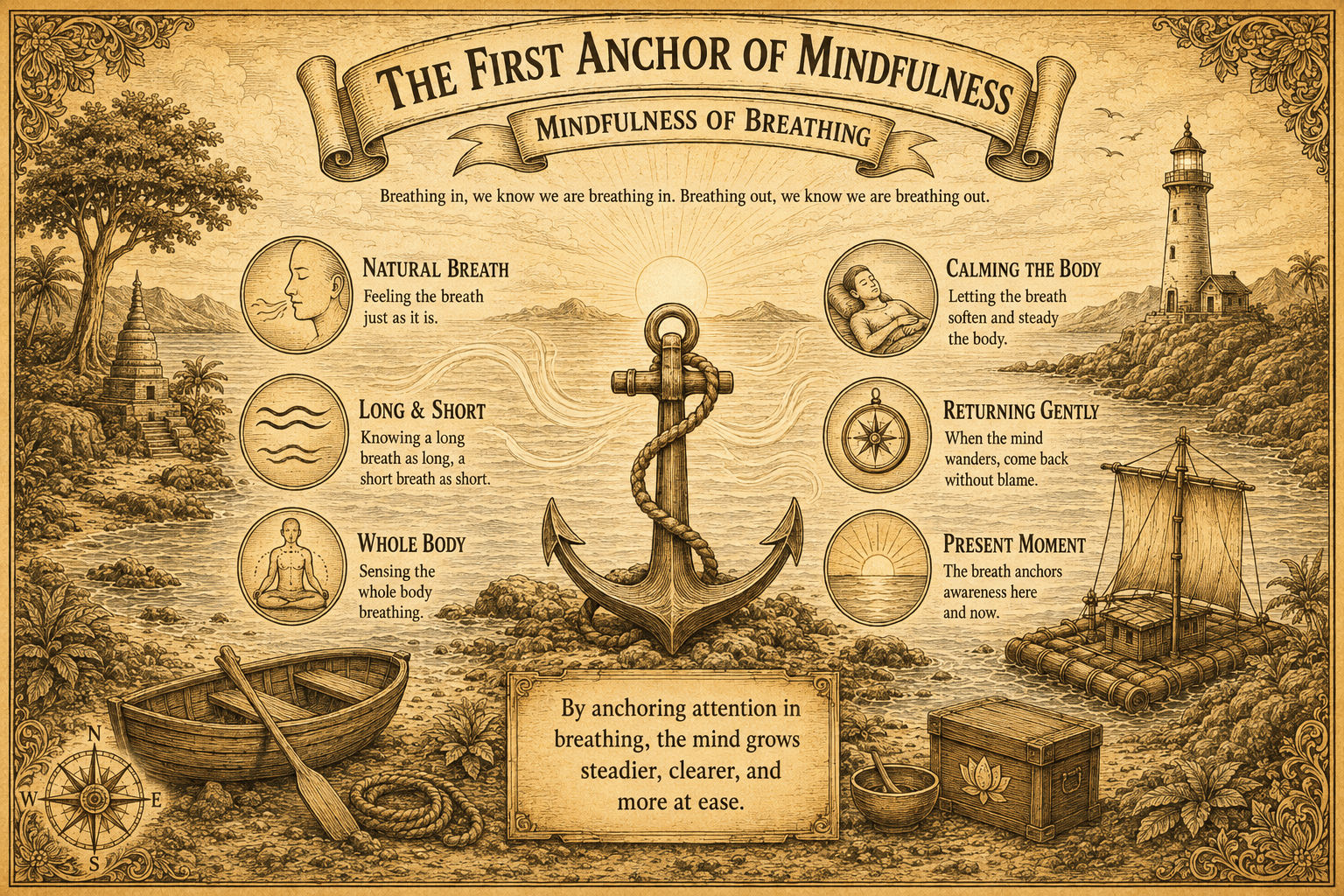
We simply bring our attention to the natural flow of the breath, feeling the physical sensations as it enters and leaves the body. We don’t try to control or change it – unless we are specifically practising a different kind of breath exercise – but rather observe its natural rhythm:
Breathing in a long breath, the meditator understands: “I am breathing in a long breath”; or breathing out a long breath, they understand: “I am breathing out a long breath.” Breathing in a short breath, they understand: “I am breathing in a short breath”; or breathing out a short breath, they understand: “I am breathing out a short breath.”
We notice the quality of the breath – long or short, deep or shallow, fast or slow. We might focus on the sensation at the tip of the nostrils where the air enters and leaves, or the rising and falling of the tummy or chest. The key is gentle, sustained attention on the physical feeling of breathing, moment by moment.
Why start here?
Mindfulness of breathing is a foundational practice for several key reasons, each providing vital material for our raft:
- Anchoring: the breath provides an immediate, tangible focal point to anchor the mind in the present, counteracting distraction and mind-wandering, and helping us find stability when caught in the turbulent currents of reactivity or an urge to fall back into old patterns. It is like a steady rope we can hold onto when the waters get rough.
- Calming: paying gentle attention to the breath tends to soothe the nervous system, reducing stress and anxiety, and calming the inner agitation that often fuels the pull of compulsive and reactive behaviours. This creates a calmer inner environment for beginning to recognise and sit with life’s inherent pain, difficulties and disappointments – Gotama’s first realisation – rather than habitually reacting.
- Developing collectedness: regularly returning attention to the breath when the mind wanders helps develop an unscattered mind, something we explore in more detail later in our journey.
- Observing change: each breath is different; the flow is constantly changing. Observing this directly gives experiential insight into impermanence, a key aspect of Gotama’s first realisation – it also helps us see that cravings and difficult emotions are themselves impermanent, arising and, in time, passing.
- Self-awareness: by observing the breath, we naturally become more aware of our mental state – is it rapid when we are anxious, shallow when we are tense, deeper when we relax? This links our inner state to our physical experience, helping us recognise our own patterns, and to notice thoughts and emotions arising and passing without immediately identifying with them as personal to us.
Mindfulness of Breathing, grounded in our commitment to the Five Gifts and held with self-compassion, is crucial: this self-compassion is an inward kindness in action, our appropriate response to our own pain, difficulties and disappointments. When we notice the mind has wandered – as it inevitably will – or when difficult feelings arise during practice, responding with gentle understanding rather than harsh judgment is itself an act of self-compassion. This matters especially given how easily self-blame can become an obstacle. Practising in this way is foundational for gathering the awareness we need to recognise and understand the terrain of our lives.
Relevance to the pull of compulsive and reactive behaviours
Mindfulness of breathing is a particularly powerful tool for the wider work of this workbook:
- Stress reduction: it directly calms the nervous system, reducing the background stress and anxiety that often fuels the pull to distract ourselves or fall into compulsive patterns.
- Increased awareness: it helps us recognise subtle cravings, triggers and emotional states that often precede falling overboard, allowing for earlier, gentler intervention.
- Improved focus: it enhances the collectedness we need to engage effectively with our practice.
- Emotional regulation: it creates a crucial gap between feeling an urge or difficult emotion and reacting impulsively, allowing time to choose a more helpful response.
- Breaking the autopilot: this practice interrupts the habitual, often unconscious, link between a trigger and a compulsive response, by bringing conscious awareness to the present moment.
- Cultivating self-compassion: practising non-judgmental observation of the breath, including moments of distraction or difficulty, fosters a kinder attitude towards ourselves, reducing shame and self-blame.
- Building routine: incorporating a regular breath practice, even just five minutes at a time, helps us establish structure and healthy habits that support our overall well-being.
Practice – anchoring in the breath
Find a comfortable seated position, and allow the eyes to close gently or rest in a soft, downward gaze.
- Bring your attention to the physical sensation of breathing, wherever it is clearest – the nostrils, the chest, or the rise and fall of the tummy.
- Simply notice each in-breath and out-breath, without trying to change or control it. Notice whether it is long or short, deep or shallow.
- When the mind wanders, as it will, gently and without judgment guide your attention back to the breath. Each return is the practice, not a failure of it.
- Continue for three to five minutes, or longer if it feels helpful.
- Before finishing, take one slightly deeper breath, and let it be a small, deliberate act of gathering yourself back into the present moment.
Self-reflections
Find a quiet moment to sit and gently bring awareness to my breath for a minute or two, then reflect:


- What physical sensations of breathing did I notice most clearly – at the nostrils, chest or tummy? (view card)
- Did my mind wander? If so, what was my reaction to noticing the wandering? (view card)
- Did I find myself trying to control my breath, or was I able to observe its natural rhythm? (view card)
- How did my body feel before, during and after this brief period of breath awareness? (view card)
- Did focusing on my breathing feel pleasant, unpleasant, or neither? (view card)
- When I noticed a craving, urge or difficult emotion arise just now, could I find the gap between feeling it and reacting to it? (view card)
- What did it feel like to simply return to the breath, again and again, rather than needing to get it “right”? (view card)


Journaling prompts
Use your journal to explore your experience with breath awareness practice:
- Starting small: commit to practising three to five minutes of mindful breathing once or twice a day for the next few days. Journal briefly after each session about what you noticed – ease, difficulty, quality of attention, thoughts or feelings that arose.
- Breath throughout the day: set an intention to consciously check in with your breath a few times during your daily activities – while waiting, walking, working. What do you notice about your breath, and your state of mind, in these different situations?
- Mind wandering: during your practice, pay attention to where your mind tends to go when it wanders. Are there common themes – planning, worrying, remembering, fantasising? Practise gently acknowledging your thoughts and guiding your attention back to your breathing. Write about this process of noticing and returning.
- Breath and emotion: notice the connection between your breath and your emotional state. When you feel stressed or anxious, what happens to your breath? When you feel calm, how does it change? Write about your observations.
- The steady rope: write about a recent moment when the breath acted as “a steady rope” you could hold onto when things felt rough. What made it possible to reach for it in that moment?
- Breath as evidence of impermanence: notice how each breath is slightly different from the last. What does it feel like to let this ordinary observation stand in for the bigger truth that reactivity and difficult feelings are impermanent too?
- A gentler autopilot: think of one habitual, semi-automatic response you’d like to interrupt. How might returning to the breath, even briefly, create a gap before you act next time?
Supporting material: scientific and philosophical perspectives on breath awareness
For those interested in the science and philosophy behind this practice, here is a brief overview.
- Neuroscience: conscious attention to breathing directly influences the autonomic nervous system. Slow, mindful breathing tends to activate the parasympathetic nervous system via the vagus nerve, counteracting the stress response, and is associated with lower heart rate, blood pressure and cortisol levels. Brain-imaging research suggests mindfulness practice strengthens activity in the prefrontal cortex, involved in attention and emotional regulation, and may reduce activity in the amygdala and the default mode network, associated with mind-wandering and rumination.
- Psychology & Psychotherapy: mindfulness of breathing is a core component of evidence-based approaches such as MBSR, MBCT, MBRP, ACT and DBT, and has been shown to be effective in reducing stress, anxiety and symptoms of depression. By creating a pause between stimulus and response, it supports emotional regulation skills that are useful for managing cravings and difficult emotions without resorting to compulsive behaviour. It also increases interoceptive awareness, helping people reconnect with their bodies and understand their own emotional cues. As Jon Kabat-Zinn writes in his book Full Catastrophe Living, this kind of practice helps us draw on the wisdom of body and mind to face stress and pain. Observing the breath without judgment is also understood to cultivate self-compassion, which can help counteract harsh self-criticism.
- Philosophy: the focus on the present moment aligns with philosophies that value direct experience over conceptualisation, such as phenomenology. The practice cultivates a kind of attentional discipline valued by Stoics and other schools focused on self-mastery. Simply observing the breath is an exercise in being rather than constantly doing – countering the restless striving that often underlies dissatisfaction, and connecting us to the fundamental rhythm of life itself.
Remember to remember
Mindfulness of breathing is far more than a simple relaxation technique; it is a foundational practice for cultivating the calm, clarity and self-awareness this whole journey depends on. It is one of the primary skills we cultivate to stabilise our raft, providing a reliable anchor in often-turbulent waters. By consistently returning our attention to the simple, tangible reality of the breath, we ground ourselves in the present moment and develop crucial skills in emotional regulation and focus.
Practise patiently, practise kindly. There is no perfect way to breathe, or to be mindful of it. Simply showing up, and gently bringing your attention back again and again, is the practice itself.
Feelings come and go like clouds in a windy sky. Conscious breathing is my anchor.
Thich Nhat Hanh, Stepping into Freedom: An Introduction to Buddhist Monastic Training
As we become more grounded through Mindfulness of Breathing, we are ready to explore the next layer of body mindfulness: our physical postures.
Sutta references
See the Index of sutta references
Please note that ideas and concepts may evolve over time as the project develops.