Category: Recognise

Posts covering the Recognise stage of the RAFT to Freedom journey

  • 06 – Recognising life is painful, difficult and disappointing

    06 – Recognising life is painful, difficult and disappointing

    Recognise – Gotama’s first realisation

    Now this, monks, for the spiritually ennobled, is the painful (dukkha) true reality: birth is painful, ageing is painful, illness is painful, death is painful; sorrow, lamentation, (physical) pain, unhappiness and distress are painful; union with what is disliked is painful; separation from what is liked is painful; not to get what one wants is painful; in brief, the five bundles of grasping-fuel are painful.

    Dhammacakkappavattana Sutta (SN 56.11), translated by Peter Harvey, in An Introduction to Buddhism (2013)

    Episode 6 – Recognising that life can be painful, difficult and disappointing

    An AI-generated ‘deep dive’ into this aspect of the RAFT to Freedom

    Surveying the dangerous shore: radical realism

    Having established a commitment to harmlessness with the Five Gifts – the essential foundational planks for our raft – we now turn our attention more directly to the first stage of our journey. We turn to Recognising what it is to be human.

    This involves taking an honest, clear-eyed look at the fundamental nature of our experience. Before we can effectively build our raft and navigate away from the dangerous shore of the pull of compulsive and reactive behaviours, we need to understand the terrain we are standing on and the currents we will be navigating.

    This honest assessment is grounded in Gotama’s (the Buddha’s) first realisation: that life is naturally painful, difficult and disappointing. The Pali word is dukkha, often translated as ‘suffering’, but its meaning is much broader and more complicated than that. It encompasses the entire spectrum of unsatisfactoriness, stress, difficulty, discomfort, pain and disappointment that is naturally part of being human.

    The word dukkha is sometimes illustrated using the image of a cart with an ill-fitting axle, which results in a bumpy and uncomfortable ride. There is no doubt that the pain, difficulties and disappointments we encounter – life’s ups and downs – are often experienced as an uncomfortable journey. Gotama shared this reality and his teachings in order to help us be cushioned against the bumpy ride, to experience less pain and discomfort than we otherwise would.

    A stark, modern rendering of the same insight might simply be: life is difficult and disappointing, we don’t always get what we want, and then we die.

    While this might sound pessimistic at first, Gotama’s intention was not to cause despair, but to give us a realistic understanding – to manage our expectations. He presented this not as a depressing final word, but as the first reality we need to recognise and comprehend fully if we wish to find our way to lasting freedom.

    For many of us, our natural response to the inevitable pain, difficulties and disappointments of life leads us to harmful patterns of escape and self-sabotage, in a futile effort to cushion the discomfort. This becomes a negative feedback loop that just causes more pain for ourselves and others, and so it goes on.

    Ignoring the difficult terrain, or pretending the dangerous currents don’t exist, won’t help us reach the safe shore. Recognising dukkha is the necessary starting point for diagnosing our situation and motivating us to gather the materials for our raft. It helps us see why we need to construct our raft in the first place.

    It can help not to take the bumpy ride personally. In his first talk after his awakening, Gotama is said to have unpacked this same truth in more detail – the opening quote above enumerates the categories of dukkha he named. Let’s unpack what he is pointing to:

    • Physical and emotional pain: life in general – ageing, illness, physical pain and death – is painful. On top of this, difficult emotions such as sorrow, grief and distress add more pain into the mix. These are universal human experiences, forms of suffering we can all readily recognise, though we are often in denial of this reality. No one gets out unscathed.
    • Pain of unwanted contact: when we are stuck with people, situations or feelings we dislike, it causes us pain and distress.
    • Pain of separation: when we lose people, things, status or experiences that we cherish, this too is painful.
    • Pain of not getting what we want: whether it’s a substance, a relationship, a job, or a state of mind, not getting what we desire is a constant source of dissatisfaction and disappointment. This sits close to the heart of the pull of compulsive and reactive behaviours this workbook addresses.
    • The pain of clinging to self: it is natural to see our sense of self as fixed and unchanging – most people do – but in reality we are made up of different, constantly changing aspects. This view is hard to hold lightly, and can cause us much suffering: because these aspects of our experience are constantly changing and ultimately beyond our control, grasping onto them as ‘me’ or ‘mine’ inevitably leads to subtle, or not-so-subtle, pain. This is the seed of a teaching this workbook returns to more fully later – the teaching of not-self, anattā – when we look closely at the five components of selfing.

    Recognising dukkha in its various forms – from the gross pain of loss or illness to the subtle stress of change – is the primary task of this first stage of our journey. It’s about seeing clearly, and more importantly accepting, that life is naturally painful, difficult and disappointing, and that our reactivity – including our denial of and resistance to this reality – creates a dangerous shore. This recognition, done with courage and an ever-emerging clarity, motivates us to wholeheartedly engage in building our raft and undertaking the journey towards the safe shore, free of avoidable and unnecessary pain.

    Gotama’s first realisation is the beginning of the first of the four tasks at the heart of this programme. To Recognise is to see clearly, and without flinching, that life is sometimes naturally painful, difficult and disappointing – that we often don’t get what we want, yet frequently encounter what we don’t want. This is universal, not personal: we are all in the same boat. Recognising this honestly is what makes the remaining tasks – to Abandon the drives that deepen our own suffering, to Feel the freedom that opens up as their grip loosens, and to Train ourselves to sustain that freedom – possible at all.

    Practice – the dukkha check-in

    A short pause, several times a day (skip this practice if you find it triggering)

    This practice asks nothing more than honest noticing. Several times through the day – perhaps when something goes wrong, or simply at set points such as waking, midday and before sleep – pause for a few breaths and ask:

    1. What is here right now that is uncomfortable, unwanted or disappointing, however small?
    2. Can I name it simply, without adding a story about why it shouldn’t be happening or whose fault it is?
    3. Can I silently acknowledge, “this is dukkha” – and let that be enough for now, without needing to fix, escape or judge it?

    Naming a difficult feeling this plainly is not just a figure of speech. The neuroscientist Matthew Lieberman’s research on affect labelling has found that putting a feeling into words – “this is disappointment,” “this is sorrow” – measurably reduces activity in the brain’s threat-response circuitry. This holds even though nothing about the situation itself has changed. Simply naming dukkha is already doing something.

    Widening the practice: RAIN

    At quieter moments – not mid-crisis, but somewhere calm enough to sit with this for a few minutes – the same honest noticing can be widened using RAIN. This sequence was developed by the meditation teacher Michele McDonald and is now widely taught, including by Tara Brach in the talk linked with this chapter:

    • Recognise what is here, naming it as simply as in the short pause above: “this is dukkha.”
    • Allow it to be present exactly as it is, without needing it to be otherwise – not agreeing with it, not fighting it, just not pushing it away.
    • Investigate with a kindly curiosity: where do I feel this in the body? What does it actually need right now – not what an old habit insists it needs, but what would genuinely help?
    • Nurture yourself in whatever small way fits the moment: a hand resting on the chest, a few words of simple kindness, or simply staying present a little longer than we might otherwise have allowed ourselves.

    A quiet dialogue with difficulty

    Some people find it useful to put this into words, spoken or written, rather than holding it only as a silent process:

    • “I see you. This is dukkha – the ordinary ache of being human, not a personal failing.”
    • “I don’t need to fix you or get rid of you right now. I can let you be here.”
    • “What do you actually need from me?”

    There is no fixed reply required. The point of the dialogue is simply to stay present with what is there long enough to see it clearly, rather than reacting to it on autopilot.

    How to practise the dukkha check-in

    1. Pause, wherever you are.
    2. Notice what is uncomfortable, unwanted or disappointing, however small.
    3. Name it simply: “this is dukkha.”
    4. Allow it to be present without needing to fix, escape or judge it.
    5. If time and circumstance allow, widen into the fuller RAIN sequence above.

    The aim, in either form, is not to dwell on difficulty or to manufacture gloom where none exists. It is to build the habit of clear, unflinching recognition – the same quality of seeing Gotama pointed to in his first realisation. That way, when real pain, difficulty or disappointment arises, we already have the practice of meeting it honestly, rather than pushing it away or being ambushed by it.

    Self-reflections

    Sit quietly and consider these questions, allowing feelings to arise without judgment:

    1. How does the direct statement “life is painful, difficult and disappointing” land for me? Is there resistance, acceptance, or something else? (view card)
    2. Looking at Gotama’s list – ageing, illness, death, sorrow, separation from what I love, contact with what I dislike, not getting what I want – which of these feel most prominent or challenging in my life right now? (view card)
    3. How has the specific suffering related to my own reactivity or compulsive behaviour shown up across these different categories? (view card)
    4. Can I recall moments of subtle unsatisfactoriness even when things seemed outwardly “okay”? What did that feel like? (view card)
    5. Could recognising and facing my pain, difficulties and disappointments – seeing them clearly instead of avoiding or denying them – actually help support my own movement from suffering towards freedom? (view card)
    6. Do I know anyone who has never experienced pain, difficulty or disappointment? Can money, or getting what I want, ever fully buy me freedom from this? (view card)
    7. When I picture the image of a cart with an ill-fitting axle, jolting over every bump in the road – how much does that describe the ride my own life has taken? What would a smoother-riding cart look like for me? (view card)

    Journaling prompts

    Use your journal to explore your own understanding of dukkha:

    1. Personal inventory of dukkha: reflecting on Gotama’s list, write down specific examples from your own life for each category where possible – an experience of physical pain, a significant loss, a time of intense frustration at not getting something, and so on.
    2. Craving and compulsion specific dukkha: focus specifically on your own experience with craving and compulsion. How did it create or intensify suffering in each of the categories Gotama named? Be specific – physical discomfort, sorrow caused to loved ones, separation from health, work or family, the constant frustration of craving itself.
    3. The pain of not getting: explore your own experience of “not getting what one wants” in relation to craving. Describe the mental and physical feeling of wanting something intensely – a substance, an experience, relief – and not being able to have it, or the disappointment when it doesn’t deliver the lasting satisfaction it promised.
    4. Recognising versus resigning: write about the difference, for you, between clearly recognising the reality of dukkha and resigning yourself to it in a hopeless way. How can acknowledging the dangerous shore empower you to build your raft, rather than simply leaving you feeling stuck?
    5. The uneven axle: write about where your own life’s ride currently feels bumpiest. What does that tell you about what most needs your honest attention right now?
    6. Not personal, not permanent: write about how it might change your relationship to a current difficulty to see it as part of the shared human condition – something everyone eventually meets – rather than as a personal failing unique to you.
    7. Gathering materials: having recognised this terrain more clearly, what do you feel you most need to gather for your own raft right now – a particular support, a practice, a new hobby, an honest conversation? Name it, however small.

    Supporting material: scientific and philosophical perspectives on difficulty

    For those interested in the science and philosophy behind this practice, here is a brief overview.

    • Neuroscience: our brains are wired with a negativity bias – we tend to pay more attention to, learn from and remember negative experiences over positive ones. This plausibly evolved as a survival mechanism, since remembering danger is crucial, but it contributes to our baseline sense of unease. Neuroscience also studies the pathways of physical and emotional pain, revealing how stress hormones such as cortisol affect the body and brain, and how chronic stress – often related to compulsive patterns and difficult life circumstances – can have long-term detrimental effects. Understanding these mechanisms normalises the experience of difficulty.
    • Psychology & Psychotherapy: psychology extensively documents human suffering – anxiety, depression, grief, trauma, the pain of broken attachments, and the stress of major life changes. Concepts such as loss aversion (losses feel more impactful than equivalent gains) and hedonic adaptation (we quickly adjust to positive circumstances, returning to a baseline level of happiness) help explain why getting what we want so often fails to bring lasting satisfaction. Evolutionary psychology suggests some modern suffering arises from a mismatch between our evolved psychological predispositions – for high-calorie foods or social status, for example – and our current environment. Compulsive patterns of use are understood in the clinical literature as complex, bio-psycho-social in origin, involving genuine and often profound suffering.
    • Philosophy: the problem of suffering is a central theme across many philosophical traditions. Existentialism grapples directly with the anxieties of existence – freedom, responsibility, isolation, meaninglessness and the awareness of death. Stoicism teaches acceptance of what we cannot control, including inevitable pain, loss and difficulty, and the focusing of our effort on our own inner responses – our judgments and our virtues. Recognising universal difficulty is framed here not as pessimism, but as a necessary step towards wisdom and equanimity.

    These perspectives converge on the same essential point Gotama’s first realisation makes: that difficulty and unsatisfactoriness are not a personal failing, but a fundamental feature of the human condition.

    Remember to remember

    Acknowledging the reality of dukkha is perhaps the most crucial first step in gathering the understanding we need for our raft. It takes courage to look directly at the difficulties inherent in life, and at those specifically created or made worse by our own harmful, compulsive patterns. But this clear seeing is not meant to discourage us – it is profoundly empowering. Once we understand the true shape of the terrain we are standing on, we can finally see why the rest of the journey is worth making.

    By honestly recognising this terrain, we are not resigning ourselves to suffering, but preparing ourselves – intelligently and compassionately – for the journey towards freedom.

    Yet those who face this truth do not find it a formula for despair, but a gateway to compassion. For within the heart is found a freedom and love even greater than the suffering. By facing the pain of the world they awaken a fearless and merciful heart, the universal birthright of humanity. When we honor the gate of suffering, what arises is the wondrous power of compassion.

    Jack Kornfield, The Truth About Suffering

    With this honest terrain surveyed, we turn next to how the appropriate heart-response of self-compassion can help us hold what we’ve just recognised.

    Sutta references

    See the Index of sutta references

    Please note that ideas and concepts may evolve over time as the project develops.

    Download the full chapter (PDF)

    Continue to the next chapter.

  • 07 – Compassion

    07 – Compassion

    Recognise – Appropriate response

    There is the case where an individual keeps pervading the first direction – as well as the second, the third and the fourth – with an awareness imbued with compassion. Thus he keeps pervading above, below and all around, everywhere and in every respect the all-encompassing cosmos with an awareness imbued with compassion: abundant, expansive, immeasurable, free from hostility, free from ill will.

    Brahmavihāra Suttas (AN 4.125-126), translated by Thanissaro Bhikkhu

    Episode 7 – The Heart’s response to difficulty: The first rope that binds our raft

    An AI-generated ‘deep dive’ into this aspect of the RAFT to Freedom

    Meeting suffering with self-compassion

    In the previous chapter, we began the first stage of our journey by confronting Gotama’s (the Buddha’s) first realisation – the inherent difficulty, unsatisfactoriness and pain that are part of our conditioned existence. We surveyed the challenging terrain of the dangerous shore we wish to leave behind. Clearly recognising this reality is essential preparation for building our raft.

    But how do we respond to this recognition of pain, difficulties and disappointments? Seeing this suffering – our own and that of the world – can evoke many reactions: fear, anger, despair, aversion, denial. Gotama’s sole motivation for sharing his insights was compassion, not a wish to win arguments or display knowledge, but to help us find freedom from suffering. The only truly wise and appropriate response to the reality of suffering is the heart’s response of compassion.

    Before we go further into compassion itself, it helps to introduce the set of qualities it belongs to. The foundational planks of our raft are the Five Gifts – our commitment to harmlessness. The ropes that bind our raft together, giving it resilience and integrity, are woven from the four Appropriate Responses, traditionally known as the four Brahmavihāras. These four boundless qualities of the heart help open us to a kind and caring wisdom towards our own suffering and the suffering in the world:

    1. Compassion: responding to suffering – one’s own and others’ – with care, empathy and the wish to alleviate it.
    2. Friendliness: wishing well-being and happiness for oneself and others.
    3. Appreciative joy: feeling genuine gladness at the happiness and good fortune of oneself and others.
    4. Equanimity: maintaining balance, impartiality and clarity even as life’s circumstances change.

    These four qualities are not only directed outwards; they are essential for our own inner well-being too, manifesting as self-compassion, self-kindness, self-appreciation and self-balance. Together they form the strong, flexible rope holding our raft together as we navigate difficult waters.

    In this first stage of our journey, having recognised the reality of dukkha – pain, difficulties and disappointments – the appropriate response to bind our raft in the making is the rope of compassion. Why? Because responding to pain with aversion, fear or anger only adds another layer of suffering; it is like tightening a knot that is already causing pain. Denial prevents us from addressing our situation realistically, and despair paralyses us. Compassion, by contrast, allows us to acknowledge the reality of pain – “yes, this hurts”, “yes, this is difficult” – without adding resistance or judgment. It opens the heart rather than closing it. It involves the courage to be with suffering, our own and others’, and the aspiration to alleviate it where possible. Where suffering cannot be changed or resolved, compassion may simply mean being willing to stay present with it, without turning away or rushing to fix what cannot be fixed. It is the response that aligns with wisdom and kindness, motivating skilful action rather than reactivity.

    Cultivating compassion, particularly self-compassion, is fundamental to our own movement from suffering to freedom. The human struggle with craving and avoidance often thrives in environments of harsh self-judgment, shame and isolation. Learning to meet our own struggles, mistakes and pain with the same kindness and understanding we might offer a dear friend is transformative. It allows us to hold the difficult reality of dukkha without being crushed by it. It also strengthens the foundational planks of the Five Gifts, fostering a kinder inner environment that makes it easier to act harmlessly. Compassion is the resilient binding that helps our raft withstand the inevitable waves of pain, difficulty and disappointment.

    Gotama’s teachings point to two distinct aspects of compassion: an instinctive empathy – a trembling of the heart in response to suffering – and an active compassion, or kindness in action, that responds to suffering with wisdom and care. The first allows us to recognise pain as a shared experience, fostering connection; the second motivates us to take action – practising self-compassion, supporting others, making choices that lead towards healing.

    Compassion can be understood as the antidote to cruelty and indifference towards ourselves and others, and it works by widening our circle of concern. The eighth-century philosopher Śāntideva made this same point: suffering should be addressed simply because it is suffering, regardless of whose it happens to be. There is no meaningful difference, ultimately, between my pain and your pain – there is only pain, met or unmet with care.

    Compassion and wisdom are sometimes called the two wings of this path – warm wisdom and wise compassion – both needed together for the bird to fly at all. Many modern approaches to cultivating compassion begin with oneself before it can be genuinely extended to others: gentleness and patience are encouraged, instead of self-blame. By practising self-compassion, we soften our inner critic and recognise that imperfection is simply part of being human. And because all beings share the same fundamental wish to be free from suffering, compassion for others tends to arise naturally once we see this clearly – caring for others is never really separate from caring for ourselves.

    One simple way to connect with others is the “just like me” reflection: this person, like me, wants to be happy; this person, like me, has known pain and loss; this person, like me, is doing their best. Held gently, this breaks down the barriers of judgment and strengthens forgiveness and patience.

    Compassion and the pull of compulsive and reactive behaviours

    Many of the patterns of escape and self-sabotage this workbook addresses arise from deep, if misguided, attempts to escape suffering – a way of numbing pain or seeking fleeting relief. Gotama taught that clinging to temporary pleasures leads to greater suffering in the long run. Rather than self-judgment, our path towards healing lies in compassionate awareness of the underlying pain itself. Shame and self-judgment fuel these patterns further, so replacing self-hatred with self-compassion allows for real change. Viewing our own patterns of escape and self-sabotage through the lens of suffering, rather than moral failure, is what breaks the cycle of shame and isolation. This support rarely happens alone – connection with others, not isolation, is what sustains the journey from bondage to freedom. No one completes it single-handed. Rather than treating cravings as enemies to be fought, compassion allows us to meet them with kindness, asking gently: what unmet need is behind this craving?

    Living with compassion

    To practise self-compassion, we recognise our own suffering without judgment. We can cultivate compassion through meditation, affirmations and aspirations and other practices. We deliberately let go of perfectionism and self-criticism. Kristin Neff, whose research on self-compassion we return to in Supporting material below, offers phrases of this kind for moments of distress: “this is a moment of suffering”; “suffering is part of life”; “may I be kind to myself in this moment”; “may I give myself the compassion I need.” To cultivate compassion for others, we see our shared humanity – everyone struggles – and we respond to pain with understanding rather than judgment, supporting and being supported by each other along the way.

    Compassion is not just a feeling; it is an active way of being that transforms suffering into connection and wisdom.

    Practice – meeting difficulty with compassion

    A short self-compassion pause (skip this practice if you find it triggering)

    Find a comfortable posture, sitting or lying down. Allow your eyes to close gently, or hold a soft, unfocused gaze.

    Take a few slightly deeper breaths, letting your body settle. Notice the points of contact between your body and the surface supporting you. Let go of any unnecessary tension you are holding.

    Silently offer yourself one, some or all of the following phrases, like a whisper at the back of the mind:

    • “May I be free of fear and danger.”
    • “May I be free of pain and sorrow.”
    • “May I hold myself with great care and compassion.”
    • “May I find peace and healing in this moment.”

    Alternative phrases:

    • “This is a moment of suffering.”
    • “Suffering is part of life; many people feel this way.”
    • “May I be kind to myself in this moment.”
    • “May I meet this difficulty with compassion.”
    • “May I hold my pain with tenderness.”
    • “May I give myself the compassion I need.”

    Repeat whichever phrases resonate most, letting them settle gently, breathing softly. There is no need to force a particular feeling – simply offer the intention of kindness towards your own difficulty. Notice any subtle shifts in body or mind: perhaps a slight softening, a little more space around the difficulty. Even if nothing changes, the act of offering compassion is itself the practice.

    Stay with this for a few more moments. When you feel ready, gently release the phrases, take another conscious breath or two, and bring your awareness back to your surroundings, opening your eyes if they are closed.

    Self-reflections

    Consider your typical responses when faced with difficulty or suffering, your own or others’:

    1. What is my habitual reaction to physical, mental or emotional pain? (view card)
    2. When I see suffering in others, what feelings arise most strongly – examples include empathy, pity, aversion, overwhelm, a wish to help? (view card)
    3. How do I typically react when I make a mistake or experience a setback? Is my inner voice harsh or kind? (view card)
    4. What does self-compassion mean to me? Does it feel accessible, difficult, or unfamiliar? (view card)
    5. Can I recall a time when responding to difficulty with compassion, from myself or someone else, made a real difference? Can I offer myself that same compassion? (view card)
    6. If a close friend were in my position right now, what kind words would I offer them? Can I offer myself the same? (view card)
    7. How can I be more present with someone else’s pain – or my own – without immediately trying to fix it? (view card)

    Journaling prompts

    Use your journal to explore compassion more deeply:

    1. Acknowledging your pain, difficulties and disappointments: write about a specific difficulty you are currently experiencing. Try to describe it simply, without excessive judgment or storytelling. Then experiment with offering yourself a phrase of compassion, such as “this is really difficult right now – may I meet this with compassion.” Write about how this feels.
    2. Compassion versus other responses: think of a recent challenging situation. What was your initial reaction – compassion, or something else, such as anger, fear, self-pity or blame? How did that reaction affect the situation and your own well-being? How might responding with compassion have changed things?
    3. Obstacles to self-compassion: what gets in the way of offering yourself compassion – beliefs such as “I don’t deserve it” or “this is self-indulgent”, fear of letting yourself off the hook, or habitual self-criticism? Explore these obstacles gently.
    4. The rope metaphor: reflect on how compassion, especially self-compassion, could act as a rope binding your own efforts together on your path to freedom. How might it provide strength and flexibility when facing challenges, preventing your raft from falling apart under stress?
    5. Just like me: choose someone you find difficult, and write the three “just like me” lines for them – they want to be happy, they have known pain and loss, they are doing their best. What shifts, if anything, as you write it?
    6. Two wings: where in your life do you notice more wisdom than warmth, or more warmth than wisdom? What would it look like to bring the other wing more fully into that part of your life?
    7. An unmet need: think of a recent craving or urge. Instead of treating it as an enemy, ask it gently: what unmet need are you pointing to? Write down whatever answer arises, without needing to act on it.

    Supporting material: scientific and philosophical perspectives on compassion

    For those interested in the science and philosophy behind this practice, here is a brief overview.

    • Neuroscience: research suggests that compassion involves distinct neural pathways from empathy alone. While empathy activates pain circuits (feeling with someone), compassion activates areas associated with reward, affiliation and readiness to help. Practices cultivating compassion, particularly self-compassion, are linked to increased heart rate variability and vagal tone – markers of better emotional regulation – and to reduced stress responses. Our brains appear to be wired for caregiving, and turning that inward seems to carry measurable benefits.
    • Psychology & Psychotherapy: pioneering work by researchers such as Dr Kristin Neff has demonstrated significant mental health benefits associated with self-compassion, including reduced anxiety, depression and stress, and increased emotional resilience and life satisfaction – contrary to fears that self-compassion breeds complacency. Self-compassion is generally understood to involve three components: self-kindness (versus self-judgment), common humanity (recognising suffering as shared, versus isolation) and mindfulness (balanced awareness of difficult feelings, versus over-identification or avoidance). Therapeutic approaches such as Compassion-Focused Therapy (CFT) directly target shame and self-criticism by cultivating compassionate mind states.
    • Philosophy: many ethical traditions place a high value on compassion. Buddhist philosophy sees it as an essential quality of an awakened mind, arising naturally from wisdom’s understanding of our interconnectedness and universal suffering. In Western ethics, the “ethics of care” tradition emphasises relationality and compassionate response; Stoicism, while stressing acceptance, does not preclude compassionate action grounded in our shared humanity and reason. Compassion offers a powerful ethical motivation rooted in affective connection rather than abstract rules alone.

    Remember to remember

    Compassion, particularly self-compassion, is the first strand of the strong, resilient rope that binds our raft together. It is the wise, kind and appropriate response to the recognition of dukkha – the inherent pain, difficulties and disappointments of life laid bare by Gotama’s first realisation. Instead of adding layers of resistance, judgment or despair, compassion allows us to meet suffering with an open heart and the intention to alleviate it.

    Let this quality of compassion be your constant companion as we continue through the first stage of our journey. It is a powerful resource, always available, helping us hold the truth of our lives with courage and grace, and preparing us for the work of Abandoning that lies ahead.

    Unlike self-criticism, which asks if you’re good enough, self-compassion asks: what’s good for you?

    Kristin Neff, Self-Compassion: The Proven Power of Being Kind to Yourself (2011)

    Now that we have laid our foundational planks and bound them with the rope of compassion, we turn to the first of our four anchors, beginning with mindfulness of the body.

    Sutta references

    See the Index of sutta references

    Please note that ideas and concepts may evolve over time as the project develops.

    Download the full chapter (PDF)

    Continue to the next chapter.

  • 08 – The First Anchor – Mindfulness of Body

    08 – The First Anchor – Mindfulness of Body

    Recognise – Mindfulness of body

    … this is the direct path for the purification of beings, for the surmounting of sorrow and lamentation, for the disappearance of pain and grief, for the attainment of the true way, for the realisation of Nirvāṇa – namely, the four foundations of mindfulness.

    Satipaṭṭhāna Sutta (MN 10), translated by Bhikkhu Ñāṇamoli and Bhikkhu Bodhi

    Episode 8 – Mindfulness of body: meeting life where it happens

    An AI-generated ‘deep dive’ into this aspect of the RAFT to Freedom

    Grounding mindfulness

    This chapter is an overview of the first foundation of mindfulness, as outlined by Gotama (the Buddha). Traditionally, the Four Foundations of Mindfulness are body, hedonic tone, mind and principles. We present these as the four Anchors of Mindfulness that steady our raft and provide safety and stability on our journey.

    Having set off from the dangerous shore on our basic raft – made up of five foundational planks, the Five Gifts, bound together by the rope of compassion – our first stop is what we call grounding mindfulness. Having recognised the reality of being human – that life is naturally painful, difficult and disappointing, dukkha – and having met this reality with compassion, we now explore where this human life is actually experienced: through our bodies.

    These practices are fundamental to securing our raft. Our bodies are the most immediate material we have at our disposal – the very substance of our vessel, always in contact with the water of experience. This awareness directs us towards gathering our first anchor: mindfulness of the body.

    Why begin our mindfulness training here, with the body? Because the body is our anchor to the present moment – the tangible reality we inhabit from birth until death. While our minds can easily wander into past regrets or future anxieties, the sensations of the body are always happening in the present. By grounding our awareness in physical experience, we move away from abstract concepts and engage directly with life as it unfolds within us and before us.

    We frame this first foundation as grounding mindfulness because it is through our bodies that we directly experience birth, ageing, illness and eventually death – the core components of dukkha named in Gotama’s first realisation. It is in our bodies that we feel physical pain, pleasure and the constant flux of sensation, providing a direct field for observing impermanence – the temporary, ever-changing nature of all experience.

    Conditioned existence

    Everything in life happens because of causes and conditions. Nothing exists on its own, or stays the same forever: our thoughts, feelings, bodies and experiences all come into being because of other things, and constantly change depending on those conditions. Both our minds and our bodies are conditioned by past and present experience. It is through investigating the body’s changing nature that we can gain insight into our sense of self – seeing it as ultimately beyond our control, and so loosening our grip on “me”, “mine” and “myself”. Mindfulness of the body is not simply relaxation or physical awareness; it is a profound practice for recognising and responding to the fundamental reality of our existence.

    This overview introduces the significance of cultivating body awareness as part of the first stage of our journey. We will touch on the different aspects of body mindfulness that Gotama taught, each explored in much greater detail in the six chapters that follow as we continue to explore this anchor:

    1. Mindfulness of breathing – observing the breath as it comes in and goes out, noticing its length and quality.
    2. Mindfulness of posture – noticing whether we are walking, standing, sitting or lying down, and the transitions between these.
    3. Mindfulness with clear comprehension – being mindful during daily actions: moving, eating, dressing, speaking, and so on.
    4. Mindfulness of the reality of the body – contemplating the body’s anatomy as made up of various parts, seeing it as a collection rather than a unified self.
    5. Mindfulness of the body through the lens of the elements – seeing the body as composed of solidity, fluidity, heat and movement, just like all physical things.
    6. Mindfulness of the body’s impermanence – reflecting on the body’s ageing, decay and eventual death, reminding ourselves of our own mortality.

    These practices, built upon the foundational planks of the Five Gifts and held with the attitude of compassion, help us see the body clearly, without aversion or clinging. This clear seeing is also essential for dismantling our delusions about permanence, control, and the body as a reliable source of lasting pleasure or a solid, fixed self. These are the delusions that often fuel craving and compulsion. These practices help us explore and understand the first Anchor of Mindfulness: mindfulness of the body.

    Practice – an initial body awareness check-in

    Take a few moments, right now, to gently check in with your body, without trying to change anything you find:

    1. Notice the physical sensations present in your body – points of contact, temperature, tingling, pressure, tightness, ease.
    2. Notice your posture, just as it is, without adjusting it yet.
    3. Notice your habitual attitude towards your body in this moment – critical, ignoring, appreciative, anxious, neutral.
    4. Take one slow breath, and let your attention settle a little more into the body as you exhale.

    There is nothing to fix here. The practice is simply the noticing itself – the beginning of an honest, ongoing relationship with the body as the place where this whole journey actually begins.

    Self-reflections

    Take a few moments to gently check in with my current relationship with my body:

    1. Right now, without changing anything, can I feel the physical sensations present in my body – points of contact, temperature, tingling, pressure, tightness, ease? (view card)
    2. How aware am I, generally, of my body’s posture and movements as I go about my day? (view card)
    3. What is my habitual attitude towards my body – critical, ignoring, appreciative, anxious, neutral? (view card)
    4. How do I physically experience a strong craving or compulsion in my body – tension, restlessness, numbness, a pull towards or push away from something? (view card)
    5. Does the idea of paying closer attention to my body feel inviting, intimidating, or neutral? Why? (view card)
    6. When I think of my body as “the only home I truly have in this life”, how well do I feel I currently inhabit it? (view card)
    7. Can I recall a time when simply noticing a physical sensation – my feet on the ground, my breath – helped me feel more grounded during a difficult moment? (view card)

    Journaling prompts

    Use your journal to reflect on these broader themes related to body awareness:

    1. Body as home: reflect on the idea that the body is the only home you truly have in this life. What does this mean to you? How well do you currently inhabit your body?
    2. Messages from the body: think about times your body may have been sending you signals – stress, fatigue, discomfort – that you ignored or overrode, perhaps in the pull of old, compulsive patterns. What were the consequences? How might listening more closely help you now?
    3. Body image and reality: explore your relationship with your body’s appearance versus its felt sensations. How much attention goes to how your body looks, versus how it feels from the inside? How have the forces of craving, clinging and reactivity affected this relationship?
    4. Anchoring in the present: recall a time when focusing on a simple physical sensation – breathing, or the feeling of your feet on the ground – helped you feel more grounded or present during a difficult moment. Describe the experience.
    5. A body worth trusting: write about one small way you could treat your body as a trustworthy companion this week, rather than as a problem to manage or a source of shame.
    6. Ageing and change: notice, without judgment, one way your body has changed over the years. What does it feel like to hold that change with curiosity rather than resistance?
    7. Six lenses ahead: of the six aspects of body mindfulness listed in this chapter – breathing, posture, clear comprehension, anatomy, the elements, impermanence – which feels most relevant to you right now, and why?

    Supporting material: why body awareness matters

    For those interested in the science and philosophy behind this practice, here is a brief overview.

    • Neuroscience: interoception – the sense of the body’s internal state – plays a crucial role in emotional regulation, self-awareness and decision-making. Brain regions such as the insula integrate bodily signals with emotional and cognitive processing, and practices like mindfulness of the body appear to strengthen these interoceptive pathways. Chronic stress and difficult life circumstances can disrupt interoception, leading to feelings of disconnection or overwhelm; body-based practices can help restore this connection, and evidence for neuroplasticity suggests sustained attention to the body can change brain structure and function over time.
    • Psychology & Psychotherapy: body-focused therapeutic approaches, such as Somatic Experiencing and Sensorimotor Psychotherapy, are increasingly used, particularly where unresolved distress is held physically. Mindfulness-Based Stress Reduction (MBSR), Mindfulness-Based Cognitive Therapy (MBCT) and Mindfulness-Based Relapse Prevention (MBRP) all place strong emphasis on the body scan and mindful movement. Disconnection from the body is common where compulsive patterns are present; reconnecting safely is understood as an important part of healing. Understanding our physical stress responses – fight, flight or freeze – helps us work with reactivity more skilfully.
    • Philosophy: phenomenology emphasises the primacy of lived, embodied experience over abstract thought – Merleau-Ponty, for example, explored the body as the fundamental ground of our perception and being in the world. Existentialism often grapples with the meaning of our finite, physical existence. Cultivating body awareness aligns with philosophies that value direct experience and the concrete realities of human life.

    These fields confirm the wisdom of starting our mindfulness practice with the body – not as physical exercise, but as a gateway to deeper self-understanding, emotional regulation and recognising the fundamental nature of our existence.

    Remember to remember

    This overview introduces the first Anchor of Mindfulness – awareness of the body – as our primary tool for grounding ourselves in present reality and continuing the work of recognising what it is to be human. By turning our attention towards physical sensations, postures and movements, held within the ethical container of the Five Gifts and the warmth of compassion, we begin to observe the raw nature of our existence directly.

    The body is where life happens. It is where we feel the ‘ouch’ of dukkha, but it is also where we can anchor ourselves as we build and navigate our vessel. Each of the six lenses that follow simply changes the angle of our contemplation, so that we can see this same terrain more clearly.

    Now one of the marvelous things about the body is that it is always in the present moment. Our thoughts and our mind might be somewhere else, but the body is always here and now.

    Gil Fronsdal, Introduction to Mindfulness Meditation, Week 2 transcript, Insight Meditation Center, 10 October 2007

    With this grounding established, we begin our exploration of the six lenses of body mindfulness with the most immediate of all: mindfulness of breathing.

    Sutta references

    See the Index of sutta references

    Please note that ideas and concepts may evolve over time as the project develops.

    Download the full chapter (PDF)

    Continue to the next chapter.

  • 09 – Mindfulness of Breathing

    09 – Mindfulness of Breathing

    Recognise – Mindfulness of body

    This concentration by mindfulness of breathing, when developed and cultivated, is peaceful and sublime, an ambrosial pleasant dwelling, and it disperses and quells right on the spot evil unwholesome states whenever they arise.

    Vesālī Sutta (SN 54.9), translated by Bhikkhu Bodhi

    Episode 9 – Mindfulness of Breathing: gathering awareness

    An AI-generated ‘deep dive’ into this aspect of the RAFT to Freedom

    Tuning into the ever-present breath

    Our first lens on this stage of the journey was grounded mindfulness, where we looked at mindfulness of the body as the primary field for recognising the nature of our existence. We now turn to the first, most fundamental and universally accessible practice within this domain: mindfulness of breathing. This practice helps us explore the nature of our direct experience, including its impermanence. It also helps us begin sitting with the discomfort that is part of life without immediately needing to escape it – an essential anchor we gather as we continue building our raft.

    The breath is unique. It is an automatic bodily function, yet we can also control it consciously. It is constantly changing, yet always present from birth until death. It sits at the threshold between the voluntary and involuntary, the conscious and unconscious. Because it is always with us, the breath serves as a reliable home base to return to whenever our minds get lost in the past, carried away by future worries, or caught in the turbulent currents of reactivity or difficult emotion.

    The basic instruction, as Gotama (the Buddha) gave it in his talk on the four Anchors of Mindfulness, is deceptively simple:

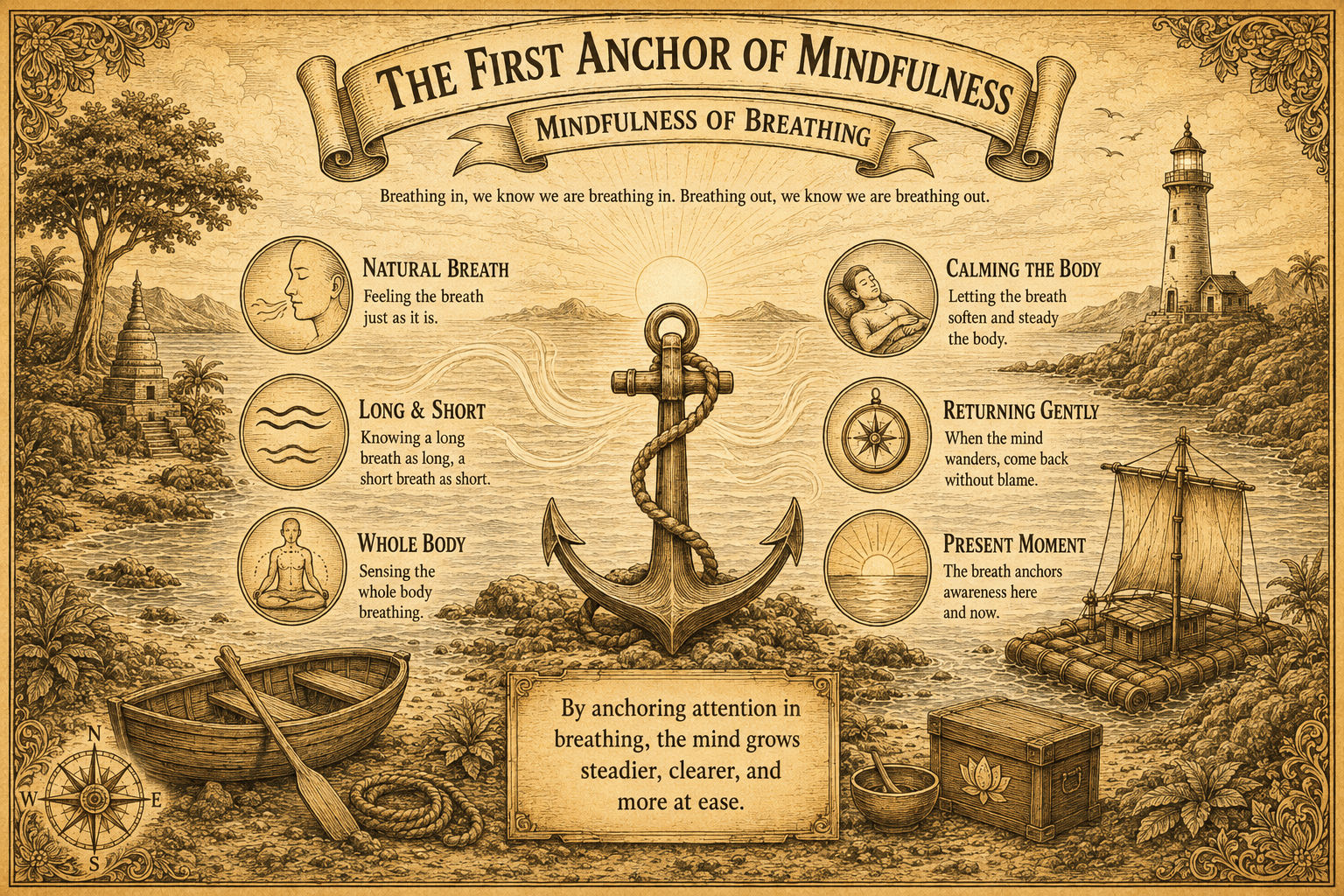
    Here a practitioner, gone to the forest or to the root of a tree or to an empty hut, sits down; having folded the legs crosswise, set the body upright, and established mindfulness in front, ever mindful they breathe in, ever mindful they breathe out.

    We simply bring our attention to the natural flow of the breath, feeling the physical sensations as it enters and leaves the body. We don’t try to control or change it – unless we are specifically practising a different kind of breath exercise – but rather observe its natural rhythm:

    Breathing in a long breath, the meditator understands: “I am breathing in a long breath”; or breathing out a long breath, they understand: “I am breathing out a long breath.” Breathing in a short breath, they understand: “I am breathing in a short breath”; or breathing out a short breath, they understand: “I am breathing out a short breath.”

    We notice the quality of the breath – long or short, deep or shallow, fast or slow. We might focus on the sensation at the tip of the nostrils where the air enters and leaves, or the rising and falling of the tummy or chest. The key is gentle, sustained attention on the physical feeling of breathing, moment by moment.

    Why start here?

    Mindfulness of breathing is a foundational practice for several key reasons, each providing vital material for our raft:

    • Anchoring: the breath provides an immediate, tangible focal point to anchor the mind in the present, counteracting distraction and mind-wandering, and helping us find stability when caught in the turbulent currents of reactivity or an urge to fall back into old patterns. It is like a steady rope we can hold onto when the waters get rough.
    • Calming: paying gentle attention to the breath tends to soothe the nervous system, reducing stress and anxiety, and calming the inner agitation that often fuels the pull of compulsive and reactive behaviours. This creates a calmer inner environment for beginning to recognise and sit with life’s inherent pain, difficulties and disappointments – Gotama’s first realisation – rather than habitually reacting.
    • Developing collectedness: regularly returning attention to the breath when the mind wanders helps develop an unscattered mind, something we explore in more detail later in our journey.
    • Observing change: each breath is different; the flow is constantly changing. Observing this directly gives experiential insight into impermanence, a key aspect of Gotama’s first realisation – it also helps us see that cravings and difficult emotions are themselves impermanent, arising and, in time, passing.
    • Self-awareness: by observing the breath, we naturally become more aware of our mental state – is it rapid when we are anxious, shallow when we are tense, deeper when we relax? This links our inner state to our physical experience, helping us recognise our own patterns, and to notice thoughts and emotions arising and passing without immediately identifying with them as personal to us.

    Mindfulness of Breathing, grounded in our commitment to the Five Gifts and held with self-compassion, is crucial: this self-compassion is an inward kindness in action, our appropriate response to our own pain, difficulties and disappointments. When we notice the mind has wandered – as it inevitably will – or when difficult feelings arise during practice, responding with gentle understanding rather than harsh judgment is itself an act of self-compassion. This matters especially given how easily self-blame can become an obstacle. Practising in this way is foundational for gathering the awareness we need to recognise and understand the terrain of our lives.

    Relevance to the pull of compulsive and reactive behaviours

    Mindfulness of breathing is a particularly powerful tool for the wider work of this workbook:

    • Stress reduction: it directly calms the nervous system, reducing the background stress and anxiety that often fuels the pull to distract ourselves or fall into compulsive patterns.
    • Increased awareness: it helps us recognise subtle cravings, triggers and emotional states that often precede falling overboard, allowing for earlier, gentler intervention.
    • Improved focus: it enhances the collectedness we need to engage effectively with our practice.
    • Emotional regulation: it creates a crucial gap between feeling an urge or difficult emotion and reacting impulsively, allowing time to choose a more helpful response.
    • Breaking the autopilot: this practice interrupts the habitual, often unconscious, link between a trigger and a compulsive response, by bringing conscious awareness to the present moment.
    • Cultivating self-compassion: practising non-judgmental observation of the breath, including moments of distraction or difficulty, fosters a kinder attitude towards ourselves, reducing shame and self-blame.
    • Building routine: incorporating a regular breath practice, even just five minutes at a time, helps us establish structure and healthy habits that support our overall well-being.

    Practice – anchoring in the breath

    Find a comfortable seated position, and allow the eyes to close gently or rest in a soft, downward gaze.

    1. Bring your attention to the physical sensation of breathing, wherever it is clearest – the nostrils, the chest, or the rise and fall of the tummy.
    2. Simply notice each in-breath and out-breath, without trying to change or control it. Notice whether it is long or short, deep or shallow.
    3. When the mind wanders, as it will, gently and without judgment guide your attention back to the breath. Each return is the practice, not a failure of it.
    4. Continue for three to five minutes, or longer if it feels helpful.
    5. Before finishing, take one slightly deeper breath, and let it be a small, deliberate act of gathering yourself back into the present moment.

    Self-reflections

    Find a quiet moment to sit and gently bring awareness to my breath for a minute or two, then reflect:

    1. What physical sensations of breathing did I notice most clearly – at the nostrils, chest or tummy? (view card)
    2. Did my mind wander? If so, what was my reaction to noticing the wandering? (view card)
    3. Did I find myself trying to control my breath, or was I able to observe its natural rhythm? (view card)
    4. How did my body feel before, during and after this brief period of breath awareness? (view card)
    5. Did focusing on my breathing feel pleasant, unpleasant, or neither? (view card)
    6. When I noticed a craving, urge or difficult emotion arise just now, could I find the gap between feeling it and reacting to it? (view card)
    7. What did it feel like to simply return to the breath, again and again, rather than needing to get it “right”? (view card)

    Journaling prompts

    Use your journal to explore your experience with breath awareness practice:

    1. Starting small: commit to practising three to five minutes of mindful breathing once or twice a day for the next few days. Journal briefly after each session about what you noticed – ease, difficulty, quality of attention, thoughts or feelings that arose.
    2. Breath throughout the day: set an intention to consciously check in with your breath a few times during your daily activities – while waiting, walking, working. What do you notice about your breath, and your state of mind, in these different situations?
    3. Mind wandering: during your practice, pay attention to where your mind tends to go when it wanders. Are there common themes – planning, worrying, remembering, fantasising? Practise gently acknowledging your thoughts and guiding your attention back to your breathing. Write about this process of noticing and returning.
    4. Breath and emotion: notice the connection between your breath and your emotional state. When you feel stressed or anxious, what happens to your breath? When you feel calm, how does it change? Write about your observations.
    5. The steady rope: write about a recent moment when the breath acted as “a steady rope” you could hold onto when things felt rough. What made it possible to reach for it in that moment?
    6. Breath as evidence of impermanence: notice how each breath is slightly different from the last. What does it feel like to let this ordinary observation stand in for the bigger truth that reactivity and difficult feelings are impermanent too?
    7. A gentler autopilot: think of one habitual, semi-automatic response you’d like to interrupt. How might returning to the breath, even briefly, create a gap before you act next time?

    Supporting material: scientific and philosophical perspectives on breath awareness

    For those interested in the science and philosophy behind this practice, here is a brief overview.

    • Neuroscience: conscious attention to breathing directly influences the autonomic nervous system. Slow, mindful breathing tends to activate the parasympathetic nervous system via the vagus nerve, counteracting the stress response, and is associated with lower heart rate, blood pressure and cortisol levels. Brain-imaging research suggests mindfulness practice strengthens activity in the prefrontal cortex, involved in attention and emotional regulation, and may reduce activity in the amygdala and the default mode network, associated with mind-wandering and rumination.
    • Psychology & Psychotherapy: mindfulness of breathing is a core component of evidence-based approaches such as MBSR, MBCT, MBRP, ACT and DBT, and has been shown to be effective in reducing stress, anxiety and symptoms of depression. By creating a pause between stimulus and response, it supports emotional regulation skills that are useful for managing cravings and difficult emotions without resorting to compulsive behaviour. It also increases interoceptive awareness, helping people reconnect with their bodies and understand their own emotional cues. As Jon Kabat-Zinn writes in his book Full Catastrophe Living, this kind of practice helps us draw on the wisdom of body and mind to face stress and pain. Observing the breath without judgment is also understood to cultivate self-compassion, which can help counteract harsh self-criticism.
    • Philosophy: the focus on the present moment aligns with philosophies that value direct experience over conceptualisation, such as phenomenology. The practice cultivates a kind of attentional discipline valued by Stoics and other schools focused on self-mastery. Simply observing the breath is an exercise in being rather than constantly doing – countering the restless striving that often underlies dissatisfaction, and connecting us to the fundamental rhythm of life itself.

    Remember to remember

    Mindfulness of breathing is far more than a simple relaxation technique; it is a foundational practice for cultivating the calm, clarity and self-awareness this whole journey depends on. It is one of the primary skills we cultivate to stabilise our raft, providing a reliable anchor in often-turbulent waters. By consistently returning our attention to the simple, tangible reality of the breath, we ground ourselves in the present moment and develop crucial skills in emotional regulation and focus.

    Practise patiently, practise kindly. There is no perfect way to breathe, or to be mindful of it. Simply showing up, and gently bringing your attention back again and again, is the practice itself.

    Feelings come and go like clouds in a windy sky. Conscious breathing is my anchor.

    Thich Nhat Hanh, Stepping into Freedom: An Introduction to Buddhist Monastic Training

    As we become more grounded through Mindfulness of Breathing, we are ready to explore the next layer of body mindfulness: our physical postures.

    Sutta references

    See the Index of sutta references

    Please note that ideas and concepts may evolve over time as the project develops.

    Download the full chapter (PDF)

    Continue to the next chapter.

  • 10 – Mindfulness of Posture

    10 – Mindfulness of Posture

    Recognise – Mindfulness of body

    Yet it is just within this fathom-long body, with its perception and conceiving mind, that I declare that there is the world, the arising of the world, the cessation of the world, and the path of practice leading to the cessation of the world.

    Gotama, Rohitassa Sutta (AN 4.45 / SN 2.26), translated by Ṭhānissaro Bhikkhu

    Episode 10 – Mindfulness of the body: mindfulness of posture

    An AI-generated ‘deep dive’ into this aspect of the RAFT to Freedom

    Recognising the shape of our experience

    Having established mindfulness of breathing – the first lens of Mindfulness of the Body – we continue exploring the first Anchor of Mindfulness by turning our attention to Mindfulness of Posture. This is the second lens connecting us with our bodies, and it involves simply knowing, clearly and directly, the position of our bodies as we move through life.

    Gotama (the Buddha) pointed to the reality that our entire experience of the world happens through our body-mind process. This includes our pain, difficulties and disappointments, and the path to their ending. Paying attention to the body, including its posture, is therefore not a trivial matter. It is engaging directly with the world as we actually experience it, with the immediate terrain we inhabit.

    The body scan: an important tool

    The body scan, as used in mindfulness-based approaches, is a simple yet powerful practice that invites us to reconnect with our physical experience of being alive. It involves slowly and attentively moving our awareness through different parts of the body, often from the top of the head to the tip of the toes, with a spirit of curiosity and kindness. As we scan, we simply notice any sensations present – warmth, tingling, tension, contact – without judgment or the need to change anything. For those of us newer to this kind of practice, and perhaps unfamiliar with Buddhist meditation, the body scan offers an accessible way to start rebuilding a safe, friendly connection with our physical self. This is a connection often disrupted by the pull of compulsive and reactive behaviours.

    This practice can be particularly supportive, since these patterns are frequently driven by a desire to escape discomfort or numb out. Instead of avoiding sensation, the body scan helps us build tolerance and curiosity, allowing us to feel more safely present with what is happening in the body, including our urges and emotions, just as they are. Rooted in ancient traditions that emphasise beginning with the body just as it is, it can help us recognise areas of tension, manage stress, and observe cravings as temporary experiences rather than urges that must be acted upon. The body scan fosters not only relaxation and emotional balance, but also self-compassion and a greater sense of being grounded.

    How to do a body scan (skip this practice if you find it triggering)

    • Begin by sitting or lying down comfortably. Allow your eyes to close gently if you wish.
    • Take a slow, deep breath in, and a long breath out.
    • Bring your attention to the top of your head. Notice any sensations – warmth, tingling or no discernable sensations at all.
    • Move your awareness down to your face: soften your eyes, your jaw, your cheeks.
    • Bring your focus to your neck and shoulders. If you notice tension, gently invite a sense of release.
    • Scan down through your arms – shoulders, elbows, wrists, all the way to your fingertips – simply noticing how they feel.
    • Draw your attention to your chest and upper back. Feel the rise and fall of your breathing.
    • Let your awareness move through your abdomen, then your lower back, noticing any areas of holding or ease.
    • Bring your attention to your hips, then slowly scan down through your legs – thighs, knees, calves – to your feet and toes.
    • Pause. Feel the weight of your body supported by the earth.
    • Take one more slow breath in, and gently exhale.
    • When you’re ready, open your eyes and return to the space around you.

    Examples of how to do a body scan can be found on the internet – for instance, Dr Mark Williams, an Oxford Professor, in his book Mindfulness and video Guided Body Scan Meditation (39 minutes). Professor Willem Kuyken also provides instruction in his book Mindfulness for Life, and video The Body Scan Practice (36 minutes).

    Mindfulness of posture

    Mindfulness of posture takes this same quality of attention into everyday life. While the body scan is a specific, often a guided practice and usually done lying down, mindfulness of posture is a more continuous awareness applied in every position throughout the day. Gotama’s instruction, from his talk on the four Anchors of Mindfulness, is characteristically direct:

    When walking, a practitioner knows, “I am walking.” When standing, they know, “I am standing.” When sitting, they know, “I am sitting.” When lying down, they know, “I am lying down.” Or however the body is disposed, they know it just so.

    This is not about judging the posture as good or bad, nor necessarily about correcting it immediately, though awareness may naturally lead to some adjustment. It is primarily about cultivating a non-judgmental awareness of how and where we are, physically, in this moment. Our posture can reflect how we are feeling – we may slump when we are tired or low, contract when we feel anxious or threatened, or naturally become more upright when we feel engaged and alert. But the relationship also appears to work in the other direction. We might also notice the transitions themselves – rising from a chair, beginning to walk, coming to a stop, or settling down to rest.

    Research suggests that changing the way we hold ourselves can feed back into our emotional and physiological state. Gently adopting a more upright, less slumped posture may, for some of us, support greater alertness, energy or a shift in mood. This gives us something else to notice and explore: not an instruction to hold ourselves in a ‘correct’ way, but an opportunity to discover how body and mind continually influence one another.

    Why this matters for our raft

    • Grounding: like the breath, awareness of posture anchors us firmly in the present, counteracting our mind’s tendency to get lost in past regret or future worry – common triggers for the pull of compulsive and reactive behaviours.
    • Mind-body connection: it helps rebuild the connection between mind and body, a connection often frayed by patterns of escape and self-sabotage and the attempt to numb uncomfortable feelings. Practices such as mindful walking, qigong and yoga make this connection explicit, weaving posture awareness directly into movement.
    • Revealing habits: it brings unconscious postural habits into our awareness – how we slump when feeling down, tense up when stressed, hold the body rigidly. Recognising these patterns is key to changing them.
    • Observing impermanence: postures constantly change, reinforcing the understanding that everything changes and is impermanent.
    • Insight into mental states: posture often reflects our inner state – we may notice ourselves slumping when low, tightening when anxious or becoming more upright when engaged. But this relationship can also work in the other direction: gently changing our posture may influence our mood, energy and level of alertness. Awareness of posture therefore gives us another way of recognising, and sometimes gently responding to, what is happening within us – noticing the physical signature of stress or craving as it arises (a clenched jaw, tight shoulders, shallow breathing) can let us intervene, with a few mindful breaths or a conscious shift in posture, before an urge has the chance to fully take hold.

    Noticing posture with kindness rather than judgment is itself an act of self-care – treating the body not as an enemy or a source of shame, but as the vehicle for this whole journey of healing and awareness.

    In terms of our raft metaphor, if the Five Gifts are the foundational planks, and the four Appropriate Responses are the rope binding them, then awareness of posture helps us understand the current condition and trim of our vessel. Are we balanced and upright, ready to navigate, or slumped and listing, taking on water? Knowing our posture helps us recognise our present state and make the adjustments our journey needs. It is another essential tool – the skill of embodied awareness – that we gather for our raft.

    Practice – a moment of posture (skip this practice if you find it triggering)

    Wherever you are right now, pause and bring awareness to your posture:

    1. Notice whether you are sitting, standing, lying down, or walking. Simply name it to yourself.
    2. You might also notice the transitions themselves – rising from a chair, beginning to walk, coming to a stop, or settling down to rest.
    3. Without judging it, notice how your body is positioned – its weight, points of contact and support, balance, tension or ease.
    4. If it feels helpful, make one small adjustment – softening the shoulders, lengthening the spine – and notice what, if anything, shifts.
    5. Notice first, then perhaps experiment gently, and notice again.
    6. Let this be enough. The practice is the noticing, not the fixing.

    Try weaving a few of these moments into an ordinary day – while waiting, working, or eating – and notice what you learn about the link between how you hold your body and how you feel.

    Self-reflections

    Take a moment right now to bring awareness to my posture:

    1. Am I sitting, standing, lying down, or walking? Can I simply note this? (view card)
    2. Without judgment, what do I notice about how my body is positioned? Tension? Ease? Slouching? Uprightness? (view card)
    3. How aware am I, typically, of my posture as I go about my day – working, eating, watching TV, talking with others? (view card)
    4. Can I recall times I noticed a link between my posture and my mood or energy level? (view card)
    5. What habitual postures do I tend to adopt when feeling stressed, tired, sad or anxious? (view card)
    6. Have I noticed that changing my posture can change my mood? (view card)
    7. When I wake in the night and an uncomfortable thought arises, do I physically turn over in an attempt to get away from it? (view card)

    Journaling prompts

    Explore your relationship with posture further in your journal:

    1. Posture check-ins: for one day, set gentle reminders – every hour, say – to check in and note your body’s posture without judgment. At the end of the day, write about any patterns or insights you noticed.
    2. Mindful adjustment: when you notice yourself in a posture associated with discomfort or a low mood – slumped shoulders, for example – gently experiment with adjusting to a more upright, open, relaxed posture. Hold it for a minute or two. Journal about any shifts you perceive, physically or mentally. Remember, this is non-judgmental self-inquiry, not self-criticism.
    3. Posture during activities: pay specific attention to your posture during a routine activity – eating a meal, brushing your teeth, working at a computer. Describe your typical posture and any sensations associated with it.
    4. Body scan connection: if you practise the body scan meditation described in this chapter, reflect on how it increases your general awareness of posture and physical sensations throughout the day.
    5. The vessel’s trim: using the chapter’s own metaphor, write about what your posture right now might say about the “trim” of your vessel – balanced and upright, or listing and taking on water?
    6. A postural habit worth changing: name one habitual posture you’d like to soften or change. What’s the smallest possible step towards noticing it more often?
    7. Turning over in the night: if the seventh self-reflection resonated, write about what it might look like to meet a middle-of-the-night thought with stillness rather than movement, just once.

    Supporting material: scientific and philosophical perspectives on posture

    For those interested in the science and philosophy behind this practice, here is a brief overview.

    • Neuroscience: our sense of body position relies on proprioception – signals from muscles and joints processed by the brain. Conscious awareness of posture engages higher cortical areas, such as the prefrontal cortex, involved in attention and self-awareness. Research on embodied cognition suggests a two-way relationship: our mood can influence how we hold and move the body, while changing posture – for example, becoming more upright rather than slumped – may in turn influence mood, energy and alertness. These effects appear to be modest and context-dependent, rather than supporting stronger claims sometimes made for ‘power posing’. Proprioception contributes to our wider sense of body awareness alongside interoception – our awareness of the body’s internal physiological state – both of which can contribute to emotional regulation.
    • Psychology & Psychotherapy: disconnection from the body is a common feature where compulsive patterns are present, often as a way of avoiding discomfort. Mindfulness of Posture directly counters this by inviting presence in the body, helping identify physical manifestations of stress – muscle tension, shallow breathing – that can precede a return to old patterns. Recognising how posture reflects emotion (shoulders slumped in sadness, chest tight in anxiety, for example) allows for earlier, gentler intervention. Body-language research also confirms posture as a significant non-verbal communicator, both reflecting and influencing inner states.
    • Philosophy: phenomenology, in the work of thinkers such as Merleau-Ponty, emphasises the “lived body” as the centre of our experience and perception of the world; posture is fundamental to this lived experience. The mind-body connection, long debated in philosophy, is explored experientially through posture awareness – seeing directly how mental states manifest physically. Stoicism, too, often attended to physical posture as an expression of inner composure.

    These fields converge on the understanding that awareness of our physical posture is far more than superficial; it is deeply intertwined with our emotional state, cognitive processes and overall sense of presence and well-being.

    Remember to remember

    Mindfulness of posture is a simple yet profound practice available in every moment. By cultivating awareness of how we hold and move our bodies, we anchor ourselves in the present and rebuild the vital mind-body connection. We also gain insight into our habits and emotional states, and develop a key skill for emotional regulation and self-compassion.

    We can also gently explore the two-way relationship between posture and how we feel: notice first, perhaps make a small adjustment, and then notice again. Our mood can shape how we hold ourselves, while becoming a little more upright, open or relaxed may sometimes shift our energy, alertness or mood in return. This awareness is another crucial tool we gather for our raft, helping us recognise the immediate terrain of our embodied experience. As you move through your day, try weaving in moments of simply knowing how your body is positioned – a small, steady practice that prepares the ground for everything that follows.

    No matter what posture you are in, if your mind is aware with understanding, you are meditating.

    Sayadaw U Tejaniya, Don’t Look Down On The Defilements, They Will Laugh At You (2008)

    This awareness of posture prepares us for the next layer of body mindfulness: bringing Clear Comprehension to our actions.

    Sutta references

    See the Index of sutta references

    Please note that ideas and concepts may evolve over time as the project develops.

    Download the full chapter (PDF)

    Continue to the next chapter.