The first factor of the Middle Way programme
The lens that steadies the helm
I believe if you change the way you look at things, the things you look at change.
Wayne Dyer
Reality is that which, when you stop believing in it, doesn’t go away.
Philip K. Dick

Episode 57 Aligning your internal map with reality
An AI-generated ‘deep dive’ into this aspect of the RAFT to Freedom
In this Training stage of our journey, we begin our active practice of our ‘RAFT Middle Way Programme’ with the first factor: Skilful Perspective (traditionally Right View or Appropriate View). Skilful Perspective means learning to see our situation more accurately – so that we can respond wisely instead of reacting automatically. Before we can change the direction of our raft, we need to understand what’s happening, what’s driving it, and what reliably helps.
In the grip of compulsion, we often suffer from what we might call existential dissonance – the strain that arises when our inner map clashes with reality. An inner map might insist, ‘I need this substance to be happy,’ or ‘I shouldn’t have to feel this pain,’ while life keeps showing us, ‘This is causing harm,’ and ‘Everything changes, including this pain.’ Our exhaustion comes not only from the facts themselves, but from our constant fight with them. Skilful Perspective is the decision to stop fighting against reality and to start working with it – aligning the mind with the basic pattern of things (the Dhamma), so that our choices become more skilful and less self-defeating.
One of the quiet habits of the mind is to misread experience. We treat what is changing as if it will stay the same. We treat what cannot fully satisfy as if it finally will. We treat passing thoughts, moods, and roles as if they define who we are. And we treat conditioned, fragile things as if they were solid and dependable.
These habits of mis-seeing are not moral failings. They are deeply human tendencies. Skilful Perspective begins to gently correct them. It teaches us to see change as change, experience as experience, and self as a process rather than a fixed entity. When we see more accurately, we suffer less unnecessarily – because we stop demanding permanence from what cannot provide it.
If the Middle Way programme is the raft we’ve built in the previous chapters, Skilful Perspective is the navigator’s eyeglass – the instrument through which we read the charts and interpret the ocean around us. To steer effectively, we must first see clearly.
Skilful Perspective is not a belief we force ourselves to hold. It is the beginning of an honest relationship with conditions. We learn to recognise what is wholesome and unwholesome: what leads toward steadiness, care, and freedom, and what leads toward agitation, contraction, and further suffering. This means learning to see what feeds the old pattern and what feeds release. A thought, mood, craving, or behaviour is not judged by whether it feels urgent, familiar, or justified, but by where it tends to lead. Does it deepen the storm, or does it help the raft become more seaworthy?
This is why Skilful Perspective is the first factor of the Middle Way Programme. It does not ask us to condemn ourselves; it asks us to understand the pattern. When craving is present, what conditions have fed it? When resentment is present, what story is keeping it alive? When clarity is present, what helped it appear? This is Skilful Perspective in practice: seeing life as a web of causes and conditions rather than as a fixed verdict on who we are. Once we see the pattern more clearly, we can begin to change the conditions – and when the conditions change, the voyage changes.
Skilful perspective has three parts, and we need all three:
- Responsibility: actions have consequences: When we act from craving, anger, or avoidance, the results usually hurt – sometimes immediately, sometimes later. When we act from honesty, restraint, and care, the results are usually steadier and kinder. This isn’t about blame; it’s about cause and effect. We may not control everything that happens to us, but we do have influence over what we choose next.
- Pattern: conditions shape experience: Skilful Perspective sees that things do not arise out of nowhere. Craving has conditions. Shame has conditions. Confusion has conditions. Clarity has conditions. Steadiness has conditions. Freedom has conditions. This means our experience is not a fixed verdict on who we are; it is a living pattern that can be understood, tended, and gradually changed. This means we do not have to reduce ourselves to a fixed identity – ‘I’m weak,’ ‘I’m broken,’ ‘This is just me.’ We can ask a wiser question: ‘What is feeding this, and what would help it fade?’ Seeing the pattern gives us something workable.
- Freedom: suffering can ease: Gotama’s Four Realisations show us that there is stress, there are causes for it, it can ease, and there is a path of practice that leads that way. This view loosens the tight story of ‘me.’ What we call the self is not a fixed thing that has to be defended at all costs, but a changing process shaped by conditions – Selfing (Chapter 54). When we hold responsibility, pattern, and freedom together, craving loses some of its authority, and the next skilful step becomes possible.
A secular dharma perspective
The secular dharma teacher Stephen Batchelor prefers to render ‘Right View’ as Perspective because ‘view’ can sound like a doctrine to believe, whereas perspective is something we can hold, test, and revise. In this reframing, Skilful Perspective is the lived capacity to widen what we can see: causes and conditions, consequences, and context. It helps us become less trapped inside a private story and more able to respond to what is actually happening.
This keeps the emphasis on dharma as the practical art of living rather than a belief system. We rarely have perfect information, so we use Skilful Perspective to choose the next good-enough step, watch the results, and adapt our actions to the reality of the new conditions we find ourselves in. This is a skilful positive feedback loop. It is the beginning of wise navigation: learning to see conditions more clearly so our choices can become more honest, careful, and free.
Reading what feeds the storm
A useful way to practise Skilful Perspective is to ask not only, ‘What happened?’ but ‘What is this feeding?’ In the old pattern, we may feed craving with fantasy, resentment with repetition, shame with secrecy, and confusion with avoidance. These are nutriments for suffering: they keep the weather rough and the raft unstable.
But we can also feed freedom. We feed steadiness with sleep, honesty, good company, mindfulness, restraint, forgiveness, and wise effort. We feed clarity by telling the truth about consequences. We feed dignity by making one clean choice, even after a difficult day. Skilful Perspective learns to read the menu of the mind: this thought, this action, this environment, this relationship – does it nourish freedom, or does it nourish the old storm?
How to practice: conditions, not conclusions
We cultivate Skilful Perspective not by forcing ourselves to believe a dogma, but by shifting how we see and interpret daily experience. We move from judging ourselves to understanding the process.
- The conditions protocol: When something goes wrong – a wobble, a slip, a regret – the mind often rushes to a verdict: ‘I’m weak,’ ‘I’ve blown it,’ ‘this is just me.’ Skilful Perspective invites a different movement: from verdict to investigation. We ask, ‘What conditions were in place?’ Was I hungry, lonely, tired, overloaded, triggered, rushing, isolated, resentful, or telling myself a distorted story?
Seeing conditions does not excuse what happened; it makes it workable. A verdict traps us in identity. A condition gives us a handle. If tiredness was present, rest becomes part of the path. If secrecy was present, honesty becomes medicine. If resentment was present, perspective and compassion may be needed. In this way, Skilful Perspective turns mistakes into information and information into wiser navigation. - The basic pattern check: When we’re confused or struggling, it can help to compare our inner map with the basic pattern of things as they really are. We can ask three simple questions about whatever we’re facing.
- First: is this permanent, or is it changing? (Often, when we look closely, it’s changing – sometimes quickly, sometimes slowly.)
- Second: can this fully satisfy me – can it provide lasting peace? (Even pleasant things tend to be imperfect and temporary.)
- Third: is this really ‘me’, or is it an experience arising and passing in a web of conditions?
When our inner map insists, ‘This high will last forever,’ or ‘This pain is who I am,’ we’re in dissonance. These questions gently bring us back into alignment with what’s really here.
- The ownership pause: Before a significant action – especially one we might regret – it helps to remember that choices have consequences. We might quietly say: ‘This action is mine. I will live with its results.’ Not as a threat, and not to stir guilt, but as a steadying reminder that we do have agency here. In this moment, we can shape the next moment.

Self-reflections
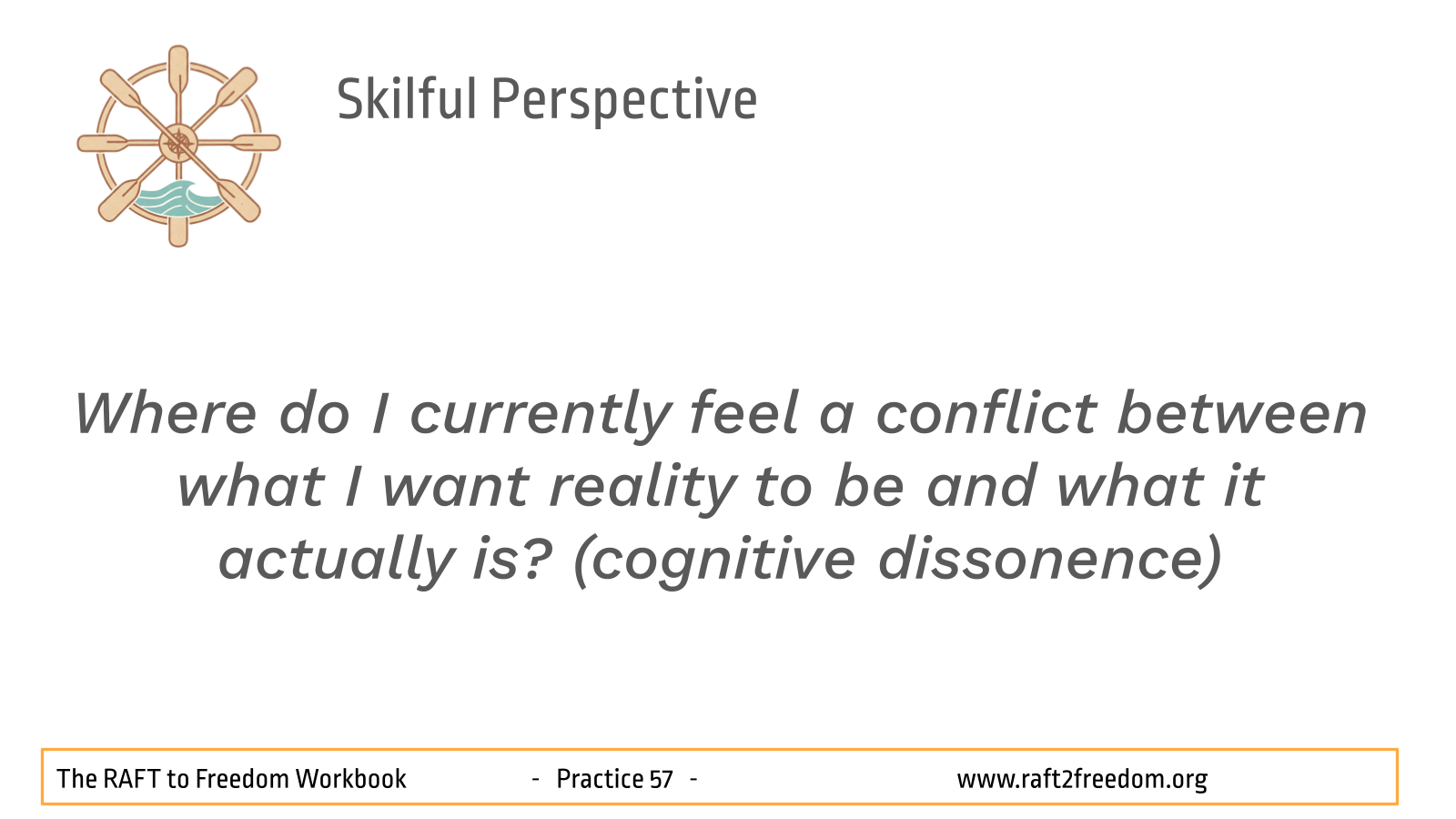
- Where do I currently feel a conflict between what I want reality to be and what it actually is? (cognitive dissonence)
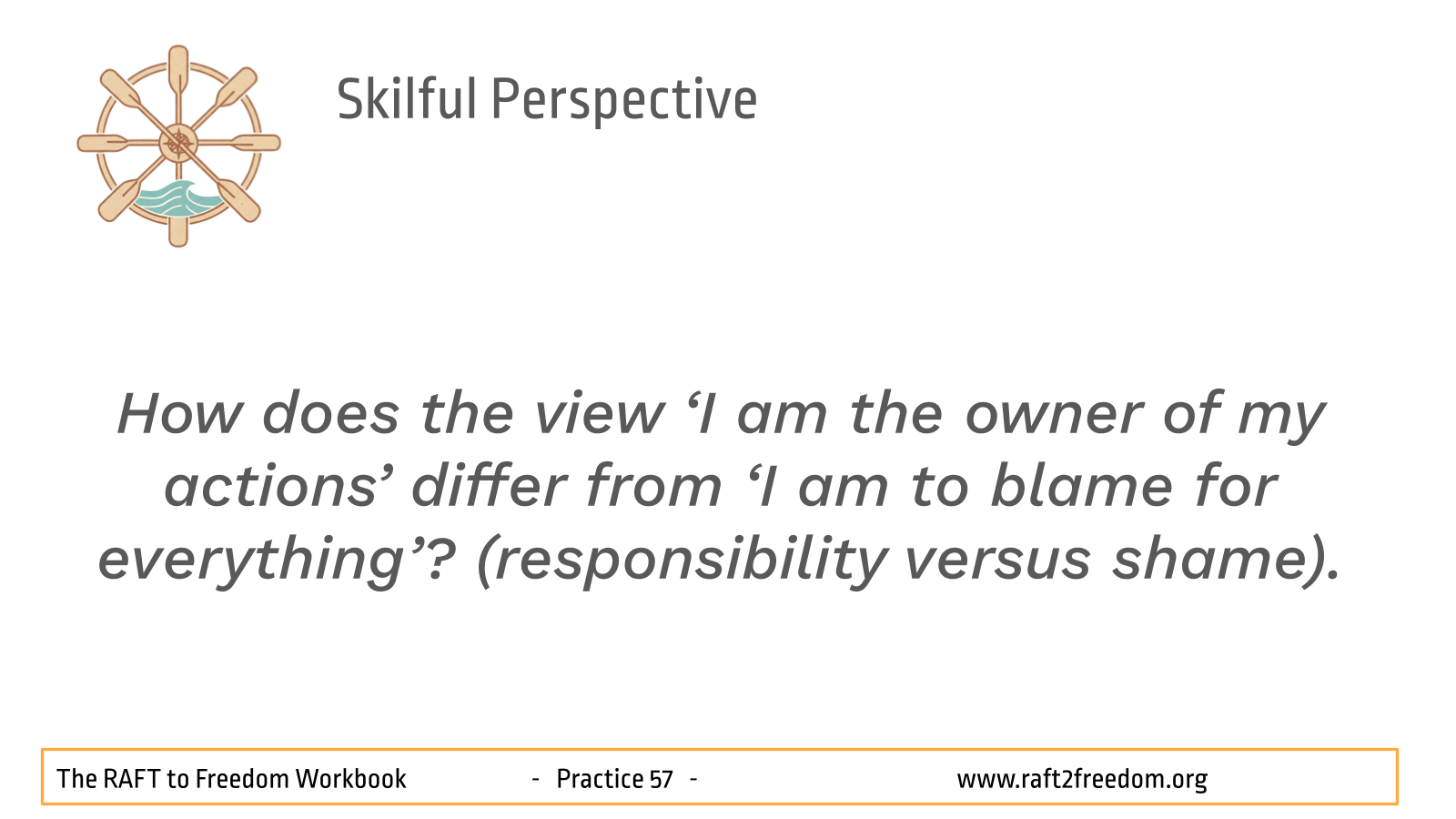
- How does the view ‘I am the owner of my actions’ differ from ‘I am to blame for everything’? (responsibility versus shame).
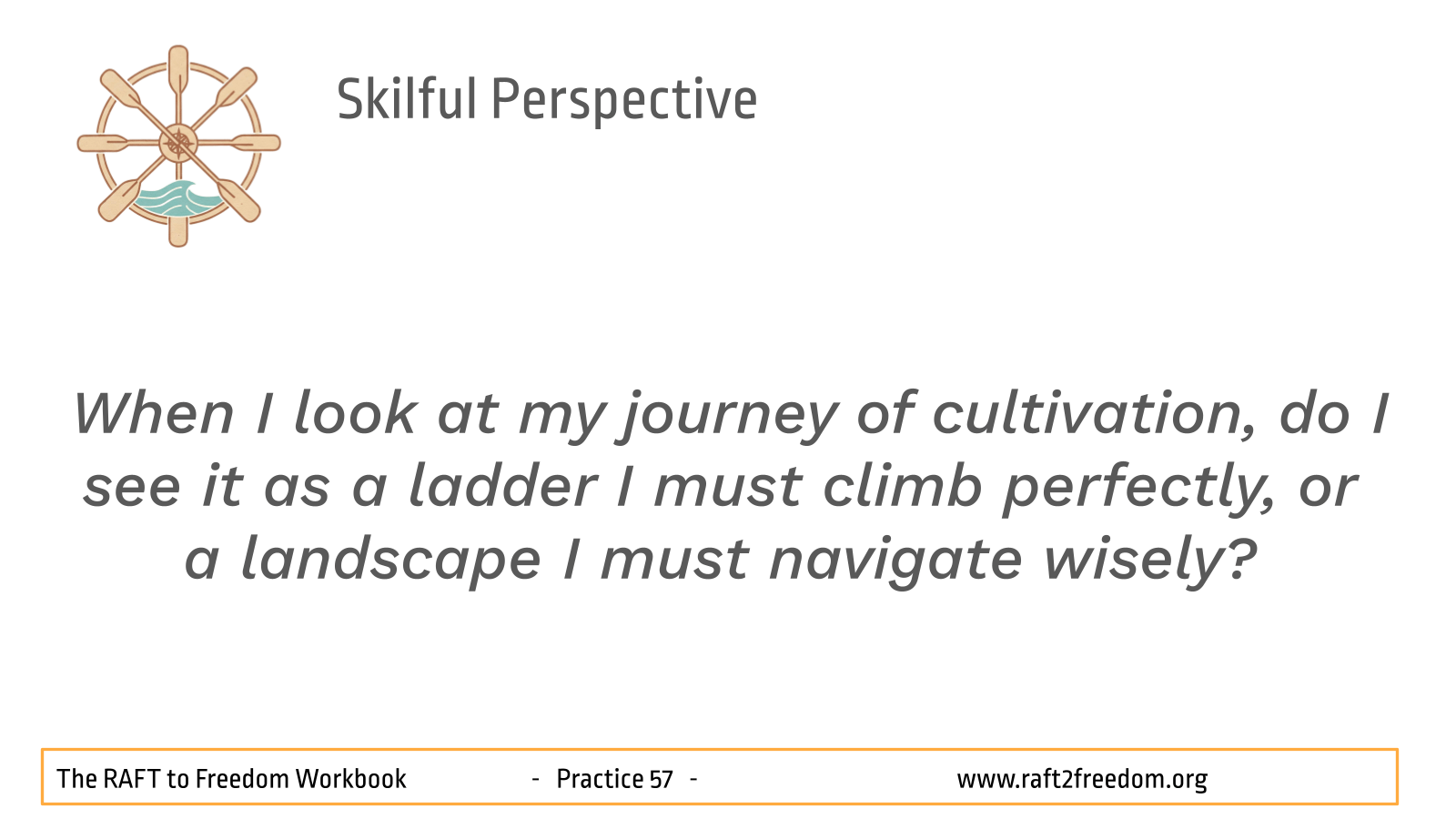
- When I look at my journey of cultivation, do I see it as a ladder I must climb perfectly, or a landscape I must navigate wisely?
- Can I recall a time when changing my perspective on a situation immediately changed my suffering, even though the situation itself didn’t change?
- How does understanding the basic pattern of impermanence help me ride out an urge?
- Do I hold any fixed views about myself (for example, ‘I am a hopeless case’) that contradict the truth of everything changes, including me?
- How does Skilful Perspective act as the forerunner for the rest of the programme? (For example, can I have Skilful Effort if my view is distorted?)
Journaling prompts
- From verdict to condition: Describe a recent mistake. First, write the ‘verdict’ your inner critic gave (for example, ‘You’re stupid’). Then, rewrite it using Skilful Perspective, listing the specific conditions that led to the mistake.
- The karma log: Trace a positive outcome you are experiencing now back to a specific skilful choice you made in the past. Validate your power to shape your life.
- Map correction: Identify one belief you used to hold that led you onto the rocks (for example, ‘Intoxication makes me charming’). Write down the updated chart reflecting the reality of that belief (for example, ‘Intoxication makes me confused and regretful’).
- The view of others: Think of a difficult person. Try to view them not as a villain, but as a being subject to causes, conditions, and their own suffering. How does this shift your feelings?
- The four realities re-write: Choose one current difficulty and describe it through the four realities: What is the stress? What is feeding it? What would easing look like? What small, skilful step points in that direction?
- Spectrum check: Where am I on the spectrum between ‘nothing matters’ (nihilism) and ‘everything is fixed’ (eternalism)? How does Gotama’s Middle Way find a footing between them?
- Message from the navigator: Write a letter from your inner navigator to your crew, explaining why following the basic pattern of things is safer than following impulses.
Supporting material: scientific and philosophical perspectives
For those interested in the scientific and philosophical underpinnings of ‘Skilful Perspective’, the following overview highlights some key connections.
- Neuroscience: Modern neuroscience increasingly describes the brain as a prediction-based inference system: it continually generates expectations about what will happen next and compares those expectations with incoming sensory data. When there’s a mismatch, the brain registers prediction error and – when it can –updates its internal model to reduce future mismatch. This ‘predictive coding / free-energy’ framing is closely associated with Karl Friston’s work: perception and action can be understood as ongoing attempts to minimize prediction error by revising beliefs and/or changing behaviour.
- Psychology: CBT rests on a simple, powerful insight: our interpretation of events strongly shapes emotion and behaviour, and those interpretations can be examined and revised. Cognitive restructuring trains us to identify automatic thoughts, spot common thinking errors (like catastrophising, all-or-nothing thinking, emotional reasoning, and selective attention), and replace them with appraisals that are more balanced and evidence-based. These ‘cognitive distortions’ were central to Aaron Beck’s work and remain a core CBT skillset.
- Philosophy: Epictetus puts the philosophy of ‘view’ in one famous line: ‘Men are disturbed, not by things, but by the principles and notions which they form concerning things.’ The Stoic point is not denial of pain; it’s that much extra suffering is generated by interpretation – by the stance we take, the story we tell, and what we demand reality to be. This maps cleanly onto the Buddhist emphasis on view as the forerunner: how we see conditions shapes what we do next.
Remember to remember
Skilful Perspective comes first in the Middle Way Programme because we cannot steer wisely while misreading the sea. It is the simple but powerful recognition that much of our suffering is intensified by friction with reality: our insistence that life should be different, our demand that discomfort should not be here, our belief that craving will save us, or our fear that a painful mood defines who we are. When perspective becomes more realistic, the whole system steadies. We stop feeding stories that intensify pain, and we start recognising the conditions that can reduce it.
Remember: we do not have to like the map, but we do have to read it honestly. The map says that everything changes, that actions have consequences, that craving adds suffering, and that freedom becomes possible when we stop feeding the causes of distress. So when we feel pulled into certainty, despair, or old reactions, we return to conditions. We name what is present, take one breath, and ask: ‘What is feeding this? What can I influence today?’ Then we do the next small, skilful thing – because direction is built from the next honest adjustment, not from perfect certainty.
We don’t see things as they are, we see them as we are.
Anaïs Nin
Dharma is something to do, not merely something to believe.
Stephen Batchelor
Sutta References
- Sammādiṭṭhi Sutta (MN 9) – Appropriate View
- Summary: This discourse offers a comprehensive definition of Right View. It explains it as understanding the wholesome and unwholesome, understanding the Four Nutriments (what feeds the mind), and understanding the Four True Realities.
- Mahācattārīsaka Sutta (MN 117) – The Great Forty
- Summary: The Buddha explains that Right View is the forerunner of the programme. It comes first because you must see the path to walk it. It also distinguishes between the Mundane’ view (Karma) and the ‘Noble’ view (Freedom from Taints),.
- Kaccānagotta Sutta (SN 12.15) – To Kaccāna
- Summary: The Buddha explains the Middle Way of view: avoiding the extreme of ‘Everything exists’ (Eternalism) and ‘Nothing exists’ (Nihilism/Annihilationism). Instead, one sees the arising and passing of phenomena dependent on conditions. This is the cure for Existential Dissonance.