
The mind’s direction of travel
Aligning intention with perspective
Whatever a person frequently thinks and ponders upon, that will become the inclination of the mind.
Gotama (The Buddha)
Hatred is never appeased by hatred in this world; by non‑hatred alone is hatred appeased. This is an ancient and eternal law.
Gotama

Episode 58 – Outsmart your autopilot with Skilful Intention
An AI-generated ‘deep dive’ into this aspect of the RAFT to Freedom
In this Training stage of our journey, we move from understanding where we are (Skilful Perspective, Chapter 57) to actively steering the vessel. The second factor of the Middle Way Programme is ‘Skilful intention’ (also translated as Right Resolve, Right Thought, or Right Motivation). In plain language, it’s the direction we choose to live from, not just the situation we find ourselves in.
Skilful Perspective helps us see the landscape – what’s happening, what’s driving it, what’s likely to help. Skilful Intention sets the course ahead. In the RAFT metaphor, perspective is the chart-reading and intention is the rudder: a deliberate choice in direction that shapes how we respond when pressure hits. It’s not random mental chatter or a passing mood. It’s the quieter, steadier ‘lean’ we rehearse again and again until it becomes the mind’s default way of moving.
Skilful Intention is not the same as a mood, an impulse, or a passing wish. A mood arrives through conditions; an impulse pulls; a wish imagines a result. Intention is different: it is the direction we choose to nourish. It is the quiet leaning of the heart before speech, action, and livelihood take shape. We may not choose every thought that appears on deck, but we can choose which ones we keep feeding, rehearsing, and steering by.
Skilful Intention is where perspective becomes direction. Once we see more clearly, we still have to decide what we are going to nourish. Will we feed craving, or practise abandoning? Will we feed resentment, or practise goodwill? Will we feed carelessness, or practise carefulness? These are not abstract ideals; they are the small inner leanings that shape the next sentence, the next choice, the next hour. Over time, the mind becomes familiar with the direction we repeatedly give it. This is why intention matters: what we often rehearse becomes easier to live.
The three rudder settings
In practice, Skilful Intention shows up as three distinct rudder settings. These are not passive states we wait for, but directions we deliberately rehearse to counter compulsive pull. Each setting keeps us oriented when the weather changes.
The three rudder settings are not three ways of shrinking life. They are three ways of freeing it. Abandoning frees us from being driven by craving. Goodwill frees us from the heat of resentment. Harmlessness frees us from the numbness that lets us damage ourselves, others, or the shared waters around us. Each one is a direction of travel: away from compulsion, hostility, and carelessness; toward simplicity, friendliness, and care.
- Abandoning: We practise the intention to let go, simplify, and release what feeds craving. This isn’t grim self-denial; it’s choosing what actually frees us. It turns a ‘no’ to compulsion into a ‘yes’ to a life that’s lighter, clearer, and less driven. We steer away from islands that promise comfort but trap us in craving, and back into open water where real freedom is possible.
- Goodwill: We practise friendliness and non-ill-will – toward others and toward ourselves. This is the antidote to resentment, irritation, and self-hatred. It cools the heat of reaction so we can respond without making things worse. We lower the temperature on deck, keep our hands steady on the helm, and avoid collisions caused by anger and reactivity.
- Harmlessness: We practise compassion and non-cruelty. This is the antidote to aggression, carelessness, and numb callousness. It asks one guiding question: does this choice reduce harm for me and for others? We choose a course that avoids damage – to our vessel, to other vessels, and to the waters we all share.
Traditionally, these three intentions are paired with the three currents they counter. Abandoning counters craving: the restless belief that more stimulation, possessions, or escape will finally complete us. Goodwill counters ill-will: the tightening that wants to blame, punish, resent, or push away. Harmlessness counters cruelty: the moment when another being’s pain stops mattering to us. Skilful Intention does not shame these currents when they arise; it recognises them as weather, then deliberately turns the rudder toward release, friendliness, and care.
A secular dharma perspective – Imagination
The secular dharma teacher Stephen Batchelor sometimes renders this factor as Imagination. Where the traditional language speaks of Skilful Intention, Resolve, or Thought, Imagination highlights the creative movement of the heart-mind before action takes shape. By this he does not mean fantasy, wishful thinking, or idle daydreaming. He means an ethically guided creativity: the capacity to envisage a response that is not simply the old reflex repeating itself. Imagination opens a space between stimulus and response, allowing us to picture a course of action shaped by abandoning, goodwill, and harmlessness rather than by craving, resentment, or fear.
When we are caught in compulsion, aversion, or despair, we can suffer from a poverty of imagination: the mind cannot picture any option except the familiar one, so the habit feels inevitable. Skilful Intention restores choice and gives us options, by helping us imagine a different course of action before we respond. We rarely have perfect information or perfect clarity, so instead of waiting for certainty, we imagine the most workable path we can: a small step that reduces harm, increases steadiness, and keeps us aligned with what matters most. We test it in action, learn from what happens, and adjust.
How to practice: the steering protocol
We strengthen Skilful Intention by deciding ahead of time what we’ll do when familiar triggers show up. A useful method is an ‘if–then’ plan: we choose a simple response in advance, so we don’t have to invent one in the heat of the moment. For example: ‘If stress hits at 5 pm, then I’ll take a walk’ (abandoning). Or: ‘If he criticises me, then I’ll take one breath and wish him well’ (goodwill). It turns intention into a ready action. We set the rudder before the weather turns. That way, when the storm arrives, we’re not trying to make decisions in chaos – we already know the direction we’re steering.
Setting intention does not magically override habit, but it gives the mind a prepared route. When a cue has already been linked with a skilful response – ‘If this happens, then I will do this’ – the wiser action is easier to find under pressure. We are not relying on heroic willpower in the middle of the storm; we are training the vessel to know its course before the wind rises.
The seven-step sequence
When we feel that familiar drift – the tug of compulsion, the heat of reactivity – it can help to run a short sequence that brings us back to centre and resets the rudder. Nothing dramatic. Just a few deliberate moves that interrupt autopilot and reopen choice.
- Name the pull: We call it out gently and directly: ‘Grasping is here,’ ‘resentment is pulling,’ ‘escape is tempting.’ Once it’s named, it’s no longer a foggy mood – it becomes something we can relate to.
- Call the tone and soften the body: We notice the feeling tone underneath it (pleasant, unpleasant, neutral) and take three soft out-breaths. As the body de-braces, the mind has more room to choose.
- Choose the intention that fits: Instead of arguing with the urge, we pick the direction that helps:
– abandon (let go, simplify)
– goodwill (soften, befriend)
– harmlessness (protect, don’t add harm)
It doesn’t have to be heroic – often the smallest shift changes everything. - Set a cue: A short phrase can hold the course for the next stretch: ‘Let go and simplify,’ ‘Stay kind,’ ‘Do no harm.’ Something the mind can remember when it’s under pressure.
- Preview it: Before we move, we rehearse the wiser option for a second – closing the tab, putting the phone down, sending the calmer message, walking away. The mind often follows what it has just pictured.
- Take one small step: We choose a single doable action that expresses the intention now: delete the draft, drink water, step outside, delay ten minutes, message someone safe. One step is enough to break the spell.
- Close the loop: We take a moment to register it: ‘I noticed. I chose. I steered.’ No fanfare – just letting the nervous system learn that we can meet the pull without obeying it. That quiet recognition is how confidence grows.
When the rudder slips
Skilful Intention does not mean we always steer perfectly. Sometimes we drift. Sometimes old currents catch us before we realise what has happened. The practice is not to turn that into a verdict, but to reset the rudder as soon as we can. A moment of irritation can become a return to goodwill. A moment of grasping can become a return to simplicity. A moment of carelessness can become a return to carefulness.
This matters because intention is trained by returning, not by performing perfection. Each return teaches the mind that it does not have to keep travelling in the direction of the first impulse. We can notice, soften, choose again, and take one small action that re-aligns us with the life we are trying to live. In this way, Skilful Intention becomes less like a heroic vow and more like a practised aspiration of the heart.
Troubleshooting: sticky loops
Sometimes an unhelpful thought doesn’t pass on its own – it keeps reappearing, tightening into a loop. When that happens, we can lean on a classic set of five ‘unsticking’ options. We don’t have to force all five; we simply try the one that fits the moment.
- Replace it with the opposite: deliberately bring to mind a steadier, kinder, or more realistic thought.
- Reflect on the downside: consider where this thought leads if we keep feeding it.
- Withdraw attention: stop giving it airtime; shift to a neutral anchor (breath, body, task).
- Soften the tension: relax the physical tightness that comes with the thought (jaw, belly, forehead), letting the loop lose fuel.
- Contain it with firm resolve: if needed, set a clear boundary – ‘not now’ – and return to what matters.
Used this way, sticky thoughts become less like commands and more like weather: something we can work with, without obeying.

Self-reflections
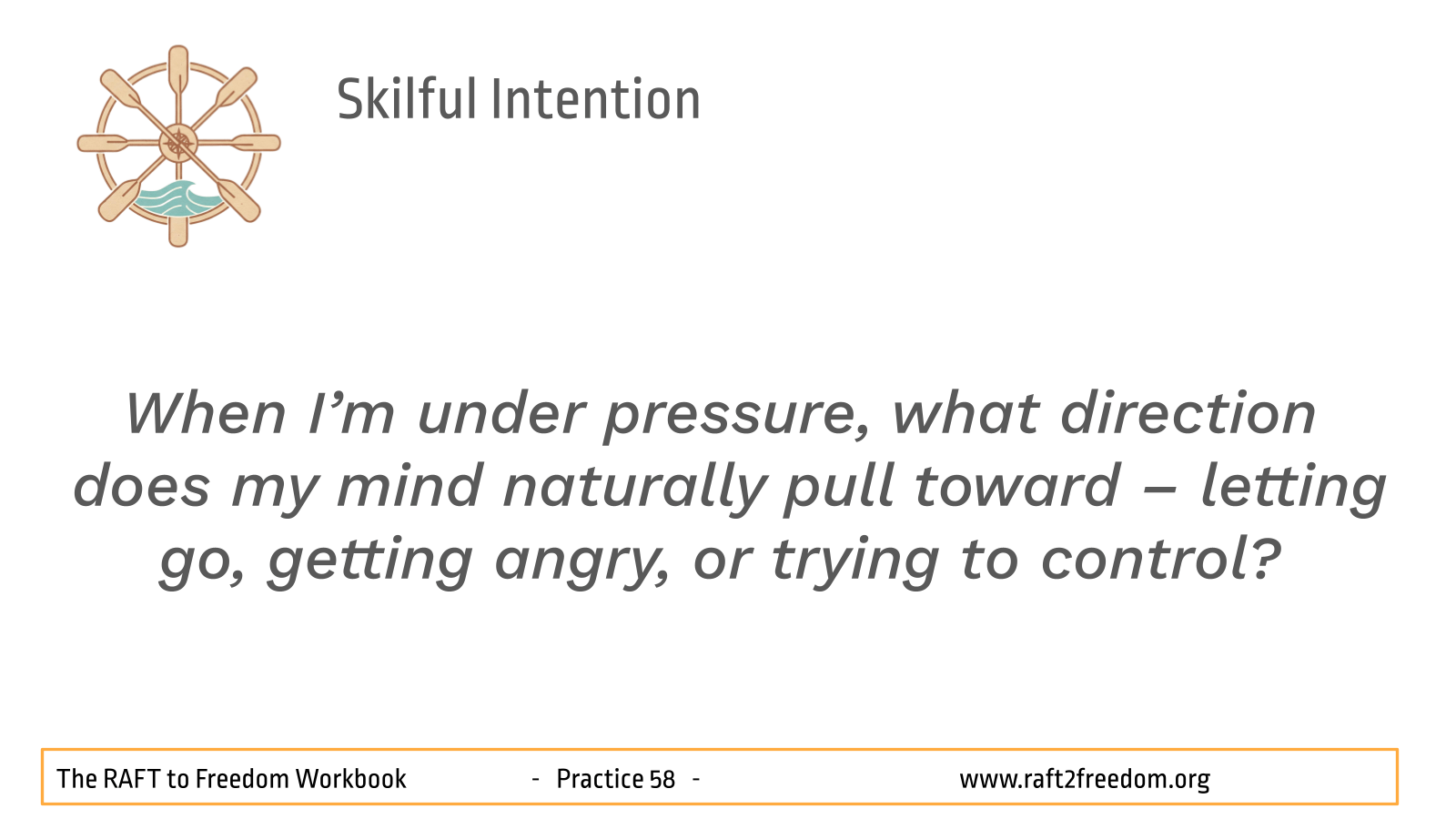
- When I’m under pressure, what direction does my mind naturally pull toward – letting go, getting angry, or trying to control?
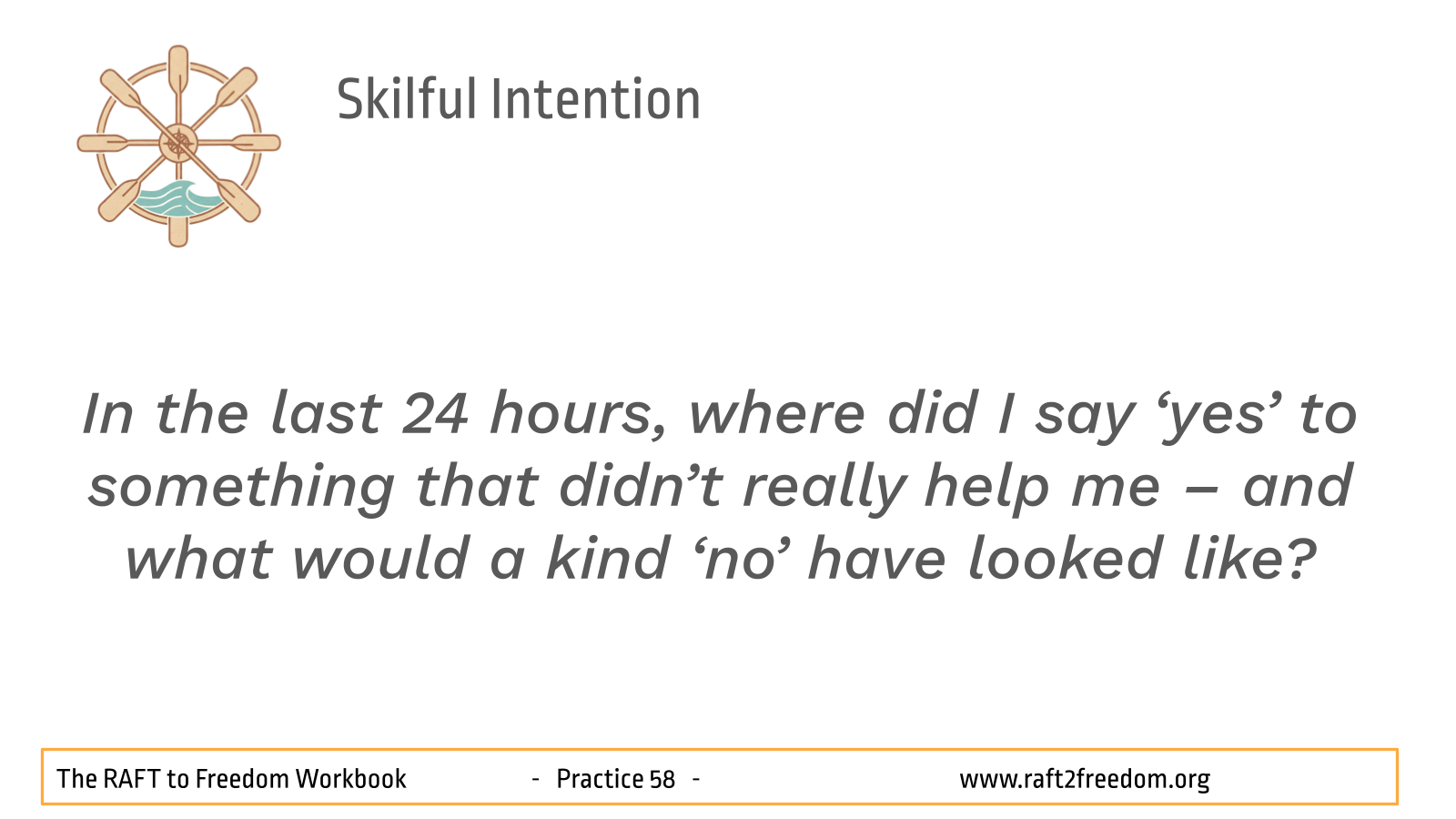
- In the last 24 hours, where did I say ‘yes’ to something that didn’t really help me – and what would a kind ‘no’ have looked like?
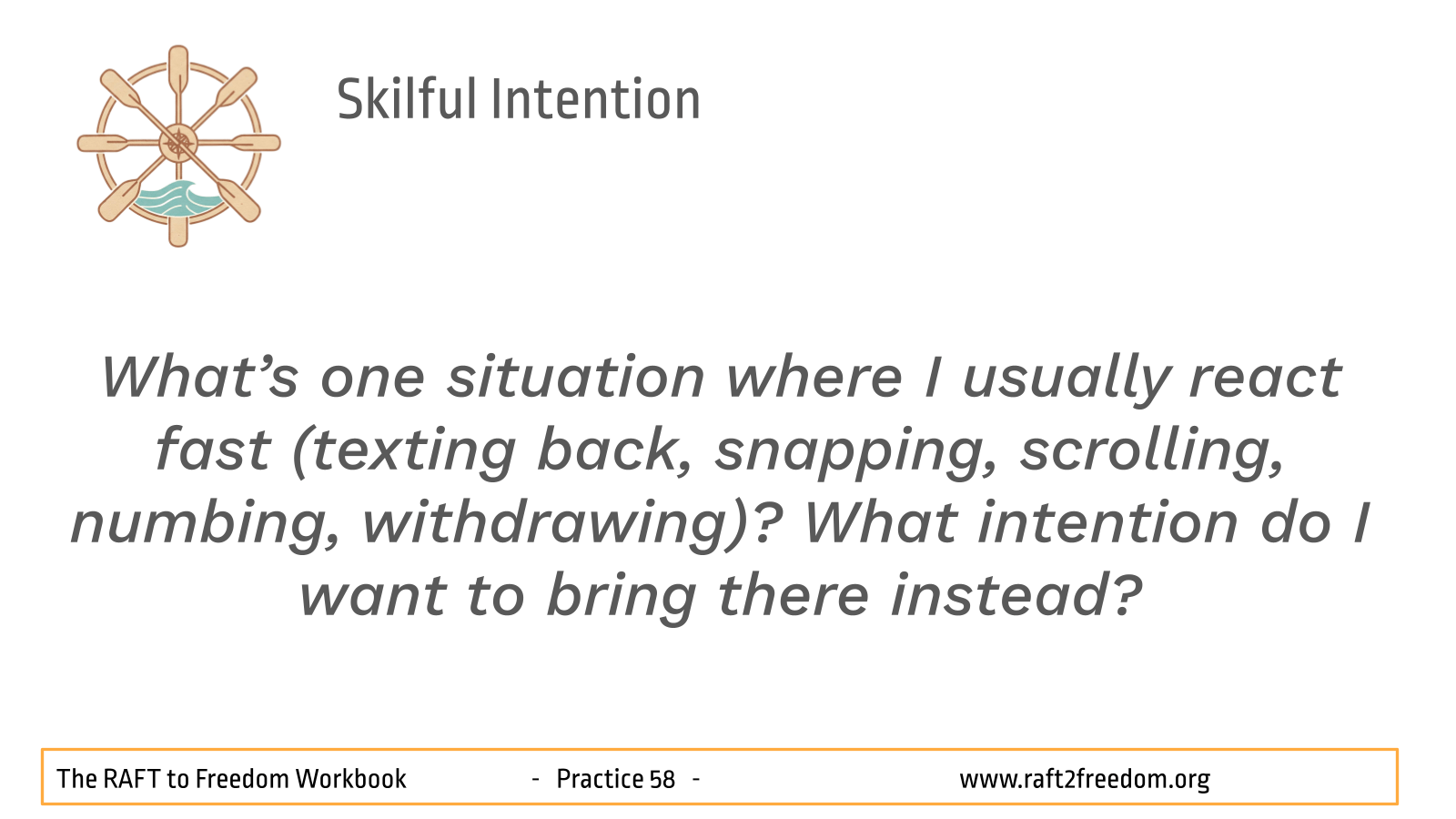
- What’s one situation where I usually react fast (texting back, snapping, scrolling, numbing, withdrawing)? What intention do I want to bring there instead?
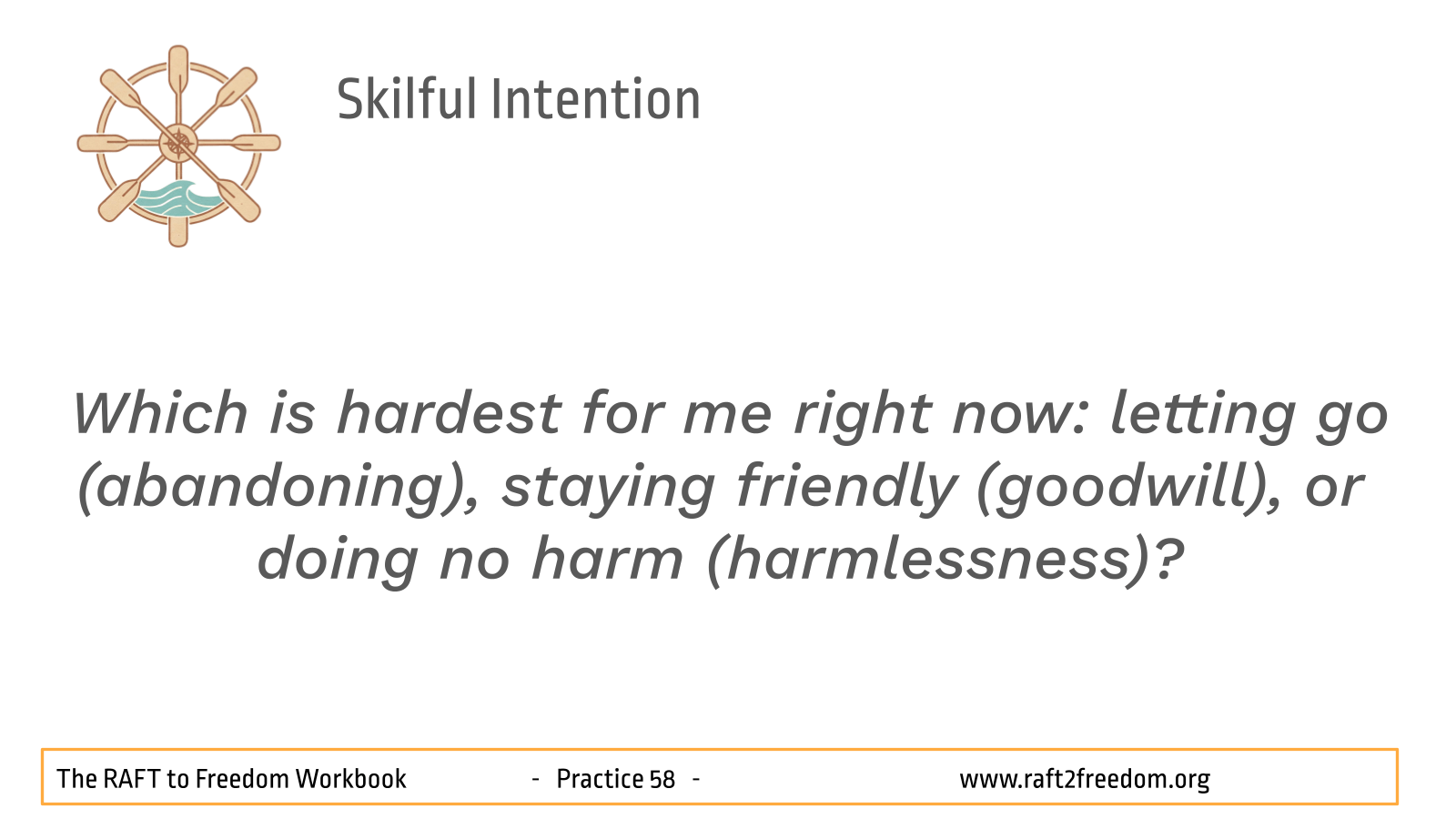
- Which is hardest for me right now: letting go (abandoning), staying friendly (goodwill), or doing no harm (harmlessness)?
- When I’m tired, hungry, lonely, or stressed, what changes in my intentions – and what support do I need before I make decisions?
- If I could rewind one moment from this week, what intention would I choose the second time around?
- What one short phrase would help me steer today (for example, ‘simplify,’ ‘stay kind,’ ‘do no harm’)?
Journaling prompts
- Intention-to-action diary: Each morning, choose one simple intention (for example, ‘Today I steer by Goodwill’). In the evening, write about the moment you enacted it – what happened, what you wanted to do, what you did instead, and how it changed the next few minutes.
- The rudder log: Identify three moments of drift today – toward craving, anger, avoidance, or numbing. For each: trigger + body signal + story. Then note how you steered back (even slightly). If you didn’t, write what happened next – no blame, just data.
- Imagining freedom: Write a five-minute scene of a future moment where you stay free, clear, or calm. Include a few details (place, sounds, body feeling, thoughts) and end with: ‘The key move was…’
- Cultivating the opposite: Pick one recurring negative loop (resentment, self-attack and so forth). Name it. Then write a short paragraph of the opposite intention (goodwill, patience, care). Note any resistance and any small softening.
- The renunciation list: List three things to let go of today – one habit, one object, and one story. Next to each, write what you’re saying ‘yes’ to (peace, time, dignity). Notice how it feels to name it.
- The harmlessness audit: Review one interaction. Was there a hidden urge to win, punish, or prove a point? Then write one alternative you’d like to practise next time: a sentence, a pause, or a boundary that reduces harm.
- Letter to the rudder: Write a short letter to your own capacity to steer. ‘Dear Intention…’ Finish: ‘When I’m pulled toward ___, remind me to ___.’ Close with one promise you can keep for the next 24 hours.
I will not suffer for my preferences.
Vince Cullen
Supporting Material: scientific and philosophical perspectives
For those interested in the scientific and philosophical underpinnings of ‘Skilful Intention’, the following overview highlights some key connections.
- Neuroscience: Setting a conscious intention recruits the brain’s executive networks (often associated with prefrontal systems) – the circuitry involved in planning, inhibition, and choosing long-term outcomes over short-term impulses. That matters because compulsive behaviour is heavily supported by fast, well-worn habit loops (often linked with basal ganglia circuitry). When we deliberately pause and set direction, we give the ‘choice’ system a chance to come online before the ‘habit’ system grabs the wheel.
Implementation intentions – the simple ‘If X happens, then I will do Y’ plan – make this even more effective because they reduce decision-load in the moment. Instead of improvising under stress, we’ve already pre-linked a trigger to a response. Adding a quick mental preview (imagining ourselves doing the skilful action) further primes the relevant action patterns, making the wiser move easier to access when pressure hits. - Psychology: Psychology has long known that rehearsal changes behaviour. Athletes use imagination and mental practice to strengthen their performance under pressure, and wellbeing can use the same mechanism: we rehearse the response we want before we’re triggered. When we repeatedly imagine meeting a cue with steadiness – pausing, reaching out, leaving the room, choosing a healthier coping strategy – the trigger becomes less novel, and the new response becomes more familiar.
Acceptance and Commitment Therapy (ACT) adds an important dimension: rehearsal works best when it’s anchored in values. We’re not just trying to ‘be good’ or ‘avoid relapse’; we’re practising a direction that matters – dignity, freedom, care, honesty, connection. Values make the intention emotionally credible, which increases follow-through. In other words, rehearsal isn’t just strategy; it’s how we train for a life we actually want. - Philosophy: Virtue ethics puts intention at the centre of character. It’s not only outcomes that matter, but the kind of person we are becoming through repeated choices. A single kind act is helpful; a repeated intention of goodwill becomes a trait. Over time, intention shapes the inner posture from which actions arise.
This is why Skilful Intention is more than positive thinking. It is deliberate formation: we practise abandoning, goodwill, and harmlessness until they become familiar ways of moving through life. In virtue terms, we’re cultivating dispositions – not as a moral badge, but as a practical foundation for freedom. When intention is trained, wise action becomes less of a struggle and more of a natural response.
Remember to remember
Skilful intention is what links understanding to behaviour – it’s where the map becomes movement. We can know what’s true about craving and consequences, and still get pulled off course in the moment. Intention is the small but powerful act of setting a direction before we act: letting go rather than grasping, softening rather than hardening, protecting rather than harming. Over time, what we repeatedly think and rehearse becomes the mind’s default lean. If we keep replaying resentment, the mind starts to expect conflict and steer toward it. If we repeatedly rehearse goodwill, the mind learns a different route – one that creates fewer aftershocks and more steadiness.
Remember, too, that intention isn’t only something we have; it’s something we can shape. One of the most practical ways is to imagine the next step – to picture the wiser move for a second before we make it. That brief pause creates choice: we notice the pull, we check the direction, and we imagine the path of harmlessness (or abandoning or goodwill) long enough for it to become reachable. Then we take one small step that matches it. Each time we do that, we’re not just avoiding a mistake; we’re training the rudder to set itself more naturally the next time the weather turns.
And when the rudder slips, the voyage is not over. We return. We do not need a perfect mind before we can practice; practice is how the mind is gradually trained. Each return matters: from grasping to release, from resentment to goodwill, from carelessness to carefulness. This is how Skilful Intention becomes embodied – not as a slogan, but as a direction we trust because we have practised steering by it.
What you can do, or dream you can, begin it; boldness has genius, power, and magic in it.
John Anster, after Goethe’s Faust
We learn to apply and reapply, moment to moment, with an effort that is calm and caring.
Christina Feldman
Sutta References
- Magga‑vibhaṅga Sutta (SN 45.8) – Analysis of the Path
- Summary: Defines Skilful Intention specifically as thoughts of renunciation (freedom from sense-craving), non‑ill‑will (goodwill), and non‑cruelty (harmlessness).
- Dvedhāvitakka Sutta (MN 19) – Two Kinds of Thought
- Summary: The Buddha describes how he divided his thoughts into two classes: those leading to affliction and those leading to liberation. He teaches how to incline the mind by frequently pondering the wholesome.
- Mahācattārīsaka Sutta (MN 117) – The Great Forty
- Summary: Explains that Skilful View is the forerunner. We must see clearly (Map) before we can intend effectively (Rudder).
- Vitakkasaṇṭhāna Sutta (MN 20) – The Removal of Distracting Thoughts
- Summary: Provides practical methods for dealing with the “wrong rudder” (unwholesome thoughts), including replacing them with the opposite and examining their danger.