“He knows a mind with lust as a mind with lust, and a mind without lust as a mind without lust.”
~ Gotama (the Buddha)
“When the mind is still, we see clearly; when the mind is clear, the heart is free.”
~ Christina Feldman
Episode 36 – The Third Anchor of Mindfulness: Monitoring Mindfulness
An AI generated ‘deep dive’ into this aspect of the RAFT to Freedom
Knowing the mind, freeing the mind
In this third stage of our journey, having cultivated ‘Appreciative Joy’ (self-appreciation) as the appropriate response, we now deepen our mindfulness practice through the ‘Third Anchor of Mindfulness’ – Monitoring Mindfulness’. This anchor corresponds to Gotama (the Buddha’s) third Foundation of Mindfulness and is the practice of observing the mind’s inner weather with calm, discerning awareness.
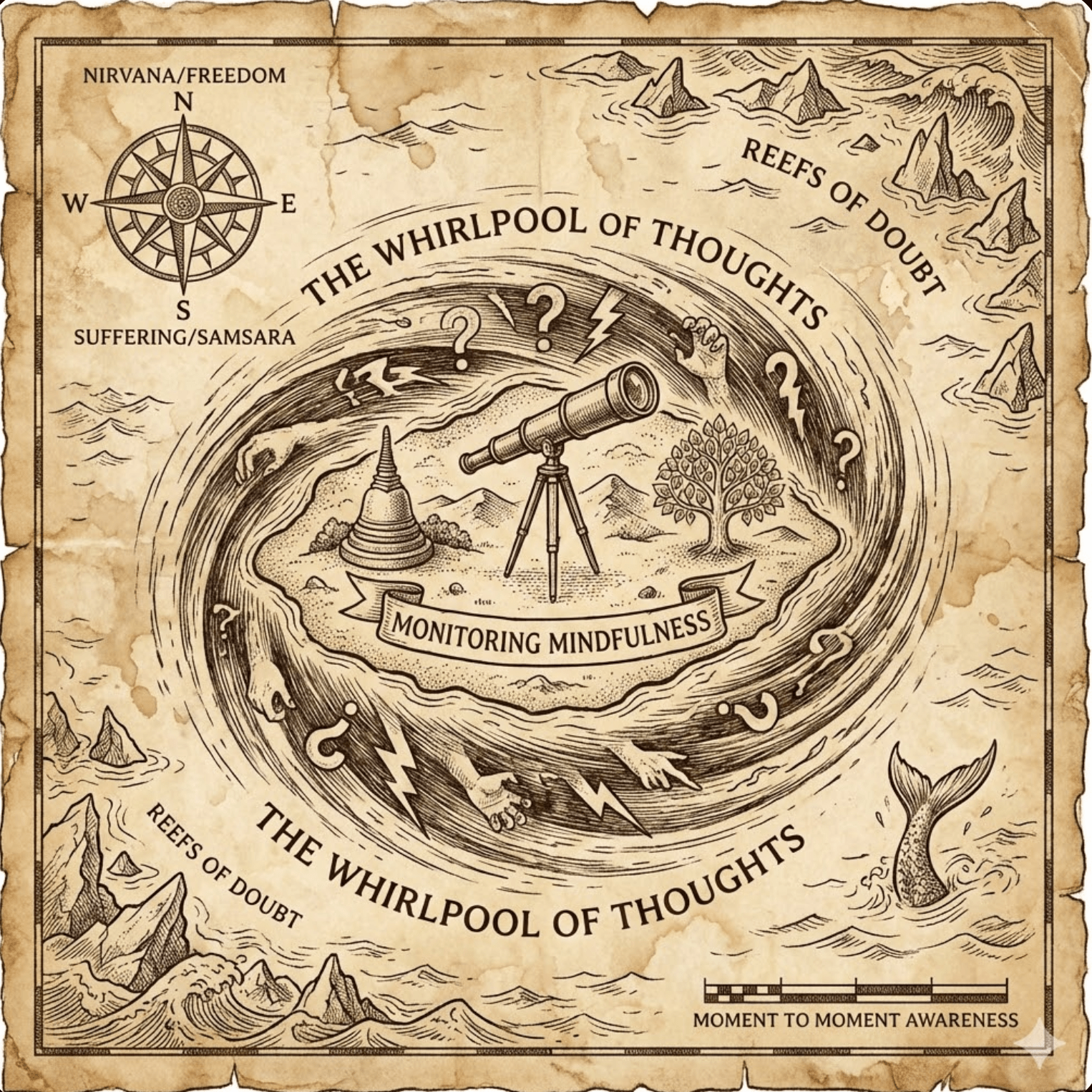
In his well known talk on establishing mindfulness, Gotama taught that we should know the mind directly. Here, mindfulness shifts from observing what the mind is thinking to recognising how the mind is – its quality, tone, or mood. We become aware not of individual thoughts, but of the state in which thinking occurs.
This requires us to observe the overall quality or condition of the mind, noting whether it is currently:
Caught up in craving, lust and wanting or free.
Caught up in aversion and ill-will or free.
Confused, deluded or ignorant or free from these.
Contracted or scattered.
Well trained and developed or undeveloped.
Has capacity to grow (surpassable) or not.
Focused or distracted.
Liberated and free or stuck in old patterns.
This detailed observation is crucial for the ‘Freedom’ stage of our journey because it allows us to directly recognise and familiarise ourselves with the mind when it is free from the core mental afflictions (defilements) of greed, hatred, and delusion. These moments are the experiential tastes of Gotama’s third realisation – that freedom from cravings, aversions, compulsions and confusion is possible – the cessation of the suffering experienced due to avoidable pain, difficulties and disappointments.
What Monitoring Mindfulness
Monitoring Mindfulness is the simple, descriptive awareness that notices what the mind is like right now. It does not analyse or fix; it simply sees. This foundation recognises the mind’s current weather –whether it is contracted or open, scattered or steady, coloured by desire, aversion, or delusion, or momentarily free from them. It observes whether attention is bright or dull, restless or settled, distracted or collected. Its task is not to change the mind but to know it honestly. Like checking the weather, it names the conditions without judgment: “The mind is tight,” “The mind is restless,” “The mind is bright and steady.” In doing so, it trains us to see the mind as an object rather than be swept away by it.
The function of ‘Monitoring Mindfulness’ is to cultivate clear, unembellished knowing of the mind’s moods, habits, and biases. By observing the mind without commentary or criticism, we learn to recognise patterns that normally operate out of sight beneath the waves. This mindful monitoring creates the space in which freedom can grow: the mere act of seeing reactivity loosens its grip. Its tone is simple, diagnostic, and observational – a quiet ‘noting’ that neither resists nor pursues anything. Monitoring Mindfulness tells us what is here; the Awakening-Factor of ‘Liberating Mindfulness’ later provides the steady presence that holds the whole path together.
In one sentence: Monitoring Mindfulness recognises what the mind is like; Liberating Mindfulness is the stable awareness that allows awakening to unfold.
In our RAFT to Freedom metaphor, this practice is like the Captain, Navigator, and Crew learning to read the inner weather. Having stabilised the vessel through the first two anchors – ‘Grounding Mindfulness’ (the body – chapters 7 to 13) and ‘Healing Mindfulness’ (Feeling Tone – chapter 27) we now raise our eyes to the inner atmosphere: the patterns of cloud, wind, and stillness that influence every movement of our raft. To know the state of the weather is to sail wisely.
The purpose of Monitoring Mindfulness
Mindfulness of mind invites us to:
Recognise mind states that obscure freedom (greed, aversion, delusion) and those that reveal it (clarity, calm, equanimity).
Observe these states as impermanent, arising and passing conditions rather than defining identity.
Familiarise ourselves with the mind at peace, building confidence that freedom is possible and real.
Strengthen the capacity to dwell in the space of freedom (non-reactivity) – the living experience of cessation.
How to practise Monitoring Mindfulness
The following steps should be undertaken with a sense of kind clarity, viewing the mind’s movements impersonally, as phenomena occurring in awareness.
Shift attention from content to context: When the mind is busy, gently turn awareness toward the mood or tone behind the thoughts, rather than analysing the thoughts themselves. Ask quietly: “What is the quality of mind right now – calm, restless, contracted, open?”.
Label with kind clarity: As Gotama taught in his talk on mindfulness, gently note the state of the mind. Use labels like: “Mind with wanting,” “Mind free from wanting,” “Mind scattered,” or “Mind bright.” Use these as friendly recognition, not as judgments.
Notice arising and passing: See how mind states are impermanent conditions that arise, linger, and dissolve, like clouds. Recognising impermanence loosens identification; these are conditions, they are not ‘me’.
Rest in clarity: When the mind feels open, steady, or unhindered, stay there. Let awareness dwell in that ease, without clinging. This is dwelling in the space of freedom – the essence of liberating mindfulness.
Recognise the conditions: Notice what nourishes clarity (calm breathing, gratitude, ethical alignment) and what clouds it (haste, craving, self-criticism). This is the practical wisdom of navigation – learning how peace arises and what disturbs it.
Practise non-identification: See each state as a passing weather pattern, not an identity. Instead of “I am anxious,” sense “Anxiety is present; it will pass.” This shift embodies the insight of non-identification with a fixed permanent ‘self’(not-self).
Appreciate the mind’s potential: Remember Gotama’s teaching, “The mind is luminous, but defiled by incoming impurities.” Each moment of clear seeing reveals this natural luminosity.
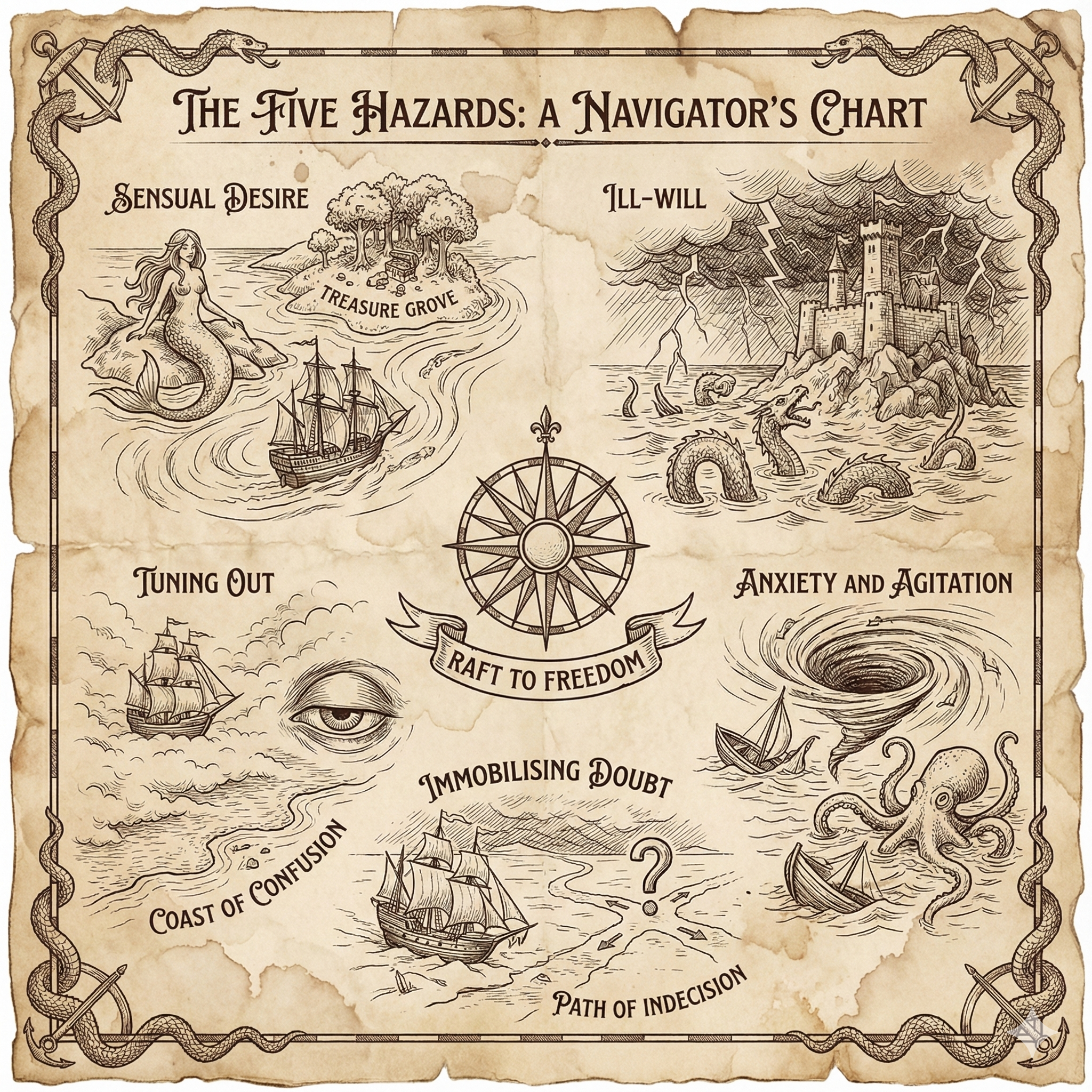
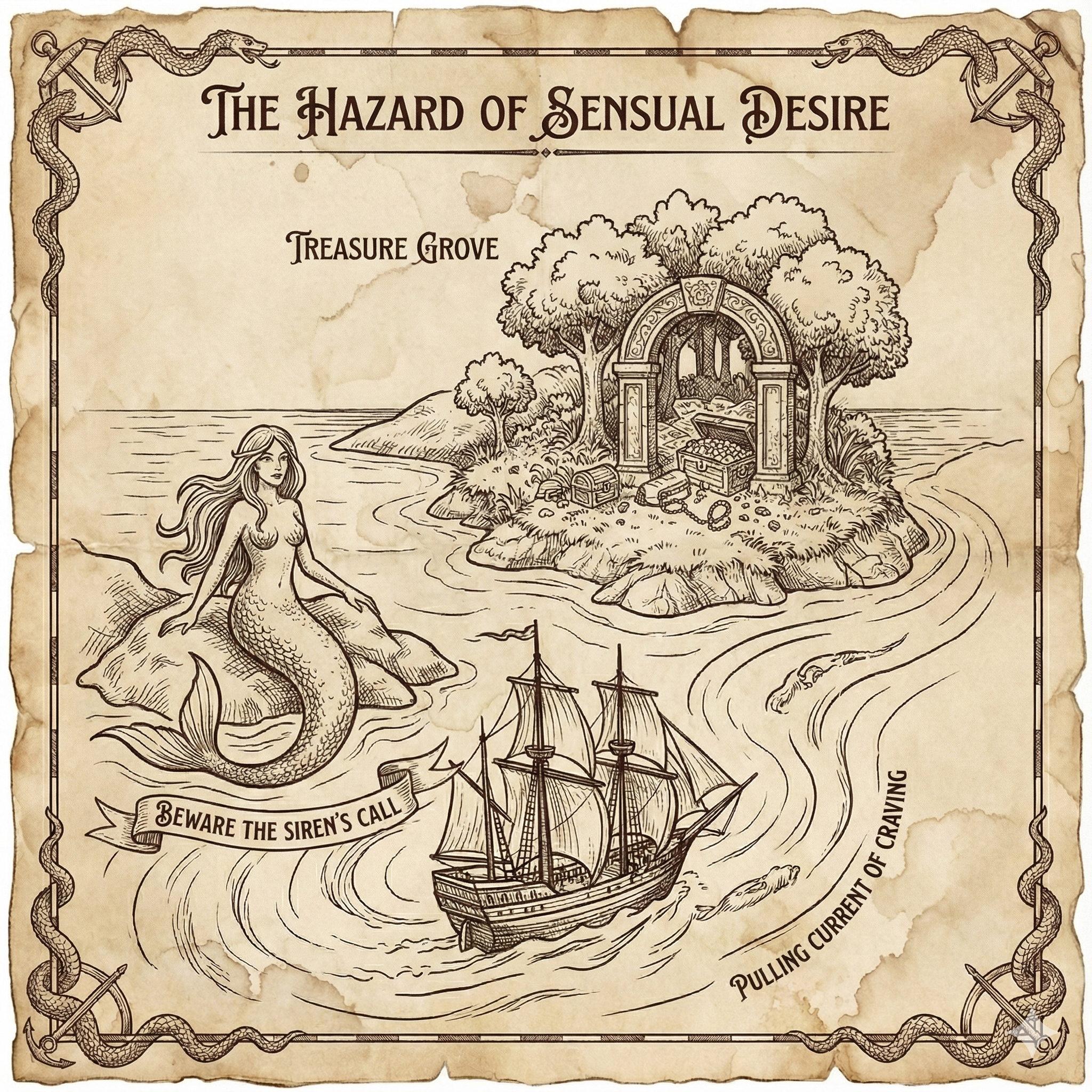
Recognise-and-rest: When you notice the absence of a hindrance – one of the Five Hazards, (chapters 37–42), examples include, freedom from ‘Sensual Desire’, ‘Anxiety and Agitation’ or ‘Tuning Out’, linger there for three breaths. Then, allow awe and wonder to arise naturally.
Self-Reflections
Explore your relationship with knowing your own mind:
What is the prevailing ‘weather’ of the mind right now?
Can I recognise the difference between mind states coloured by wanting or aversion and those free from them?
What does a clear, calm mind feel like and how do I know it?
How does observing the mind differ from identifying with it?
Which conditions nourish clarity and steadiness? Which obscure them?
How does awareness of mind states influence behaviour and speech?
Can I trust the luminous mind as a natural refuge?
Journaling prompts
Mind-weather journal: Throughout the day, pause and note the predominant tone of the mind (calm, restless, bright, heavy). How often does it change?
Freedom moments: Recall a time when the mind felt free from craving or agitation. Describe the texture of that moment.
Observing versus owning: Reflect on a recent strong emotion. What changed when you saw it as ‘a mind state’ rather than ‘my feeling’?
Trigger tracking: Identify recurring moods and what conditions trigger them. How might mindfulness interrupt their momentum?
Luminous mind reflection: Write about moments when the mind felt naturally radiant, kind, or clear.
The witness stance: How does it feel to rest in awareness itself, without trying to fix or analyse anything?
Learning from fog: Describe a time when the mind felt clouded. What helped it clear?
Supporting material: scientific and philosophical perspectives
For those interested in the scientific and philosophical underpinnings of ‘Monitoring Mindfulness’,the following overview highlights some key connections.
Neuroscience: Monitoring Mindfulness aligns with modern findings on metacognition – the capacity to observe one’s own mental processes. Studies show that mindfulness meditation strengthens neural circuits connecting the prefrontal cortex (self-awareness) with the amygdala (emotion), improving emotional regulation. By quieting rumination and self-centred thinking, mindfulness of mind reduces activity in the self-referential networks known as the Default Mode Network (DMN). This consistent practice increases grey matter density in regions linked to attention and empathy (neuroplasticity) and enhances interoceptive awareness (knowing ‘what state the mind-body is in’).
Psychology: Psychological models confirm the wisdom of observing inner states. Cognitive Behavioural Therapy (CBT) trains awareness of thoughts as transient events, which is a secular expression of anattā (not-self). Metacognitive Therapy (MCT) specifically develops ‘detached mindfulness’ – observing mind states without fusion. Emotion Regulation Theory shows that naming emotional states reduces their power. Furthermore, research into Flow States and Presence confirms that awareness of inner states fosters creativity and stability, correlating with the mahaggataṃ citta (‘great, expansive mind’) described by Gotama.
Philosophy: Practices of self-examination are found in various philosophical traditions. The Stoics spoke of prosoche – vigilant attention to one’s inner state – as the path to freedom. Spinoza noted that joy increases the mind’s power to act when understanding replaces confusion. Phenomenology explores consciousness as a field of appearing phenomena, mirroring Cittānupassanā’s open inquiry into the mind’s nature. Stephen Batchelor defines the outcome of this practice as existential freedom – an awareness that rests in the openness from which new possibilities for life can emerge.
Remember to Remember
Monitoring Mindfulness is the art of knowing the mind as it is and letting that knowing set it free. When mindfulness turns toward itself, awareness recognises both turbulence and calm as passing weather – and glimpses the sky beyond them.
This practice reveals the living truth of Gotama’s third realisation: that freedom is not something to achieve but something to recognise. Each moment the mind is seen clearly, it returns to its natural luminosity. Mindfulness of mind allows us, as the Captain, Navigator, and Crew of our raft, to sense when the vessel sails in clear water or drifts into fog. With this awareness, we steer not by compulsion but by clarity.
To ‘remember to remember’ is to meet each state – calm or restless, bright or clouded – with equanimity and curiosity. It is to trust that beneath the waves, the ocean of awareness remains still, deep, and vast. This is mindfulness that supports liberation, mindfulness that sets the heart free.
The practice of Monitoring Mindfulness is like a ship’s Captain moving from constantly battling the external storm (Healing Mindfulness) to realising the true key to safety lies in maintaining perfect instruments and clear-eyed focus within the bridge itself (Monitoring Mindfulness). It is the difference between fighting the waves and aligning the internal navigation systems so skillfully that the ship rests naturally, even between swells.
“When mindfulness sees clearly, the heart discovers it was never truly confined.”
~ Christina Feldman
“You are the sky. Everything else – it’s just the weather.”
~ Pema Chödrön
Sutta References
Satipaṭṭhāna Sutta (MN 10 / DN 22) – The Foundations of Mindfulness:Summary: This primary text defines the Third Foundation. It instructs practitioners to know the mind directly, specifically identifying whether it is with or without lust, aversion, and delusion, and whether it is scattered, concentrated, developed, or liberated. It emphasises observing these states as temporary, arising and passing phenomena, leading to detachment and freedom.
Aṅguttara Nikāya 1.49–52 – The Luminous Mind:Summary: Gotama describes the mind (citta) as naturally luminous (radiant) but defiled by incoming impurities. This highlights the potential for clarity and freedom that is revealed through the practice of Cittānupassanā.
Upanisa Sutta (SN 12.23) – Prerequisites:Summary: This sutta outlines the causal sequence of liberation, showing that from freedom from remorse arises gladness, from gladness joy, and from joy comes the concentration and true seeing necessary for liberation. It affirms that knowing the mind’s state is a vital link in the chain of freedom.
Nīvaraṇa Suttas (Various suttas discussing the Five Hindrances):Summary: These discourses detail sensual desire, ill will, sloth/torpor, restlessness/remorse, and doubt (The Five Hindrances). Recognising when these states are present or absent in the mind is a direct and practical application of Cittānupassanā, and provides foundational awareness for the next chapter on the Hindrances.
When the mind is obstructed by the Five Hindrances, it cannot see clearly. It is like water that is boiling, dark, covered by algae, stirred by the wind, or muddied with clay.
~ Gotama (the Buddha – paraphrased)
The obstacles to peace are not the storms themselves, but our failure to see them as passing weather.
~ Christina Feldman
Episode 37 – The Five Hazards: Overview
An AI generated ‘deep dive’ into this aspect of the RAFT to Freedom