Category: workbook

Chapters from the RAFT to Freedom workbook

  • 65 – Fearlessness – laying our ghosts to rest

    65 – Fearlessness – laying our ghosts to rest

    Forgiveness as an essential practice

    There are those who do not realise that one day we all must die. But those who do realise this settle their quarrels.

    Gotama (The Buddha)

    How do we love our enemies? First, we must develop and maintain the capacity to forgive. He who is devoid of the power to forgive is devoid of the power to love.

    Martin Luther King, Jr.

    Episode 65 – Forgiveness is a one player game

    An AI generated ‘deep dive’ into this aspect of the RAFT to Freedom

    Read more: 65 – Fearlessness – laying our ghosts to rest

    The rock of fearlessness

    In this Training stage of our journey, we have learned to build and steady our raft through the three great trainings of Gotama’s Middle Way Programme. Ethics forms the sound timber of the vessel: the planks, bindings, and careful craftsmanship that keep it from leaking or breaking apart (Chapters 59–61). Collectedness steadies the raft on the water: the balanced deck, the trimmed sail, and the quiet hand on the oar that help it move without being thrown about by every wave (Chapters 62–64). Wisdom is the compass and clear seeing that shows us how to read the currents, avoid hidden rocks, and keep the far shore in view (Chapters 57–58).

    With these three in place, our raft begins to run true. And yet, even a well-built raft can struggle to cross the ocean if its cargo hold is filled with the heavy ballast of the past. This burden appears as resentment, guilt, and the haunting memory of old wounds. To travel onward, we must learn what to carry, what to repair, and what to release into the sea.

    Our wisdom, mental stability, and ethical outlook reveal what remains. When the mind is no longer scattered, we can feel what we have been carrying. To lighten the vessel for the final crossing, we engage the practice of Forgiveness. In the context of the RAFT to Freedom Programme, forgiveness is not a separate, gritty duty. It is the natural outcome of cultivating the four Heart Practices (Appropriate Responses) that hold our raft together.

    If we truly cultivate friendliness (Chapter 06), we cannot continue to cling to hatred. If we truly cultivate compassion (Chapter 26), we begin to understand the suffering of those who hurt us. If we truly cultivate appreciative joy (Chapter 35), envy and bitterness loosen their grip. If we truly cultivate equanimity (Chapter 52), we learn to meet what cannot now be altered without adding further struggle.

    When these qualities are steady within us, forgiveness is not something we force ourselves to perform. It becomes a natural expression of maturity. It is the wisdom of non-ill-will – the refusal to keep feeding hostility in the heart. It is the lightening of the cargo so the crossing can continue.

    Linking harmlessness and fearlessness

    At the very start of this journey, we committed to the ‘Five Gifts’ of harmlessness (Chapter 04). We committed to not harming living beings in any way – including ourselves. Forgiveness is the mature expression of that commitment. It completes what harmlessness began.

    When we forgive, something subtle but powerful shifts. We become safe for others to be around because we have put down our weapons of retaliation. We are no longer carrying the quiet readiness to strike back, withdraw, punish, or prove. We can look at the world and say, ‘You have nothing to fear from me.’

    But fearlessness is not only outward. It is inward as well. When resentment and guilt loosen, we are no longer bracing against our own memories. We are not flinching from the past or defending ourselves against it. We become safe inside our own mind. There is less inner argument, less rehearsed grievance, less guardedness. The nervous system softens because it is no longer preparing for battle.

    This is fearlessness – not bravado, not denial, but the steadiness that comes from having nothing to defend and no revenge to pursue. It is the confidence of a heart that has chosen not to harm. That safety, both for ourselves and for others, is the reliable rock upon which our raft can moor.

    Forgiveness is not reconciliation

    Forgiveness does not mean excusing harm. It does not mean denying what happened. It does not mean returning to unsafe situations or abandoning healthy boundaries. It is not forgetting, minimising, or pretending that injury did not occur.

    Reconciliation is relational. It requires trust, accountability, and changed behaviour. Forgiveness is internal: an inner release, a decision not to let hostility organise the heart. We may forgive someone and still choose distance. We may release resentment and still say no. We may let go of vengeance and still insist on justice.

    Fearlessness does not mean becoming naive. It means we are no longer organised around retaliation. We are not governed by revenge, bitterness, or the need to prove our innocence. We act from clarity rather than from injury.

    In this way, forgiveness strengthens healthy boundaries rather than dissolving them. When we are not reacting from hurt, we can choose wiser limits. When we are not driven by anger, we can respond firmly without hatred. Forgiveness clears the water; it does not remove the hazards. It allows us to steer with discernment instead of steering from pain.

    Preparing for the final crossing

    Why is this important? As Navigators, we hope to meet the later stages of life with as much peace, honesty, and freedom as possible. This does not mean having resolved every sorrow or repaired every relationship. Some situations call for clear distance, firm boundaries, or practical protection. These are not failures of forgiveness; they can be the ground from which genuine release begins. From there, we can slowly loosen resentment’s grip without denying what happened or exposing ourselves to further injury.

    Forgiveness is the practice of settling our quarrels with the world while we are still here. It is choosing to resolve what can be resolved, to release what cannot be changed, and to stop carrying unfinished battles forward. It is the decision to put down the hot coal of resentment, recognising that holding it burns only our own hands.

    This does not mean pretending we were never hurt. It means refusing to let old injury define the present. It means acknowledging wrongdoing clearly – in ourselves and in others – and responding with honesty rather than denial or revenge.

    As Gotama taught:

    “These two are fools. Which two?
    The one who does not see their transgression as a transgression,
    and the one who does not rightfully pardon another who has confessed their transgression.
    These two are fools.
    These two are wise. Which two?
    The one who sees their transgression as a transgression,
    and the one who rightfully pardons another who has confessed their transgression.
    These two are wise.”

    Forgiveness, then, is not weakness. It is wisdom in action. It requires the courage to admit harm and the strength to release it. It is how we prepare our raft for its final crossing: lighter, less burdened, and more at ease. When the heart is still at war, it can be harder to meet the end of our days peacefully.

    The heaviest cargo – forgiving ourselves

    For many of us, the deepest resentment is not toward others. It is toward ourselves. We replay mistakes. We rehearse old conversations. We carry the quiet sentence: ‘I should have known better.’ Guilt becomes identity. Shame becomes a story about who we are.

    Self-forgiveness is not self-excusing. It is not pretending harm did not occur. It begins with honesty. We acknowledge clearly: ‘Yes, that caused pain.’ We take responsibility where it is ours. We repair what can be repaired. We apologise where apology is due. Accountability is part of the crossing. But once responsibility has been taken, punishment does not purify the past. Endless self-attack does not undo harm. It only adds more suffering to what has already happened.

    Self-forgiveness means releasing the identity built around the mistake. It means recognising that harmful actions arose from conditions – confusion, fear, craving, immaturity, pain – not from a fixed, irredeemable core. We are responsible for our actions, but we are not identical to our worst moment.

    In this way, self-forgiveness is aligned with Skilful Perspective. It remembers that everything changes. It remembers that we are processes shaped by causes and conditions. It refuses to turn a moment into a permanent verdict. On our raft, this is like removing hidden ballast. We may not even realise we have been weighed down by it. But once unburdened, our vessel moves more freely. 

    Self-forgiveness does not erase consequences. It allows growth to replace self-condemnation. It allows remorse to mature into wisdom rather than harden into shame. And just as with forgiving others, it does not require forgetting. It requires learning – and then choosing not to keep harming ourselves in the name of the past.

    Guilt and remorse

    As we clear the hold of our raft, we must distinguish carefully between guilt and remorse. They feel similar at first, but they move the heart in very different directions.

    Guilt says, ‘I was bad. I am bad. I will always be bad.’ It turns an action into a permanent identity. It is heavy and static – a weight that sinks the raft and keeps us circling the same waters.

    Remorse is different. Remorse says, ‘I caused harm.’ It recognises the action clearly, feels its impact, and resolves not to repeat it. Remorse is honest but not self-destructive. It is dynamic. It moves toward repair. It strengthens conscience rather than crushing the spirit.

    Guilt paralyses. Remorse mobilises. Guilt keeps us staring backward. Remorse turns us toward wiser action.

    Self-forgiveness is the alchemy that transforms toxic guilt into functional remorse. It does not deny responsibility. It refines it. It allows us to acknowledge harm, make amends where possible, learn from it, and then step forward without dragging a permanent verdict behind us. In this way, forgiveness does not weaken accountability. It makes growth possible.

    How to practise – the three directions

    Forgiveness has three directions: a gradual practice of laying ghosts to rest. We begin with what is most accessible and turn, in time, toward what is more difficult.

    Asking for forgiveness – Cleaning our side of the street: We acknowledge that, driven by confusion, fear, or unskilful habits, we have harmed others. We visualise those we have hurt and quietly say to ourselves:

    ‘For any harm I have caused you through my thoughts, words, or actions, I ask for your forgiveness. You have nothing to fear from me.’

    This is not about demanding their forgiveness or reopening unwanted contact. It is about clearing our own conscience. We take responsibility where it is ours. We acknowledge sincerely. We commit to harmlessness going forward. In doing so, we travel more lightly.

    Offering forgiveness to ourselves – understanding the confusion: We turn compassion inward. We recognise that many of our past actions were clumsy attempts to cope with pain, fear, or unmet needs we did not yet know how to handle wisely. We say to ourselves:

    ‘For the harm I have caused myself, and for not understanding at the time, I offer myself forgiveness.’

    This is not about denying what happened. It is about meeting the past with honesty, learning, and care. As ex-Buddhist monastic and teacher Jeff Oliver puts it:

    “That was who I was then; it is not who I am now. It is not who I will be in the future.”

    Offering forgiveness to others – the most difficult current: This direction is often the hardest. Many of us carry deep wounds from betrayal, neglect, abuse, or abandonment. We remember that others, driven by their own ignorance, fear, hurt, or pain, have harmed us. We visualise them – if and when we feel ready – and quietly say to ourselves:

    ‘For the harm you have caused me, knowingly or unknowingly, I offer you my forgiveness, as best I am able right now. You have nothing to fear from me.’

    This does not require reconciliation or remove boundaries. It simply releases the grip of retaliation within our own heart. And it is important to add: forgiveness can be gradual. ‘As best I am able right now’ may be very small. That is enough. The direction matters more than the speed.

    Wise boundaries and the kindness of turning away

    Forgiveness does not make us available to harm. We need not invite the person who scuttled our raft back on board. Releasing ill-will is not reconciliation: we can forgive from a distance, stand against injustice without hatred, and let a firm no arise from safety rather than punishment. Boundaries are not acts of aggression; they are acts of clarity.

    Turning away from what is unwholesome is a form of befriending ourselves. We release what is harmful because it is dangerous – not because the heart is at war. This distinction protects the raft. It prevents secondary suffering from being added to primary pain. Forgiveness softens the heart; healthy boundaries steady the helm. Both are necessary for the crossing.

    The ‘As best I am able’ clause

    Forgiveness is not a switch. It is a thawing.

    If the heart is not ready to forgive a deep wound, we do not force it. We do not shame ourselves for hesitation. We simply acknowledge where we are. Sometimes the first step is forgiving ourselves for not being ready yet.

    We practise fore-giving – giving up the demand that the past should have been different. We stop negotiating with history. We allow what happened to belong to the past without continuing to relive it.

    Some ghosts dissolve slowly. That is not failure. It is human. We leave what we cannot yet resolve on the far shore and continue the crossing.

    The deeper current – perspective and not-self

    Forgiveness is not separate from the earlier stages of our training. It rests directly on ‘Skilful Perspective’ (Chapter 57). When we understand that actions arise from causes and conditions – confusion, fear, unmet needs, inherited patterns – we stop turning harm into eternal identity. We see that wrongdoing has causes. We see that pain has causes. We see that both can change. This does not excuse harm; it explains it. And understanding can soften the reflex to retaliate.

    Forgiveness also grows naturally from our investigation of the self. When we examined the ‘Five components of selfing’ (Chapter 54), we saw that what we call me is a changing process, not a fixed core. The same is true of others. The person who hurt us was not a solid villain at the centre of reality; they were a conditioned being acting from ignorance, hurt, or pain. And we too were once driven by conditions we did not yet understand.

    When we see this clearly, resentment loosens. The rigid story – ‘They are always this,’ ‘I am always this’ – begins to soften. The past remains real, but it is no longer frozen. It becomes part of a moving stream rather than a permanent verdict. Forgiveness, then, is not sentimental. It is aligned with reality. It is the heart’s response to understanding impermanence, causation, and the absence of a fixed self.

    As perspective clears, we may begin to see that neither we nor those who harmed us are fixed, unchanging identities. We are more than the worst thing we have done, and they are more than the harm they caused – though that harm still matters and may still require clear boundaries.

    This understanding does not ask us to abandon our safety. It can, however, soften the rigid stories of victim, offender, failure, or enemy that keep grievance locked in place. As these identities become less fixed, forgiveness may become more possible: not as denial, reconciliation, or release from accountability, but as a gradual easing of the burden we have been carrying. Our raft becomes lighter, and the ongoing crossing more possible.

    Self reflections

    1. If I was reaching the end of my life, which resentment or regret would weigh most heavily on my heart, and what would it take to begin laying it down now?
    2. Where might my difficulty in forgiving reveal a blockage in my friendliness or   compassion, and what does that tell me about the state of my heart?
    3. Can I trace a clear line between a specific childhood wound and my present patterns of craving, avoidance, or reactivity, and what changes when I see that connection?
    4. When I reflect on my past, do I feel the crushing identity of ‘I am a failure,’ or the clarifying energy of ‘I did harm and want to do better,’ and how does each perspective shape my next step?
    5. Can I distinguish clearly between releasing ill-will toward someone and re-inviting them into my life, and what does that distinction protect?
    6. What boundary would reduce the risk of further harm while remaining rooted in steadiness rather than anger?
    7. When I look at the younger version of myself who acted from confusion or pain, can I recognise the conditions they were under and offer forgiveness for not yet understanding?

    Journaling prompts

    1. The unsent letter: If it feels manageable, begin with a smaller hurt, disappointment, or unresolved tension rather than the experience that feels most overwhelming. Write a private unsent letter that names what happened and how it affected you. You might include what you wish had been understood, acknowledged, or done differently.
    2. The ‘That was then, this is now’ list: If it feels manageable, choose a past action, choice, or moment that you still judge yourself for. Write down a few words about it. Underneath, write: ‘That was then. This is now. It is part of my story, but it is not who I am today, or who I will be tomorrow.’ You might then add: What have I learned, changed, or begun to understand since then?
    3. Navigation note: Write a brief note on the next wise step regarding a difficult relationship. Is it a boundary? A repair? A pause? Write one step only.
    4. The ‘As best I am able’ log: Identify a person you are not ready to forgive. Write: ‘I am not ready to forgive [Name] yet, and I can still practise self-care and boundaries today.’ How does that feel?
    5. Arriving more lightly: Imagine reaching the Safe Shore no longer weighed down by resentment or ill will. What might it feel like in your body, heart, and mind to have more space, ease, and freedom?
    6. A sentence of release: If it feels right, write the phrases: ‘I forgive myself for the mistakes of the past – I forgive myself for not understanding’. Pause after writing it once or twice. Notice gently what, if anything, arises in your body, heart, or mind. There is no need to make yourself feel forgiveness; simply allow the words to be there.
    7. Guilt transformation: List three things you feel guilty about. Rewrite them as ‘Remorse Statements’ – focusing on the action and the repair, rather than your worth as a person.

    Supporting material: scientific and philosophical perspectives

    For those interested in the scientific and philosophical underpinnings of ‘Forgiveness’ the following overview highlights some key connections. 

    • Neuroscience: Neuroscience now shows that memory is not a fixed recording. When a memory is reactivated, it briefly becomes malleable before being stored again – a process known as reconsolidation. If a painful memory is repeatedly recalled in a state of threat, it strengthens its emotional charge. The brain continues to simulate danger, keeping stress circuits active as though the event were still unfolding.

    However, if that same memory is brought into awareness while the body is regulated – breathing steadily, feeling supported, anchored in safety – the emotional intensity can be updated. Over time, the nervous system learns that the event is no longer happening. The body stops bracing. Forgiveness practices, when done gradually and safely, may support this updating process. We are not erasing memory. We are changing our relationship to it. The neural trace softens because the present is no longer confused with the past. In RAFT language, this is not forcing calm. It is re-teaching the body that the crossing is happening now, not then.

    • Psychology: Modern trauma psychology shows that many patterns we later regret began as adaptive responses. The large-scale Adverse Childhood Experiences studies demonstrated strong links between early trauma and later mental and physical health outcomes. When a child grows up in unpredictability, neglect, violence, or emotional insecurity, the nervous system learns strategies for survival – hypervigilance, emotional numbing, appeasing, controlling, withdrawing. What once protected can later harden into reactive habits.

    Seen this way, harmful behaviour is often less a sign of a broken character and more a nervous system that learned quickly in order to survive. This does not excuse harm, but it reframes it. Understanding the origins of our reactions helps shift us from shame to responsibility with compassion. Forgiveness, in this context, is not denial of injury. It is the gradual uncoupling of present life from past threat. When we stop organising around old dangers, the body begins to settle. The raft is no longer steered by storms that have already passed.

    • Philosophy: Ancient philosophy offers a parallel insight. Socrates and later the Stoics argued that people do not willingly choose what they truly understand to be harmful. Harmful actions arise from ignorance – from a distorted view of what is good, necessary, or justified. When someone injures others, they are acting from a mistaken map of reality. This perspective does not deny responsibility. It reframes wrongdoing as misperception rather than pure evil. If actions arise from confusion, fear, or false belief, then understanding becomes the antidote. Seeing harm as rooted in ignorance allows us to respond without hatred. We can condemn the action while recognising the confusion that produced it.

    In RAFT terms, someone may have been steering with a damaged compass. Recognising that does not mean we let them steer our vessel. It means we no longer need to carry resentments as ballast. Forgiveness becomes less an emotional surrender and more a rational response to the tragic fact that human beings often act from distorted maps.

    Remember to remember

    Forgiveness is the act of laying our ghosts to rest. Resilient Equanimity (Chapter 52) reminds us that we cannot rewrite the past, but we can change our relationship to it. The nervous system may still echo with old memories, but we are not required to keep reliving them. We can meet what happened with steadiness rather than reactivity. We can allow the story to soften without denying its reality. Forgiveness is not erasing history; it is loosening the grip of yesterday on today. It is how the heart aligns with Skilful Perspective – recognising impermanence, causation, and the possibility of change.

    Forgiveness is often gradual and partial – another crossing made in stages. It may begin with a modest truth: ‘Not today. I am not ready.’ That honesty is not failure; it is wisdom. We practise first with the smaller hurts, allowing the capacity to grow safely over time. As Friendliness, Compassion, and Appreciative Joy are cultivated, resentment loses its fuel. The heart becomes less organised around injury and more organised around care. This is how we travel lightly. And most importantly, remember this: much of what shaped us was not our fault. We are responsible for what we choose now – but we are not to blame for the conditions we were given.

    Forgiveness is the fragrance that the violet sheds on the heel that has crushed it.

    Mark Twain

    Without forgiveness, the grudge you’re holding is actually holding you.

    Oprah Winfrey

    Sutta references

    • Aghāta Sutta (AN 5.162) – Removing Resentment
      • Summary: The Buddha offers five practical methods for removing annoyance/resentment: cultivating loving-kindness, compassion, or equanimity toward the person; forgetting/ignoring the thought; or reflecting on the ownership of deeds (karma).
    • Vatthupama Sutta (MN 7) – The Simile of the Cloth
      • Summary: The Buddha compares the mind to a cloth that needs to be washed before it can be dyed. He lists ‘hostility, resentment, and denigration’ as defilements that must be washed away. Once the mind is clean (forgiven/forgiving), it can absorb the dye of bliss and wisdom.
    • Abhaya Sutta (AN 4.184) – Fearlessness
      • Summary: The principle of Abhaya (fearlessness) is central to forgiveness. To be ‘safe’ for others (harmless) and to feel ‘safe’ from one’s own past (forgiven) is the essence of the fearless heart.
    • Kakacupama Sutta (MN 21) – The Simile of the Saw
      • Summary: A radical training instruction on non-ill-will. The Buddha teaches that even under extreme provocation (symbolized by bandits sawing off one’s limbs), the disciple trains the mind to remain free of hatred and filled with compassion. This illustrates that our internal state of non-ill-will is independent of the external harm.
  • 66 – Putting down our raft – from surviving to thriving

    Conclusion: Living skilfully on the Safe Shore

    The whole of this spiritual life, Ānanda, consists of good friendship, good companionship, and good comradeship.

    Gotama (the Buddha)

    I have shown you the Dhamma … as being like a raft, for the purpose of crossing over, not for the purpose of holding onto.

    Gotama

    Episode 66 – Abandoning the raft that saved you

    An AI generated ‘deep dive’ into this aspect of the RAFT to Freedom

    Read more: 66 – Putting down our raft – from surviving to thriving

    Our journey completed

    We have now reached the end of our shared crossing through the RAFT to Freedom workbook. Together, we have drawn upon the enduring wisdom of early Buddhist psychology, enriched by insights from modern neuroscience, psychology, and philosophy. With these tools, we navigated from the Dangerous Shore – the shore of compulsion, reactivity, shame, and despair – toward the Safe Shore of steadiness, clarity, and a deepening sense of well-being.

    Before we step ashore, it may help to pause and take in the ground we have covered. It is worth turning to look at the wake behind us. The journey unfolded through the four movements of the RAFT, mirroring Gotama’s four realisations.

    We began with ‘Recognise’. In Chapters 01–21, we faced directly the pain, difficulties, and disappointments woven into every human life. We surveyed the terrain of the Dangerous Shore, grounded ourselves in the ethical generosity of the Five Gifts, and acknowledged the biological reality of our impulses without shame. We set our direction through the ‘Four Resolves’ and reconnected with our inner capacities through the ‘Four Creative Powers’. We learned a foundational truth: we cannot leave a shore we refuse to recognise.

    We then moved into ‘Abandon’. In Chapters 22–33, we engaged the engine of the Five Defenders. Using confidence, courageous effort, healing mindfulness, a gathered mind and discernment, we bailed the water of craving and loosened the cargo of ill-will. We discovered that abandoning is not deprivation, but the relief of setting down what we no longer need to carry.

    From there, we entered ‘Feel’. In Chapters 34–50, we learned to recognise the Five Hazards – and, just as importantly, to notice when they were absent and the coast was clear. We raised the sails of the Seven Supports and became familiar with moments of cessation – the quiet absence of craving, aversion, and confusion. We discovered that peace is not simply the absence of turbulence, but the living presence of liberating mindfulness, penetrating inquiry, enthusiasm, energising joy, deep calm, a unified mind, and balanced equanimity.

    Finally, in the ‘Training stage’, we opened the Operating Manual of Gotama’s Middle Way Programme. We trained in skilful perspective, intention, speech, action, livelihood, application, mindfulness, and collectedness. The captain learned to remember. The navigator learned to read conditions. The crew learned to work as one. The vessel became seaworthy in real weather.

    This workbook has offered maps, tools, practices, and companions for the crossing. But the crossing itself has always been yours. Every recognition, every restraint, every pause, every repair, every return to the next skilful step – these are not ideas on a page. They are the evidence of freedom becoming embodied.

    The parable of the raft – leaving the burden behind

    Now, as the keel touches the sand of the Safe Shore, we encounter the final and most subtle challenge:

    Putting down the raft.

    In Gotama’s talk on the Simile of the Raft, he describes a man who builds a raft to leave a dangerous shore. Through effort and ingenuity, the man reaches the safety of the far shore. Once there, he reflects, ‘This raft has served me well. Perhaps I should lift it onto my head and carry it with me wherever I go.’ Gotama asks: ‘Would this be wise? Of course not. The raft is for crossing over, not for clinging to.’

    In our journey, the raft is the framework of practice itself – the workbook, the language, the structures, even the identity of being someone who is ‘working on themselves.’ At first, we needed the planks, the engine, the compass. We needed to train deliberately. But there comes a point when the qualities of mindfulness, patience, ethics, discernment, and composure are no longer external supports. They have become embodied.

    We no longer need to carry the identities of ‘the struggler’ or ‘the broken one’ as our deepest names, or to see ourselves only through the lens of what we have had to heal from. These identities may have helped us make sense of the crossing, but they are not the whole of who we are. The crossing has done its work when the principles no longer feel like instructions imposed from outside, but capacities arising from within. We move from trying to get better to living with greater honesty, steadiness, kindness, and care.

    We lay the raft down and we walk.

    Living the path – the Safe Shore is shared ground

    Liberation is not a static endpoint. The Safe Shore is not a place where storms never arise; it is a place where we no longer drown in them. Life will still bring loss, uncertainty, conflict, illness, disappointment, and change. Old currents may still pull. Old habits may still whisper. But something fundamental has shifted: we now know how to pause, how to steady, how to ask what is skilful, and how to begin again without turning a stumble into a verdict.

    • We continue cultivating wisdom and discernment – deepening understanding through reflection and experience. Ignorance, confusion and delusion may still arise, but we recognise them as part of an old map that no longer applies. We see them sooner. We are less ruled by them.
    • We continue practising ethical conduct – living with integrity, guided by harmlessness, honesty, and responsibility. Ethics is not moral perfection. It is the protection of peace. It keeps the hull of our life watertight and our relationships steady.
    • We continue developing mental discipline – maintaining the clarity and resilience of the mind. We apply effort consistently, but without harshness. Practice becomes a refuge rather than an obligation; a steady pleasure rather than a burden.

    The Safe Shore is not a destination that we arrive at with a finish line. It’s not a place at all, it is an embodied way of being: a felt sense of ease, steadiness and perspective; a conscious recognition of the absence of craving, aversion and confusion. It is not a milestone to be reached. It’s a way of meeting experience as it is happening in each moment. We learn to recognise this place within ourselves, to dwell there when we can, and to return to it more readily when strong currents have carried us off course. In this sense, the Safe Shore becomes a refuge: not perfection, but freedom available again and again in ordinary everyday life.

    Crucially, we do not walk this shore alone. Good friendship sustains the crossing and stabilises the vessel. Wise companions remind us of what matters when we forget. Shared practice deepens resilience. The Safe Shore is a shared destination.

    Connect with community (Sangha).

    Having stabilised our own footing, we are now able to become stable ground for others. Safety is no longer something we are desperately seeking; it is something we can help generate. We know what it is to be in the flood. We know what it is to build a raft. That lived understanding becomes quiet authority.

    The ultimate fruit of the RAFT to Freedom workbook is not only personal relief. It is the capacity to be a wise friend, a steady companion, or simply a kind presence to those still navigating turbulent waters. Sometimes this means offering guidance. Sometimes it means listening without judgement. Sometimes it means embodying calm when others feel overwhelmed. Community is not an optional extra; it is how the crossing continues beyond us.

    When one raft reaches the shore, it becomes a landmark for others. When one person steadies, the waters around them steady too. In this way, freedom matures into generosity. The Safe Shore expands.

    Self-reflections – looking forward

    1. Am I ready, even tentatively, to loosen the identity of ‘the one who is surviving’ and begin to inhabit the identity of ‘one who is thriving’?
    2. Which elements of the RAFT to freedom programme have become embodied habits – so natural that they arise without conscious effort?
    3. When I look back at the dangerous shore, can I do so without aversion – perhaps even recognising the lessons it revealed?
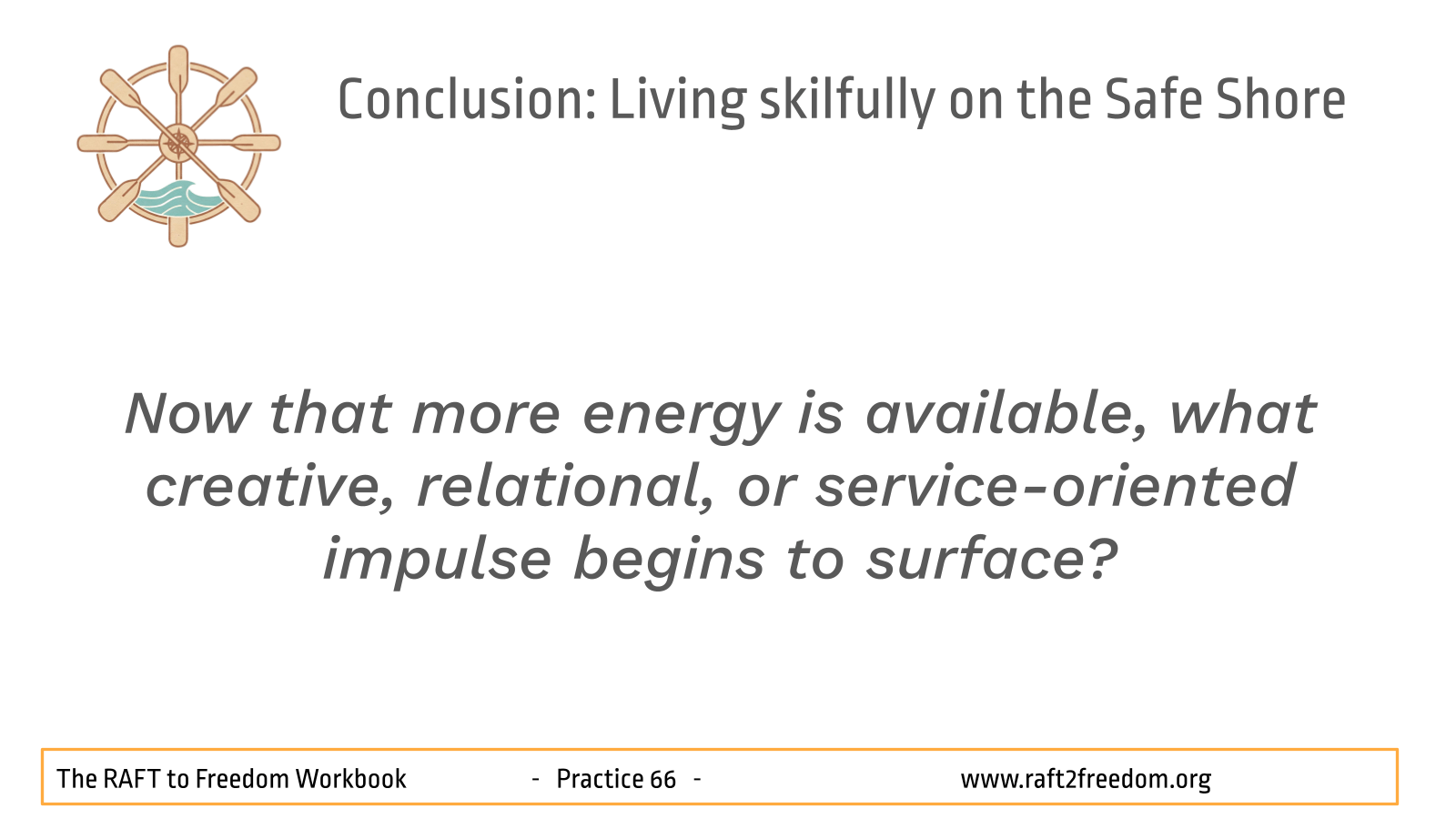
    4. Now that more energy is available, what creative, relational, or service-oriented impulse begins to surface?
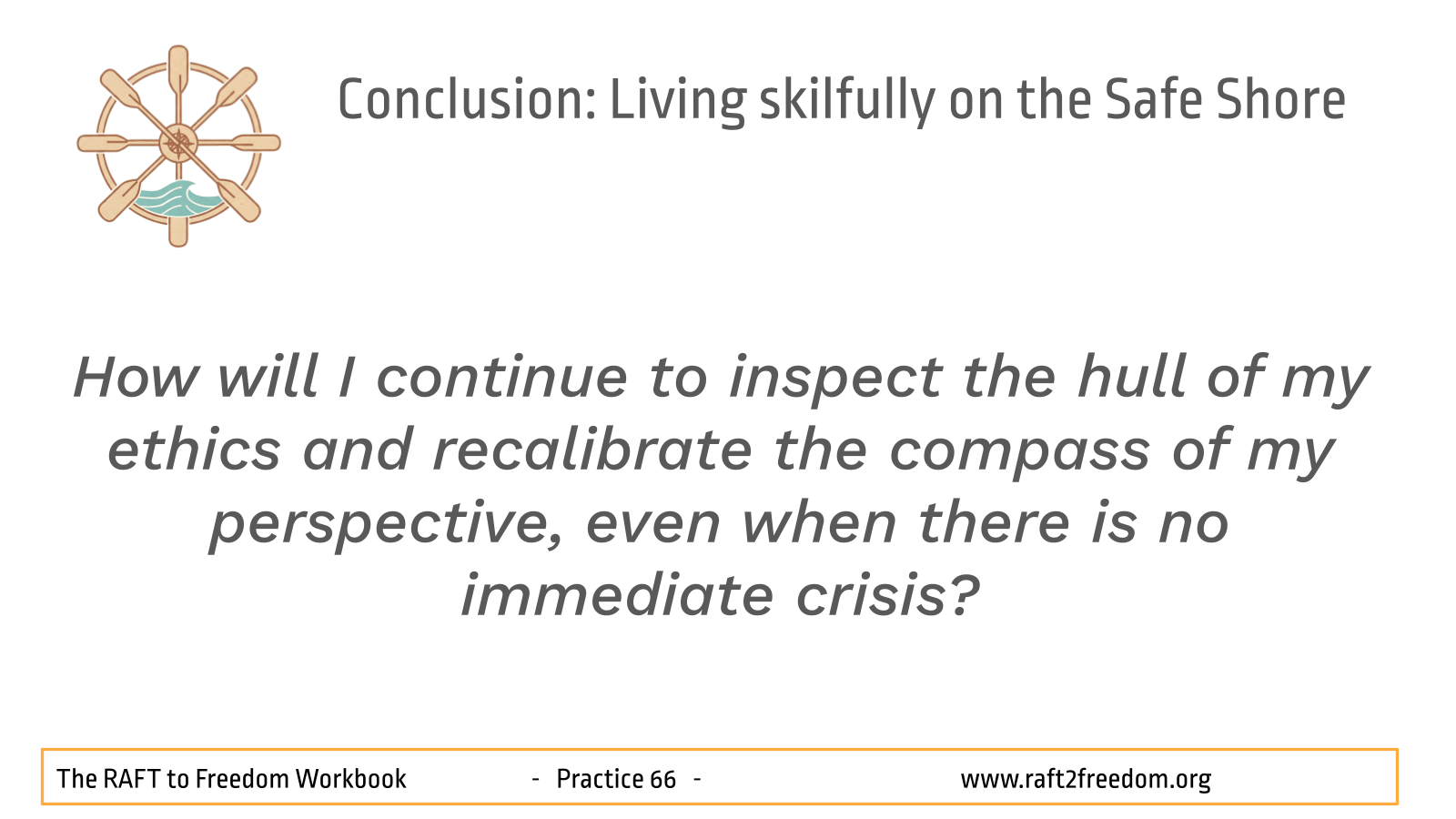
    5. How will I continue to inspect the hull of my ethics and recalibrate the compass of my perspective, even when there is no immediate crisis?
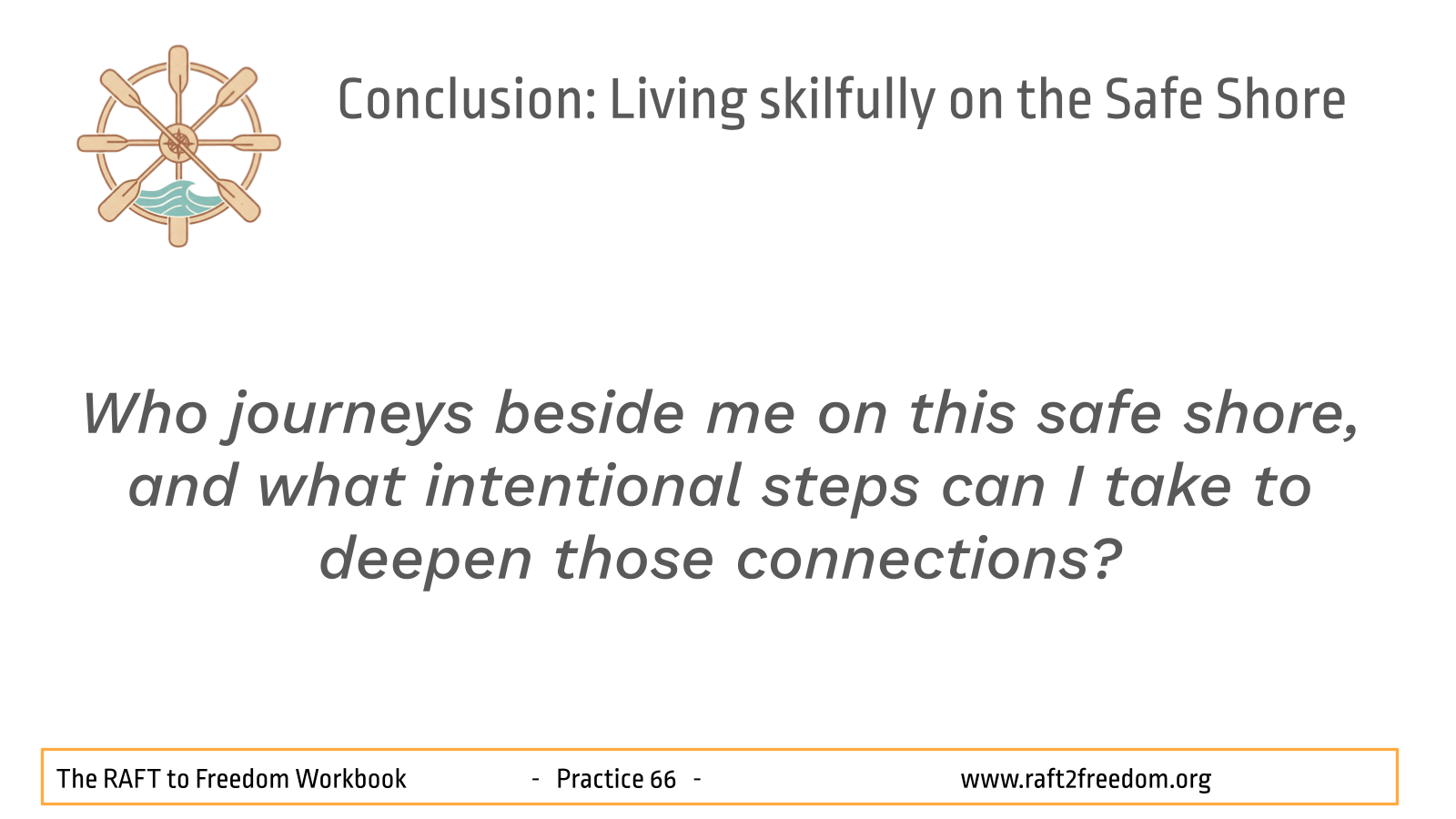
    6. Who journeys beside me on this safe shore, and what intentional steps can I take to deepen those connections?
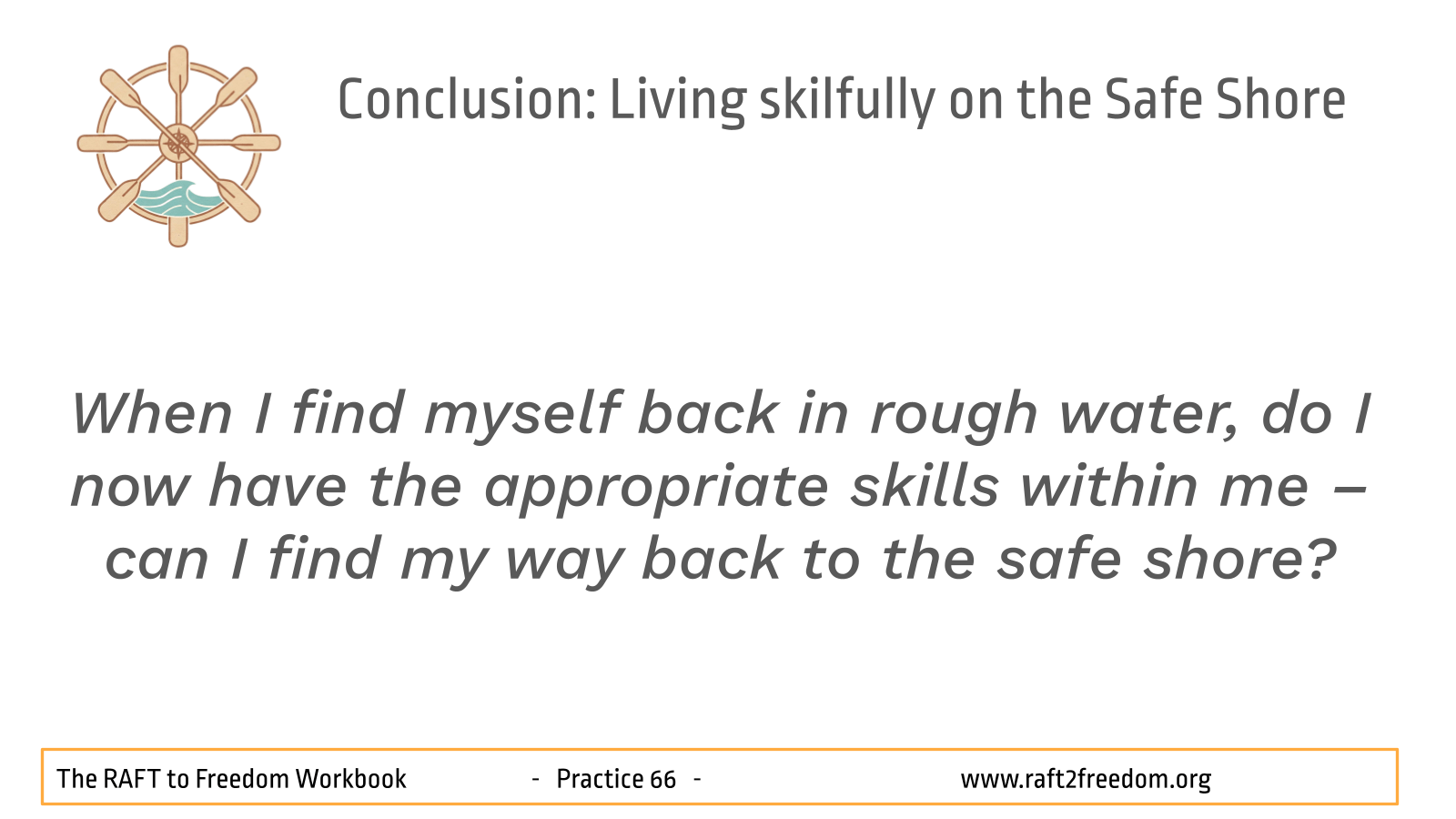
    7. When I find myself back in rough water, do I now have the appropriate skills within me – can I find my way back to the safe shore?

    Journaling prompts – continuing the voyage

    1. The vision of arriving: Imagine your life one year from now, as you move from merely surviving towards thriving. Picture yourself living more steadily on the safe shore. What does an ordinary day look and feel like? What has become possible again – in your relationships, your interests, your work, your creativity, or your capacity for joy?
    2. The gratitude inventory: List five specific tools, insights, or turning points from this workbook that steadied you when the waters were rough. Write a brief note of appreciation to each one. What changed because you practised it?
    3. Leaving the identity: Reflect on the phrase: ‘I am no longer defined by my past struggles; I am defined by my present capacity for care.’ What resistance arises? What relief?
    4. The integration plan: Choose one factor from Gotama’s Middle Way Programme – such as perspective, speech, or livelihood. Describe how this will remain active in your daily life without external prompting. What rhythms, reminders, or habits will sustain it?
    5. The letter to the past: Write a compassionate letter to the version of yourself who began this journey. Acknowledge their fear, confusion, or determination. Tell them what has changed. Thank them for not giving up.
    6. Navigating future storms: Imagine a future challenge (examples include, loss, change, pressure, uncertainty). Describe how you will meet it using the skills of the RAFT, not from desperation, but from steadiness. What will you remember first?
    7. The vow of friendship: Write a simple personal commitment to be a wise and steady friend to others. How will you offer stability without rescuing? How will you share kindness without judgement? How will you protect your own balance while supporting someone still crossing?

    Supporting material – why the RAFT to Freedom workbook is helpful

    For those who wish to understand how the RAFT framework aligns with contemporary psychology, neuroscience, and philosophy, the following reflections outline the deeper mechanisms behind the crossing from the dangerous shore to the safe shore.

    • Neuroscience – from alarm to integration

    RAFT to Freedom has not yet been tested as a single, named neuroscience programme. However, its four movements draw together practices that are supported by a growing body of research in mindfulness, addiction science, stress regulation, learning and behaviour change.

    • Recognise begins with a simple neuroscientific insight: the human nervous system is designed to detect threat, anticipate loss and pay close attention to uncertainty. This negativity bias is not a personal failing; it is part of our protective biology. Life will therefore sometimes feel painful, difficult or disappointing, not because we are doing it wrongly, but because change, vulnerability and loss are woven into human life.
    • Recognising this does not remove pain. It can, however, reduce the additional distress created when we treat ordinary human difficulty as evidence that something is wrong with us, or struggle against experience that cannot immediately be changed.
    • Abandon works with the learning loops that keep compulsive patterns going. Cravings and reactive habits are strengthened when they are repeatedly followed by the same behaviour and short-term relief. Mindfulness-based approaches to relapse prevention, including learning to experience an urge without acting on it, have been associated with reductions in craving, stress and substance misuse for some people. Each time we pause, ground ourselves and choose not to feed an old reactive pattern, we weaken its hold and begin to establish an alternative response.
    • Feel turns our attention towards the freedom that becomes available when craving, aversion and confusion are not being continually reinforced. The nervous system is naturally drawn to danger, disappointment and unfinished business. Learning to notice moments of ease, safety, calm, connection, joy and non-reactivity helps counter this bias. Practices of appreciative attention and savouring can strengthen positive emotion and well-being, making these states more familiar, more believable and easier to return to. In RAFT language, we learn not only to spot the storm but also to recognise when the coast is clear.
    • Train reflects a basic neuroscientific principle: what we practise becomes easier to access. Repeated attention, behavioural and emotional-regulation practices can strengthen the brain networks involved in attention, self-regulation and flexible responding. Over time, returning to the body, pausing before acting, and choosing a more skilful response may make these alternatives more available under pressure.

    This does not mean that practice removes pain or prevents difficult experiences. It means that, with repetition, we may become less governed by automatic alarm and more able to respond with steadiness, discernment and care. In RAFT terms, we are learning the skills of Gotama’s Middle Way programme so that, when difficult weather comes, we have more ways of navigating it.

    • Psychology – from reactivity to deliberate living

    RAFT to Freedom has not yet been tested as a single, named psychological programme. However, its four movements draw together practices that are reflected in research on acceptance, behaviour change, mindfulness, positive psychology and values-guided action.

    • Recognise begins by acknowledging that pain, uncertainty, loss and disappointment are part of human life. Psychologically, this resembles acceptance-based approaches, which distinguish unavoidable pain from the additional suffering created by fighting, denying or personalising what cannot immediately be changed. Recognising that difficulty is universal, rather than evidence of personal defect, can help loosen shame and create a more realistic, compassionate starting point.
    • Abandon works with the learned patterns that maintain craving, avoidance and compulsive behaviour. Behavioural psychology shows that habits are strengthened when they repeatedly bring short-term relief or reward. When we pause, refrain from acting automatically and choose a different response, we interrupt that cycle. Old patterns may not disappear at once, but they need not continue to be reinforced in the same way.
    • Feel turns attention towards the freedom that becomes available when craving, aversion and confusion are not being fed. Psychological research on appreciative attention, positive emotion and savouring suggests that deliberately noticing moments of ease, calm, connection, gratitude and well-being can strengthen these experiences and make them more available in daily life. In RAFT terms, we learn not only to identify what troubles us, but also to recognise when the coast is clear.
    • Train is the sustained practice of Gotama’s Middle Way programme: developing skilful perspective, intention, speech, action, livelihood, application, mindfulness and collectedness in ordinary life. Psychology supports the general principle that repeated practice, clear routines and behaviour aligned with deeply held values can make skilful responses easier to access over time. The aim is not to suppress symptoms or achieve perfection, but to build a life in which wisdom, ethical care and mental steadiness increasingly shape how we meet experience.

    Psychologically, the raft moves us from survival-driven coping towards more deliberate living. It does not ask us to deny our history or manufacture a new identity. Rather, it invites a shift from self-defining statements such as, ‘I am broken,’ towards a more truthful and workable understanding: ‘I am learning to steer.’ 

    • Philosophy – from confusion to wise living

    RAFT to Freedom is rooted in the practical philosophy of Gotama’s Middle Way: a way of understanding suffering, its causes, its cessation and the path of practice that makes freedom increasingly possible. Its four movements also resonate with other philosophical traditions, including Stoicism and virtue ethics, which ask how we can live wisely in the midst of uncertainty, difficulty and change.

    • Recognise begins with seeing life as it is, rather than as we wish it to be. Early Buddhist philosophy treats pain, change, vulnerability and disappointment as universal features of human existence, not signs of personal failure. Stoic thinkers made a similar distinction between events themselves and the judgements we add to them. We may not control what happens, but we can learn to examine the meanings, assumptions and impressions through which we meet it.
    • Abandon concerns the freedom that becomes possible when we do not automatically assent to every urge, fear, resentment or story the mind produces. In Buddhist thought, craving, aversion and confusion are not fixed features of a self; they are conditioned processes that arise and can cease when their supporting conditions are no longer fed. Stoicism likewise emphasises pausing before giving full authority to an initial impression. In both traditions, restraint is not repression. It is the cultivation of room to choose what is skilful rather than simply doing what is immediate.
    • Feel turns towards the direct experience of freedom when craving, aversion and confusion have fallen quiet. In the Buddhist tradition, this is not merely the absence of distress, but the presence of clarity, calm, joy and equanimity. It invites us to recognise that well-being need not depend entirely on getting what we want, avoiding what we dislike or controlling the conditions around us. In RAFT language, we learn to notice not only the storm, but also the open water and the clear horizon.
    • Train reflects the philosophical understanding that a good life is formed through practice. Aristotle argued that character develops through repeated action, while Gotama’s Middle Way programme offers a practical training in perspective, intention, speech, action, livelihood, application, mindfulness and collectedness. Wisdom is therefore not simply something we think about or agree with. It becomes visible in how we speak, act, relate, make a living and respond when conditions are difficult.

    Philosophically, the raft moves us away from the idea that we are permanently defined by our thoughts, impulses or past actions. We are shaped by causes and conditions, but we are also capable of participating in those conditions through attention, ethical choice and repeated practice. 

    Integration – the crossing as coherence

    Across neuroscience, psychology, and philosophy, one theme repeats: behaviour arises from conditions, perception shapes response, and disciplined awareness creates freedom. The dangerous shore represents a system organised around threat and misperception. The safe shore represents a system organised around regulation, coherence, and value-guided action. The RAFT to Freedom workbook does not remove storms; it reorganises how the system meets them.

    What psychology calls resilience, neuroscience calls integration, and philosophy calls wisdom. RAFT calls it freedom. The crossing is developmental rather than dramatic – a gradual reorganisation of perception, emotion, and behaviour into steadiness. And once steadiness is embodied, the raft can be set down with gratitude, because its work has been fulfilled.

    Remember to remember

    As we close this workbook, we pause not in triumph, but in recognition. This journey has asked for courage. It has asked for honesty. It has asked us to look at what we once avoided and to practise what once felt unnatural. We have learned to recognise the currents, to abandon what sinks us, to feel the resulting freedom, and to train with steadiness. That work matters. It deserves acknowledgement – not as achievement, but as evidence of our willingness and capacity to grow.

    We remember that the safe shore is not a place without weather. It is a way of standing in weather without being blown away. Storms will still pass through. Old habits may still whisper. Difficult emotions will still arise. But we now know how to pause. We know how to breathe. We know how to check the hull and recalibrate the compass. We know that freedom is not perfection; it is responsiveness.

    We remember that we are not defined by the dangerous shore. We are shaped by what we practise. The skills we have cultivated are no longer external instructions. They are capacities within us. They can be forgotten, but they cannot be lost.

    We remember that beginning again is always available. If we drift, we can regather. If we run aground, we can repair. If we are pulled under briefly, we know how to surface. The crossing has taught us something deeper than technique – it has taught us trust.

    And so we continue:

    We continue choosing clarity over confusion.
    We continue choosing care over retaliation.
    We continue choosing steadiness over panic.
    We continue choosing truth over self-deception.
    We continue choosing the next skilful step.

    Keeping these aspirations in mind:

    May we trust the freedom already growing within us.
    May we live fully on this shared shore.
    May we meet life as it is – with courage, humility, tenderness, and quiet strength.
    May we remember that peace is not possessed, but practised.
    May we remember that no sincere beginning is ever wasted.
    May we remember that we can begin again.

    May we walk the shore together.

    In the midst of winter, I found there was, within me, an invincible summer.

    Albert Camus

    Suppose I were to haul the raft onto the dry land or set it adrift in the water, and then go wherever I want.

    Gotama

    Sutta references

    • Alagaddupama Sutta (MN 22) – The Simile of the Snake/Raft
      • Summary: This is the definitive teaching for the conclusion. It teaches that the Dhamma is a vehicle for crossing over, not an object to be grasped. It warns against dogmatic clinging to the teachings once their purpose (liberation) has been fulfilled.
    • Mahāparinibbāna Sutta (DN 16) – The Great Passing
      • Summary: In his final days, the Buddha told his attendant Ānanda, ‘Be islands unto yourselves, refuges unto yourselves, seeking no external refuge.’ This reinforces the goal of the workbook: to internalise the raft so that the practitioner becomes their own source of safety.
    • Upaḍḍha Sutta (SN 45.2) – Half the Holy Life
      • Summary: When Ānanda suggests that good friendship is half of the holy life, the Buddha corrects him: ‘Not so, Ānanda! Good friendship is the whole of the holy life. This reminds us that the Safe Shore is inhabited by a community of peers, and our freedom is interdependent.
    • Dhammacakkappavattana Sutta (SN 56.11) – Setting the Wheel of Dhamma in Motion
      • Summary: The foundational teaching outlining the Four Noble Truths and the Middle Way. It provides the essential map for the entire journey from the first recognition of suffering to the final liberation.