Gotama’s Middle Way Programme
The ecology of Freedom
To avoid all evil, to cultivate the good, and to purify the mind – this is the teaching of the Buddhas.
Gotama (The Buddha)
There is a Middle Way discovered by Gotama that avoids both extremes… it leads to peace, to direct knowledge, to enlightenment, to Nibbāna.
Gotama

Episode 56 – Stopping the pendulum with the middle way
An AI-generated ‘deep dive’ into this aspect of the RAFT to Freedom
The operating manual for the voyage
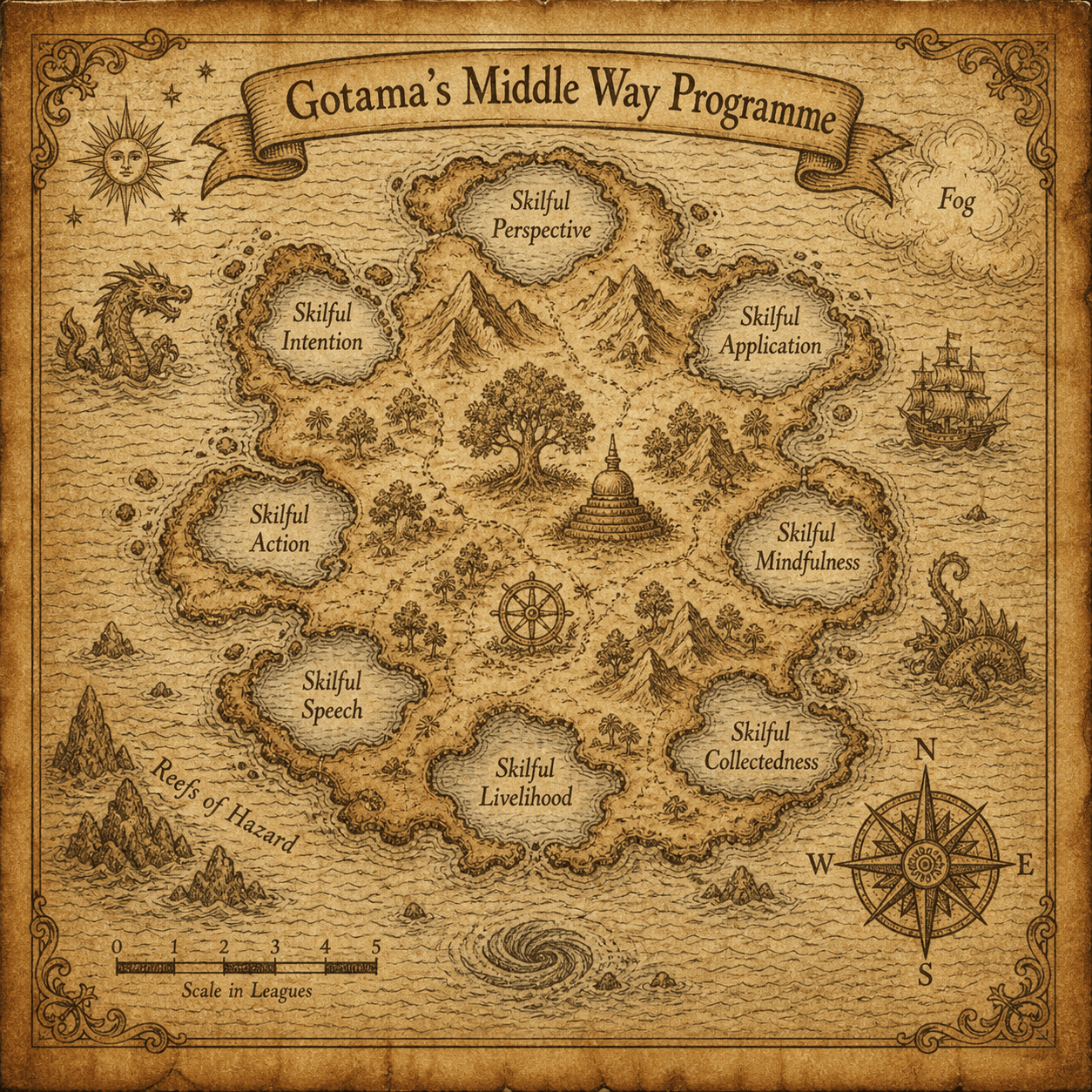
We’ve done the groundwork. We’ve learnt how to orient ourselves (the map), how the sense of ‘me’ gets built up in real time (the five components), and how experience enters through the senses (the six sense doors). Now we turn to the question that matters in daily life: how do we live in a way that reduces harm and increases freedom? In the RAFT to Freedom workbook, we study ‘Gotama’s Middle Way Programme’ (traditionally called the Noble Eightfold Path).
It isn’t a list of commandments, and it isn’t a ladder where we climb up from step one to step eight. It’s more like a set of eight living skills that support each other all the time. Work on one and the others are strengthened; neglect one and the whole system wobbles. It’s an ecology rather than a checklist – a way of training the whole person: how we understand, speak, act, earn, practice, steady the mind, and see clearly.
The ‘Middle Way’ also names something very practical: a route between two extremes that tend to trap us on the journey to freedom. At one end is indulgence – chasing relief, pleasure, numbness, or escape. At the other is self-punishment – shame, harsh discipline, and grim white-knuckling. The Middle Way is not a lukewarm compromise between the two. It’s a steadier third option: using desire as energy without letting it run the show, and using discipline as support without turning it into violence against ourselves.
And it’s not one-size-fits-all. A person living in a monastery will make different choices from someone with a job, family, and a phone that never stops pinging. The real question becomes: where is the line for us personally – between healthy enjoyment (good food, a sunset, travel, intimacy, rest) and compulsive craving (needing stimulation to avoid discomfort or boredom)? The Middle Way Programme is the tool for calibrating that line. It trains us out of the old fantasy that consequences don’t apply to us, and into a quieter truth: when we stop fighting reality and start working with conditions, life becomes less of a battle.
Gotama didn’t present this path as a list of rules or a linear ladder, but as a system where all eight factors work together – like the parts of a craft that must cooperate. A seaworthy raft needs structure, steering, propulsion, and a crew that knows what it’s doing. In the same way, the path factors support each other to keep us off the rocks: not drifting into indulgence, and not smashing ourselves with self-punishment. The Middle Way is the navigable channel that keeps the voyage dignified, workable, and free.
A secular dharma perspective
The secular dharma teacher Stephen Batchelor reimagines the eightfold path as a set of practical human capacities rather than a doctrine to believe or a ladder to climb. His language shifts the emphasis from fixed religious categories toward lived skills we can test, revise, and embody. For example, ‘view’ becomes less about holding the correct belief and more about learning to see clearly: causes and conditions, consequences, context, and the stories we may be trapped inside. In this reframing, the dharma of Gotama’s Middle way is a practical response to the way things really are – ‘the art of living’ – a way of orienting ourselves so we can respond more wisely to what is actually happening.
Batchelor also stresses that the path factors support one another as a living system. They are not separate boxes to tick, but interdependent capacities that need to be kept warm together – like a hen turning a clutch of eggs. Practice therefore becomes experimental and responsive. We rarely have perfect information, so we take the next good-enough step, watch what it produces, and adjust. The path is not about moral perfection or certainty; it is about learning how to live with greater care, freedom, steadiness, and responsibility in the midst of ordinary life.
The three strands of training
The eight factors of the Middle Way are often grouped into three broad areas of training. In this workbook we translate the pali word sammā not simply as ‘right,’ but as ‘skilful’ – meaning what fits this situation, in this moment, and leads away from harm.
1) Wisdom – the navigator: This is the part that reads the conditions and sets the course. It includes ‘Skilful Perspective’ (Chapter 57) and ‘Skilful Intention’ (Chapter 58). Skilful Perspective is the navigator’s realism: actions have consequences, conditions matter, and we’re not separate from the sea we’re travelling on – it cures the fantasy that we’re exempted from reality – unconscious personal exceptionalism. Skilful Intention is the direction of the heart: steering away from craving, resentment, and harm, and toward letting go, goodwill, and harmlessness. It is not merely having a good idea about life; it is the inner resolve that aims the whole raft. Skilful Perspective helps us see clearly; Skilful Intention asks, ‘Given what I now see, what kind of person am I choosing to become, and what direction am I willing to travel?’ Without this strand, our raft may be moving, but it will not be heading anywhere reliable.
2) Ethics – the compass and crew: Once we have set a course, we need a way to stay on it and a crew that we can trust. This strand includes ‘Skilful Speech’ (Chapter 59), ‘Skilful Action’ (Chapter 60), and ‘Skilful Livelihood’ (Chapter 61). It develops the foundation we laid in the Five Gifts (Chapter 04): the commitment to reduce harm, live honestly, respect boundaries, speak truthfully, and protect the clarity of the mind. On our journey from the dangerous shore to the far shore, ethics are less like rules and more like guardrails: they stop us generating fresh storms of regret, conflict, secrecy, and fear. When our speech is honest, our actions are clean, and our livelihood is aligned with our values, the deck becomes safer. Our raft is less likely to be rocked by the consequences of our own behaviour, and the mind finds more room to settle.
3) Mental discipline – the stability of the vessel: Even with a good course and a reliable crew, our raft still needs steadiness to handle the waves. This third training strand includes ‘Skilful Effort’ (Chapter 62), ‘Skilful Mindfulness’ (Chapter 63)’, and ‘Skilful Collectedness’ (Chapter 64)’. Skillful Effort is the ongoing application that prevents and lets go of unhelpful states and encourages what’s wholesome. Skilful Mindfulness is the watchkeeper that notices what’s happening as it’s happening. Skilful Collectedness is the ballast – the gathered steadiness that helps us hold the course when winds pick up. Together, these are what give our raft stability. This stability gives us enough weight and power to move through stormy conditions without being thrown off course.
How to practice: keeping the voyage moving
Practice is not something we possess; it is something we keep doing. We could call it voyaging: the continuous movement between contemplative steadiness and ethical re-engagement.
It can help to think of the Middle Way as a living loop that quietly reinforces itself. When perspective clears a little, intention often softens. When intention softens, speech and actions tend to do less harm. When we do less harm, life produces fewer aftershocks – less conflict, less regret, less inner noise – and the mind settles more easily. In that steadier space, mindfulness and collectedness show up with less forcing, and from there understanding deepens again.
Nothing dramatic has to happen for this wheel to turn. Small shifts in one place make the next place more workable. Over time, the navigator finds there is less to battle and more to steer with – and the voyage becomes a little safer, a little calmer, and a little more free.

Self-Reflections
- Do I swing between indulgence (craving/tuning out) and self-punishment (white-knuckling/rigid regimes)?
- Do I hear ‘the Middle Way’ as boring, or as poised and steady?
- When I chase new experiences, is it healthy interest or restless craving/escape?
- Is it helpful to consider the eight factors working as one system, not separate steps?
- Which is strongest for me right now – wisdom, ethics, or mental discipline – and which needs attention?
- Do I secretly believe life shouldn’t be this hard for me? What changes when I bring in a wider perspective of how things really are?
- Am I trying to build mental discipline (effort, mindfulness, collectedness) without a base of ethics? What happens to my stability when I skip that foundation?
Journaling prompts
- The Middle Way map: Draw a line. Label one end ‘Indulgence’ and the other ‘Self-harm’ Place an ‘X’ where you usually live. Write a brief description of what the space in the middle feels like.
- The wild and precious life: Reflect on Mary Oliver’s question: ‘Tell me, what is it you plan to do with your one wild and precious life?’ How does the Eightfold Path support this plan?
- Intention-to-action diary: Choose a value in the morning (for example, care, patience, resolve). At day’s end, record the exact step you took to enact it, noting obstacles and supports.
- Progress, not perfection: The Middle Way does not ask me to get everything right; it asks me to keep practising. Where have I made a small but real movement in the right direction recently? What helped me return to the voyage, even if I did not do it perfectly?
- Effort tune-up: Document one task where you used the minimum effective dose of effort (not too tight, not too loose). Did it change your energy level or the outcome?
- The three-legged stool: Imagine wisdom, ethics, and mental discipline as legs of a stool. If you remove one (for example, ethics), what happens to your mental stability? Write about the collapse.
- The vow of the path: Write a personal statement of commitment to the process of the Middle Way, acknowledging that you will drift and return, drift and return.
Supporting Material: scientific and philosophical perspectives
For those interested in the scientific and philosophical underpinnings of ‘The Middle Way Programme’, the following overview highlights some key connections.
- Neuroscience: The brain isn’t powered by a single ‘willpower’ switch; it’s a set of interacting networks for planning, attention, emotion, threat, habit, and social connection. Compulsion thrives when these systems become fragmented: threat and habit loops run hot, while reflective choice goes offline. The Middle Way Programme supports neural integration by training multiple systems together, so the mind is less ‘parts at war’ and more ‘systems cooperating.’
Wisdom factors repeatedly recruit executive functions (the long view, inhibition, reappraisal). Ethics factors engage value and social-empathic circuitry, strengthening the capacity to weigh consequences and care. Mental Discipline factors stabilise attention and help downshift threat reactivity. With consistent practice, these networks tend to coordinate more effectively (greater functional connectivity), making it easier to notice earlier, recover faster, and act in line with what matters – especially under stress. - Psychology: Self-Determination Theory suggests we sustain change best when actions are self-concordant – aligned with our own values – rather than driven by guilt, pressure, or fear. Compulsion often runs on controlled motivation: ‘I must’ or ‘I should,’ powered by shame and escape. That fuel burns fast and leaves us depleted, which then feeds the very behaviours we’re trying to leave behind.
The Eightfold Path shifts the centre of gravity toward autonomous motivation: we practise because we care about the life we’re building, and because the results are directly livable – more steadiness, fewer aftershocks, better relationships, clearer mind. It also creates a recovery ecology: when one area wobbles, another can support it. If mood is low, structure and small ethical actions can carry the day; if attention is scattered, values can re-orient; if we slip, repair restores dignity and keeps the training alive. - Philosophy: Aristotle’s Golden Mean frames virtue as the middle – not of compromise, but of fit – the right response in the right measure for the situation. Courage isn’t bland moderation; it’s the action that meets conditions wisely. Gotama’s Middle Way is similar: it avoids the two reflexes that perpetuate suffering – indulgence and self-harm – and trains the capacity to respond in ways that reduce harm and increase freedom.
This is why the path is best understood as praxis: philosophy enacted. It isn’t a creed to believe; it’s a method to perform and test in lived consequences. Existentialists add a bracing clarity: we become what we repeatedly choose. The Middle Way Programme gives those choices a reliable shape – so freedom isn’t a mood or a breakthrough, but a way of living we steadily actualise.
Remember to remember
The Middle Way Programme is the standing order for the rest of our lives — not a set of demands, but a description of how a freer life gradually becomes possible. It keeps practice grounded in the day-to-day: how we understand what is happening, how we choose our direction, how we speak, how we act, how we earn, how we steady ourselves, and how we return when we drift. The programme does not ask for perfection. It asks for honesty, steadiness, and the willingness to begin again and again and again.
Remember: the voyage is how freedom stays lived. Each skilful step makes the next one more possible. A little more perspective softens intention; a little more care in speech and action reduces inner noise; a little more steadiness helps us see clearly when the weather turns. Over time, the Middle Way becomes less like something we are trying to follow and more like a way of travelling: less pulled by extremes, less trapped by old reactions, more guided by wisdom, ethics, and care.
You cannot separate mindfulness from mindful speaking, acting, working, and engaging in the world.
Plum Village, Key Teachings of Thich Nhat Hanh
Don’t worry about achieving. Don’t worry about perfection. Just be there each moment as best you can.
Pema Chödrön
Sutta References
- Dhammacakkappavattana Sutta (SN 56.11): Setting the Wheel of Dhamma in Motion
- Summary: The foundational discourse where the Buddha rejects the extremes of sensual indulgence and self-mortification, declaring the Middle Way as the path to peace and Nibbāna.
- Magga-vibhaṅga Sutta (SN 45.8): The Analysis of the Path
- Summary: Offers the essential definitions of what constitutes each element of the Eightfold Path.
- Mahācattārīsaka Sutta (MN 117): The Great Forty
- Summary: Explains the ‘supramundane’ path where the factors work together. It highlights that Appropriate View comes first, acting as the forerunner, and that Appropriate Effort and Appropriate Mindfulness circle around every other factor to keep them on track.
- Sedaka Sutta (SN 47.19): The Acrobat
- Summary: ‘Protecting oneself, one protects others.’ It links mindfulness to mutual protection, grounding the path’s relational ethics.