The communications protocol of our raft
Speak not harshly to anyone; spoken to, they may answer you in kind.
Gotama (The Buddha)
Speak only the well-spoken: truthful, purposeful, kind, and timely.
Gotama

Episode 59 – The biological weight of your words
An AI-generated ‘deep dive’ into this aspect of the RAFT to Freedom
The protocol of connection
In this Training stage of our journey, we move from inner orientation to outward relationship. Having set our direction with Skilful Perspective (Chapter 57) and our rudder with Skilful Intention (Chapter 58), we now engage the first factor of ethical conduct within Gotama’s Middle Way Programme: Skilful Speech. In plain language, this is the practice of using the voice – out loud and inside our own head – in a way that reduces harm and increases trust.
In the practice of the ‘Five Gifts’ (Chapter 04), we laid one of the foundational planks of our raft by offering the fourth gift: a commitment to abstain from false speech and to cultivate truthfulness. Now we expand that intention. Skilful Speech is not only about avoiding harm through false speech, harsh speech, divisive speech, or idle chatter. It becomes a living aspiration for wise connection – how we tell the truth without cruelty, how we set boundaries without aggression, and how we communicate in a way that repairs rather than fractures.
Skilful Speech is our vessel’s communications protocol. Whether we’re signalling to other rafts (social interaction) or speaking over the internal intercom (self-talk), the transmission needs to be clear for our raft to remain on course. We maintain truthfulness – accurate reporting of our position and condition. If we broadcast false coordinates, no help can reach us and we lose our own bearings. We also prioritise harmony, using the radio to build cooperation rather than spreading conflict through divisive speech. And we speak with purpose, avoiding the static of idle chatter that clogs the channel and wastes the crew’s energy.
Skilful Speech begins before the first word is spoken. It begins with listening. If we do not listen carefully, we answer the story in our head rather than the person in front of us. On the raft, this is like transmitting before we have received the signal. Listening gives speech its bearings: we pause, take in tone and context, notice our own reactivity, and ask what this moment is actually calling for. Sometimes the most skilful speech begins as silence – spacious enough for another person to be heard.
Internal speech – the intercom
This protocol applies inwardly as well. In the teachings, speech is an action, and the words we repeat inside the mind shape intention, emotion, and behaviour. After a mistake, a craving, or a hard day, a harsh inner voice tends to feed aversion, agitation, shame, and doubt. It does not make the raft more disciplined; it starts an internal mutiny.
In this stage of training, we practise speaking to ourselves with the same qualities we would offer a friend: truthful, beneficial, timely, and kind. This is not self-indulgence; it is a skilful command. A raft cannot travel far with constant fighting on board. It steers best when the captain’s voice is clear, honest, steady, and humane.
Digital speech – the long wake
In modern life, much of our speech travels without our body present: texts, emails, comments, posts, voice notes, and group chats. These forms of speech can feel less serious because we are not looking into another person’s face, but they still leave a wake. A message sent in anger can be reread for years. A rumour shared in a group chat can travel far beyond its first audience. A sarcastic comment can harden a relationship before we realise what has happened.
Skilful digital speech uses the same protocol: is it true, beneficial, timely, and kind? Before pressing send, we can pause and ask: would I say this in person, with this tone, at this time? Is this message clarifying the channel or adding static? Sometimes the most skilful practice is to save the draft, breathe, and return when the weather on deck has settled.
Abandon and cultivate
Skilful speech is speech that avoids and reduces harm and supports kindness for ourselves and for others. It has a clear direction: it is grounded in truth, shaped by care, and offered at a time and in a way the other person can actually receive. Speech that is not Skilful Speech does the opposite. It distorts reality, inflames conflict, hardens the heart, or fills the space with noise that drains attention and energy. In Gotama’s Middle Way Programme, this unhelpful speech is grouped into four patterns: false speech (lying or exaggerating), divisive speech (splitting people apart), harsh speech (cruelty in tone or content), and idle chatter (aimless talk that distracts and clouds the mind).
As we have explored previously in the workbook, our training has two movements: we refrain (abandon) from what causes harm, and we actively grow (cultivate) what brings benefit. With Skilful Speech, we practise not lying or exaggerating, and we cultivate truthfulness and rigorous honesty. We step back from gossip, triangling, and taking sides in ways that split people apart, and we cultivate harmony – words that connect, clarify, and unite. We avoid insults, sarcasm, and shouting, and we cultivate gentleness – maintaining kindness and respect even when we disagree. And we avoid idle chatter by reducing distracted, aimless noise. Cultivating purpose – speaking at the right time, in the right measure, about what actually matters.
This does not mean that every conversation must be solemn or important. Warmth, humour, small talk, and ordinary friendliness can all be skilful when they build connection and ease. The question is not whether speech is casual; the question is whether it clouds the mind, wastes energy, or pulls people away from what matters. Skilful speech can be light without being careless.
How to practice: the four gates protocol
To move from reactive blurring to clear transmission, we use the ‘four gates’ check. Before speaking, or when reviewing a conversation, we ask four questions in sequence.
- Is it true? If the answer is no, we maintain silence.
- Is it beneficial? Does this speech reduce harm or help the situation? If not, we maintain silence.
- Is it timely? Is the other person ready to hear it? If not, we wait for an appropriate time.
- Is it kind? Is my tone appropriate? If the answer is no, we wait for better conditions.
This isn’t about perfection. It’s a way of slowing down enough to remember that words have consequences, and that timing and tone often determine whether truth becomes medicine or poison.
The four gates do not only teach us how to speak; they also teach us when not to speak. Silence can be avoidance, but it can also be wisdom. If something is true but not beneficial, we wait. If something may be beneficial but the timing is wrong, we wait. If our tone is still carrying heat, we wait. This kind of silence is not withdrawal from connection; it is protection of the channel until the signal can be sent clearly and cleanly.
Repairs over explanations
We will inevitably make mistakes. When our words harm trust, it’s helpful to repair early. A beneficial repair has three simple components.
- Acknowledge the impact rather than defending intent (for example, ‘I see that my words hurt you’).
- Apologise without defence (for example, ‘I am sorry I spoke harshly’, rather than ‘I’m sorry, but I was tired’).
- State the change (for example, ‘I will take a breath before responding next time’).
A secular dharma perspective – Voice
The secular dharma teacher Stephen Batchelor renders this factor as Voice, which highlights participation rather than rule-keeping. Where the traditional language speaks of Skilful Speech, Voice points not only to the words we avoid, but to how we show up in the world as relational beings. It begins with listening: taking in what is actually being said, sensing what the moment is asking, and noticing the conditions in ourselves before we add more sound. From there, Voice becomes responsive: offering the next good-enough sentence that is truthful, measured, timely, and oriented toward reducing harm.
Voice also includes finding our own voice – not merely repeating the voices we have inherited, absorbed, or reacted against. It asks us to speak from lived understanding rather than borrowed certainty. Because we rarely have perfect information, perfect timing, or perfect tone, we treat speech as something we refine in real time: listening carefully, speaking simply, noticing the effect, and adjusting based on what we learn. The aim is not to win conversations or prove a point, but to tell the truth in a way that keeps connection possible, reduces harm, and lets our voice become one more way the journey is navigated with care.

Self reflections
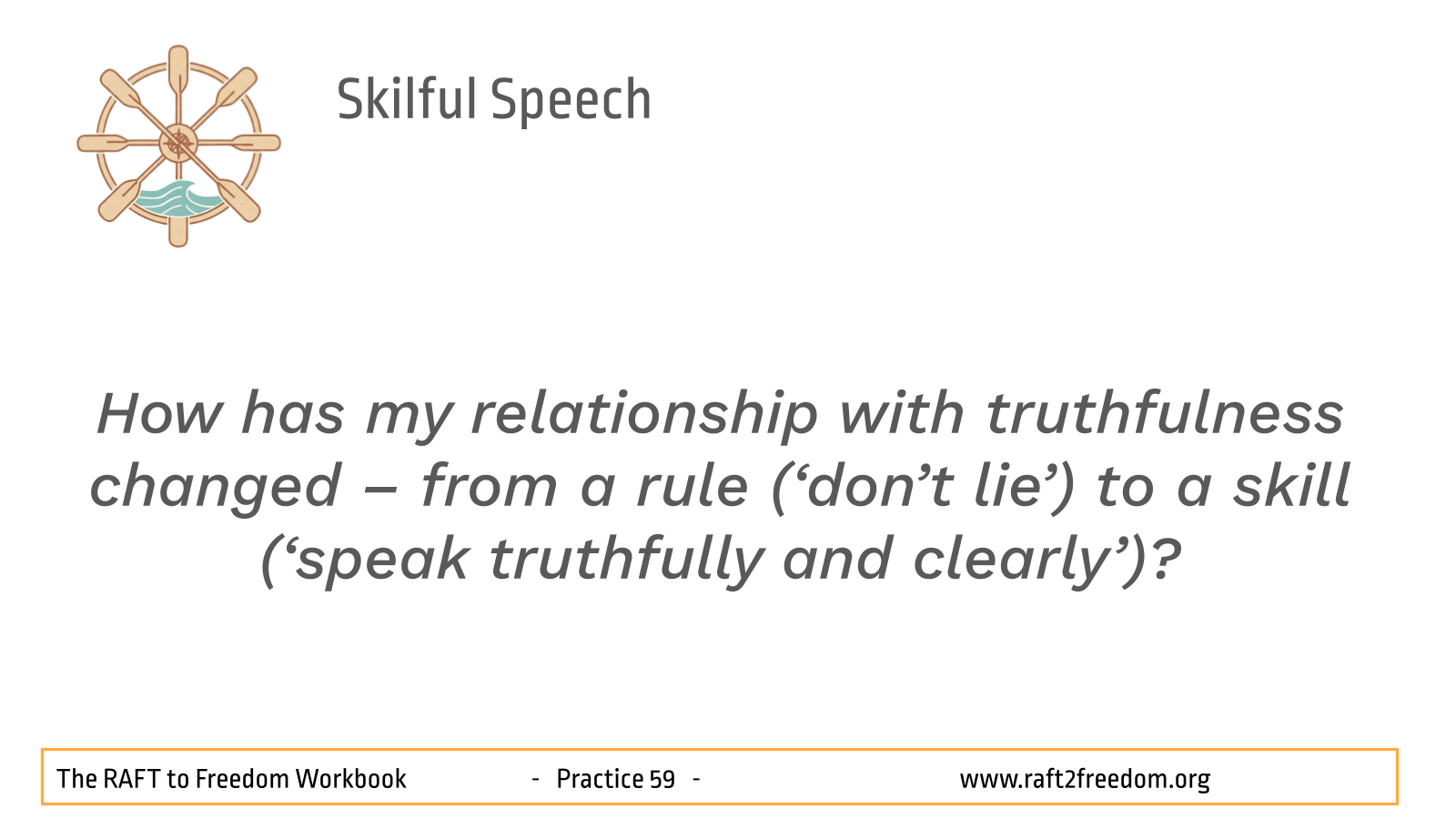
- How has my relationship with truthfulness changed – from a rule (‘don’t lie’) to a skill (‘speak truthfully and clearly’)?
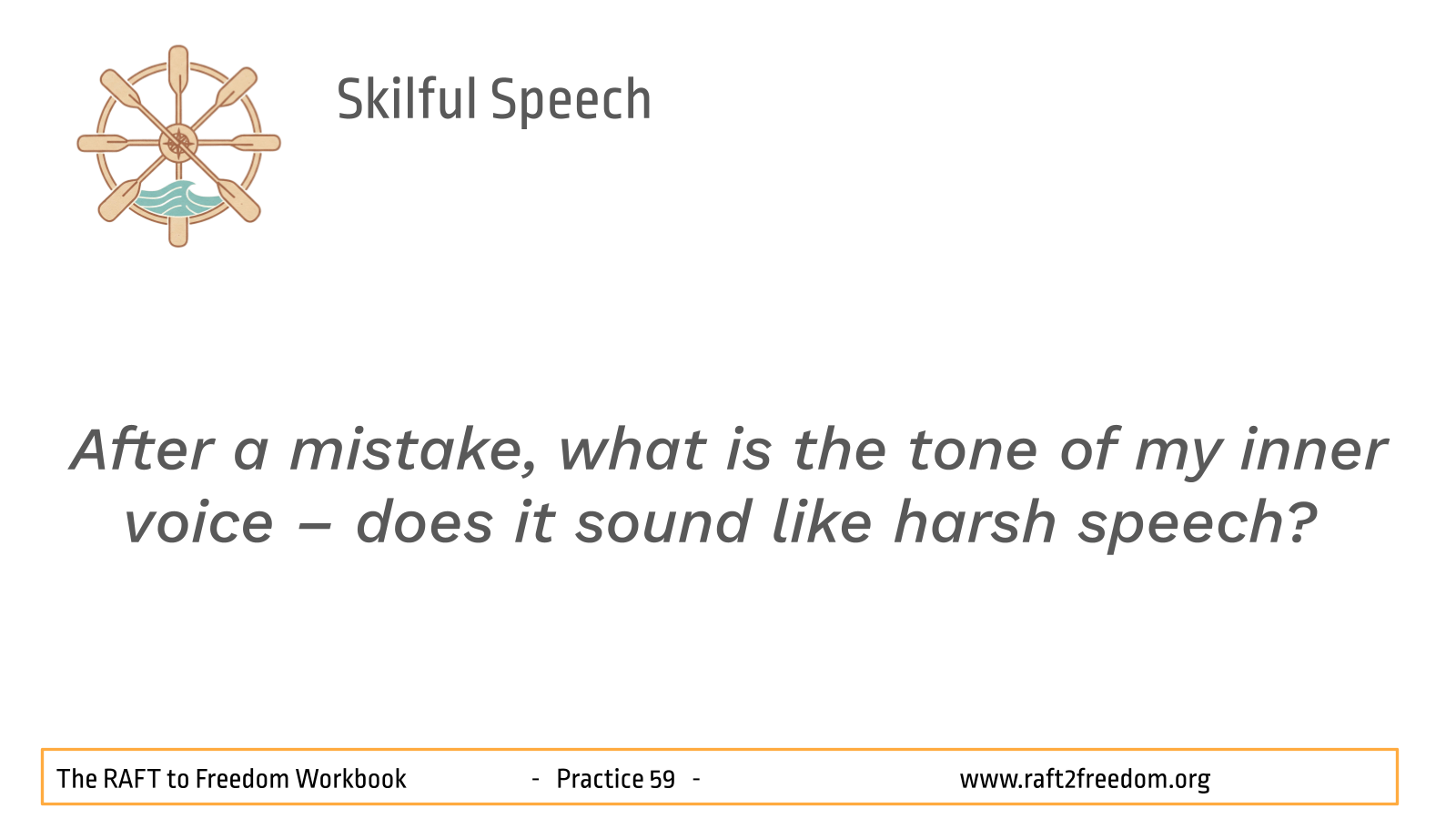
- After a mistake, what is the tone of my inner voice – does it sound like harsh speech?
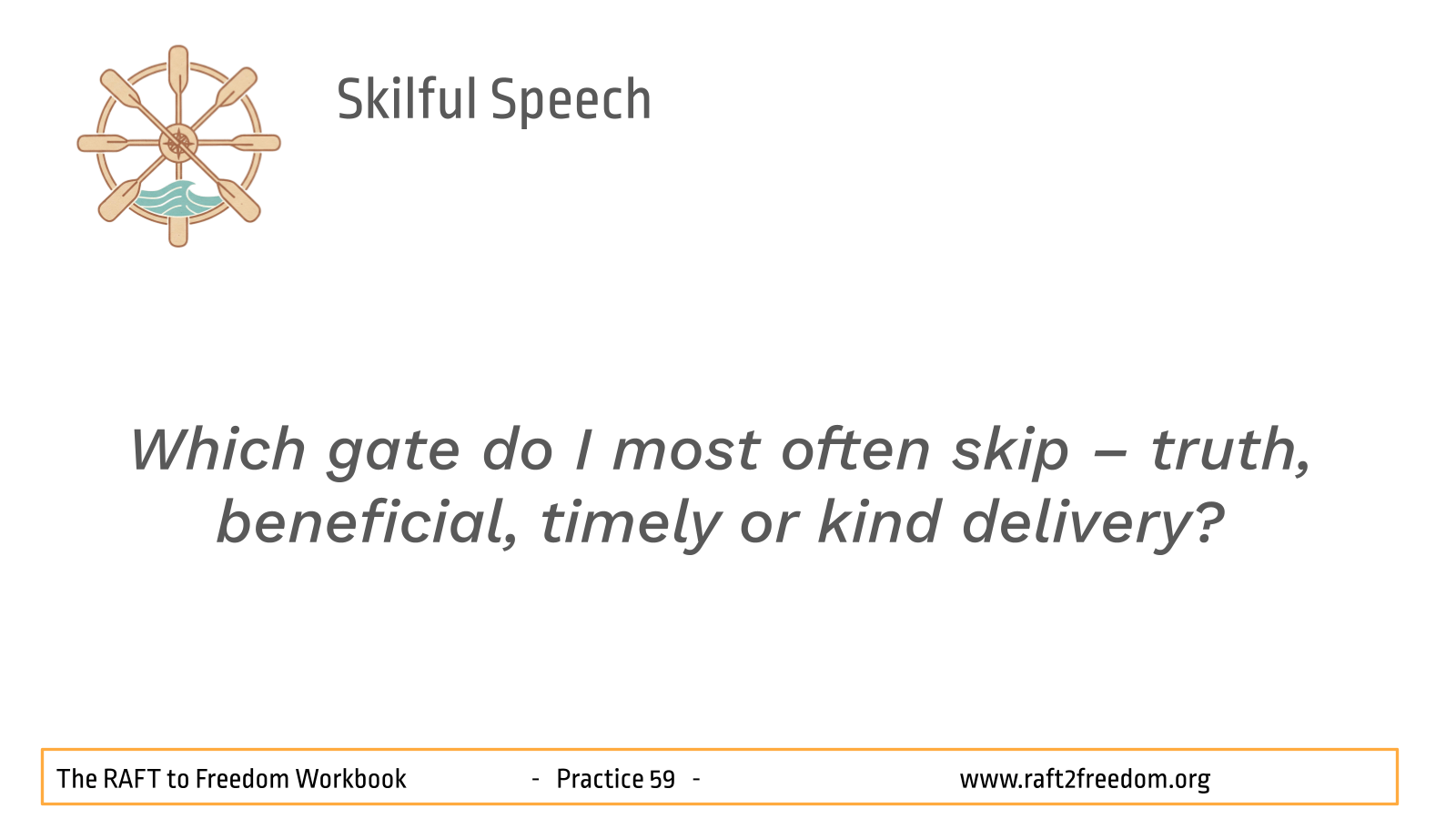
- Which gate do I most often skip – truth, beneficial, timely or kind delivery?
- Where do I still ‘bend the signal’ – exaggerating, leaving key things out, or shaping the story to look better?
- When do I drift into divisive speech – gossip, triangling, taking sides, or venting in a way that splits people apart?
- What body cue tells me I’m about to speak from reactivity (tight throat, heat in face, clenched jaw) – and what helps me pause?
- When I need to repair, do I explain myself (‘I was tired’) or name impact (‘I realise I have upset you’) – and what changes when I drop the defence?
Journaling prompts
- The four gate diary: Write one tricky conversation from today. Score it against true / beneficial / timely / kind. Rewrite one sentence the way you’d like to say it next time.
- The repair log: Describe one repair you made (or avoided). Write the repair in three lines: impact, apology (no defence), change.
- Internal rewrite: Write a short script of your inner critic after a mistake. Then rewrite it as Skilful Speech – truthful, beneficial, and kind.
- Divisive to harmonising: Describe one moment you were tempted to gossip or triangulate. Rewrite what you could have said that protects trust and connection.
- One clear message: Draft a single sentence you’ve been avoiding saying. Make it simple, non-inflammatory, and aligned with the four gates – true / beneficial / timely / kind.
- Pause and tone: Note three moments when one breath (or three soft out-breaths) changed your tone or timing. What was different in the outcome?
- Listening first: Pick a challenging conversation (digital or otherwise) and practise writing a two-sentence summary of what the other person actually meant before writing your reply. What changed when you did that?
Supporting material – scientific and philosophical perspectives
For those interested in the scientific and philosophical underpinnings of Skilful Speech, the following overview highlights some key connections.
- Neuroscience: Deception is cognitively expensive because it usually requires holding two versions of reality at once: inhibiting the truth, constructing an alternative, monitoring consistency, and managing the risk of contradiction. Meta-analytic work on deception consistently finds activation across regions linked to executive function – including prefrontal and cingulo-opercular control systems – alongside areas involved in conflict monitoring and action selection. The simplest takeaway for this chapter is practical: when we distort the signal, we load the system.
Rigorous honesty isn’t only moral – it is metabolically kind. Truth reduces the number of threads we have to track, and it lowers the background stress of maintaining a second story. Under pressure and in recovery, attention and working memory are scarce resources; truthfulness frees bandwidth for regulation, listening, and repair. Over time, speaking plainly and accurately becomes a form of nervous-system care: less scrambling, fewer aftershocks, more steadiness. - Psychology: Speech is one of our primary tools for co-regulation. Long before the brain analyses content, the body reads tone, rhythm, pace, and facial cues as signals of safety or threat. Polyvagal theory describes this as neuroception – an implicit scanning process that influences whether we move toward connection, mobilisation, or shutdown. Prosody (the patterns of stress and intonation in a language) is not merely decoration; it carries emotion and intent in parallel with words, which is why the same sentence can land as care or attack depending on how it is delivered.
This is also why repair matters so much. When harsh speech trips threat responses, the channel narrows and misunderstanding multiplies. A clean repair – acknowledging impact, apologising without defence, and naming a change – helps reopen safety and restore trust. Experimental work shows that apology and restitution can increase empathy and positive emotion while reducing negative emotion and stress-related responses, and trust-repair research supports the idea that how we repair affects how trust rebounds. In other words: Skilful Speech isn’t only prevention; it’s also the willingness to repair quickly when we drift. - Philosophy: Philosophers of language point out that speech is often performative: by speaking we don’t only describe reality, we create it. We promise, accuse, invite, refuse, apologise, forgive – and these utterances change obligations, relationships, and the social atmosphere we all have to live in. This is the core insight of speech act theory: language is a form of action, and words that can do things in the world simply by being spoken in the right context.
The Stoics add an older, very compatible ‘gates’ sensibility: filter speech through truth and integrity, and reduce unnecessary talk that fuels reactivity. Marcus Aurelius gives a stark version – if it isn’t true, don’t say it; if it isn’t right, don’t do it – and Epictetus repeatedly advises restraint from gossip and blame. Read alongside the Buddhist training, this becomes a shared philosophical point: speech is not neutral. It either increases confusion and friction, or it supports clarity, trust, and the conditions for freedom.
Remember to remember
Skilful speech is where inner steadiness becomes shared reality. Words are actions: they carry weight, they leave a wake, and they shape the conditions we then have to live inside. When we remember the four gates – is it true, is it beneficial, is it timely, and is it kind? We slow down enough to choose speech that builds trust rather than burning it. This protects the integrity of our raft and the safety of those sailing near us, because relationships are part of our ecology. This protocol applies inwardly too: the way we speak to ourselves after a craving, a mistake, or a hard day either steadies the system or fractures it. So we practise a voice that is honest without cruelty – clear, kind, and useful – the same voice we would offer a friend.
Remember, too, that repair restores trust. We do not have to speak perfectly; we only need to notice when we have drifted and be willing to come back. A clean repair is simple and strong: name the impact, apologise without defence, and state the change. This turns a slip of the tongue into training rather than shame. It also keeps small ruptures from becoming long silences, resentments, or avoidance. In RAFT terms, we keep the channel clear and the hull sound: we pause, listen, breathe, choose the next good-enough sentence, and steer again – not to win conversations, but to keep connection seaworthy.
Words are windows, or they’re walls. They sentence us, or set us free.
Ruth Bebermeyer
If you can’t say something nice, don’t say nothing at all.” ~ Thumper
Bambi – Disney
Sutta references
- Abhayarājakumāra Sutta (MN 58) – To Prince Abhaya
- Summary: The Buddha analyses speech according to whether it is true, beneficial, and agreeable or disagreeable to others. He says he does not speak what is false or unbeneficial; but when something is true and beneficial, he knows the right time to say it, whether or not it is pleasing, because he speaks out of compassion.
- Ambalaṭṭhika‑Rāhulovāda Sutta (MN 61) – Advice to Rāhula summary:
- Summary: The Buddha warns his son that “for one who is not afraid to tell a deliberate lie, there is no evil that they cannot do.” He instructs on reflecting before, during, and after action (speech is an action).
- Subhāsita Sutta (Sn 3.3) – Well‑spoken words
- Summary: Defines ‘well‑spoken’ speech as having four qualities: it is spoken well (kindly), it is just (lawful/truthful), it is pleasing (not harsh), and it is true.