The logistics of the voyage
Ethical logistics
There is the case where a disciple of the noble ones abandons wrong livelihood and maintains his life with right livelihood.
Gotama (The Buddha).
Our vocation can nourish our understanding and compassion, or erode them. We should be awake to the consequences, far and near, of the way we earn our living.
Thich Nhat Hanh.

Episode 61 – Skilful Livelihood a biological necessity
An AI-generated ‘deep dive’ into this aspect of the RAFT to Freedom
In this Training stage of our journey, we have laid the foundations for living differently: we’ve clarified how we see things with Skilful Perspective (Chapter 57), set our direction with Skilful Intention (Chapter 58), trained our communication with Skilful Speech (Chapter 59), and brought our values into what we do with Skilful Action (Chapters 60). Now we turn to the practical question of how we support a life that can actually be lived day by day. This is the fifth factor of Gotama’s Middle Way Programme: ‘Skilful Livelihood’.
Skilful Livelihood is where ethics meets economics. It’s the discipline of sustaining life without causing harm – earning, spending, and resourcing ourselves in ways we can stand behind. In the chapter on the Five Gifts (Chapter 04) we established key planks of the raft, especially non-harming and honesty. Here we apply those commitments in the real world: how we work, what we sell, what we participate in, and what our livelihood asks of our nervous system. The question is simple and searching: Can I make a living in a way that supports my journey to freedom, protects others, and keeps my raft seaworthy?
Skilful Livelihood is about how we support our life. It asks where our money and resources come from, whether our work is honest, and whether it harms other people or harms us. It also asks what our work does to our nervous system: does it push us into stress, secrecy, and constant reactivity, or does it support stability and our journey to freedom? Work can feed us and still cost us – through anxiety, shame, burnout, or pressure to compromise our values. Skilful Livelihood is the practice of earning and living in a way we can stand behind, without creating avoidable harm.
Skilful Livelihood governs how we acquire supplies – food, fuel, and shelter – to keep our raft afloat. First, we consider the source: do we acquire our supplies through ‘piracy,’ relying on fraud, theft, or exploitation? If so, the crew lives in constant anxiety, looking over their shoulder for authorities or retaliation. Piracy provides resources but poisons the peace of the voyage. Second, we consider the cargo: are we transporting ‘toxic cargo’ that endangers the ocean and the vessel itself? Dealing in harm, intoxicants, or weapons weighs down the raft with heavy consequences. Finally, livelihood represents the day-to-day maintenance of the vessel: if the work is toxic, the hull rots; if the work is ethical, the journey remains sustainable over the long haul.
Traditionally, Skilful Livelihood begins with how we earn our living: whether our work depends on deception, exploitation, killing, intoxication, or harm. In this workbook we also widen the lens to include the whole logistics of daily life – how we spend, schedule, resource, rest, and recover – because livelihood is not only income. It is the pattern of conditions that keeps the raft afloat.
Avoid and affirm
Gotama gave specific guidance on how to navigate the economy of life in ways that protect the mind from remorse and protect the world from avoidable harm. The traditional manual highlights five ‘toxic trades’ to avoid because they tend to destabilise the heart and create suffering: dealing in weapons, living beings, meat or killing for profit, intoxicants, and poisons. In a modern context, that last category can also include forms of livelihood that profit from degradation and harm at scale. And the avoidance of intoxicants can reasonably be extended beyond selling alcohol or drugs to include business models built on addiction and compulsion – such as gambling, peddling digital addiction, or algorithmic outrage. We avoid these paths not out of moral superiority, but because they make steadiness much harder to sustain.
Conversely, we practise what we might call job crafting: shaping our livelihood so it supports honesty, care, and balance. Ideally, we earn our living in ways we can stand behind, and use what we gain to support family, community, and our journey to liberation. Even if we can’t change jobs immediately, we can often change how we do the job: clearer boundaries, cleaner speech, fairer exchange, fewer compromises, more service. Over time, Skilful Livelihood becomes part of the teaching itself – a quiet demonstration that it is possible to survive and even thrive without deception, exploitation, or self-betrayal.
Clean supplies, clean conscience
A livelihood can provide money and still cost too much. If it repeatedly requires us to deceive, harden, manipulate, overwork, or participate in harm, the supplies come aboard contaminated. The raft may look provisioned, but the crew becomes restless. We carry the cost as tension, secrecy, resentment, exhaustion, or a quiet loss of self-respect.
Clean livelihood does not mean perfect livelihood. It means moving toward work and resourcing that leave fewer stains on the mind. We ask: can I tell the truth here? Can I act fairly here? Can I ensure enough rest and clarity here? Can I earn what I need without making suffering my business? These questions are not accusations; they are navigational instruments. They help us keep the voyage sustainable.
The wake of spending
Skilful Livelihood is not only about how supplies come on board; it is also about where they go. Spending is a form of participation. Each purchase, subscription, investment, or habit quietly supports a wider chain of conditions. We cannot make every choice perfectly pure, and trying to do so can become another form of strain. But we can ask a cleaner question: does this use of money support steadiness, dignity, and care – or does it feed harm, compulsion, waste, or forgetfulness?
This turns spending into practice rather than shame. We begin where we are: one subscription cancelled, one purchase delayed, one debt faced honestly, one act of generosity made possible. In this way, money becomes less of a secret current pulling the raft off course, and more of a conscious supply line that supports the voyage.
Working within the system
Livelihood is never only personal. Most of us work inside systems: organisations, markets, supply chains, platforms, policies, and cultures. Skilful Livelihood does not mean pretending we control all of that. It means noticing our place in the system and asking where our influence is real. Can we reduce unnecessary harm in our team? Can we refuse deception? Can we make a process fairer? Can we speak up, document, redirect, or choose a cleaner supplier? Even small adjustments in a system can reduce the wake.
How to practise: the logistics sequence
Livelihood isn’t only what we do for a living. It’s the shape of our days – what we’re repeatedly exposed to, what we’re asked to do, and what it does to our nervous system. When work or money feels tight, we can end up making choices from scarcity, dread, or adrenaline. Livelihood is the logistics of the voyage. It’s how we keep the crossing supplied, stable, and sustainable – without leaking integrity or running the crew into the ground. This sequence is a way to bring steadiness back online so our livelihood supports our journey rather than undermining it.
- Name the current conditions: We start by telling the truth about what we’re actually living in – work, home, money, time. Where are the pressure points? Where is harm most likely to happen – to us, to others, or to the wider field?
- Call the tone and soften the body: Before we make decisions, we notice the feeling-tone in the system – anxiety, dread, urgency, excitement – and take three soft out-breaths. Money and time decisions tend to land better when we’re steadier, not when we’re braced.
- Run the three questions: With the next task in view, we hold it up to three simple checks:
- Does this preserve life and dignity?
- Does this honour fairness and consent?
- Does this safeguard clarity?
We’re not looking for perfection, just a cleaner direction.
- Create friction for harm and ease for care. A few small adjustments can change everything. We make the harmful pattern slightly harder (blocking work emails after 7 pm, moving apps off the home screen), and we make the helpful pattern easier (prep food, put the walking shoes by the door, book the meeting in the diary).
- Craft the role we have. If we can’t change jobs today, we can still change conditions. We clarify expectations, reduce unnecessary load, and set boundaries that protect sleep, practice, and support meetings. Even one honest conversation can shift the whole weather of a week.
- Repair early and proportionally. When we miss the mark – an error, a corner cut, an unfair benefit – we keep it clean. We acknowledge it, put it right where we can, and move on. A cleaner conscience is a steadier nervous system.
- Close the loop. At the end of the day, we ask one simple question: ‘What helped me stay steady today?’ Then we make one small adjustment for tomorrow, so the learning accumulates.
- Keep a couple of boundary sentences ready. When the moment comes, it helps to have words we can actually say: ‘I’m not available between 6 pm and 8 am,’ or ‘I can take this on, but the deadline will need to move.’ Boundaries aren’t a refusal of work; they’re a way of keeping the voyage sustainable.
A secular dharma perspective – Survival
The secular dharma teacher Stephen Batchelor reimagines this factor as Survival. In this lens, survival is more than earning a living. It is the whole question of how we keep life going: food, shelter, safety, money, time, relationships, community, and a nervous system that can actually function — without outsourcing the cost to other people or to the wider world. This widens Skilful Livelihood beyond the private question, ‘How do I support myself?’ It asks, ‘What kind of life am I helping to sustain?’
Our work, spending, consumption, schedules, technologies, and dependencies all create conditions. They either help protect the raft, the crew, and the waters we share, or they add hidden costs somewhere else. We rarely get perfect options, so the practice is to look for the next good-enough step: one that reduces harm, supports steadiness, and keeps the voyage sustainable. Seen this way, Survival is not only ‘me and mine.’ It is the shared task of keeping life liveable – provisioning the raft as cleanly as we can, while remembering that the waters are shared.

Self reflections
- Does my work regularly ask me to cross a line on honesty or non-harming? Where do I feel pressure to lie, hide, exploit, or harden?
- Where is harm most likely to arise in my day – to me, colleagues, customers, or family (because work spills over)? What one boundary would reduce that this week?
- Does my livelihood mostly give me clean supplies (stability, dignity, enough rest), or does it keep bringing toxic cargo on board (stress, triggers, secrecy, burnout)?
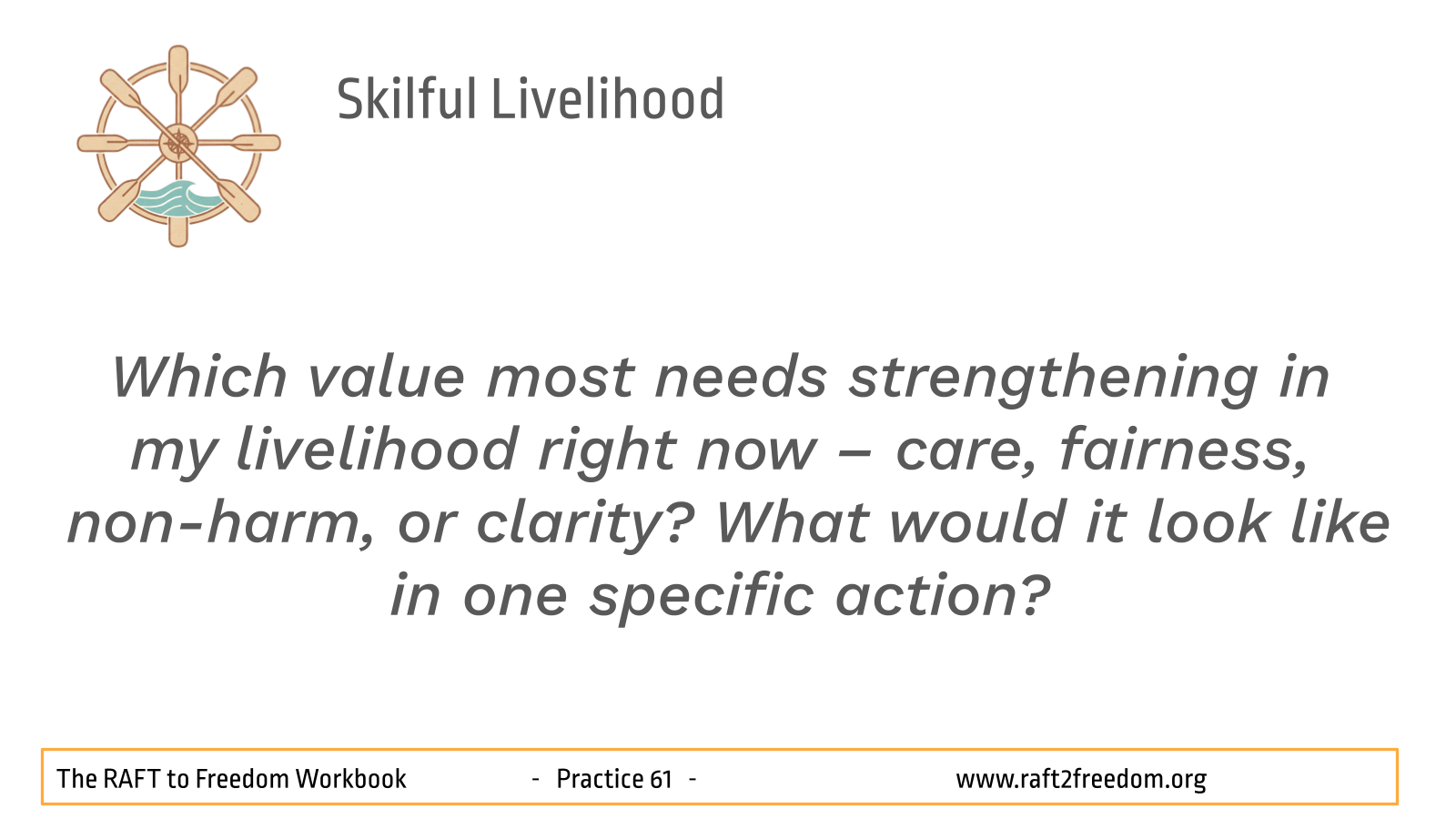
- Which value most needs strengthening in my livelihood right now – care, fairness, non-harm, or clarity? What would it look like in one specific action?
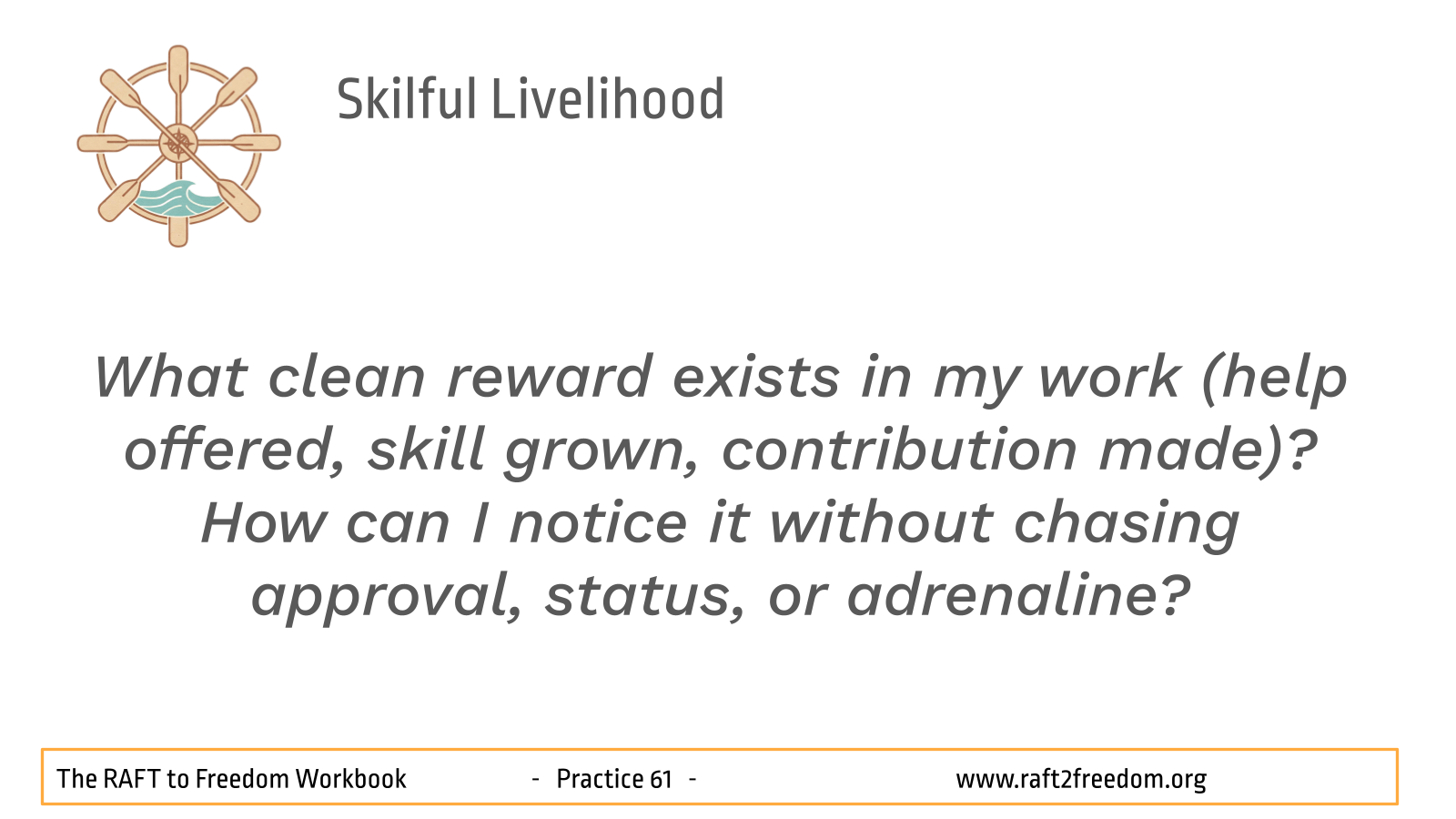
- What clean reward exists in my work (help offered, skill grown, contribution made)? How can I notice it without chasing approval, status, or adrenaline?
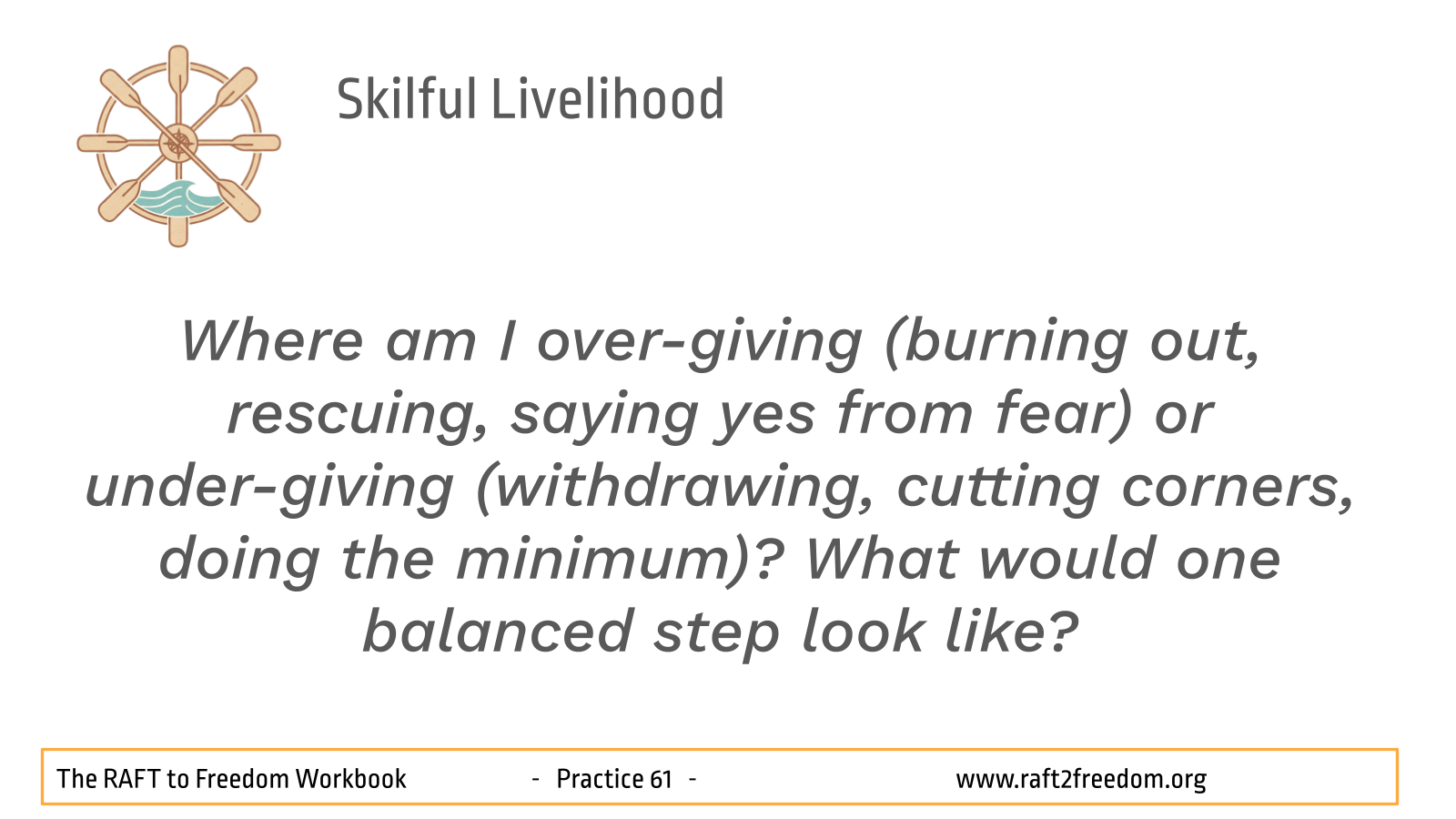
- Where am I over-giving (burning out, rescuing, saying yes from fear) or under-giving (withdrawing, cutting corners, doing the minimum)? What would one balanced step look like?
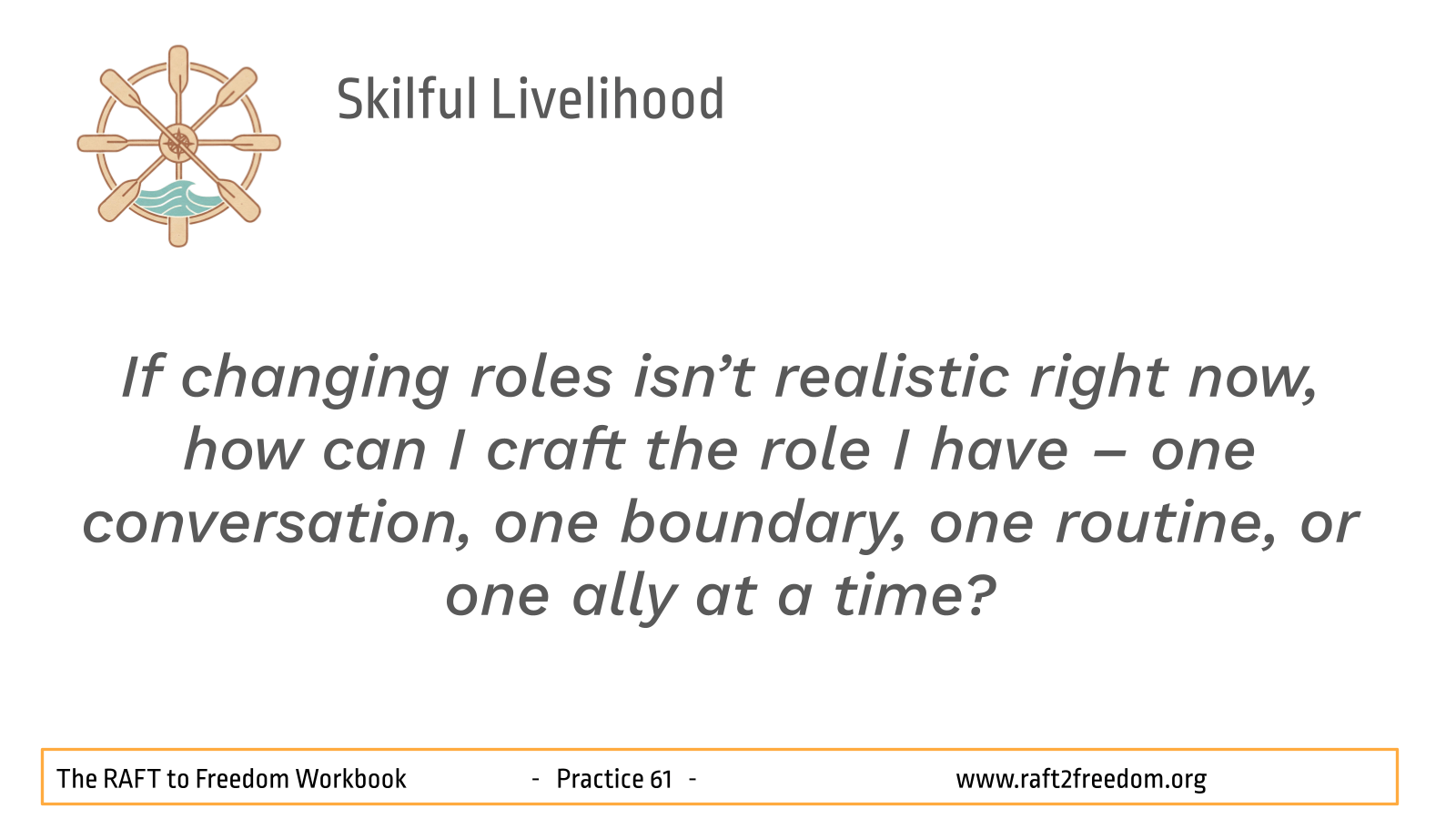
- If changing roles isn’t realistic right now, how can I craft the role I have – one conversation, one boundary, one routine, or one ally at a time?
Journaling prompts
- Livelihood map: Draw three circles – self, others, wider field. Under each, write two ways your current work supports it, and two ways it risks it. Choose one small change to try this week.
- Friction and ease design: Pick one unhelpful work pattern (over-checking email, skipping lunch, late nights). List three frictions that make it harder. Pick one helpful pattern (walk at lunch, prepared food, leaving on time). List three eases that make it easier.
- Boundary script: Write one clear, kind boundary for time or energy. Write the exact words you’ll say, who you’ll say them to, and when you’ll say them. Add one backup line if you get pushback.
- Clean reward log: Record one wholesome outcome from today’s work (help offered, skill grown, task finished cleanly). What did it feel like to earn that result through effort rather than a quick fix?
- Repair plan: Outline one proportional repair for a professional slip or conflict. What impact needs naming? What is the clean apology? What change will you make? When is the earliest appropriate moment?
- The supply chain: List the ‘supplies’ your job gives you (money, structure, purpose, community) and the ‘costs’ it charges (stress, triggers, time, fatigue). Is the trade-off sustainable as it is? If not, what is one adjustment you can make now?
- The clean supplies check: Describe one episode at work where you paused before acting from stress or scarcity. What was the cue, what did you do to steady, and what cleaner choice became possible?
Supporting material – scientific and philosophical perspectives
For those interested in the scientific and philosophical underpinnings of Skilful Livelihood, the following overview highlights some key connections.
- Neuroscience: Livelihood shapes the nervous system because it shapes the conditions we live in all day: pressure, control, conflict, exposure to harm, and the need to hide or perform. A large body of research shows that stress chemistry can impair prefrontal functioning – the very capacities we rely on for planning, inhibition, and wise choice. Chronic and acute stress are associated with measurable disruptions in executive function and prefrontal network performance. Work stress is also linked with altered cortisol patterns, including findings using salivary cortisol and longer-term markers like hair cortisol, especially in high workload or effort–reward imbalance contexts. This is one reason ‘clean livelihood’ matters for wellbeing: if our daily conditions keep the stress system chronically activated, our capacity to regulate, pause, and choose is simply harder to access.
Autonomy and fairness are not just feel-good ideas – they are biological buffers. Self-determination theory argues that workplace conditions that support autonomy and competence are associated with more sustainable motivation and wellbeing. When work repeatedly violates values, another pathway opens: moral distress and moral injury – a form of ethical and psychological strain linked with guilt, shame, anxiety, burnout and related outcomes in occupational contexts. Finally, livelihood shapes reward learning. Dopamine systems are strongly implicated in reward prediction and habit formation, and addiction models highlight how short-term ‘relief’ can train the brain toward compulsive seeking. In this light, ‘clean reward’ is not moralism – it is stability: effort that earns a result without spikes of secrecy, fear, or the crash of downstream consequences.
- Psychology: Psychology frames livelihood as an ecosystem of demands, resources, and meaning. Job crafting research describes how people can actively reshape tasks, relationships, and the way they interpret their work to improve fit and meaning – and meta-analyses and longitudinal studies link job crafting with higher work engagement, meaningfulness, and other positive outcomes. This supports the ‘craft the role you have’ emphasis: even when the job cannot change immediately, small, intentional changes in boundaries, routines, and relational patterns can measurably shift the felt quality of daily life.
Modern work psychology also helps explain why livelihood can destabilise wellbeing. Job demands-resources theory highlights how high strain can push people toward maladaptive self-regulation strategies. ACT (acceptance and commitment therapy) adds a particularly relevant lens for this factor: values-based action and psychological flexibility – the capacity to stay open to experience while acting in line with what matters.
In livelihood terms, this becomes practical: we clarify values (honesty, non-harm, care), set boundaries that protect sleep and practice, and choose the next workable step even when anxiety or scarcity is loud. It is not ‘finding the perfect job’; it is steadily building conditions where a sane life can continue.
- Philosophy: Philosophy asks what it means to live well while earning a living. The Stoics draw a sharp line between what we control (our choices and actions) and what we do not (many outcomes), and they treat integrity as the centre of the good life. Marcus Aurelius gives an unusually clean action-filter that fits this chapter: ‘If it is not right, do not do it; if it is not true, do not say it.’ Read as livelihood guidance, the point is simple: we can’t control the whole economy, but we can refuse work that repeatedly requires deception, cruelty, or exploitation – and we can bring honesty and restraint into the roles we do hold.
Other traditions sharpen the same question in different ways. Marx’s account of alienated labour describes work that is separated from our values and experienced as coerced extraction – labour as mere survival rather than meaningful contribution. Skilful Livelihood is one response to that dilemma: moving, wherever possible, from extraction toward contribution – even if the job remains the same, the relationship to it can shift. That’s the heart of the ‘survival’ framing: livelihood is not just income, but the conditions that allow a life of practice to be lived – with enough honesty, stability, and care that the crossing remains sustainable.
Remember to remember
Skilful Livelihood is the factor that keeps the voyage sustainable. It reminds us that practice doesn’t happen in theory – it happens inside the conditions we live in every day: the hours we keep, the stress we carry, the compromises we make, the people we serve, the way we earn and spend. A livelihood that repeatedly demands deception, exploitation, or chronic overdrive gradually erodes steadiness and makes training harder. A cleaner livelihood – or even a cleaner way of doing the livelihood we already have – protects the mind from remorse and protects the body from burnout. It gives us ‘clean supplies’: enough stability, honesty, and safety to keep practising.
Remember, too, that this is rarely an all-or-nothing decision. Most of us can’t redesign our whole life overnight. So we take the next good-enough step that reduces harm and supports wellbeing, then we learn and adjust. We craft the role we have, set boundaries we can actually keep, and create friction for what destabilises us while making it easier to do what helps. And when we do drift – a corner cut, a compromise, a mistake – we repair early and proportionally so the conscience stays clean. In RAFT terms: we keep the supply lines honest, the cargo safe, and the hull maintained, so the crossing can continue – day by day, steadily, without sinking our values to stay afloat.
Your values are the heartbeat of meaningful work.
Diana Hill, PhD.
“ntegrity is choosing courage over comfort.
Brené Brown.
Sutta references
- Magga‑vibhaṅga Sutta (SN 45.8) — Analysis of the path
- Summary: Defines Right Livelihood as earning a living in a way that abandons wrong livelihood (deceit, harm) and embraces a way of life that is blameless.
- Vāṇijjā Sutta (AN 5.177) — Trade
- Summary: Provides the clearest classical list of the five trades to avoid for a lay follower: trading in weapons, living beings, meat, intoxicants, and poison.
- Sigālovāda Sutta (DN 31) — Advice to Sigāla
- Summary: Grounds livelihood in responsibility, prudence, and generosity. It teaches that wealth should be acquired harmlessly (like a bee gathering nectar) and used to support family, friends, and the community