45 – Penetrating Inquiry as a Support
Practitioners, there are wholesome and unwholesome states… wise attention, much practised, is the nutriment for the arising of the unarisen investigation-of-states enlightenment factor.
Gotama (The Buddha)
The greater the doubt, the greater the awakening; the smaller the doubt, the smaller the awakening. No doubt, no awakening.
Zen Proverb

Episode 45 – The navigator’s chart-work and the ‘Lamp of Curiosity’
An AI generated ‘deep dive’ into this aspect of the RAFT to Freedom
A gentle hand-off from Liberating Mindfulness
When ‘Liberating Mindfulness’ is steady, something else naturally awakens: curiosity: we start to notice more. The mind grows interested in what is happening, moment by moment – not in order to fix ourselves, but to understand experience more clearly. Instead of getting swept into the story, attention turns towards curiosity – the lived details: what a state feels like in the body, how it changes, what seems to feed it, and what allows it to fade. In the early teachings, this is called the second Factor of Awakening: investigation of states – what we are calling ‘Penetrating Inquiry’. Once mindfulness is steady, attention naturally begins to explore experience more closely, and the next phase of the journey becomes less about repair and more about understanding.
From fixing the engine to reading the wind
It helps to distinguish ‘Penetrating Inquiry’ from the ‘Fearless Investigation’ that we used for problem-solving as one of the Creative Powers that we explored earlier on our journey (Chapter 24).
- Fearless Investigation was often deliberate and strategic: figuring out causes, identifying triggers, and working out what to change – “What led to this?” “How do I stop it?” “What’s the pattern?” That kind of inquiry is useful when we need clarity and repair.
- Penetrating Inquiry is different. It is quieter and more immediate. It arises from steady mindfulness and stays close to what is happening right now: the felt texture of experience in the body, the feeling tone, the movement of the mind, and how things change when they’re observed. Instead of analysing the past or trying to force the present to be different, it asks simple, direct questions: “What is this like?” “Is it solid?” “Is it shifting?” In this way, inquiry becomes less about solving a problem and more about seeing a process clearly enough for reactivity to loosen.
‘Fearless Investigation’ was the engine mechanic doing repairs; ‘Penetrating Inquiry’ is the navigator reading the wind – a responsive intelligence that helps the journey continue smoothly.
The spark that lights the fire
Penetrating Inquiry is the first member of the ‘Energising Triad’ (Penetrating Inquiry, Enthusiasm, Energising Joy) introduced in Chapter 43. Its specific tactical role is to counter the Hazard of ‘Tuning Out’ (Sloth and Torpor). When the mind becomes heavy, dull, or uninterested – like a fire dying down – we don’t add the wet grass of more calmness or relaxation. Instead, we add the dry fuel of curiosity. ‘Penetrating Inquiry’ works by engaging ‘Appropriate Attention’. It shifts the mind from a passive, checking-out state into an active, wondering state, breaking the trance of dullness by asking simple, experiential questions: “What is the texture of this heaviness?” “Where is it felt?” “Is it permanent?” In the very act of looking, ‘Enthusiasm’ is generated – and ‘Energetic Joy’ follows. This is a clean kind of energy: brightening without agitation.
In the early discourses, this Support is also described as the beginning of a reliable unfolding. When experience is investigated with wisdom, energy is stirred; with energy, joy can arise; with joy, the system begins to settle; and from that settling, steadiness and balance become possible. In other words, a small, sincere “What is this?” can set the whole raft in motion toward calm, collected clarity.
When inquiry lights up the moment, energy tends to rise naturally – and when energy is steady, joy is not far behind.
The pivot of Freedom: from ‘why’ to ‘what’
The pivot that opens the door to freedom in this chapter is the shift from conceptual questions to experiential questions. When we are stuck in suffering, we usually ask ‘Why?’, “Why do I feel this way?”, “Why can’t I stop?”. ‘Why’ questions often lead to rumination and stories about the past. They spin the wheel of the narrative self.
‘Penetrating Inquiry’ pivots the mind to ask ‘What?’, “What is the specific sensation of this urge?” (heat, tension, vibration?), “How does it change when I watch it?”.
“Why am I like this?” pulls us into identity and history. “What is happening in the body right now?” returns us to contact and change.
This shift disengages the mind’s storytelling mode and returns us to direct sensory experience. We stop trying to solve the problem of the self and start investigating the process of experience itself. The point isn’t to find better answers, but to change our relationship to what is happening: ‘What?’ brings us closer to direct contact – and direct contact is where reactivity begins to loosen.
In this Freedom stage, Penetrating Inquiry is less like analysis and more like a gentle leaning-in – the mind’s natural wish to see clearly. If inquiry starts to feel tense or self-critical, we can soften back into simple mindfulness and begin again. The traditional teachings are also clear about timing. Investigation is medicine for a mind that is dull or drifting, but when the mind is already agitated, too much probing can intensify the heat. In that case, the ‘Ballast Triad’ calming Supports do their work, and ‘Liberating Mindfulness’ remains the steady regulator that keeps the balance.
Secular Buddhist teacher, Stephen Batchelor, often reframes investigation not as analysis but as wonder. When reactivity stops, the mind does not become blank; it becomes freshly alive. What appears is a sense of surprise and mystery – an endless curiosity about what is here, before habit and language rush in to label it and tell a story. Many people recognise this on retreat: after a period of steady sitting, the world can feel strangely vivid – a tree, a sound, a shaft of light – ordinary, yet astonishing. In this sense, Penetrating Inquiry is not the head trying to solve experience, but awareness meeting life directly, with great questioning held together with great faith and great courage – the willingness to stay present long enough for reality to reveal itself.
How to practise: the lantern of inquiry
- Lantern, not floodlight: We’re not trying to work things out. We’re letting experience show itself more clearly – a gentle leaning-in.
- Right medicine, right time: Inquiry helps when the mind is heavy or drifting. If the system is already hot or agitated, we ease back into mindfulness and let the calming supports steady things first.
- Wonder over analysis: When reactivity pauses, the mind can feel freshly alive – a clean curiosity before habit rushes in to label and narrate.
- State over story: Instead of explanations, we stay with lived detail: hot or cool, tight or loose, moving or still – and where it’s felt.
- Simple questions, present tense: A quiet What is this? is often enough. We also name the mode lightly – planning, judging, resisting, craving – to stay close to what’s happening now.
- Follow the movement: We track the arc of a state – what feeds it, where it peaks, how it changes, how it ends. Endings teach something simple: no wave lasts forever.
- Steer by small tests: We make one tiny adjustment (soften the jaw, lengthen the out-breath, widen awareness) and see what shifts – then do a quick course check: does this lead toward the Safe Shore or the Dangerous Shore? When inquiry steadies, energy often lifts – and joy can follow.
Self-reflections

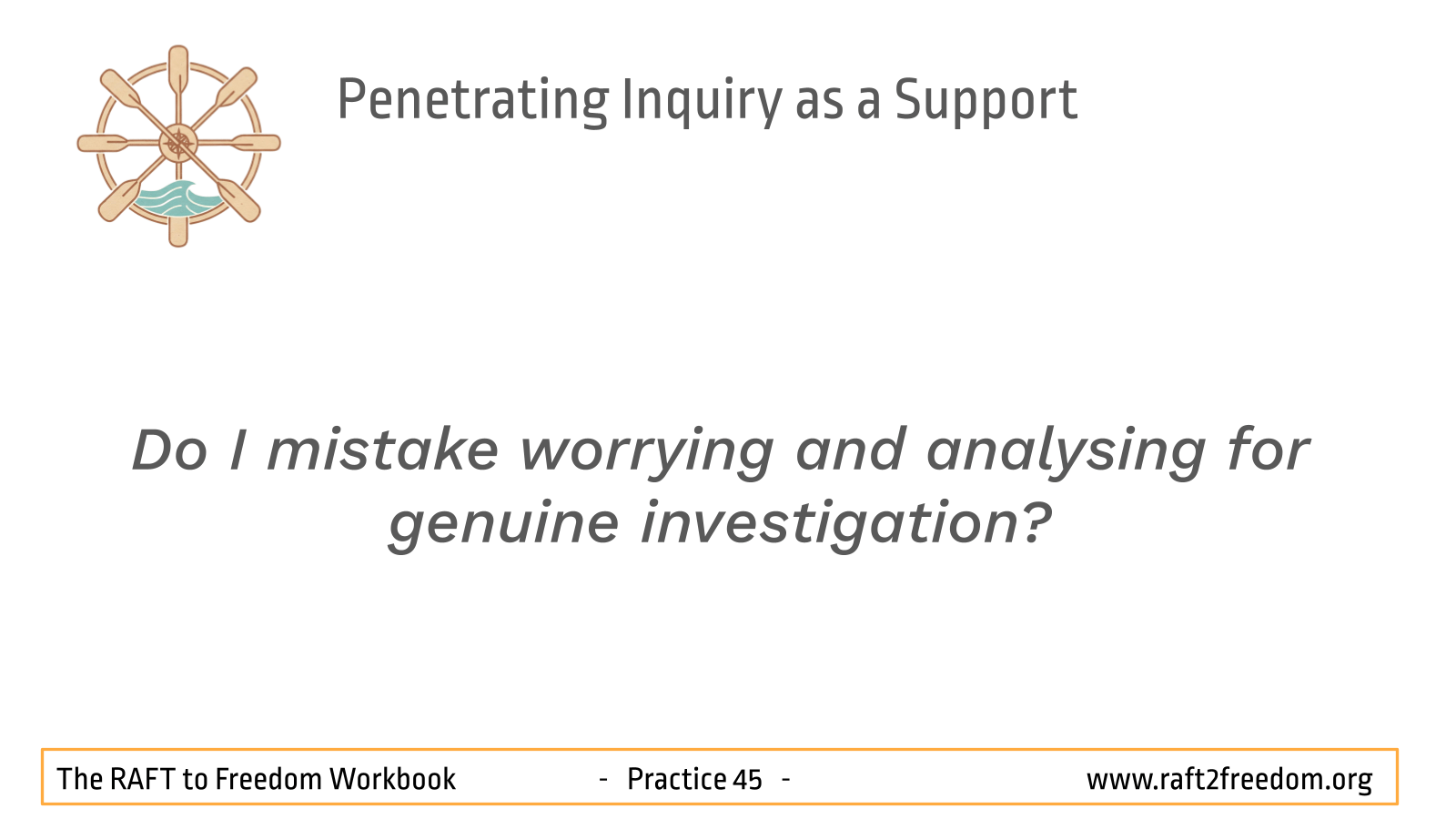
- Do I mistake worrying and analysing for genuine investigation?
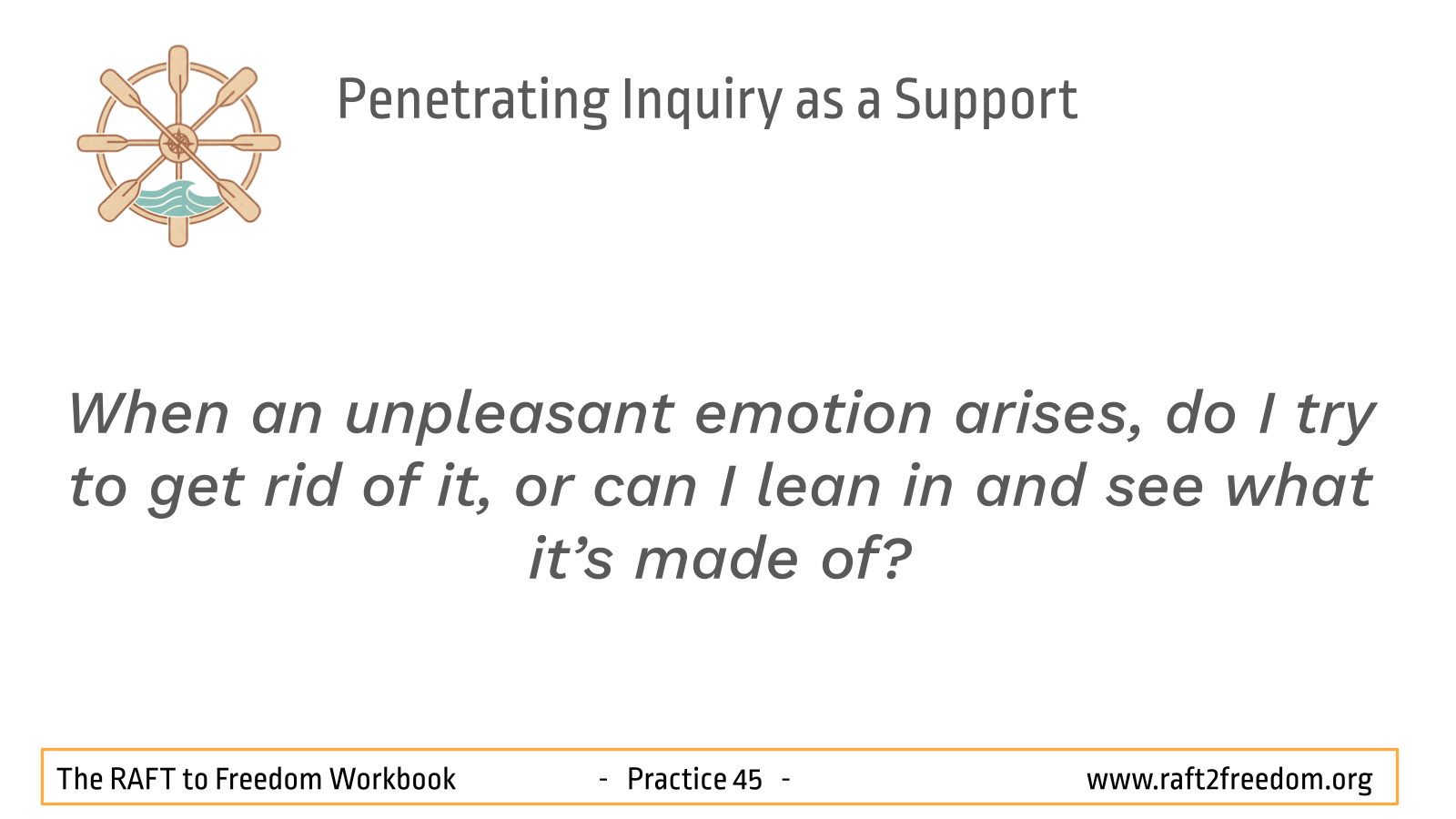
- When an unpleasant emotion arises, do I try to get rid of it, or can I lean in and see what it’s made of?
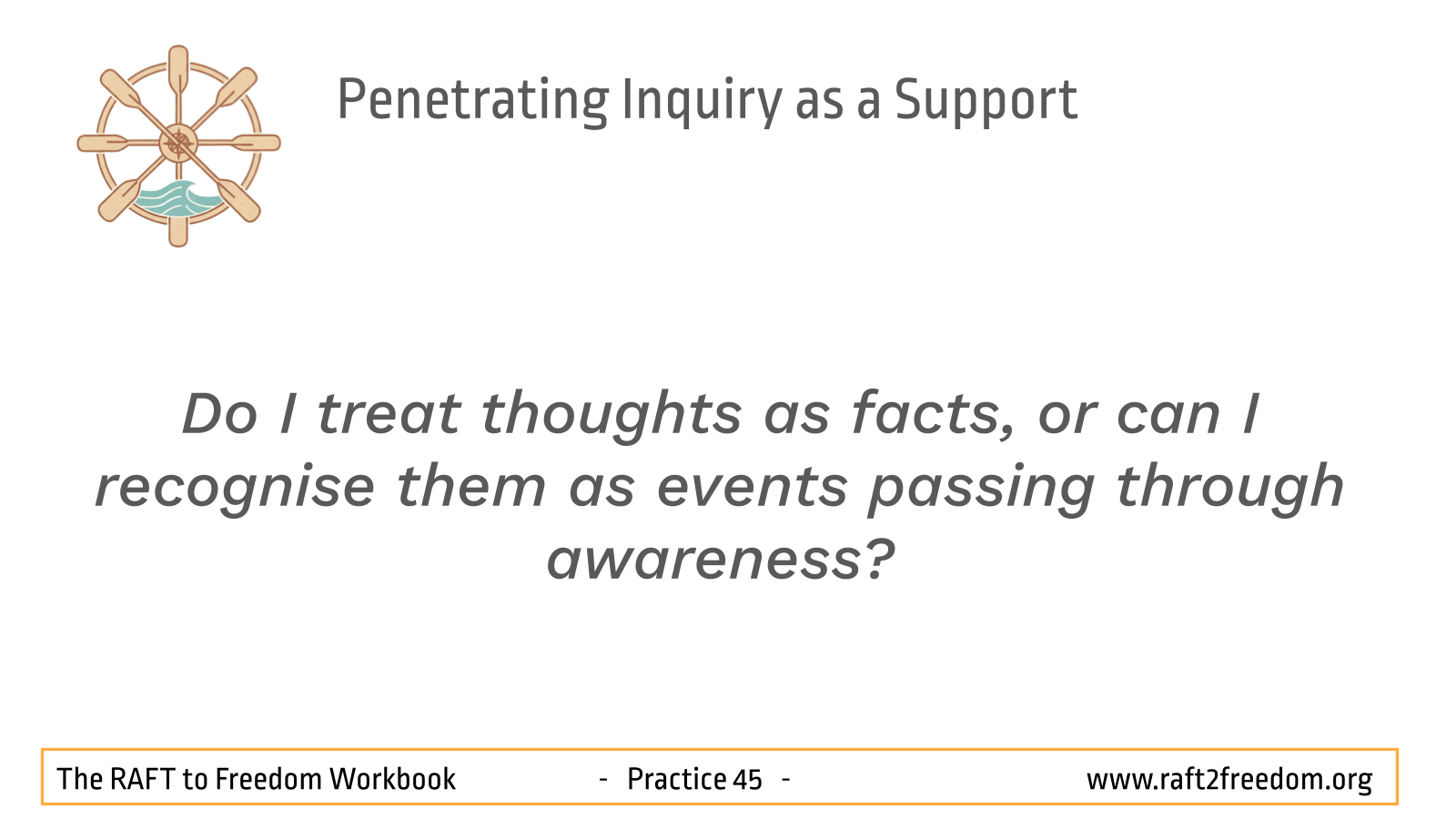
- Do I treat thoughts as facts, or can I recognise them as events passing through awareness?
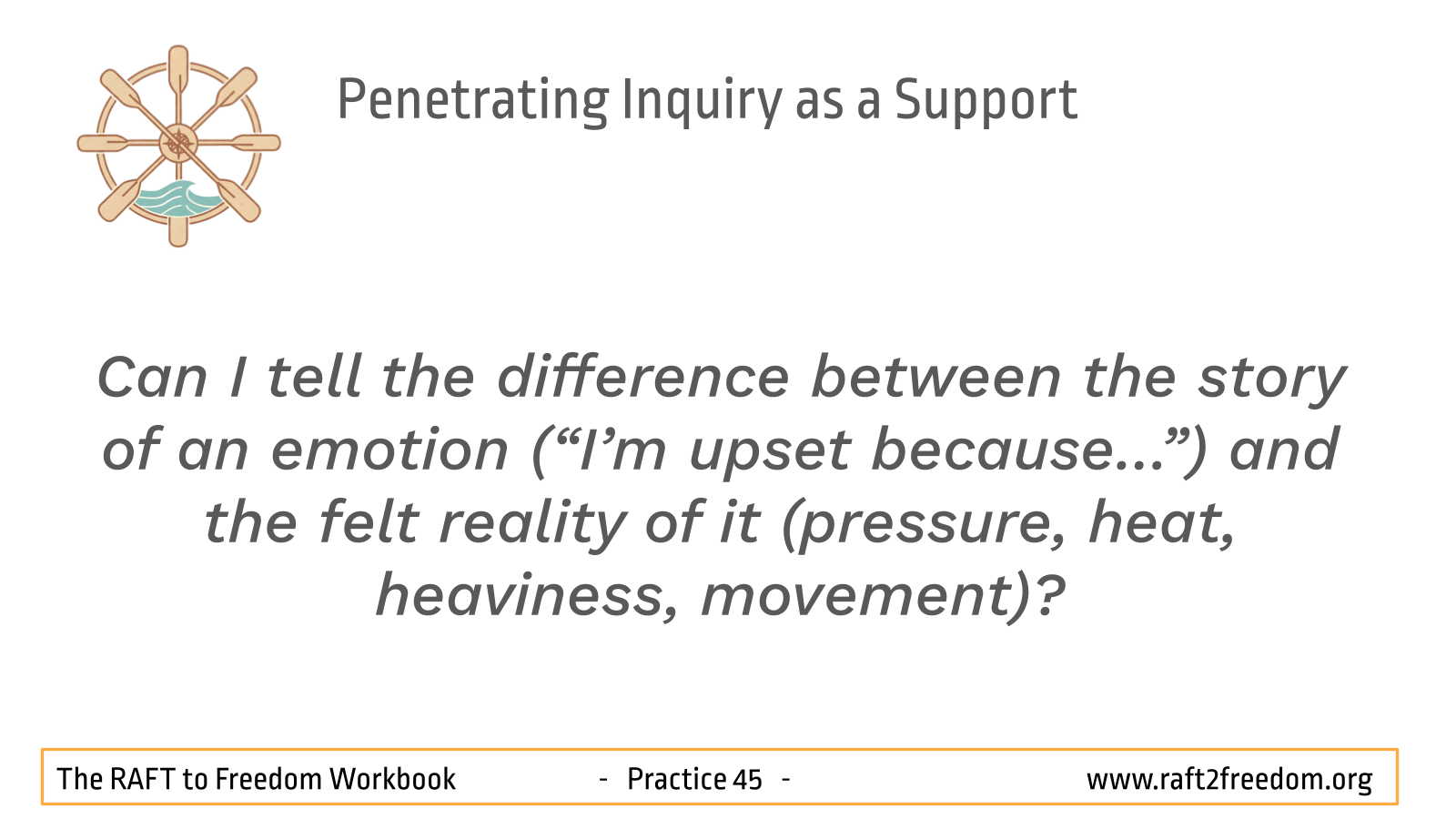
- Can I tell the difference between the story of an emotion (“I’m upset because…”) and the felt reality of it (pressure, heat, heaviness, movement)?
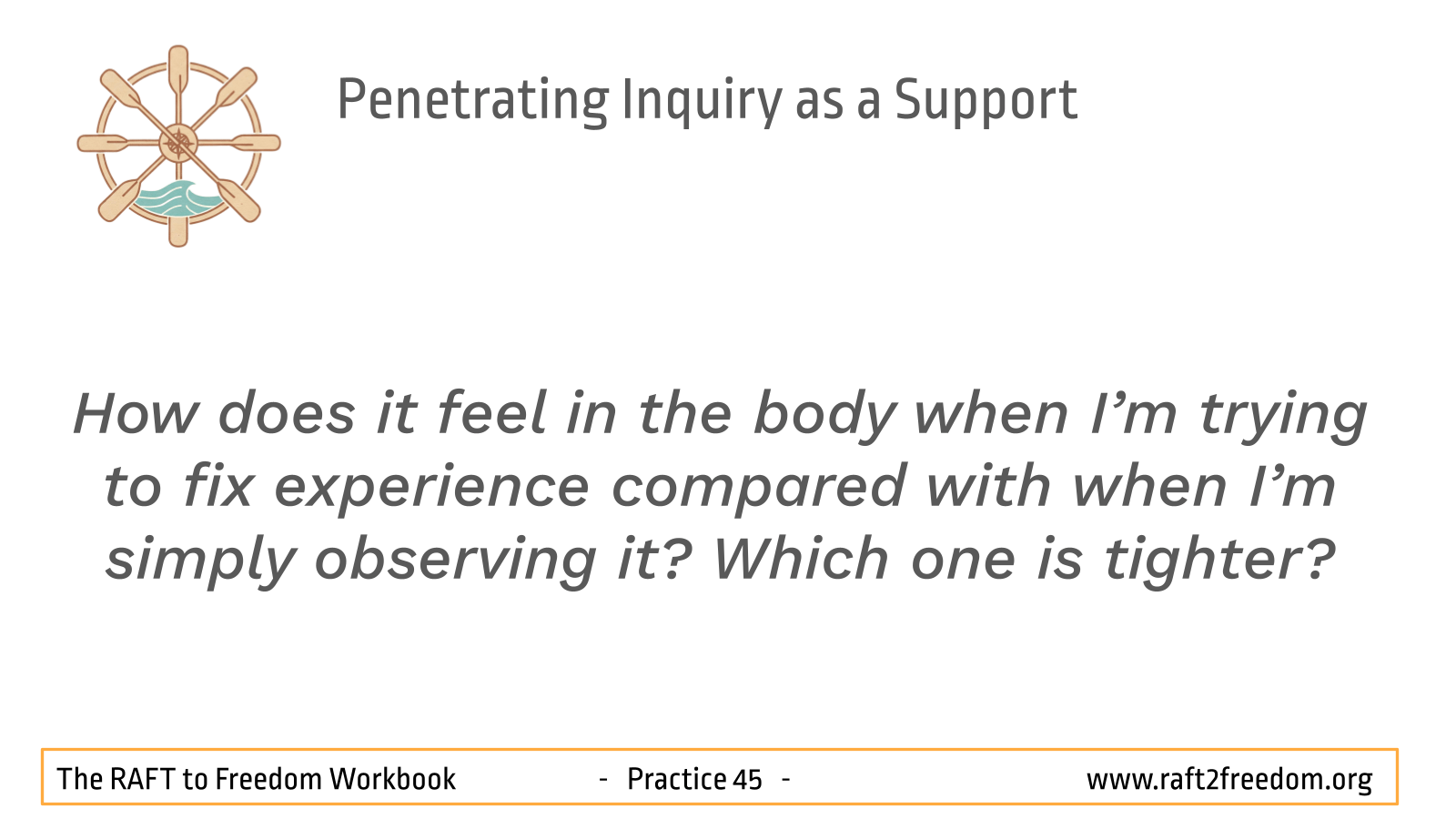
- How does it feel in the body when I’m trying to fix experience compared with when I’m simply observing it? Which one is tighter?
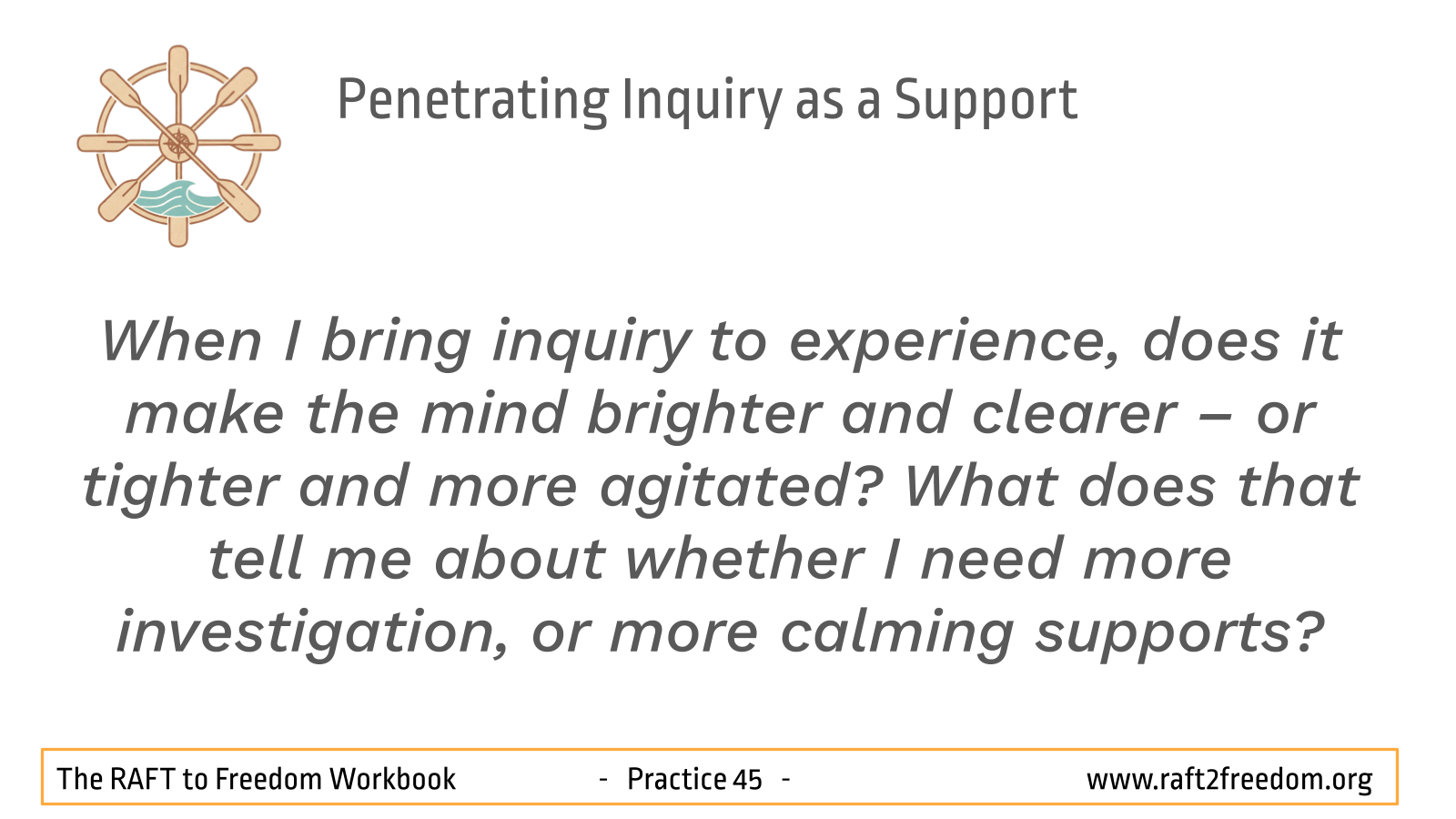
- When I bring inquiry to experience, does it make the mind brighter and clearer – or tighter and more agitated? What does that tell me about whether I need more investigation, or more calming supports?
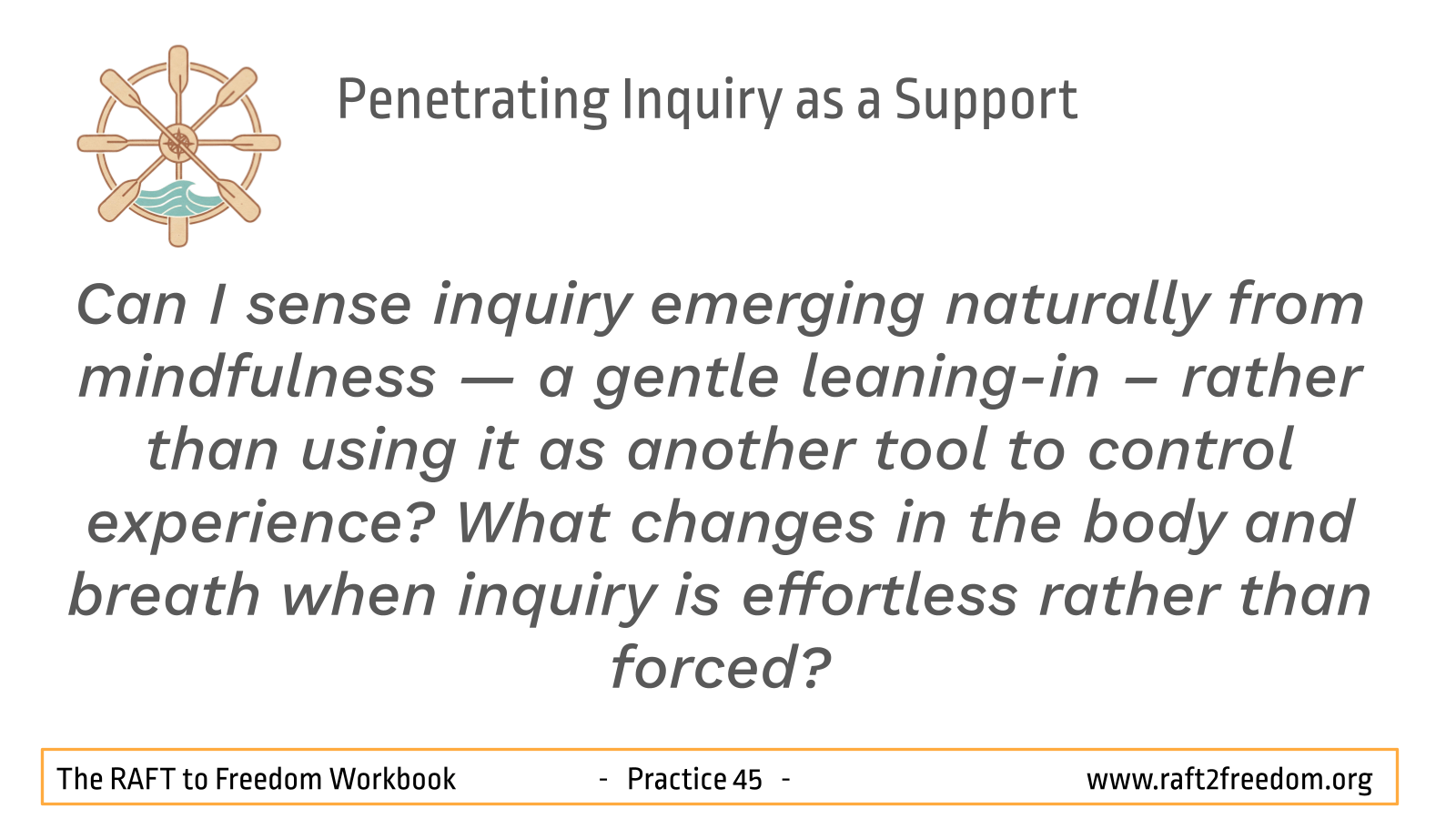
- Can I sense inquiry emerging naturally from mindfulness — a gentle leaning-in – rather than using it as another tool to control experience? What changes in the body and breath when inquiry is effortless rather than forced?
Journaling prompts
- Outcome comparison: Describe two different responses to the same challenge this week: one rooted in reactivity (habit) and one rooted in inquiry (curiosity). How did the outcomes differ?
- Starving the narrative: Select a recurring resentment or worry. Write out the story the mind tells. Then write the raw physical sensations present when the story is left alone.
- Signature of release: Write a sensory description of the moment a difficult state dropped away. Was it sudden or gradual? What replaced it?
- Question bank: Draft five short questions that brighten curiosity (for example, “What is this?”, “Where is this felt?”, “Is it solid?”). Keep these as a pocket practice.
- Navigator’s log: Record a moment when Penetrating Inquiry acted as a light that made the safe course visible in the midst of confusion.
- The Spark: Describe a time when you felt mentally sluggish. What happened when you applied interest to the sluggishness itself?
- From seeing to doing: After a curious pause today, note the one wise or kind action that became obvious. How did the seeing lead to the doing?
Supporting Material: scientific and philosophical perspectives
For those interested in the scientific and philosophical underpinnings of Penetrating Inquiry as a support, the following overview highlights some key connections.
- Neuroscience: Distress is often maintained by fast, self-reinforcing loops: a trigger is detected, the body shifts into threat or drive mode, attention narrows, and the mind runs repetitive thoughts. Mindfulness-related research suggests that when people move from reacting to observing and investigating, rumination-linked activity tends to reduce while networks for present-moment attention, body-sensing, and cognitive control become more engaged, supporting greater emotional stability and behavioural flexibility.
Curiosity is especially useful here. Unlike compulsive seeking, it is oriented toward learning, not urgent relief. It can brighten attention without over-arousal, helping the mind step out of habitual loops and meet experience with more choice. - Psychology: Penetrating Inquiry overlaps with decentering/defusion: thoughts, urges, and moods are seen as passing events rather than facts or commands. This reduces the ‘must act now’ pressure and increases distress tolerance, making wiser responses more available.
This mechanism is trained directly in ACT (defusion + values), MBCT (decentering from rumination), DBT (observing skills + distress tolerance), and MBRP (curious ‘urge surfing’). Across these approaches, investigation changes the relationship to experience, loosening automatic reactions. - Philosophy: Many traditions agree that suffering is intensified by the meanings we add. The Stoics argue we are disturbed less by events than by our judgments about them, while William James highlights how attention shapes experience – what we repeatedly attend to becomes our lived world.
Others emphasise how concepts can trap us. Wittgenstein notes that a picture can hold us captive; inquiry loosens the grip by returning to what is actually present. Spinoza suggests that clearly understanding an emotion reduces its compulsive power, and the Pyrrhonists propose suspending premature conclusions as a path to tranquillity.
Remember to remember
We are no longer just bailing water; we are learning the physics of the ocean. Penetrating Inquiry is the Support that turns difficulty into understanding, not by explaining everything, but by looking closely enough for illusion to loosen. In this stage we stop mistaking a wave for a command, or a mood for a verdict. The Navigator does not argue with the storm or blame the sea. The Navigator studies the conditions – the direction of the wind, the pull of the current – and learns how to set the sail so the raft continues toward the Safe Shore.
This kind of inquiry is not the anxious mind searching for certainty. It is the clear mind learning how experience works – and, at times, rediscovering a quiet sense of wonder: the surprise and mystery of what is here before habit names it and rushes ahead. When we ask “What is this?” we step out of rumination and return to direct contact: heat, pressure, tightening, release; arising and passing; a state becoming stronger or fading. In the very act of seeing, something shifts – reactivity has less to grip, and the system finds its balance. With practice, this curious clarity becomes a reliable inner light: it helps us recognise what leads toward freedom, and what leads back into entanglement, so that wiser action can follow naturally.
Thinking does not solve the problems of life, but it can prevent catastrophes.
Hannah Arendt
The cure for boredom is curiosity. There is no cure.
Dorothy Parker
Sutta references
- Bojjhaṅga Saṃyutta (SN 46) – The Factors of Awakening
- Summary: Describes Investigation-of-States (dhamma-vicaya) as the factor that arises supported by mindfulness, where one examines and scrutinises experience with wisdom.
- Āhāra Sutta (SN 46.51) – Nutriment
- Summary: Explains that the “nutriment” (food) that keeps this bright curiosity alive is Wise/Appropriate Attention (yoniso manasikāra), applied to internal and external states, distinguishing what is wholesome from what is unwholesome.
- Anāpānasati Sutta (MN 118) – Mindfulness of Breathing
- Summary: Shows the sequence in which mindfulness establishes presence with the object, inquiry examines the nature of experience (including impermanence), and energy and joy naturally follow.
| RAFT to Freedom © 2025 by Dr Cathryn Jacob and Vince Cullen is licensed under CC BY-NC-SA 4.0. To view a copy of this license, visit https://creativecommons.org/licenses/by-nc-sa/4.0/ |