44 – Liberating Mindfulness as a Support
Luminous is the mind. And it is defiled by visiting impurities.
Gotama (The Buddha)
Freedom is not something you acquire; it is the absence of the compulsion to grasp or resist – the opening of a space where life can unfold.
Stephen Batchelor

Episode 44 The ever-wakeful watch and the space of non-reactivity
An AI generated ‘deep dive’ into this aspect of the RAFT to Freedom
The central regulator of the Seven Supports
In our overview of the Seven Supports (Chapter 43), we saw that the Seven Supports function as an integrated system for balancing the mind once the ‘Hazards’ come into view, in the service tasting Freedom, Gotama’s third reality. At the centre of that system sits ‘Liberating Mindfulness’ – not as another technique to apply, but as the capacity that monitors conditions and coordinates the response. This chapter explores mindfulness in that role: not fighting experience, but knowing it clearly enough for freedom to emerge.
From monitoring to abiding
In this Freedom stage, our raft enters the metaphorical ‘Land of Perpetual Dawn’. Here, mindfulness does not appear as something new, but as something that has matured through the journey.
In the initial ‘Recognise’ stage, we first learned ‘Grounding Mindfulness’ (Chapter 07): anchoring awareness in the body as the most immediate place where life is felt. This practice taught us how to arrive, stabilise, and meet experience where it actually happens in the body. As the journey deepened, ‘Affective Mindfulness’ (Chapter 27) refined this grounding by tuning awareness to ‘Feeling Tone’ – the subtle pleasant, unpleasant, or neutral flavour that precedes craving and aversion. This sensitivity allowed us to recognise the earliest currents that pull the raft off course.
In the ‘Abandon’ stage, mindfulness took on a protective role. ‘Healing Mindfulness’ (Chapter 31) functioned as a ‘Defender’: a vigilant, therapeutic presence that helped interrupt compulsive loops, meet urges without acting them out, and reduce harm through early recognition and restraint.
As we approached the ‘Freedom’ stage, ‘Monitoring Mindfulness’ (Chapter 36) emerged as the third Anchor – a steady, panoramic awareness capable of reading the wider inner weather of the mind. This form of mindfulness trained us, the navigator, to notice patterns, tendencies, and conditions without being immediately drawn into them.
Now, as the first of the Seven Supports, mindfulness comes fully into its balancing mode as ‘Liberating Mindfulness’. This is not mindfulness as effort, vigilance, or repair, but mindfulness as a stable operating condition of the mind itself: a non-reactive awareness that abides with experience rather than managing it. From this abiding clarity, the other Supports can be activated appropriately, and the journey toward freedom becomes increasingly self-sustaining.
The steady watch
If mindfulness was previously the lookout scanning for rocks and storms, Liberating Mindfulness is the vessel’s steady watch. It confirms that the raft is trimmed correctly for the long crossing. In this stage, its primary role is balancing. It functions as the regulating intelligence at the centre of the instrument panel, continuously assessing the sea state of the mind. From this clear seeing, it determines whether the vessel needs the energising supports – ‘Penetrating Inquiry’, ‘Enthusiasm’, and ‘Energetic Joy’ – to counter dullness and ‘Tuning Out’, or the calming supports – ‘Deep Calm’, ‘A Unified Mind’, and ‘Balanced Equanimity’ – to settle agitation.
This is why mindfulness is described as always useful: it does not replace the other Supports, but helps us recognise what is needed and allows the right one to come forward at the right time. In the teachings on the Seven Factors of Awakening, mindfulness is not mere neutral monitoring. It is cultivated with a clear orientation – grounded in stepping back (seclusion), cooling the grip of craving (dispassion), and allowing patterns to fade (cessation) – so that it naturally matures into release. In this way, Liberating Mindfulness becomes a quiet inner compass: it steadies the mind and gently inclines it toward letting go
The space of ‘not doing’
In the early stages of our journey from the human struggle with craving and avoidance, or at the beginning of any behaviour-change process, mindfulness is often effortful – we are trying to be mindful, holding attention tightly, watching for mistakes. Liberating Mindfulness is different. It is the simple remembering to be present. In the early discourses, mindfulness is repeatedly described in very plain terms as the capacity to remember and recall – to not forget what matters in the moment. It is the mind’s ability to keep the present in view, and to call to mind what is helpful, even under pressure. This is why mindfulness can feel less like doing a technique and more like coming back to what we already know. Here, effortless does not mean inattentive. It means no longer interfering with what is already being known.
Liberating Mindfulness realises that the ‘watcher’ does not need to fight the waves; it only needs to observe them. This creates a gap – a quiet, sacred pause – where the automatic link between Feeling Tone (Chapter 27) and craving, compulsions and aversions begins to loosen.
The pivot of Freedom: the gap of choice
The pivot of this chapter – the specific mechanism that opens the door to Freedom – lies in this brief moment, the gap between ‘Feeling Tone’ and cravings, compulsions and aversions before they arise.
In the cycle of ‘Dependent Origination’ – which simply means how one moment leads to the next – experience unfolds in a predictable sequence. Something is seen, heard, remembered, or felt, and almost immediately a Feeling Tone arises: pleasant, unpleasant, or neutral (Chapter 27). In an untrained mind, this sets off a reflex. Pleasant feelings spark the urge to grasp and keep them; unpleasant feelings spark the urge to push them away or escape. Neutral feelings often lead to drifting or dullness. This automatic chain – stimulus, feeling, reaction – is the engine of compulsion.
Liberating Mindfulness allows us, as the Navigator, to feel the pleasantness of a sensation – a warm sound, a comforting thought, the ease of a relaxed breath, the satisfaction of being understood – without turning that pleasant feeling into a command to hold on, repeat, or seek more. The experience can be enjoyed as it is, without the extra tightening of “I must keep this.”
In the same way, it allows unpleasant sensations – tension in the body, a sharp word, a wave of sadness, a restless thought – to be felt directly, without turning discomfort into a command to escape, fix, or push it away. The sensation is known, but it is not obeyed.
In this way, Liberating Mindfulness restores a simple truth we may have forgotten: sensations arise because conditions are present, and they pass when those conditions change. They do not require immediate action. When pleasant and unpleasant experiences are allowed to come and go in this way, the mind begins to trust that it can stay present without being driven. The space between feeling and reacting widens, and choice quietly returns.
By resting in this pause – even for a few quiet seconds – the old chain begins to loosen. Feeling no longer rushes headlong into action. The pivot turns, gently, from reflex to response. We discover for ourselves that strong sensations can rise and fall like weather, without demanding that we move, fix, or follow them.
With practice, this pause becomes familiar. What was once a brief gap begins to feel like a place we can return to. Gradually, we learn to dwell here more often – in a clear, steady, non-reactive presence that does not need to control experience to be at ease. When craving or aversion does arise, as it inevitably will, we no longer feel lost. We know the way back. We settle again into this quiet, spacious awareness – a peaceful inner refuge, a place that feels like home – Freedom at last!
How to cultivate Liberating Mindfulness – staying oriented as conditions shift.
- Subtle orientation: At this stage, we’re not trying to do mindfulness right. We’re learning to stay oriented as conditions shift – like a sailor who keeps feeling the wind rather than fighting the sea.
- Pausing to notice: Sometimes we feel the raft begin to tilt – a flicker of agitation, a pull of wanting, a sudden mood change. When we notice that, it can be enough to pause. One breath completes itself, and attention returns to what’s here now.
- Staying with direct experience: Rather than following the storyline, we rest with what’s concrete: tightness in the chest, warmth in the face, pressure behind the eyes. Nothing needs to be solved. Often, seeing clearly is already the adjustment.
- Widening the field: When reactivity gathers, attention narrows and the mind circles to one thing – a thought, a person, a memory. We let awareness widen again: sounds, temperature, posture, contact with the ground. As the field opens, the trigger becomes one movement within a larger space, and momentum often softens by itself.
- Acknowledging what visits: Thoughts, moods, and impulses keep arriving. When one becomes prominent, we name it lightly – planning, worrying, judging, craving – almost in passing. The aim is to stay in the seat of the watch, not to label everything.
- Checking the trim: A few times a day, we do a simple instrument check:
- Body – held or at ease?
- Tone – pleasant, unpleasant, neutral?
- Mind – scattered, heavy, clear?
These aren’t questions that demand fixing. They keep us in touch with conditions so small adjustments come naturally.
- Feeding what supports Freedom: Over time, this way of pausing, widening, and acknowledging becomes nourishment. The awakening factors grow when they’re fed – and for mindfulness, the main food is Appropriate Attention: turning toward what’s happening, and away from what inflames confusion.
- Natural hand-off: When clear awareness is steady, interest tends to arise on its own. Seeing gives rise to curiosity – and that’s the hand-off into ‘Penetrating Inquiry’.
Self-reflections

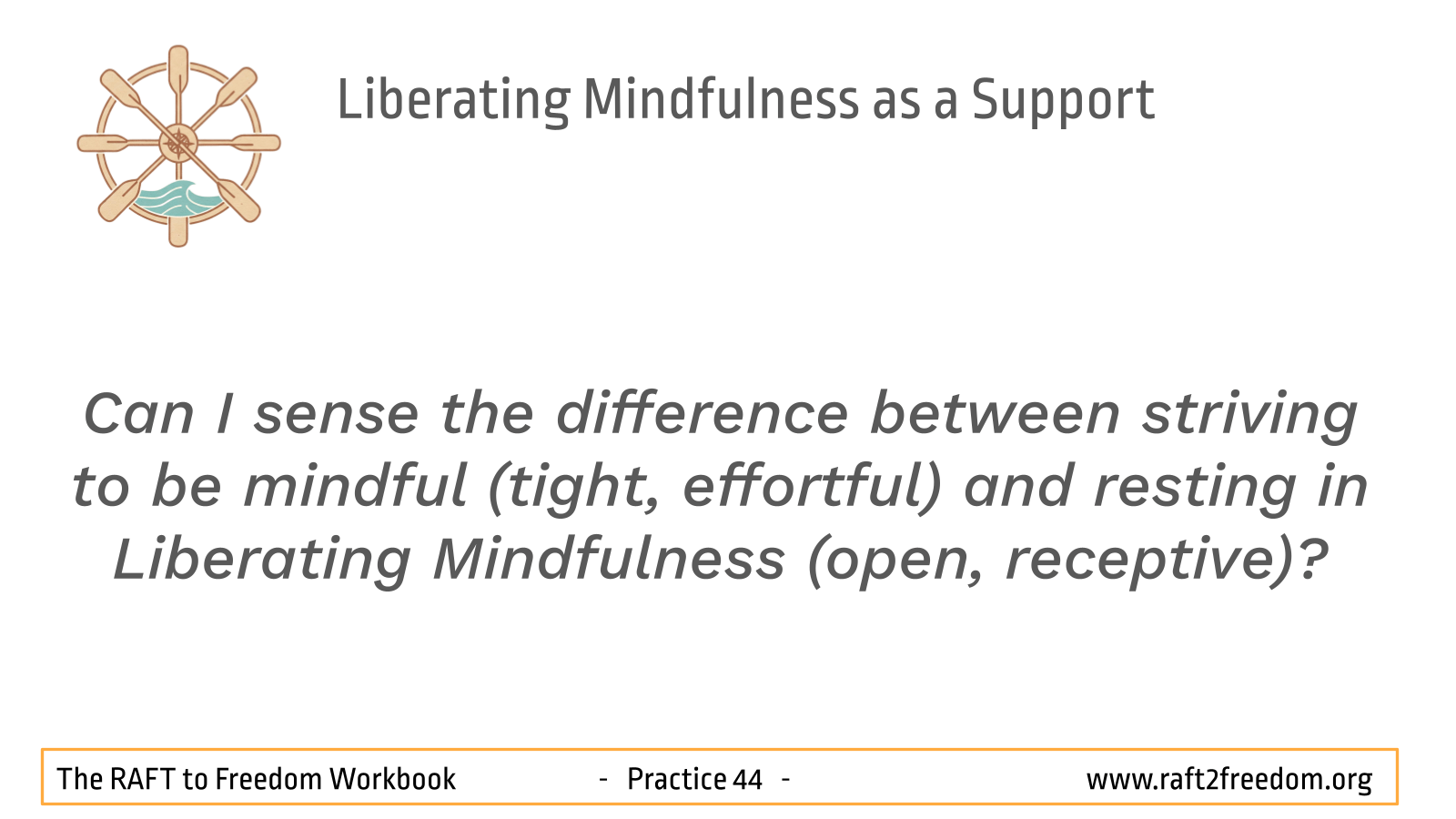
- Can I sense the difference between striving to be mindful (tight, effortful) and resting in Liberating Mindfulness (open, receptive)?
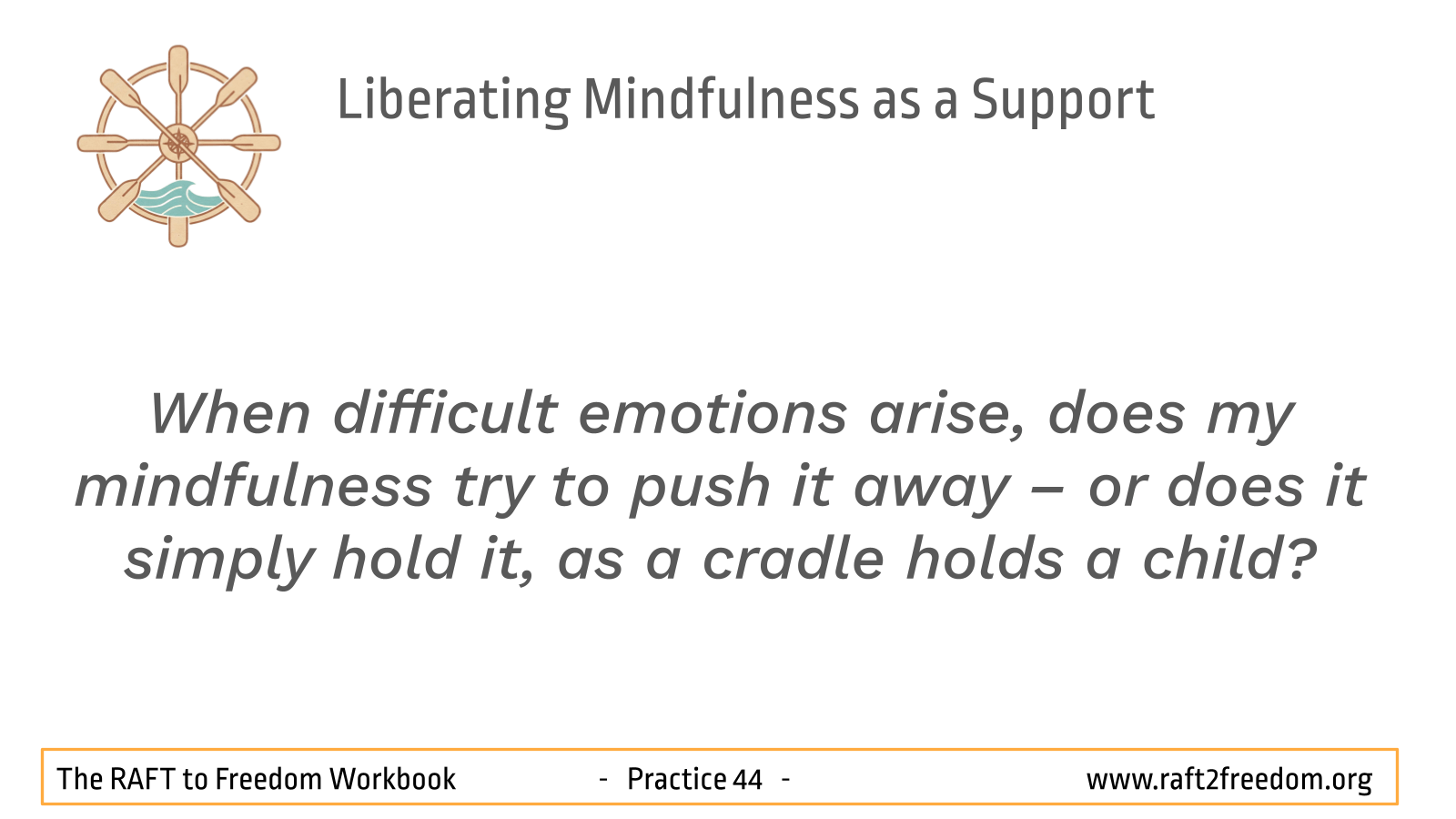
- When difficult emotions arise, does my mindfulness try to push it away – or does it simply hold it, as a cradle holds a child?
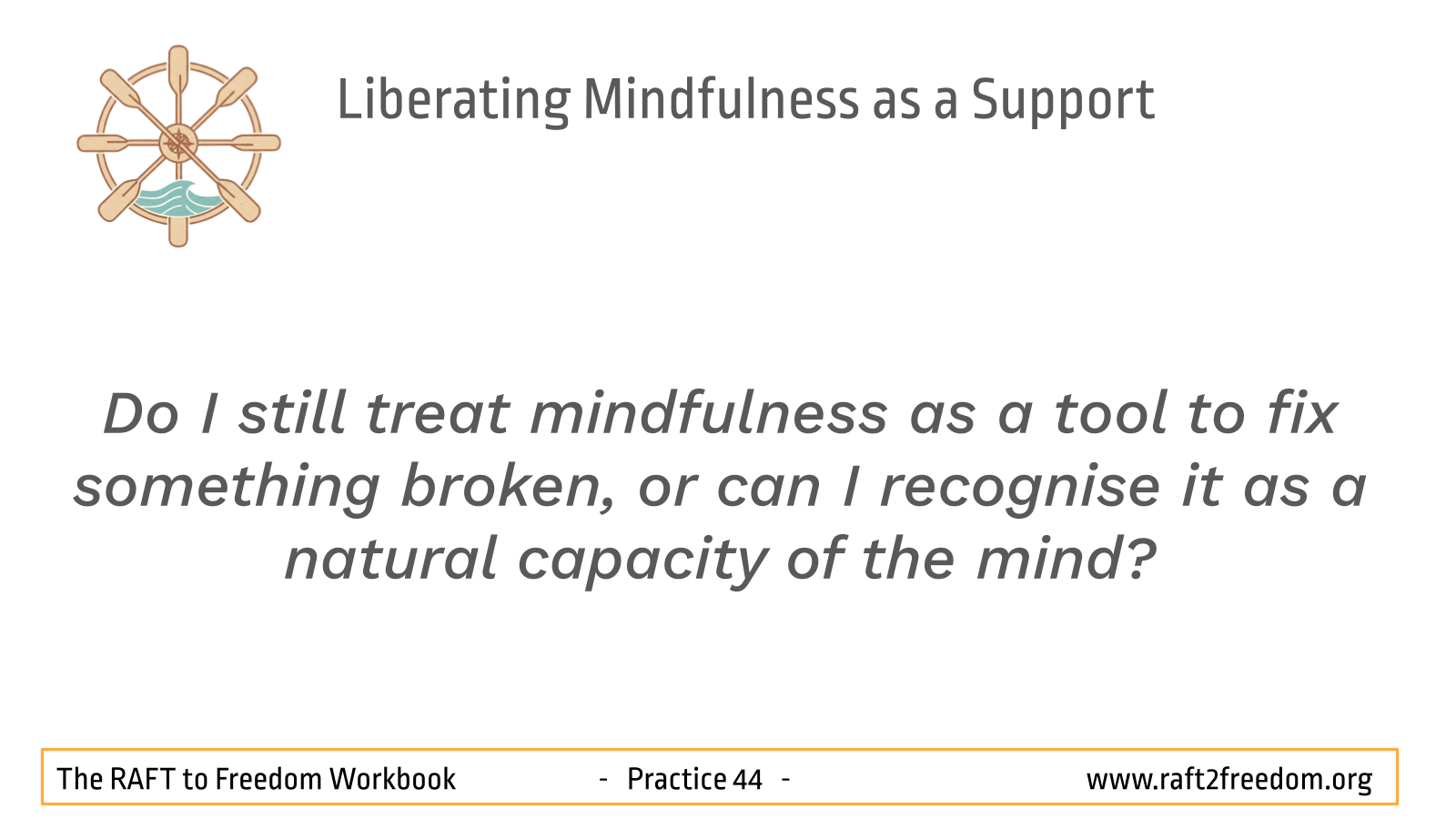
- Do I still treat mindfulness as a tool to fix something broken, or can I recognise it as a natural capacity of the mind?
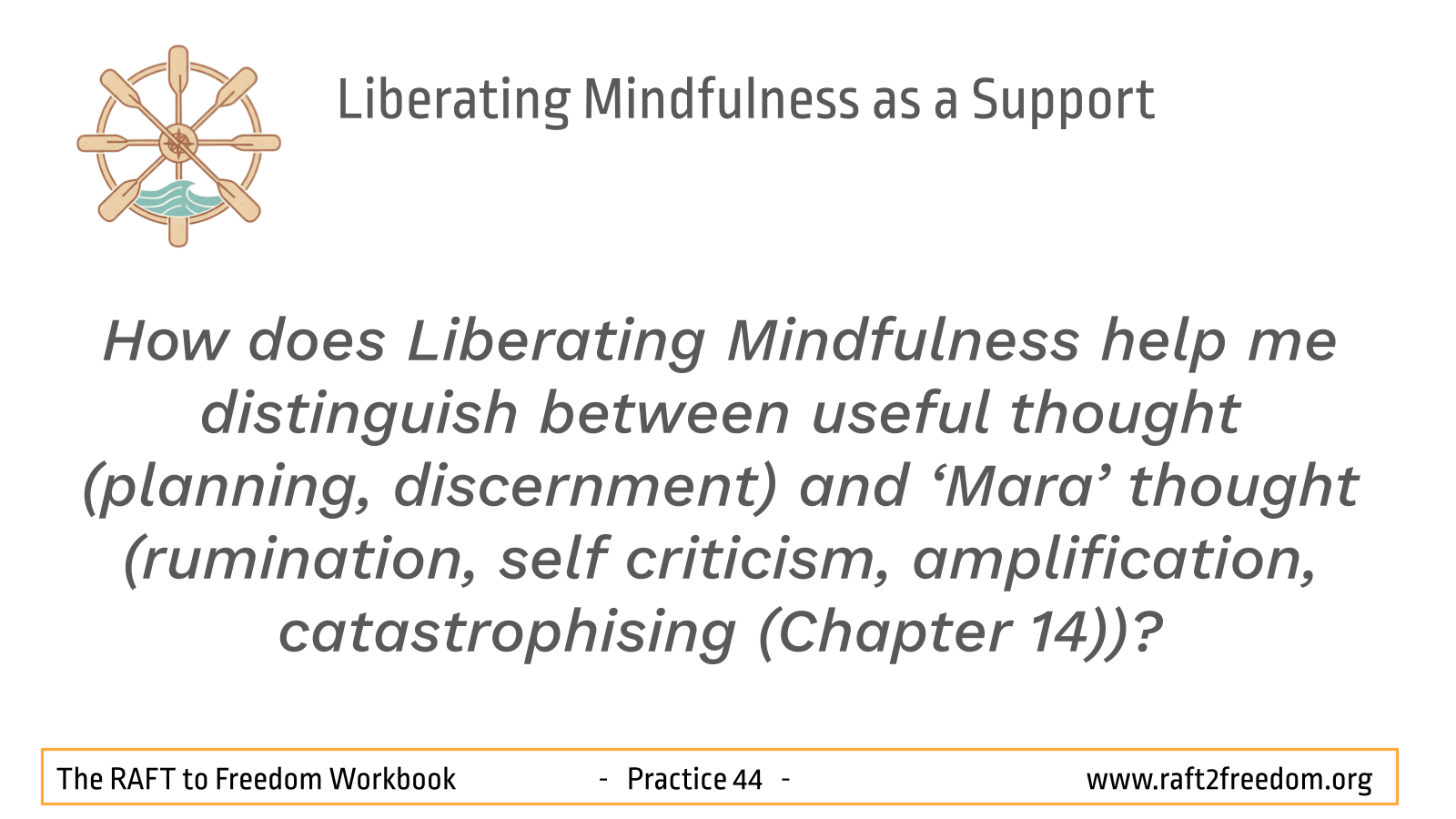
- How does Liberating Mindfulness help me distinguish between useful thought (planning, discernment) and ‘Mara’ thought (rumination, self criticism, amplification, catastrophising (Chapter 14))?
- Can I trust that clearly seeing a pattern is already a form of loosening it – without needing to attack or suppress it?
- In what moments today did I lose the watch? What specifically pulled attention away?
- Does my awareness tend to feel narrow and spotlight-like, or wide and lantern-like?
Journaling prompts
- The shift log: Describe a moment today when you shifted from fighting an urge to witnessing it. What changed in the body?
- The instrument panel: Imagine your mind as the raft dashboard. Which warning lights are blinking? How does Liberating Mindfulness register them without panic?
- The pause button: Recall a recent automatic reaction. Rewrite the moment as if you had paused for three seconds. What would have been noticed?
- Who Is watching?: Sit quietly for five minutes and observe thoughts. Then write about the sense of distance between the traffic (thoughts) and the road (awareness).
- The ‘suchness’ practice: Choose a mundane activity and describe only the raw sensory experience. This is the practice of suchness. Practising suchness is resting with experience exactly as it is – before naming, judging, or trying to change it – meeting each moment with clear, open awareness – the true nature of reality, as-it-is-ness.
- The gatekeeper’s report: Write from the perspective of your inner gatekeeper. Which visitors arrived today? Which were met with clarity and care?
- Freedom from ‘me, my and mine’: Take a worry – my anxiety. Change it to ‘there is anxiety’. Reflect on how this grammatical shift alters your relationship to it.
Supporting material: scientific and philosophical perspectives
For those interested in the scientific and philosophical underpinnings of Liberating Mindfulness as a support, the following overview highlights some key connections.
- Neuroscience: Suggests that much human distress is sustained by self-referential thinking – the ongoing mental narrative of ‘me, my problems, my past, my future. This mode of processing is associated with the Default Mode Network (DMN), which becomes highly active during rumination, craving, and worry. When the DMN dominates, experience is filtered through personal interpretation, often amplifying emotional reactivity and mental fatigue.
Research on mindfulness shows a reduction in DMN activity leads to an increased engagement of brain networks involved in present-moment awareness, interoception, and emotional regulation. Liberating Mindfulness supports this shift by moving attention away from story-making and into direct sensory experience. As identification with the self-story loosens, physiological arousal settles and the nervous system is given space to rebalance. Experience continues, but without the added strain of constant self-reference.
- Psychology: From a psychological perspective, liberating mindfulness aligns with core mechanisms of change identified across evidence-based therapies. Central among these is decentering (or cognitive defusion): the ability to observe thoughts, emotions, and urges as transient events rather than as facts, commands, or definitions of the self. This capacity is fundamental to approaches such as Mindfulness-Based Cognitive Therapy (MBCT), Acceptance and Commitment Therapy (ACT), Dialectical Behaviour Therapy (DBT), and Mindfulness-Based Relapse Prevention (MBRP).
Liberating mindfulness cultivates this decentered stance directly. It does not attempt to eliminate internal experiences, but changes how they are met. As awareness becomes non-reactive, urges and emotions lose their compulsive force. This increases distress tolerance and restores behavioural choice, allowing responses to be guided by values and context rather than by automatic grasping or avoidance.
- Philosophy: Philosophical traditions have long argued that suffering is intensified not by experience itself, but by the judgments and assumptions imposed upon it. In phenomenology, this insight is expressed through epoché – the suspension of habitual interpretation in order to encounter phenomena as they actually appear. Rather than deciding what an experience means, one temporarily sets aside evaluation and simply observes.
Liberating mindfulness enacts this philosophical principle in lived experience. Assumptions such as “this must last,” ‘this must stop,’ or ‘this defines me’ are gently bracketed. What remains is the clear knowing of sensations, feelings, and mental states arising and passing in accordance with conditions. In this way, Freedom is understood not as a special state to achieve, but as a shift in how experience is met – with clarity rather than struggle.
Remember to remember
We are not building a raft to carry us away from ourselves, or to escape the difficulties of being human. We are building a raft strong enough to carry us through our conditioning – through habit, reactivity, longing, fear, and confusion – without being overwhelmed by them. Freedom does not require a different life or a perfected self. It begins with learning to pause, to stay, and to meet experience as it is, without immediately turning toward grasping or resistance. Again and again, we discover that clarity does not have to be forced. Often, it is already available when we stop interfering.
Liberating Mindfulness is the Support that reminds us we are already safe enough to pause. Like an open sky, it allows the changing weather of emotions, sensations, and thoughts to move through without destabilising the whole system. This is not neutral observation for its own sake, but awareness shaped by care – attentive to what leads toward Freedom and alert to what pulls us back into entanglement. As we return again and again to simple presence, the mind learns something vital: Freedom does not need to be manufactured. It appears naturally in the moments when craving loosens and reactivity quiets. Over time, these moments become familiar, a place we know how to return to – a steady, peaceful awareness that feels like home.
My experience is what I agree to attend to.
William James
Men are disturbed not by things, but by the views which they take of things.
Enchiridion
Sutta references
- Bojjhaṅga Saṃyutta (SN 46) – The Factors of Awakening
Summary: This collection presents mindfulness as the first factor of awakening and the central balancer of the system. Mindfulness is shown as the quality that senses when energy needs to be encouraged and when calm needs to be protected. Grounded in seclusion, dispassion, and cessation, mindfulness matures naturally toward release rather than effortful control. - Indriya-vibhaṅga Sutta (SN 48.10) – From Faculty to Power
Summary: This discourse distinguishes between mindfulness as a wavering faculty and mindfulness as a stable power. In the Freedom stage of the journey, mindfulness is cultivated as a power that guards the mind – able to remain present under pressure without collapsing into reactivity or distraction.
- Satipaṭṭhāna Sutta (MN 10) – Knowing what Is present
Summary: Here, mindfulness is framed as the capacity to know experience clearly as it arises – recognising qualities as present or absent and understanding the conditions that support their development. This teaching underpins Liberating Mindfulness as a way of abiding with experience rather than managing it, allowing clarity and balance to unfold across body, feeling, mind, and patterns.
| RAFT to Freedom © 2025 by Dr Cathryn Jacob and Vince Cullen is licensed under Creative CommonsAttribution-NonCommercial-ShareAlike 4.0 International. |