The Five Hazards: Anxiety and Agitation
Restlessness has the characteristic of disquietude, like water whipped up by the wind. Its function is to make the mind unsteady.
~ Bhikkhu Bodhi
When thoughts are racing and repetitive, remember: no one can harm the practitioner as much as the untamed mind.
~ Jack Kornfield

Episode 41 – The Five Hazards: Anxiety and Agitation
An AI generated ‘deep dive’ into this aspect of the RAFT to Freedom
Understanding the Swirl
The fourth of the ‘Five Hazards’ is ‘Anxiety and Agitation’, traditionally known as Restlessness and Remorse. This hazard constitutes a surge into chaotic, high-arousal states that scatter our attention and unsettle the heart. It is two-fold: Anxiety is the forward-pulling restlessness often called the “monkey mind”, while Agitation is the backward-pulling, sticky fixation on past missteps, worry, or guilt. Within our RAFT to Freedom framework, this hazard arises from Delusion – a momentary misreading of what is happening, where thoughts feel solid and urgent, and the changing nature of experience is forgotten.
In this third stage of our journey – Freedom – this hazard matters because inner agitation and restlessness prevents the mind from settling enough to recognise freedom as a lived experience rather than an idea. These stormy mental states block the ability of the mind to access ‘A Gathered Mind’ (Chapter 32) and Deep Calm (Chapter 48). These inner winds make it difficult for us to personally verify the presence of ‘Freedom’ from cravings, compulsions and aversions.
What the early texts call restlessness and worry now often shows up as what modern psychology calls hurry sickness – a driven, anxious sense of speed that feels productive but quietly erodes clarity. Over time, rushing becomes a habit, even when there is no real urgency. This constant speeding-up creates a self-reinforcing positive feedback loop: moving fast fuels agitation, and agitation then pushes us to move even faster, leaving little space for the Joy-Gladness that naturally arises when the mind is not caught in such storms.
Agitation begins as an adaptive alarm system. It is rooted in an evolutionary smoke detector principle, where a low threshold for danger detection historically offered survival benefits. However, when this system spirals, vigilance becomes hypervigilance, and reflection becomes rumination. The paradox is that our attempts to suppress or push away restlessness often generate even more agitation.
Gotama (the Buddha) illustrated this hazard by likening anxiety to water stirred by the wind, its surface broken into waves that cannot reflect anything clearly. Remorse and agitation clouds perception like water muddied with clay, making discernment impossible. Together, these images point to the same difficulty: when the mind is agitated or clouded, it cannot reflect experience clearly.
In contemporary life, this hazard is rarely generated by the mind alone. Beyond the meditation cushion, agitation is amplified by the social gale – the constant pressure of digital notifications and the comparison traps of modern social life. These external forces act as a secondary wind, whipping up the monkey mind by demanding instant reactions to non-urgent events. When we become lost and adrift in these streams of information, restlessness spreads as a shared social contagion, making it even harder to recognise the quiet clarity of the present moment. Without a deliberate intention to step back, the mind remains in a state of hypervigilance – scanning for social threats or missed opportunities rather than navigating toward the safe shore.
Postponement Strategy
Postponement strategy is a skilful response to Anxiety and Agitation that works directly with the paradox of high arousal rather than against it. It does not try to resolve everything immediately, nor does it suppress concern.
When restlessness or worry scatters attention and creates the felt pressure to resolve everything at once, the practitioner deliberately pauses the rush by naming the concern, assigning it a clear and trustworthy time for review, and returning attention to a reliable anchor in the body. This conscious slowing interrupts the feedback loop of hurry sickness – motion without direction, effort without rest, speed without arrival – allowing the inner winds to settle.
In RAFT terms, postponement is not avoidance or disengagement; it is heaving-to in choppy waters so the vessel can regain balance. By choosing steadiness over acceleration, the mind relearns that freedom emerges not through urgency, but through a gathered, calm presence that makes wise movement possible.
When the impulse to rush is met with deliberate steadiness in this way, the scattered energies of anxiety begin to organise themselves, opening the space in which the specific practices for working with Anxiety and Agitation can take hold.
Anchoring against Agitation and the values of the Heart
On our RAFT to Freedom chart, Anxiety and Agitation appear as the Hazard of the Choppy Waters of Restlessness and the Dragging Anchor of Remorse. Anxiety and Restlessness are the gusting winds pulling the mind toward imagined futures, while Agitation and Remorse is the heavy anchor of self-reproach, fixating on the past and preventing us from moving forward.
To navigate these turbulent conditions, the ‘Five Defenders’ are deployed to steady the vessel (Chapters 28-33):
- A Gathered Mind grounds attention in the body or breath as an immediate antidote to scattering.
- Healing Mindfulness notices agitation with warmth, preventing reactive spirals.
- Confidence counters self-doubt and the discouragement that follows remorse.
- Discernment reveals the futility of rumination and distinguishes between the Circle of Concern and the Circle of Influence. Which is what we worry about versus what we can act on – the difference between scanning the horizon and steering the raft.
- Courageous Effort provides the strength to stay present with discomfort without scuttling the raft through escape or distraction.
Anxiety and Agitation steal our capacity to live from what the heart holds sacred, pulling attention away from our values and into urgency. These practices restore the ability to act with care rather than blind compulsion.
How to work with Anxiety and Agitation
The task here is not to eliminate agitation, but to ground the mind, calm the system, and restore clarity so a wise response becomes possible.
- Ground the anchor: When agitation spikes, our first task is to drop the anchor into the body. Bring awareness to reliable sensations – the breath, the solidity of the feet – interrupting the runaway narrative of anxiety.
- Emphasise the out-breath: Intentionally lengthen the out-breath, inviting ease into the body. This simple shift can settle both the mind and nervous system, on and off the cushion.
- Calm the system with the Seven Supports: Agitation is soothed by the calming triad of supports. ‘Deep Calm’ softens the nervous system, ‘A Unified Mind’ gathers scattered attention, and ‘Balance’ holds comfort and discomfort evenly. (Chapters 48-50).
- Interrupt rumination through clear seeing: Label mental activity clearly and impersonally – “Anxious thinking is here,” or “Self-criticism is arising.” This aligns with cognitive defusion, recognising thoughts as events, not instructions. (Chapter 10)
- Distinguish concern from influence: When worry arises about the world or others, use Discernment to separate the Circle of Concern (what the mind worries about) from the Circle of Influence (what can actually be changed). If action is possible, take it. If not, acknowledge the concern and gently decline the worry.
- Use the Postponement Strategy: When persistent worry or doubt intrudes, set a clear and kind boundary: “I hear you, but not now. I will attend to you at [specific time].” Often, by the time that hour arrives, the urgency has already dissolved.
- Meet remorse with confidence and repair: When guilt arises, offer compassion rather than self-attack. If appropriate, take the smallest ethical step toward repair. Confidence reminds awareness that remorse is a signal for learning, not a verdict on worth.
- Savour the stillness that follows – Freedom: When agitation subsides, attend carefully to the cool, clear space that remains – the ease, spaciousness, and quiet brightness.Familiarising the mind with this state strengthens its ability to return there, and to respond from this calm clarity rather than from urgency or reactivity.
Practise micro-grounding in transit: When moving between tasks or locations – walking to a meeting, standing in a queue – deliberately drop the anchor by feeling the weight of the body and the texture of the ground. This ‘Ethical Mindfulness’ (Chapter 53) interrupts automatic rushing and prevents agitation from accumulating. By choosing presence in these in-between moments, daily movement becomes a series of small clearings, keeping the raft steady even in a chaotic environment.

Self-Reflection Questions
- What specific bodily sensations are observed when agitation first arises?
- What is the habitual focus of remorse–the past, the future, or both?
- How does observing mental scattering change the relationship to it?
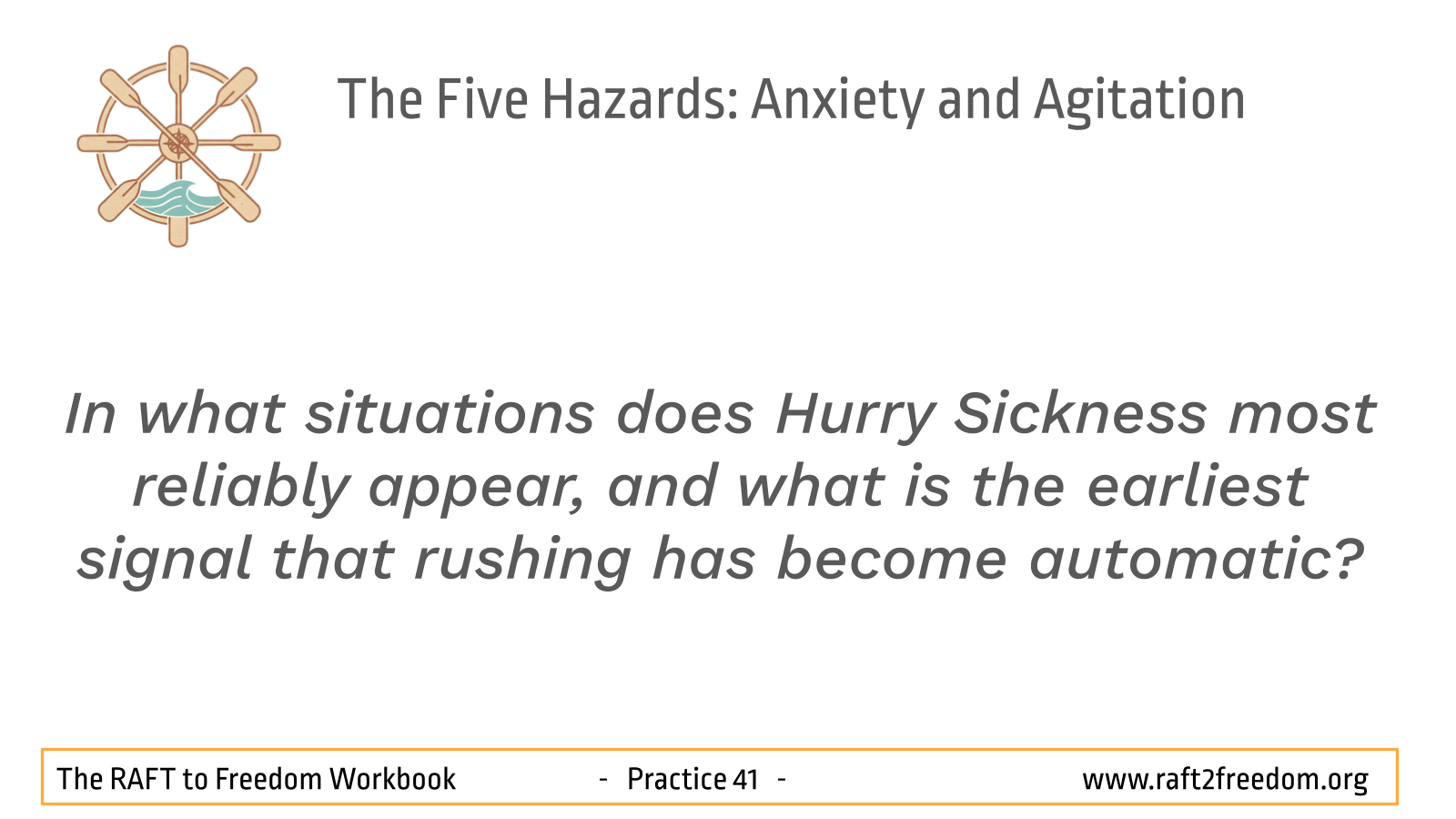
- In what situations does Hurry Sickness most reliably appear, and what is the earliest signal that rushing has become automatic?
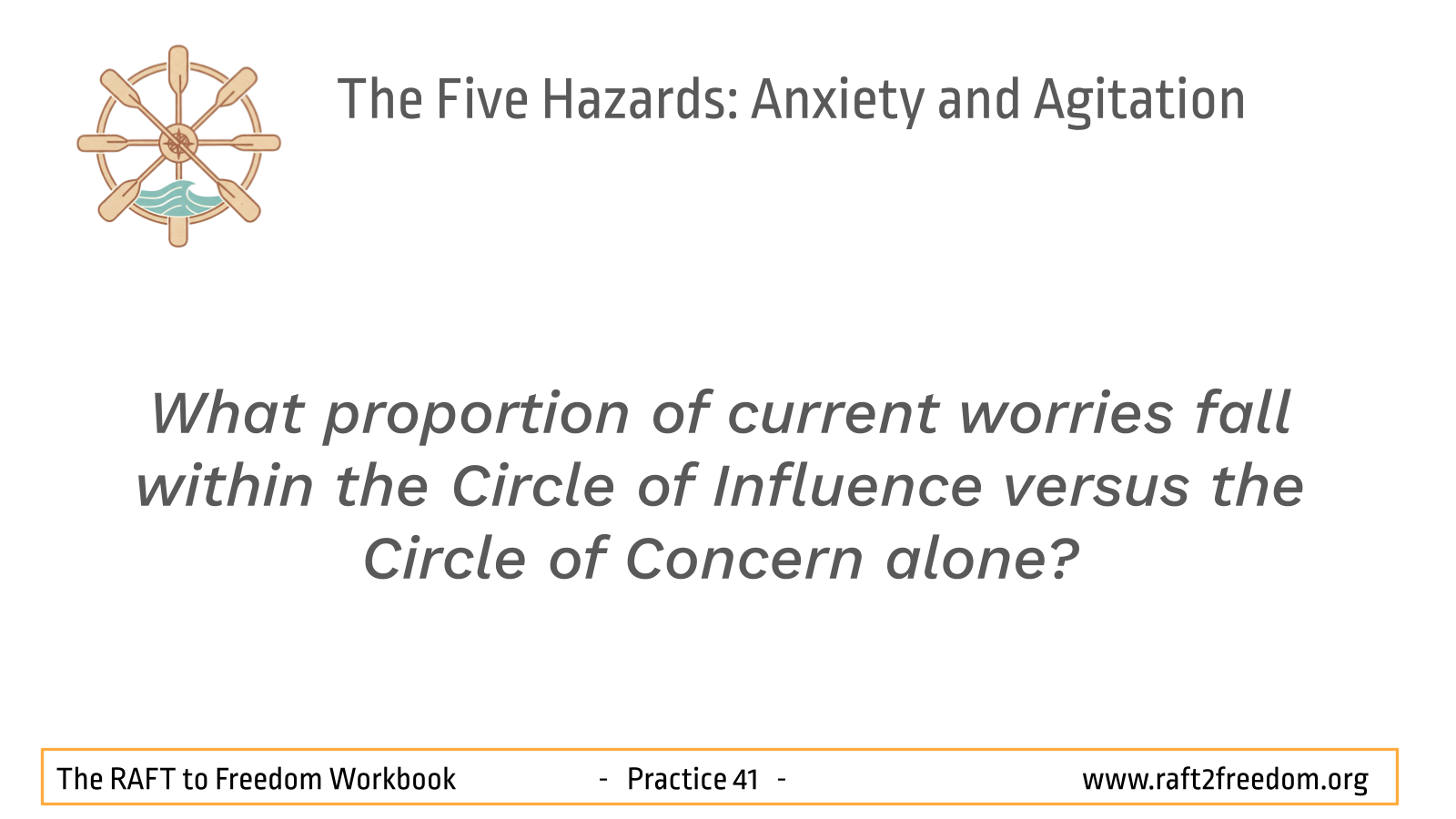
- What proportion of current worries fall within the Circle of Influence versus the Circle of Concern alone?
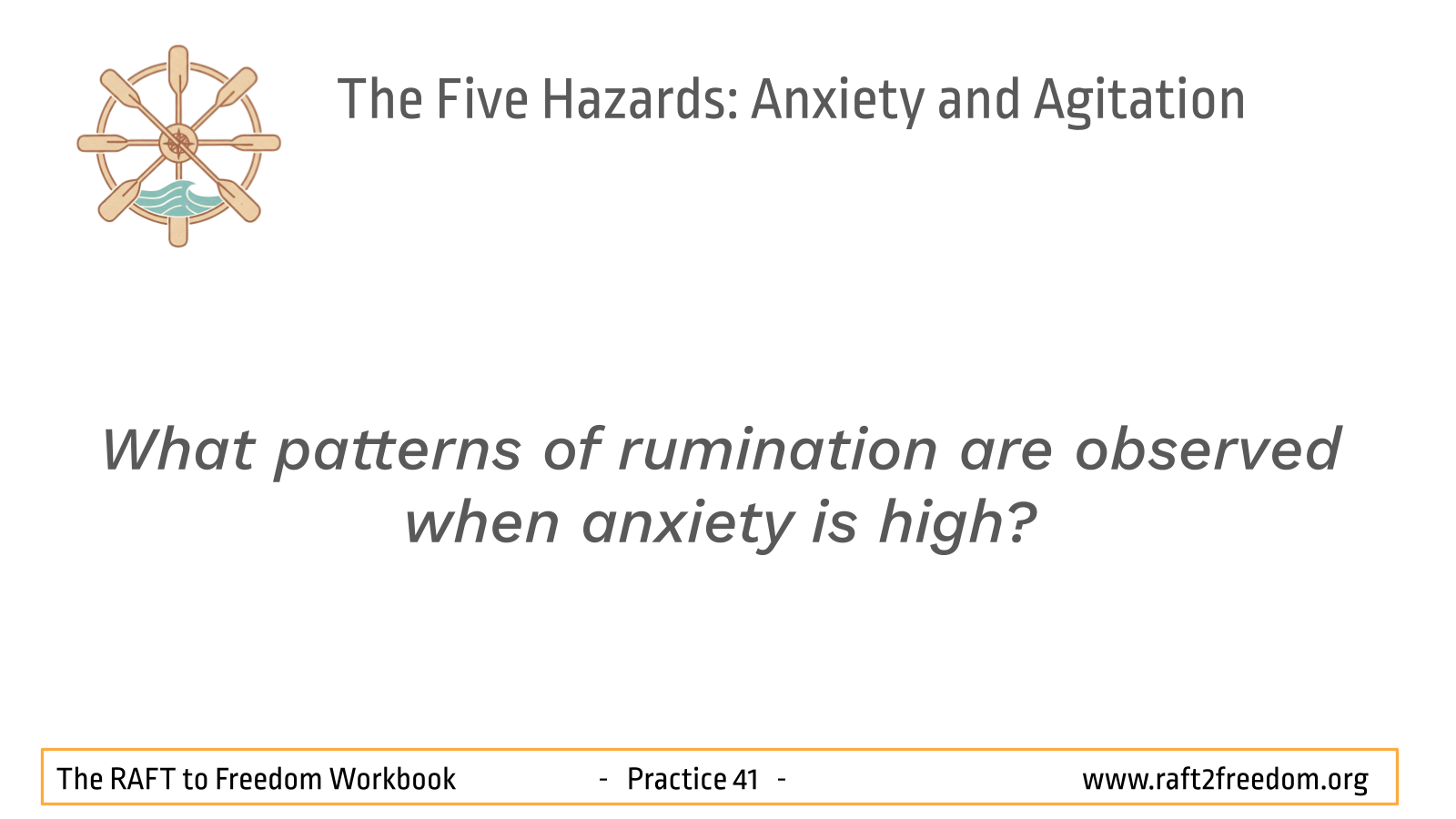
- What patterns of rumination are observed when anxiety is high?
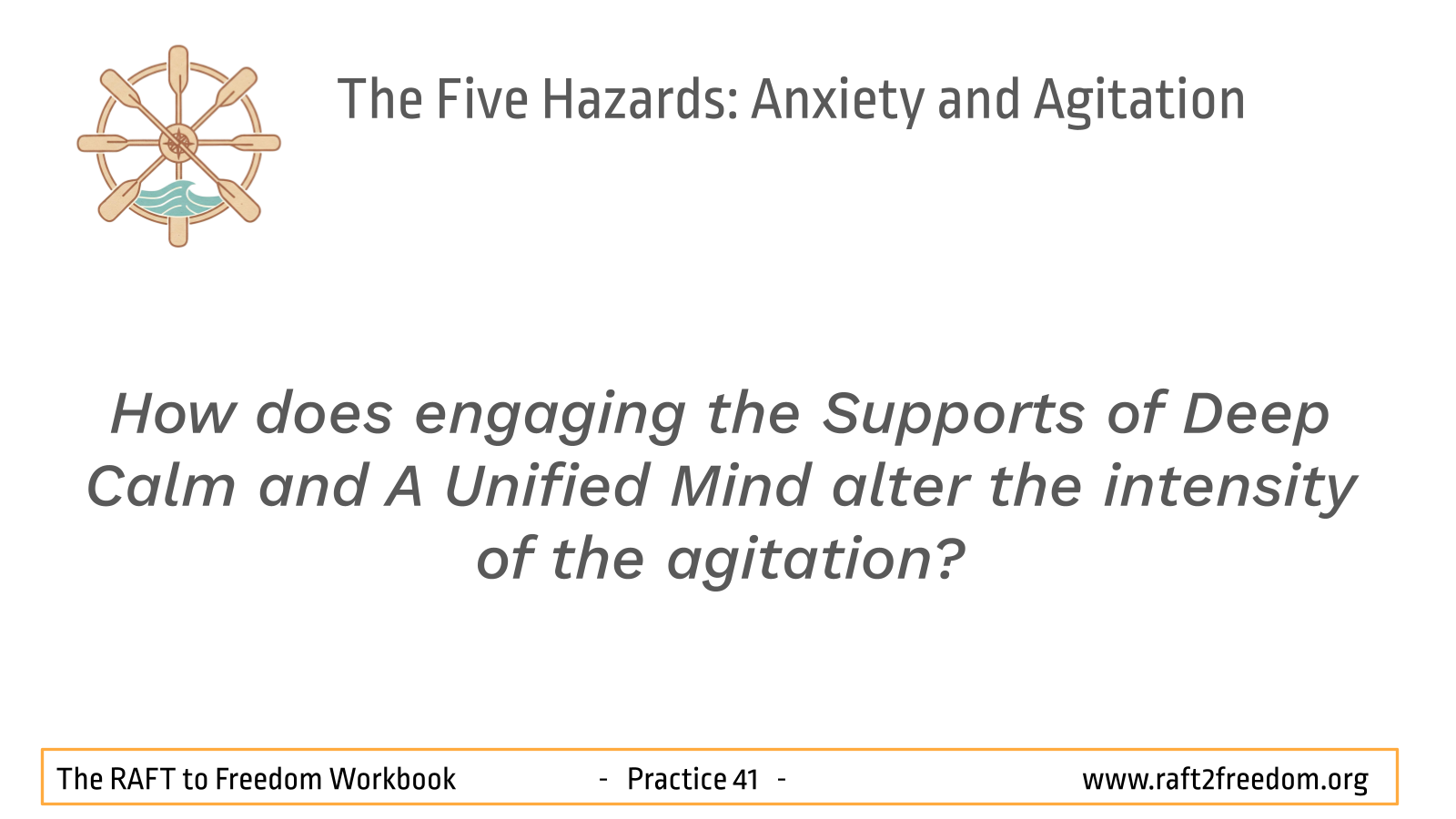
- How does engaging the Supports of Deep Calm and A Unified Mind alter the intensity of the agitation?
JournalinJournaling Prompts
- Agitation Map: Describe a recent time mental restlessness was high. Map the sequence: trigger > scattering thoughts > calming supports applied > result.
- Circle of Influence Log: List three current worries. Categorise them into “Things I can change” and “Things I cannot.” Note how this affects the feeling of agitation.
- Deferral Experiment: Practice the Postponement Strategy for one week. Record the worry, the agreed return time, and what happened when that time arrived.
- Speed Audit: For three days, record every instance of automatic rushing, including physical hurrying and mental racing.
- Defusion Practice: For one day, every time a self-reproachful thought arises, rewrite it: “The awareness notices the thought that…“
- Stillness Log: Describe the bodily and mental qualities of three brief moments of settled presence or quiet clarity experienced this week.
- Calming plan: List the three most reliable calming supports (for example, breath focus, nature walk, supportive communication). Plan to use one of these next time agitation arises.
Supporting Material: Scientific and philosophical perspectives
For those interested in the scientific and philosophical underpinnings of Anxiety and Agitation as a Hazard, the following overview highlights some key connections.
- Neuroscience: Agitation and restlessness reflect heightened reactivity in the brain’s threat and self-focused systems. The amygdala ramps up vigilance and bodily tension, while the Default Mode Network (DMN) becomes overactive, fuelling rumination. This experience of being compulsively drawn into the gravitational pull of a hindrance is the phenomenological presentation of Executive Function (EF) failure, specifically a compromise in inhibitory control. Focusing attention on a single anchor helps quiet DMN activity, while training in Tranquillity and Equanimity strengthens the Prefrontal Cortex (PFC), the region responsible for emotional regulation and wise choice.
- Psychology: In an evolutionary context, generalised anxiety is an overextension of the protective smoke detector principle, where a low threshold for danger detection historically offered survival benefits. Modern therapies like Dialectical Behaviour Therapy (DBT) use distress tolerance skills–simple grounding practices–to help the being ride out spikes of panic. Acceptance and Commitment Therapy (ACT) encourages defusion, seeing anxious thoughts as passing events rather than personal truths.
- Philosophy: Early Buddhism views agitation and remorse as conditioned events – changing, unstable, and not who the self fundamentally is. The Stoics emphasised that disturbance comes from interpretations rather than events themselves. The philosophical antidote is Equanimity (Balance) – a steady, balanced awareness that allows anxious thoughts to lose their authority. This is supported by the insight into Impermanence (Anicca), which helps the mind recognise that powerful urges are temporary “waves” that inevitably peak and subside.
Remember to remember
Remember that beneath agitation lies a stillness that never disappears. Each time awareness anchors attention and allows the waves to settle, the mind glimpses this stability. These brief clearings teach the heart that calm is not created – it is revealed when the inner winds die down.
Anxiety and Agitation can make the raft feel like a small, panicked vessel caught in choppy waters. In these moments, awareness itself is the most powerful stabilising force. When attention is grounded in the immediacy of the breath or the present moment, the mind is protected from the scattering winds of anxiety and the dragging undertow of self-reproach. When the choice is made to release hurrying, worrying and regretting, the heart remembers what it truly values: presence, kindness, and the capacity to meet life with an open, steady awareness.
Anxiety is a thin stream of fear trickling through the mind. If encouraged, it cuts a channel into which all other thoughts are drained.
~ Arthur Somers Roche
We suffer more often in imagination than in reality.
~ Seneca
Suppose a person were a slave, not their own master, subject to the commands of another and unable to go where they liked. Later, they are released from that slavery, becoming their own master, independent and able to go wherever they wish. In the same way, when Anxiety and Agitation are abandoned, the mind is no longer forced to obey the erratic commands of restless thoughts, regaining its autonomy.
~ Gotama
Sutta References
- Saṅgārava Sutta (SN 46.55): To Saṅgāvara
- Summary: Illustrates the hindrance of restlessness and remorse by likening the agitated mind to water stirred by the wind, showing why this state prevents clear seeing and insight.
- Satipaṭṭhāna Sutta (MN 10): The Foundations of Mindfulness
- Summary: Instructs the practitioner to know when the hindrance is present or absent, how it arises, how it is abandoned, and how to prevent its future arising, providing the operational framework for working with this mental state.
- Upanisā Sutta (SN 12.23): Prerequisites
- Summary: Shows the causal sequence of liberation, linking freedom from remorse to the arising of gladness, joy, tranquillity, and collectedness. Establishes that overcoming remorse is a critical prerequisite for achieving deep calming states (Samādhi).
| RAFT to Freedom © 2025 by Dr Cathryn Jacob and Vince Cullen is licensed under Creative CommonsAttribution-NonCommercial-ShareAlike 4.0 International. |