The Five Hazards: Ill-Will
Hatred is never appeased by hatred in this world. By non‑hatred alone is hatred appeased. This is an eternal law.
~ Gotama (the Buddha)
Even if bandits were to carve you up savagely, limb by limb, with a two‑handled saw, whoever let their heart get angered would not be doing my bidding. Train thus: ‘Our mind will remain unaffected, filled with goodwill, without inner hate.’
~ Gotama

Episode 39 – The Five Hazards: Ill-Will
An AI generated ‘deep dive’ into this aspect of the RAFT to Freedom
Understanding the Aversion Response and the Tempest of HostilityUnderstanding the ‘Aversion Response’ and the ‘Tempest of Hostility’
Ill-Will is the second of the Five Hazards – the persistent push of the heart against people, situations, or even ourselves. It encompasses the full spectrum of aversion, ranging from mild irritation and coldness to resentment, hostility, bitterness, or full-blown rage.
When active, it swamps the mind, weakening both ‘A Gathered Mind’ (Chapter 32) and ‘Discernment’ (Chapter 33). This is why ill-will is treated not just as an unhelpful or destructive emotion, but in meditation as a specific obscuration.
In this third stage of our journey – Freedom – ‘Ill-Will’ matters profoundly because it blocks the warmth, clarity, patience, and ‘Forgiveness’ (Chapter 65) required for Joy-Gladness (Chapter 35) to arise.
Ill-Will begins as a protective impulse – an attempt by the mind to shield itself from pain, injustice, or threat. At its root is the perfectly human wish not to be hurt; to stay safe and protected, usually at any cost. However, when this impulse becomes rigid or reactive, protection turns into hostility, and the heart contracts around aversion. Seeing Ill-Will as distorted self-protection helps to dissolve shame and opens the door to us meeting it with clarity and compassion.
The problem arises when this adaptive fight, flight, or freeze response becomes excessive or misdirected, escalating fear into hostility, hatred, and meanness.Early Buddhism likens Ill-Will to boiling water: when heated, the surface breaks, bubbles, and distorts, making clear reflection impossible. When the heat subsides, clarity returns.
As we journey on our raft, ill-will appears as the hazard we call the Tempest of Hostility and Resentment. Sudden squalls of blame and anger whip up the surface, making navigation reactive and unstable. It’s helpful if we (The Captain, Navigator, and Crew) read these winds quickly and respond with stabilising skills, especially the Heart Practices of ‘Compassion’ (Chapter 6) and ‘Befriending’ (Chapter 26).
Three mistaken intuitions
Ill-Will relies on three mistaken intuitions. It can be understood as resting on deeply misleading assumptions about how aversion works — namely, that pushing away will protect, purify, or fix things. These intuitions misread experience and end up strengthening both the hazard itself and the underlying destructive currents of craving, aversion, and confusion.
- First mistaken intuition – ‘Ill-will protects me’: A first intuitive move is: “If I stay angry, suspicious, or hard, I will not be hurt again.” Ill-Will is treated as a shield that keeps threats at bay, so the heart tightens in an attempt at self-protection. In lived experience, however, Ill-Will breeds further conflict, retaliation, and inner agitation, leaving us more exposed and reactive rather than genuinely safe.
- Second mistaken intuition – ‘Ill-will is purification’: A second intuition is that harshness, anger, or contempt are needed to clean up wrongs – toward others or ourselves. This shows up as the sense that strong dislike is morally clarifying – that we see the truth more clearly when fueled by anger. But the tradition points out that Ill-Will itself is rooted in the unwholesome root of hatred and therefore cannot purify; it stains the very mind that is trying to discern, undermining appropriate intentions of goodwill (Chapter 26) and harmlessness (Chapter 4).
- Third mistaken intuition: ‘Ill-will fixes what is wrong’: The third intuition is that aversion will effectively change the situation: “If I hate this enough, it will stop or go away”. Ill-will here is treated as a tool of control, a way to push reality into a preferred shape. In practice, this creates a tangled wake of consequences – especially unskillful speech and action – and deepens the momentum of the habitual mind driven by the three destructive currents, rather than resolving the situation.
The practices that directly counter these intuitions are the cultivation of goodwill (Chapter 26) and the commitment to harmlessness (Chapter 04), which replace the idea that hatred protects or purifies with the understanding that only non‑ill‑will actually loosens the hindrance. In meditation, this is approached not by repression (which turns Ill-Will inward as self‑contempt or depression) but by recognising the Hazard, seeing the mistaken intuitions at work, and cultivating alternative responses such as Befriending and Clear Seeing (Chapter 57).
The Five Defenders (Chapters 28-33) are deployed against this hazard. ‘Healing Mindfulness’ notices the early contraction of the body, and ‘Discernment’ sees the true cost of aversion. ‘Courageous Effort’ enables non-reaction, ensuring the mind does not flee into distraction or old habits.
The off-the-cushion danger – the fire of resentment
Ill-will may seem like a small irritation when we are sitting in meditation, but in daily life it becomes far more dangerous. When resentment flares, the mind’s ability to pause and choose drops away just when we need it most.
In a difficult conversation or a moment that feels unfair, the heart tightens into a fight, flight or freeze reaction. Attention narrows, and we become caught in the story of blame or grievance. From here, the Tempest of Hostility takes over. We no longer see clearly – it is like trying to navigate through boiling water.
In this state, reactive words and impulsive actions feel justified, even necessary. Yet they often damage relationships, destabilise our raft, and leave consequences that can echo for years.
The navigator’s countermeasure – widening the pause
Widening the pause means creating a small but crucial gap between the trigger and the response. It is the moment where automatic reactions slow down and choice becomes possible again. Even a single breath, a softening of the body, or a silent naming – “ill-will is here” – is enough to prevent us from falling overboard.
To navigate these dangerous waters, it’s helpful if we (the Navigator) treat the first sign of bodily heat or a tightening jaw as a universal warning signal of an impending falling overboard into old patterns. In RAFT terms, this is where the ‘Five Defenders’ (Chapters 28-33) come online together: ‘Healing Mindfulness’ spots the early warning signs, ‘Discernment’ understands the danger, ‘Courageous Effort’ holds the pause, ‘Confidence’ cools reactivity, and ‘A Gathered Mind’ keeps the heart steady. Instead of obeying the reactive urge to lash out or punish, we must drop anchor by widening the pause between the trigger and the response.
By naming the hazard and intentionally shifting attention toward skillful countermeasures, we cool the fire from the inside out. This choice is an act of supreme self-care, proving that the heart can remain steady and unharmed even in the roughest emotional weather.
How to work with the Hazard of Ill-Will
- Recognise and name it: Ill-Will has a distinct bodily signature (tightening jaw/chest, heat, narrowing of eyes). Gently label what is happening: “Ill-will is here.” This simple, non-judgemental naming loosens its hold.
- Turn attention skilfully: Ill-Will is fed by dwelling on irritation and blame; it is starved when attention shifts towards Befriending, Compassion, or Balance (Chapter 52) – the mental release that undoes hostility.
- Use Gotama’s five tactics for removing unwholesome thoughts: When angry thoughts recur, the mind can:
- Replace the thought with a wholesome one.
- Reflect on the danger of pursuing the unwholesome thought.
- Withdraw attention (ignore it).
- Calm the thought-formation (relax the body).
- Apply forceful suppression (firm determination to stop).
- Apply five ways to remove resentment: These five methods directly dismantle anger and Ill-Will:
- Cultivate goodwill towards ourselves, others, or the situation.
- Cultivate compassion (including Self-Compassion).
- Rest in equanimity (Balance – Chapter 50).
- Practise strategic non-attention (stop feeding the story).
- Reflect on ownership of deeds: “Everyone is the heir to their own actions”.
- Balance with the Seven Supports: Consciously cultivate the opposing factor (Chapter 43 – 50). For instance, Energetic Joy softens bitterness, and Deep Calm (Chapter 48) soothes the nervous system.
- Savour its absence: When Ill-Will drops away, even for a breath, stay with the warmth, spaciousness, and ease that emerge. Notice how, from this steadier place, it becomes possible to respond with kindness and compassion rather than anger or ill-will. This familiarisation with Freedom strengthens the mind’s ability to return there more easily next time.
Wise boundaries and the kindness of turning away
This practice emphasises that the heart-mind can:
- Stand against injustice without hatred: responding to harm with a firm “no” rooted in the wish for safety rather than the urge to punish.
- Set boundaries as an act of kindness: recognising that turning away from a painful or unwholesome situation is a form of befriending ourselves and the moment.
- Release what is harmful without ill-will: abandoning a habit, relationship, or environment because it is dangerous shore material, not because we are at war with it.
- Respond with moral clarity rather than reactive anger: using the Five Defenders – especially Discernment – to see the long-term benefit of stepping back.
This distinction is crucial for our journey to freedom. It allows for engaged, ethical action that protects our raft without stirring the dyed waters of secondary suffering created by anger or aversion.

Self-Reflection QuSelf-Reflection Questions
- What triggers Ill-Will most frequently – tone of voice, injustice, shame, or fatigue?
- How does Ill-Will manifest in the body and behaviour?
- Which of the five tactics for removing unwholesome thoughts is most workable for the mind?
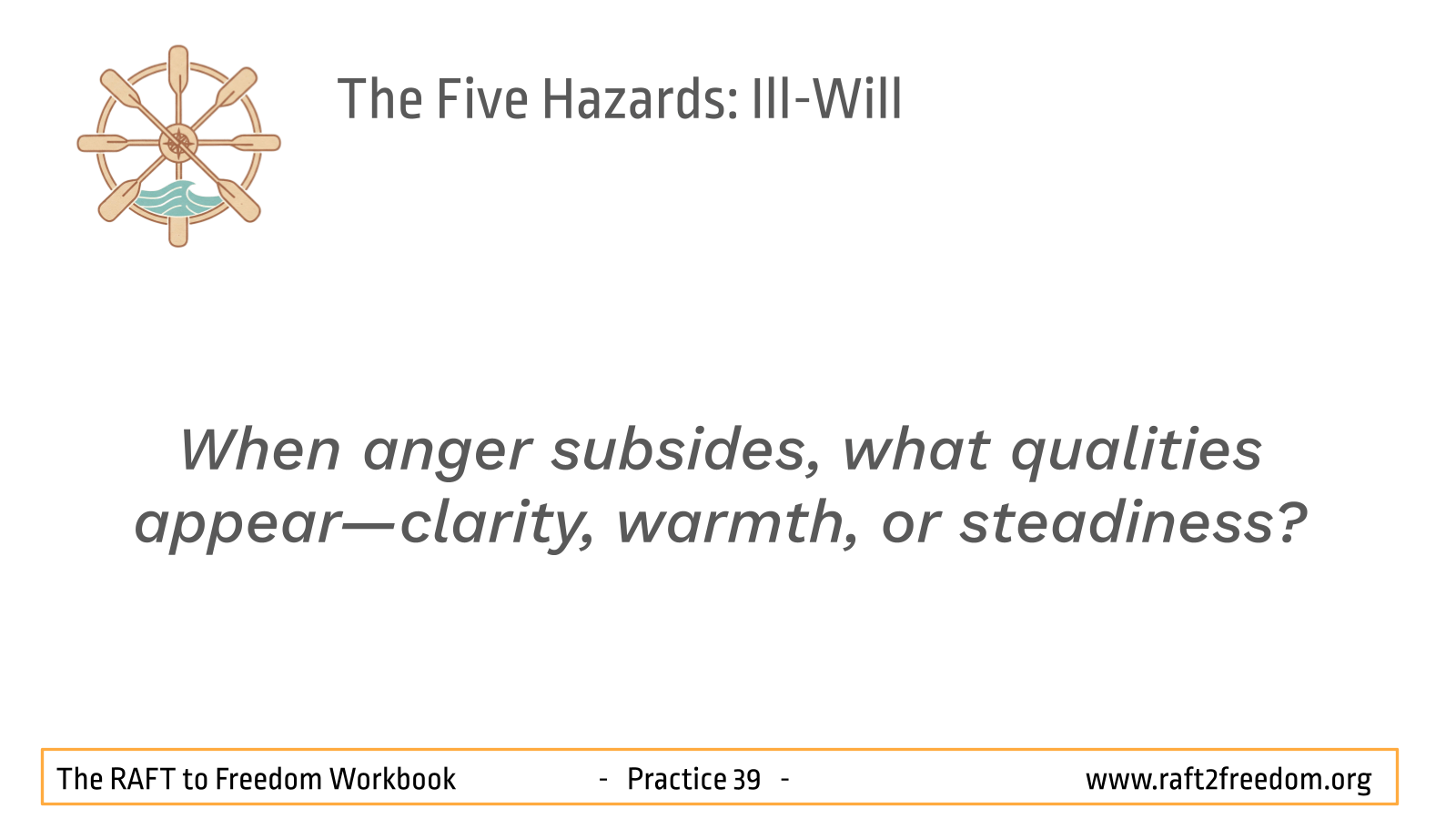
- When anger subsides, what qualities appear – clarity, warmth, or steadiness?
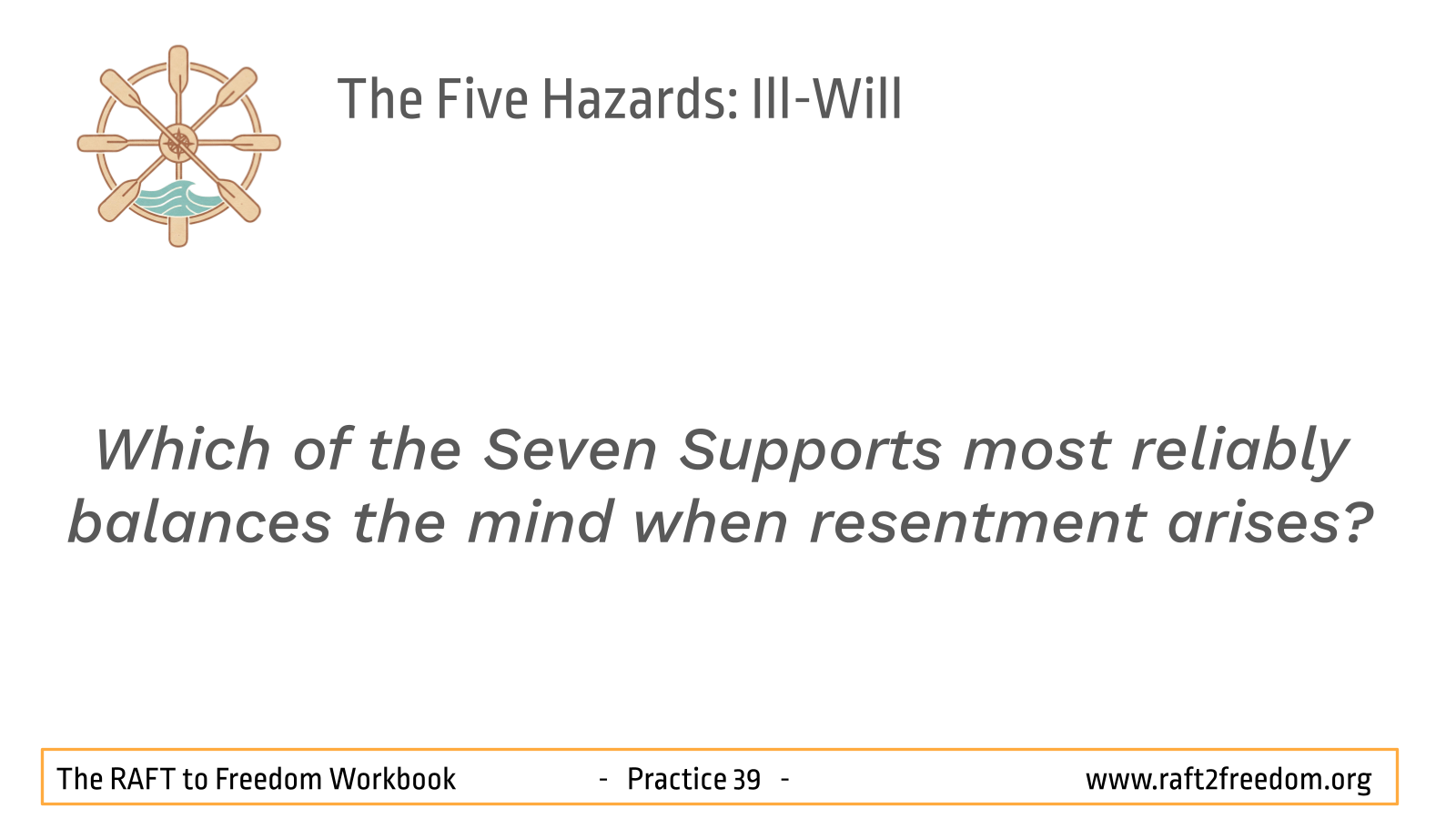
- Which of the Seven Supports most reliably balances the mind when resentment arises?
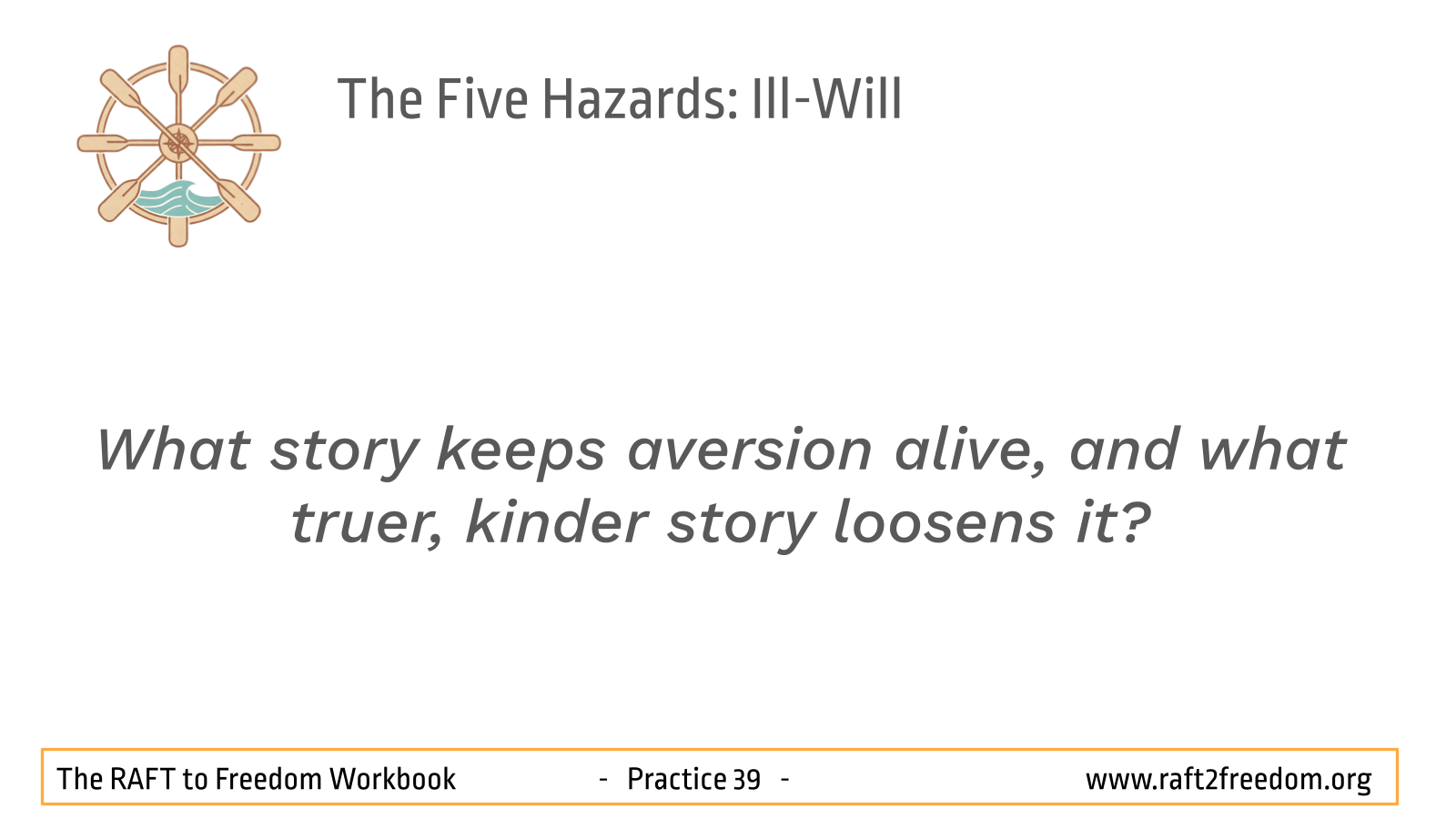
- What story keeps aversion alive, and what truer, kinder story loosens it?
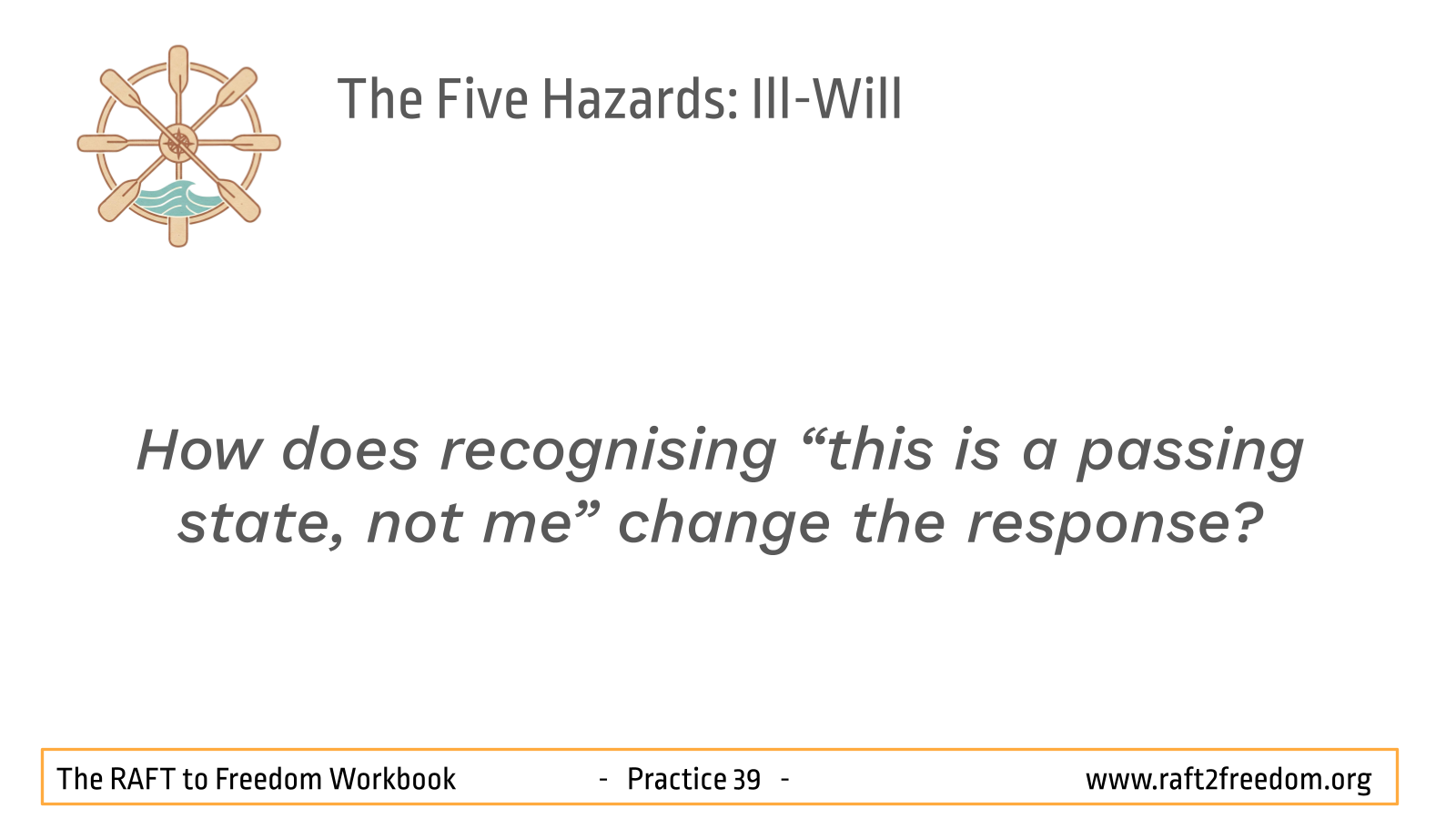
- How does recognising “this is a passing state, not me” change the response?
Journaling Prompts
- Anatomy of an outburst: Track one episode from trigger > peak > fade. What helped the mind let it pass?
- Five ways in action: Practise one tactic to remove resentment each day for five days; note the effects on the feeling tone.
- Boundless practice: Write about a brief Befriending session directed to a difficult person. What shifted in the heart?
- The quiet after: Describe the bodily feel and mindset when anger ends. How can awareness dwell there longer?
- Reframing harm: Journal a reflection on consequences: “This being is heir to their actions” (karma). What softens?
- Micro-freedoms: List three small moments this week when irritation did not stick – what allowed release?
- Two kinds of thought: Note a time the mind chose befriending over ill-will; what did that choice make possible?
Supporting Material: Scientific and philosophical perspectives
For those interested in the scientific and philosophical underpinnings of Ill Will as a Hazard, the following overview highlights some key connections.
- Neuroscience: The experience of ill-will activates the threat system of the brain, significantly heightening amygdala reactivity, which accelerates defensive responses and narrows the scope of perception. This defensive arousal is an ancient, adaptive fight, flight or freeze mechanism evolved for survival, yet in the modern world, it often becomes a maladaptive tempest. Within this biological storm, the prefrontal networks function as the Navigator, providing the regulation and perspective required to cool the system from the inside out.
Practices that cultivate Compassion and Befriending strengthen these prefrontal pathways, allowing the Navigator to regain control and return the vessel to a steady course. Systematic training in these heart practices effectively reshapes affective networks, increasing activation in brain regions associated with emotion regulation. This neural counterbalance dissolves the physiological contraction of ill-will, shifting the brain’s state from reactive hostility to a spacious and liberated presence.
- Psychology: Ill-Will is rooted in the adaptive fight, flight or freeze response but becomes maladaptive when fuelled by rumination. The inherent negativity bias in the nervous system unconsciously fuels this. Therapeutic approaches like CBT reduce anger by identifying ‘hot thoughts’ and reappraising their meaning. ACT supports defusion – experiencing “I’m furious” as a passing thought rather than a command. Compassion-Focused Therapy (CFT) trains the cultivation of warmth toward oneself and others, paralleling the Buddhist antidote of goodwill.
- Philosophy: Early Buddhism understands anger as one of the unwholesome roots (akusala-mūla) that obscure clarity, arising directly from aversion (Dosa). The antidote is non-hatred and wisdom. The Stoics viewed anger as a reaction based on a misjudgment of value, which dissolves when reassessed. The Simile of the Saw (Kakacūpama Sutta) sets the contemplative ideal: maintaining a steady, unharmed mind even when provoked. This skill is described as ‘dwelling in non-reactivity’ – a contemplative freedom where ethical possibilities emerge.
Remember to remember
The heat of ill-will is a passing storm, not a permanent or fixed identity. When the heart begins to burn with aversion, it is often a distorted attempt at protection. However, by recognising the Tempest of Hostility early, we, the Navigator can widen the pause between the trigger and the reaction. In this space, the choice to cool the fire becomes an act of supreme self-care, ensuring our raft is not abandoned to the burning currents of reactivity.
True freedom is found in the clear, unagitated air that follows the storm. By mooring the heart in kindness, awareness learns to trust the spaciousness and warmth that emerge when hatred is released. Each moment of non-reactivity strengthens the vessel, proving that the heart can remain steady and unharmed even in rough weather. This lived experience of peace confirms that the path to the safe shore is paved with goodwill rather than the toxic currents of resentment.
“When we meet our anger with mindfulness, we create the conditions for insight, understanding, and healing.” ~ Jack Kornfield
“By doing this you are like a man who wants to hit another and picks up a burning ember or excrement in his hand and so first burns himself or makes himself stink.” ~ Buddhaghosa“Suppose a person were seriously ill, in great pain, unable to enjoy food and with no strength in the body. Later, that person recovers from the illness, food tastes good again, and strength returns. The person would reflect: ‘Formerly I was ill, but now health is restored.’ In the same way, when Ill-Will is abandoned, the burning fever of anger subsides, restoring health and ease to the system.” ~ Gotama
When we meet our anger with mindfulness, we create the conditions for insight, understanding, and healing.
~ Jack Kornfield
By doing this you are like a man who wants to hit another and picks up a burning ember or excrement in his hand and so first burns himself or makes himself stink.
~ Buddhaghosa
Suppose a person were seriously ill, in great pain, unable to enjoy food and with no strength in the body. Later, that person recovers from the illness, food tastes good again, and strength returns. The person would reflect: ‘Formerly I was ill, but now health is restored.’ In the same way, when Ill-Will is abandoned, the burning fever of anger subsides, restoring health and ease to the system.
~ Gotama
Sutta ReferencesSutta References
- Aghātavinaya Sutta (AN 5.161) – Removing Annoyance
- Summary: Offers five ways to remove resentment: goodwill, compassion, equanimity, strategic non-attention, and reflecting on ownership of deeds (kamma). Provides a direct, text-based toolkit for dissolving resentment.
- Satipaṭṭhāna Sutta (MN 10) – The Foundations of Mindfulness
- Summary: Instructs knowing hindrances as present/absent, their arising, abandoning, and prevention. This provides the operational method for recognising, releasing, and dwelling in the absence of Ill-Will.
- Kakacūpama Sutta (MN 21) – The Simile of the Saw
- Summary: Commands the practitioner to train to keep the mind unharmed, kindly, without inner hate even under extreme provocation, setting the ethical and contemplative ideal for non-hatred.
- Dvedhāvitakka Sutta (MN 19) – Two Kinds of Thought
- Summary: Suggests dividing thoughts into Ill-Will vs non-ill-will; recognising costs/benefits; and inclining the mind to what aids wisdom. An early cognitive method for redirecting aversive thinking.
| RAFT to Freedom © 2025 by Dr Cathryn Jacob and Vince Cullen is licensed under Creative CommonsAttribution-NonCommercial-ShareAlike 4.0 International. |