Building a vessel for the journey
RAFT to Freedom uses the image of a raft to explore how we can move from harmful patterns towards greater freedom and well-being.
The raft is not something separate from us. It is built from the qualities, practices, relationships, and understandings that can help when we are caught in cravings, aversions, compulsive habits, difficult emotions, or patterns of behaviour that bring suffering.
The image is not about escaping from life or becoming someone else. It is about learning how to navigate life with more clarity, courage, kindness, and care.
On one shore may be the familiar experience of feeling caught: pulled by craving, pushed by aversion, overwhelmed by difficult emotions, or drawn back into old habits. The other shore represents the possibility of greater ease, balance, connection, and freedom.
The journey is rarely a straight line. There may be calm stretches, rough weather, times of confusion, and moments when we need to pause and repair the raft. Yet every part of the raft can help us make the crossing.
The four movements of RAFT
RAFT is made up of four connected movements: Recognise, Abandon, Feel, and Train.
These are not rigid stages to complete perfectly. They are strands of an ongoing exploration that can be returned to again and again.
Recognise
Recognise is the beginning of the journey: seeing more clearly what is happening.
This may include noticing the body tightening, the mind rehearsing old stories, the pull towards an unhelpful habit, or the wish to avoid something difficult. It may also include recognising the deeper conditions that shape our lives: stress, loneliness, fear, grief, exhaustion, longing, hope, and the wish to be at ease.
Recognise is not about blaming ourselves for being human. It is about becoming more honest and more intimate with experience.
At this stage, we begin gathering the materials for the raft: ethical commitment, generosity, self-compassion, embodied awareness, skilful effort, and trust in our capacity to learn and change.
Abandon
Abandon is not about forcing anything away or rejecting parts of ourselves.
It is about becoming less entangled in the cravings, aversions, compulsive habits, and patterns of behaviour that add to harm. We begin to notice the difference between an urge and an instruction; between a difficult feeling and the actions we may be tempted to take because of it.
This movement includes learning how feeling tone can shape our responses. Pleasant experience can lead to grasping, unpleasant experience can lead to resistance, and neutral experience can lead to drifting or disconnection.
The Five Defenders can be especially helpful here: confidence, courageous effort, healing mindfulness, a gathered mind, and discernment. Together, they offer support when old habits pull strongly.
Feel
Feel is about becoming familiar with freedom while it is present.
There may be moments when craving softens, when an old impulse is not followed, when the mind settles, or when there is a simple experience of calm, joy, clarity, connection, or relief. These moments can seem small, but they matter.
Rather than passing over them, the practice is to notice, appreciate, and become more familiar with them. This is not about trying to manufacture a particular state. It is about recognising that freedom is not only a distant destination. It can be glimpsed in ordinary moments.
The Seven Supports help illuminate this part of the journey: mindfulness, inquiry, energy, joy, calm, collectedness, and equanimity. They are signs of a mind moving towards balance and freedom.
Train
Train is about creating the conditions in which freedom becomes more available.
This includes the gradual cultivation of wisdom, ethical conduct, mindful awareness, and a more gathered mind. It draws on Gotama’s middle way: neither following every impulse nor meeting ourselves with harshness or self-punishment.
The Eightfold Path offers one way of understanding this training. It brings together how we see, intend, speak, act, work, make effort, attend, and gather the mind.
Training is not about achieving perfection. It is about returning, again and again, to the possibility of a more skilful response.
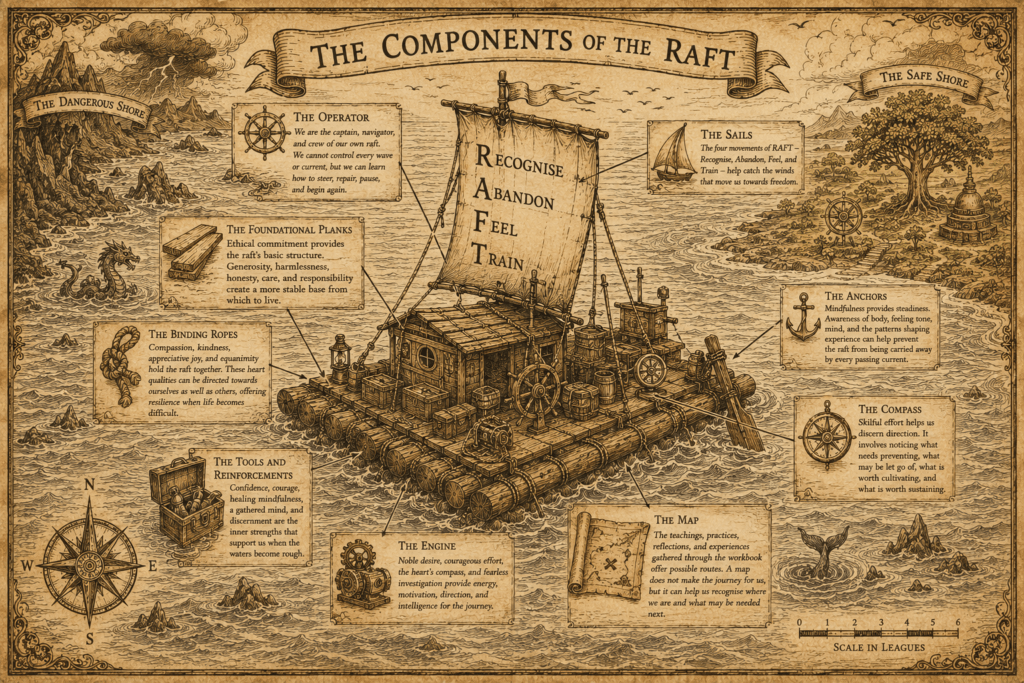
The components of the RAFT
The raft is built from many connected elements. Each one supports the journey in a different way.
The operator: We are the captain, navigator, and crew of our own raft. We cannot control every wave or current, but we can learn how to steer, repair, pause, and begin again.
The foundational planks: Ethical commitment provides the raft’s basic structure. Generosity, harmlessness, honesty, care, and responsibility create a more stable base from which to live.
The binding ropes: Compassion, kindness, appreciative joy, and equanimity hold the raft together. These heart qualities can be directed towards ourselves as well as others, offering resilience when life becomes difficult.
The sails: The four movements of RAFT — Recognise, Abandon, Feel, and Train — help catch the winds that move us towards freedom.
The anchors: Mindfulness provides steadiness. Awareness of body, feeling tone, mind, and the patterns shaping experience can help prevent the raft from being carried away by every passing current.
The compass: Skilful effort helps us discern direction. It involves noticing what needs preventing, what may be let go of, what is worth cultivating, and what is worth sustaining.
The engine: Noble desire, courageous effort, the heart’s compass, and fearless investigation provide energy, motivation, direction, and intelligence for the journey.
The tools and reinforcements: Confidence, courage, healing mindfulness, a gathered mind, and discernment are the inner strengths that support us when the waters become rough.
The map: The teachings, practices, reflections, and experiences gathered through the workbook offer possible routes. A map does not make the journey for us, but it can help us recognise where we are and what may be needed next.
| RAFT Component | Core Principle | Buddhist Foundation (Gotama’s Realisations) | Key Modern Scientific & Psychological Parallels |
| R – Recognise | Recognise pain and dissatisfaction. | The reality of dukkha (suffering/unsatisfactoriness). | Hedonic Treadmill, Negativity Bias, Evolutionary Mismatch. |
| A – Abandon | Abandon harmful cravings and reactivity. | The origin of dukkha is craving (taṇhā). | Dopamine Reward System Hijacking, Neuroplasticity, ACT, DBT, MBRP. |
| F – Feel | Familiarise with moments of non-craving. | The cessation of dukkha is possible (nirodha). | Positive Psychology (Flourishing), Neuroplasticity (Rewiring for Calm). |
| T – Train | Train the mind and body via a structured path. | The path to the cessation of dukkha (magga). | Behaviour Change Models (e.g., SMART Recovery), Askesis (Philosophical Training). |
The waters we travel
The journey may involve familiar hazards.
There can be currents of craving, where something promises relief or completion. There can be waves of aversion, where we want to push away what feels difficult. There can be fogs of confusion, where it is hard to know what matters or which way to turn.
The Five Hazards describe some common forms these difficulties can take:
Sensual desire: The pull towards something that promises comfort, pleasure, relief, or escape.
Ill will: The wish to resist, reject, blame, or push away what is difficult.
Tuning out: A drifting, numbing, or disengaging from experience.
Anxiety and agitation: A mind caught in worry, restlessness, planning, replaying, or unease.
Immobilising doubt: A paralysis of uncertainty that makes movement feel impossible.
These are not personal failings. They are common human patterns. Naming them can make them easier to recognise and less likely to govern the journey unnoticed.
What supports the crossing
RAFT to Freedom brings together ancient insight and modern understanding.
The programme draws on secular dharma, especially Gotama’s exploration of suffering, its causes, the possibility of freedom, and the path that supports it.
It also draws on neuroscience, psychology, and philosophy. These perspectives can help us understand habit formation, attention, emotion, reward, behaviour change, ethical living, and human flourishing.
None of these perspectives needs to be accepted as a fixed belief system. They are offered as possible companions for reflection and practice.
A raft made for real life
The raft is not built once and then finished.
It is adjusted as circumstances change. It may need repair after difficult weather. Some parts may become stronger through use. At times, another person may help us see a leak, steady the boat, or remember the direction of travel.
The point is not to create a perfect raft or to arrive somewhere permanently beyond difficulty.
The point is to become increasingly able to meet life with a little more freedom, care, and choice.
The journey begins wherever you are.